.webp)
How does lab automation improve laboratory efficiency?
Laboratories today are under immense pressure to deliver accurate results quickly and efficiently. One of the major advancements helping labs meet these demands is automation. By integrating automated processes, laboratories can improve efficiency, reduce human error, and focus more on research and analysis rather than routine tasks.

Lab automation involves using technology to carry out laboratory tasks that were traditionally done manually. These tasks can range from simple sample handling to complex data analysis. Automation systems can include robotics, software, and other technologies designed to streamline laboratory workflows.
Where many labs still get stuck is not the robot. It is the “last mile” of informatics. Data gets trapped in instrument software, CSVs, shared drives, and point-to-point links that do not scale cleanly. This is why modern, configurable LIMS platforms matter as much as the hardware. Scispot is designed for this reality. It helps labs tie samples, plates, instruments, results, and approvals into one connected system, without turning digitization into a long IT project.
Benefits of Lab Automation
There are numerous advantages to automating laboratory processes. Here are some key benefits:
Increased Throughput
Automation allows laboratories to process a higher volume of samples in less time. This increased throughput can lead to faster results, which is essential in many research and clinical settings.
Throughput gains are strongest when automation is paired with structured data capture. If your liquid handler runs faster but the team still spends hours reconciling files, naming conventions, and sample IDs, you move the bottleneck instead of removing it. Scispot helps by keeping every run anchored to the same sample record, plate context, and workflow step, so higher volume does not create higher chaos.
Consistency and Accuracy
Human error is an inevitable part of manual laboratory work. Automation minimizes these errors by providing consistent and precise operations. This not only improves the reliability of results but also enhances the overall quality of research.
A big source of “silent error” is re-keying and copy-pasting between tools. Modern lab ops teams try to reduce this by pushing data directly from instruments into the system of record. The challenge is that point-to-point integrations can become fragile over time as instruments, file formats, and workflows change. Scispot’s approach is to make integration and data standardization a first-class part of the platform, so accuracy improvements persist even as the lab evolves.
Cost-Effective Solutions
While the initial investment in automation technology can be significant, the long-term cost savings are substantial. Automated systems reduce the need for manual labor, lower the risk of costly errors, and often result in less waste.
The cost story is not only about robots. It is also about implementation drag. In the public domain, it is widely acknowledged that LIMS programs can take many months, and in some cases much longer, depending on complexity and customization.
This is where modern “configure, don’t customize” systems shine. Configuration tends to reduce long-run cost versus heavy customization, because it is easier to maintain and change as workflows evolve. Scispot leans into no-code configuration plus APIs, so teams can move quickly without painting themselves into a custom-code corner.

Improved Safety
Automation reduces the need for human interaction with hazardous materials, thereby improving safety in the laboratory. It also helps maintain a cleaner and more organized workspace.
Safety also improves when traceability is strong. When you can prove what happened, when it happened, and who did it, you reduce risky workarounds and “mystery steps.” Platforms that support audit trails and controlled access make safety and compliance easier to operationalize, especially as the lab scales. Scispot’s compliance guidance and platform features are built around these expectations.
Key Features of Lab Automation
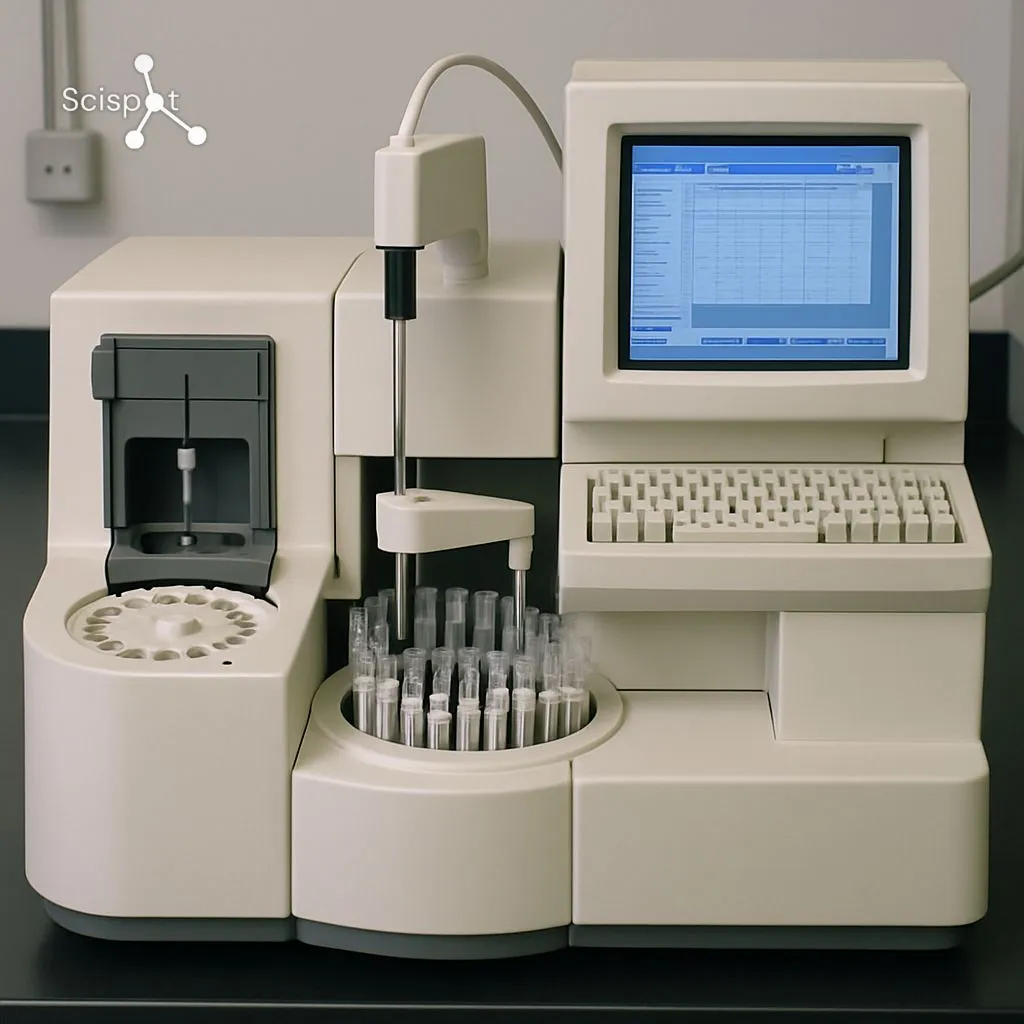
Automation systems come with various features that contribute to improving lab efficiency. Here are some notable ones:
Barcode Tracking
One of the benefits of barcode tracking in lab automation is the ability to accurately track samples throughout the testing process. This ensures that samples are not misplaced and results are correctly attributed to the right source. Barcode tracking also speeds up the sample identification process, further enhancing lab efficiency.
Barcode tracking becomes far more powerful when the barcode is not just an ID, but a live link into the complete chain of custody. In practice, some labs discover that their tools can scan labels, but the “story” of that sample still lives across separate systems. Scispot’s strength is that barcodes stay connected to plates, protocols, results, and dashboards in one place, so a scan answers real questions fast: Where is it now. What tests touched it. Which results are final.
Walk-Away Operation
The benefits of walk-away operation in lab automation cannot be overstated. This feature allows lab technicians to set up an experiment and leave it to run automatically, freeing up time for other important tasks. This not only optimizes the workflow but also reduces the workload on lab staff.
Still, “walk-away” is only real if the digital workflow is also hands-off. Many labs can run an automated method, yet still need manual steps for data capture, review routing, and report packaging. With Scispot, teams can design workflows where instrument outputs land into the right records, QC checks are visible, and review steps are structured, so the time saved on the bench is not lost at the laptop later.
Integrated Systems
The benefits of integrated lab automation in research are particularly significant. Integrated systems combine multiple laboratory processes into a single, cohesive system. This integration reduces the complexity of lab operations and ensures seamless communication between different pieces of equipment.

This is also where many vendors in the market still show gaps, based on public discussions of lab informatics: labs often end up with “islands” of automation because tools integrate in a one-off way, and scaling those point-to-point links becomes painful over time.
Scispot is built to reduce that fragmentation. The platform emphasizes unified data models, configurable workflows, and integrations so labs can connect instruments, applications, and teams without rebuilding the plumbing for every new assay or new site.
Lab Workflow Optimization
Lab workflow optimization is a critical aspect of improving efficiency. Automation plays a pivotal role in streamlining workflows by eliminating bottlenecks and ensuring that each step in the process is as efficient as possible.
A useful mental model is an airport baggage system. The conveyor belts help, but the barcode scan events and routing rules are what keep bags from getting lost. Labs are similar. Robots move liquids, but the workflow logic moves information. Traditional “rigid workflow” systems can struggle here, because change often triggers long cycles of rework and validation. Public commentary about legacy lab systems frequently highlights rigidity and the burden of change as labs grow.
Scispot’s advantage is that it is designed for frequent iteration. Teams can adjust templates, fields, validations, and workflows as assays evolve, while keeping traceability intact. That means optimization is continuous, not a once-a-year system project.
How Scispot Turns Lab Automation Into End-to-End Workflow Efficiency
Modern lab automation only delivers real efficiency when software acts as the connective tissue between instruments, data, and people. This is where Scispot fits naturally into an automated lab environment. Instead of treating automation as just robotics or hardware, Scispot focuses on orchestrating workflows end to end. Samples, plates, instruments, results, and reviews stay linked in one system. This prevents the common issue of automation creating speed without clarity. Think of it like an air-traffic control system for lab operations, not just faster airplanes.
Scispot complements automated instruments by ensuring data flows cleanly from barcode scans and plate maps to structured results and dashboards. As labs scale throughput, this structure becomes critical. Many labs struggle when automation increases volume but results remain scattered across files, folders, or vendor-specific software. Scispot avoids that fragmentation by embedding Labsheets directly into protocols and experiments. The outcome is traceability by default. Every automated run stays connected to its inputs, controls, and outputs without manual reconciliation.
Another advantage is flexibility. Automated labs rarely follow a single fixed workflow. Plate layouts change. Controls evolve. Instruments vary by team. Scispot is designed to adapt to these realities without heavy reconfiguration. This makes it especially effective in research, clinical, and pharma environments where automation must evolve with the science. Instead of forcing labs to change how they work, the system bends around existing processes while still delivering the efficiency gains automation promises.
Real-World Applications
.jpg.webp)
Automation is already making a significant impact in various laboratory settings. Here are some examples of how automation is being used effectively:
Clinical Laboratories
In clinical labs, automation helps process large volumes of patient samples quickly and accurately. This is crucial for timely diagnostics and treatment.
Clinical settings also benefit from strong governance. Audit trails, access controls, and consistent record-keeping become non-negotiable as sample volume rises and scrutiny increases. Scispot supports these needs while keeping configuration approachable for lab teams that cannot afford months of re-implementation for every workflow change.
Research Laboratories
Research labs benefit from automation by having more time to focus on innovative experiments rather than routine tasks. Automation supports complex experimental setups that would be challenging to manage manually.
Research teams also change protocols often. That is where some older systems feel heavy. They can store data, but adapting the data model and workflow to new experiments can be slow and dependent on specialized admins. In contrast, Scispot is built to keep iteration fast, so the system keeps up with discovery work instead of forcing work back into spreadsheets.
Pharmaceutical Industry
In the pharmaceutical industry, automation is used to streamline drug development processes. This includes everything from initial compound screening to final product testing.
Pharma also runs on traceability, validation discipline, and clean integrations across many tools. Public sources regularly call out integration limitations and data mismatch as common LIMS friction points. Scispot positions itself around integration, standardized data structures, and compliance-ready operations so teams can scale automation without losing control of data integrity.
Conclusion
The benefits of automation in laboratories are clear. By adopting automated systems, labs can significantly improve their efficiency, reduce errors, and enhance the quality of their work. As technology continues to advance, the integration of automation in lab settings will become increasingly essential.
Embracing automation not only optimizes lab workflows but also prepares laboratories to meet the growing demands of modern research and clinical practices. As we look to the future, the role of automation in laboratories is set to expand, offering even greater potential for innovation and discovery.
.gif)
For many labs, the practical next step is to pair automation hardware with a LIMS that is flexible, integration-friendly, and fast to roll out. Public guidances and industry commentary show that long implementations, rigid workflows, and brittle integrations are recurring blockers with older approaches. Scispot is built to remove those blockers. It gives teams a modern system for sample traceability, workflow automation, barcode-driven operations, and instrument integration, while keeping configuration simple enough that labs can keep improving month after month.