.webp)
Can BD Kiestra's lab automation solutions be integrated with existing microbiology labs?
In today’s fast-moving microbiology labs, speed matters. So does accuracy. BD Kiestra is well known for automating core bench steps like inoculation, incubation, and imaging. Their Total Lab Automation (TLA) approach is built to streamline the physical workflow from sample processing through reporting.
The real question is not “can it work in an existing lab?” It’s “how cleanly can it plug into the systems the lab already depends on?”
That’s where a modern LIMS becomes the difference between “robot on the floor” and “automation that actually scales.”

What BD Kiestra brings to an existing microbiology lab
BD Kiestra’s portfolio is designed as a practical automation journey. Many labs adopt a module first and expand later. For example, ReadA is positioned as a standalone incubation and imaging system.
InoqulA focuses on automated sample processing, including handling both liquid and non-liquid samples.
This matters because most microbiology labs have legacy benches, mixed instrument vendors, and established SOPs. A modular approach reduces disruption.
It also lets labs move in phases, instead of doing a full rip-and-replace from day one.
Can it integrate with existing LIS/LIMS setups?
Yes. In practice, BD’s own informatics layer is often part of the answer.
BD Synapsys is positioned as the platform that connects lab automation and diagnostic instruments into a shared view, including microbiology testing workflows.
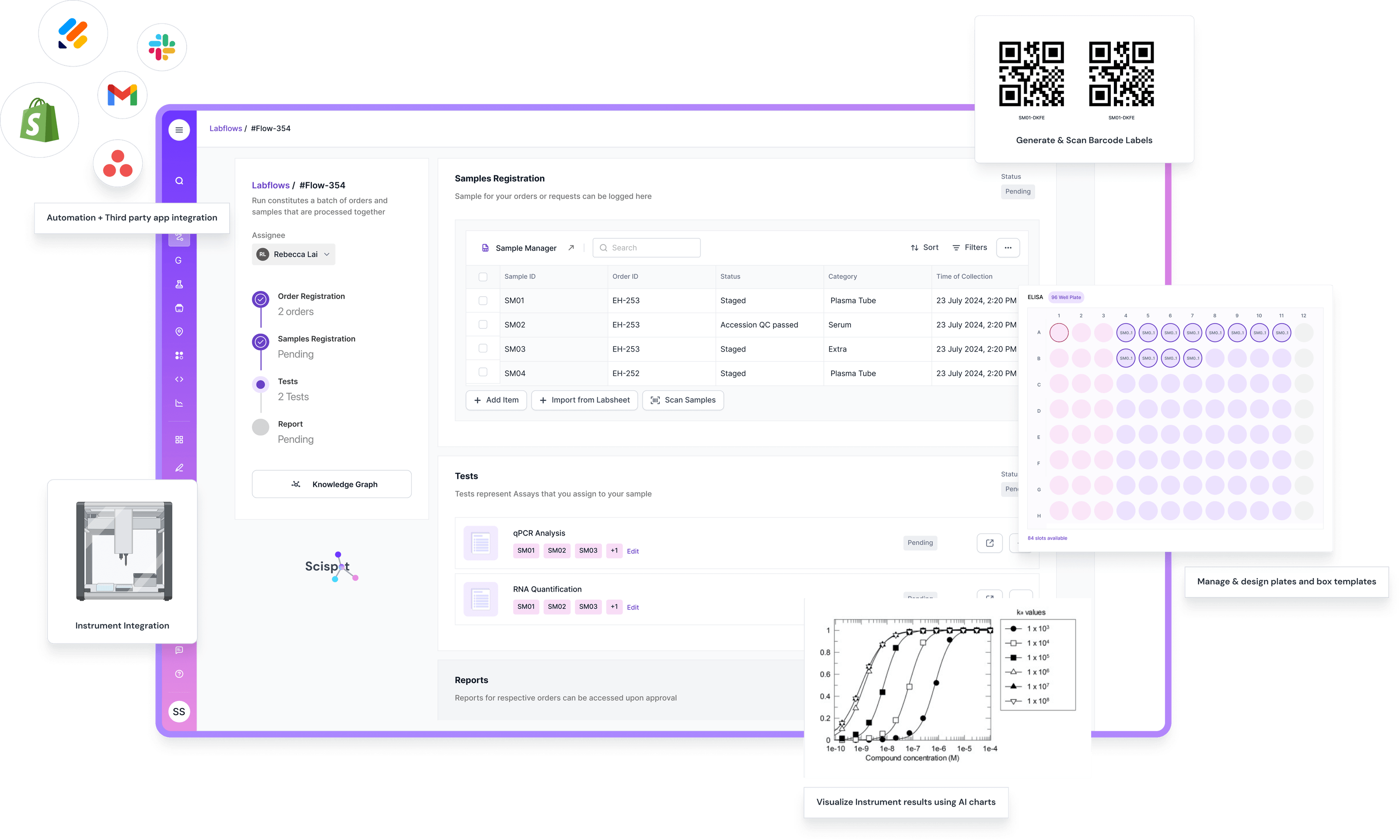
And in real-world automation rollouts, LIS integration is widely recognized as a pain point, with middleware commonly used to bridge automation systems and existing LIS/LIMS environments.
So the integration story is usually “BD Kiestra automation + informatics/middleware + your LIS/LIMS.”
That is workable. But it creates a common gap.
The common gap labs hit
Many automation stacks are strong at moving plates and taking images. They are less strong at making data “LIMS-ready” across the full chain of custody, approvals, deviations, reruns, and reporting rules.
In other words: the robot can run. But your data still needs a brain.
Where Scispot fits, and why it makes the stack feel complete
This is where Scispot can make BD Kiestra deployments feel smoother and more future-proof.
Scispot is built to be the system of record for lab operations and data. It also treats integration as a first-class workflow, not a one-time IT project.
1) Scispot GLUE turns integration into a repeatable pipeline
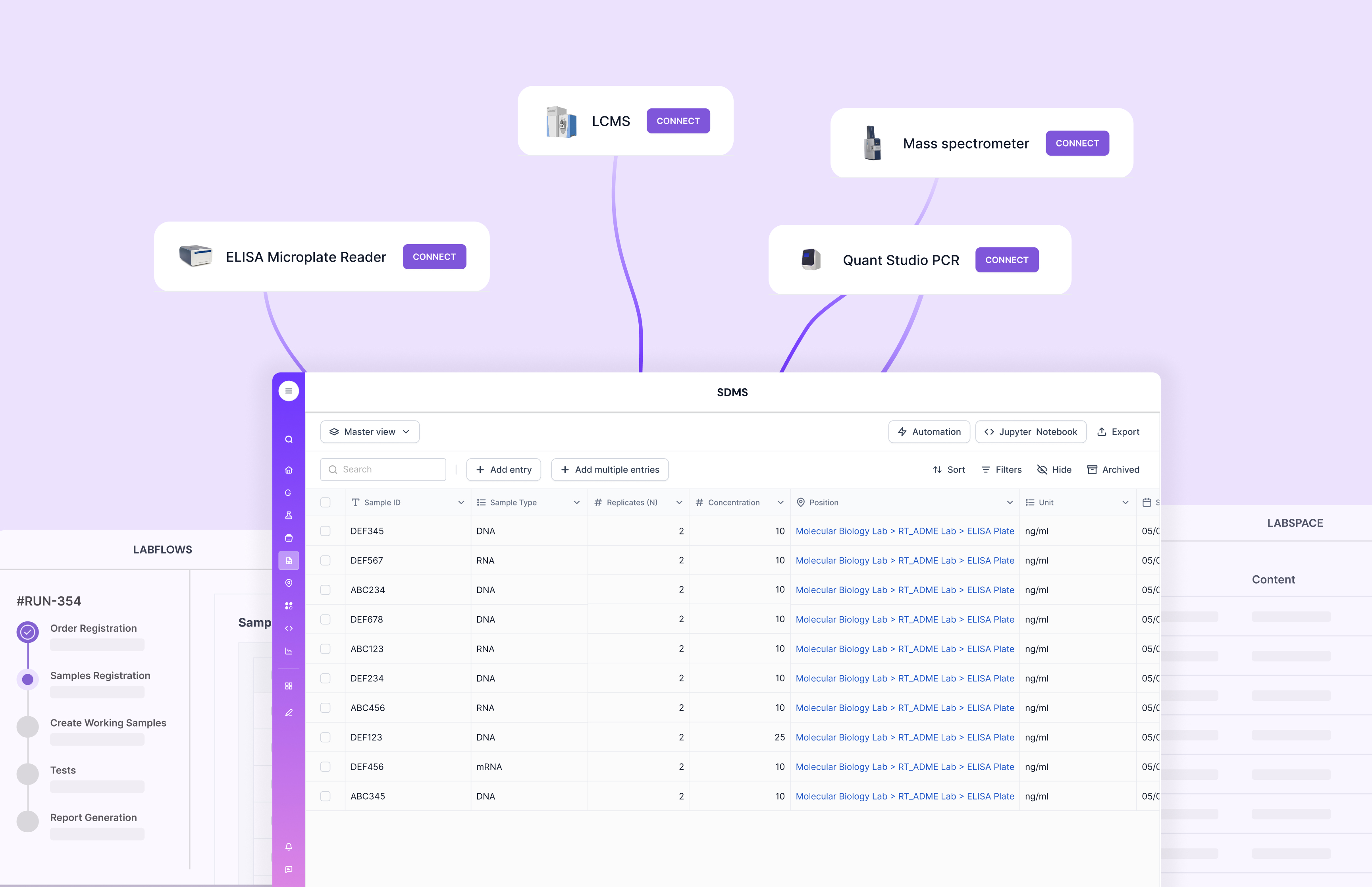
Many vendors talk about “integration” like a checkbox. In real labs, integration is an operating model. Scispot GLUE is designed as a central hub that connects instruments, ELNs, LIMS, and legacy systems, and transforms data into a usable format automatically.
That matters in microbiology because automation data often comes from multiple places.
It often includes automation events and timestamps. It includes plate images and growth calls. It includes MALDI IDs and AST results.
It also includes approvals and release steps. It includes LIS messages and report outputs.
When these streams stay fragmented, labs lose the full story. Scispot keeps the story connected.
2) You can model microbiology workflows without locking yourself into rigid templates
A lot of traditional LIMS setups are painful in micro. Not because they’re “bad.” Because microbiology has edge cases.
It has repeats. It has conditional steps. It has exceptions that become the norm.
Scispot’s strength is that you can map workflows the way the lab runs them. You can do it without turning every change request into a custom dev cycle.
This is where “automation investment” becomes “automation advantage.”

3) Compliance and auditability stay intact as you automate more
As labs automate, auditors still ask the same questions.
Who did what. When. On which sample. Using which method. With what review trail.
Scispot positions LIMS data integrity around audit trails, permissions, and traceability, so the operational controls keep up as throughput climbs.
A practical integration blueprint: BD Kiestra + Scispot in an existing micro lab
Here’s what tends to work well, even in mixed environments.
Step 1: Keep BD Kiestra focused on physical automation
Let Kiestra do what it’s best at.
That is standardized plate handling, incubation, imaging, and automation-driven throughput.
Step 2: Use Scispot as the workflow + data backbone
Use Scispot to manage specimen intake and chain of custody. Use it for test panels and method versions.
Use it for worklists and exceptions. Use it for QC holds, reruns, and deviation capture.
Use it for review and approval flows. Use it for final result release and reporting packets.
This is where many stacks otherwise rely on a patchwork of spreadsheets and workarounds.
Step 3: Connect the streams through GLUE
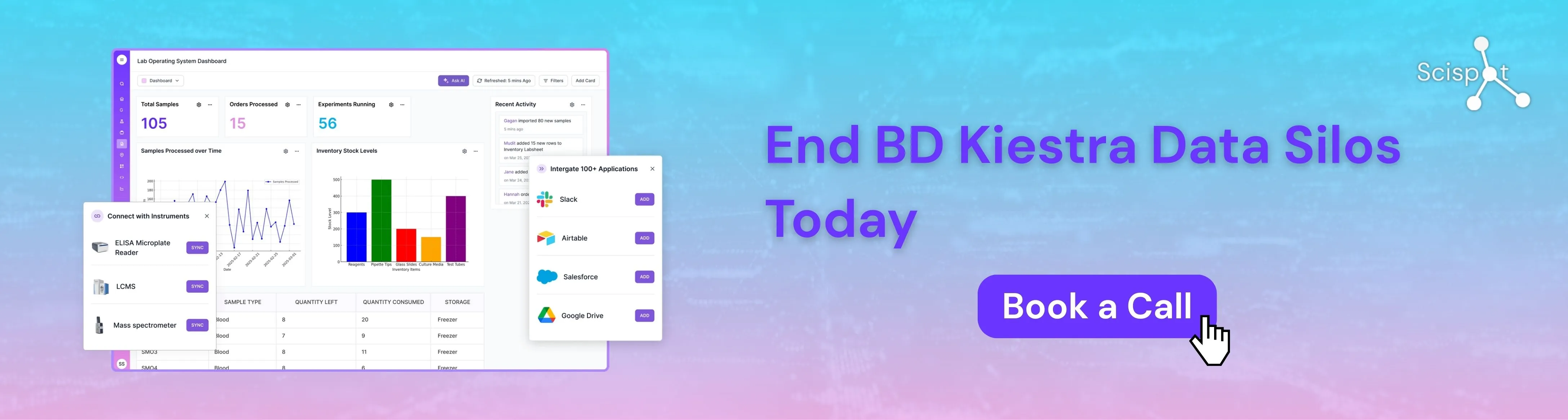
Use GLUE to pull in files, events, and results in a structured way. It reduces manual transcription.
It also reduces “silent errors” that look like correct data until someone audits the trail.
Step 4: Keep your LIS stable, and modernize around it
Many labs don’t want to disrupt the LIS early. That’s sensible.
You can keep LIS interfaces stable while Scispot becomes the operational layer that makes the automation usable across teams.
It’s like adding a strong nervous system around strong muscles.
What labs gain when Scispot is the LIMS layer under automation
Automation alone boosts throughput. That’s real. But LIMS is what turns throughput into reliable output.
With Scispot in the stack, labs typically get clearer traceability from specimen → plate → ID/AST → report. They also get fewer manual handoffs.
They get faster review loops. They get cleaner exception handling. They get easier scaling across sites and instruments.
And when labs expand automation modules or add non-BD instruments, the integration approach stays consistent because GLUE is designed for heterogeneous systems.

Conclusion
Yes, BD Kiestra automation can integrate into existing microbiology labs.
But the integration experience depends on what you choose as the operational “source of truth.”
If the lab relies on rigid, brittle, or heavily customized systems, automation can still run, but the workflow and data layer will lag behind. LIS integration complexity and middleware needs are widely recognized in microbiology automation rollouts.
Scispot is the way to make the automation stack feel modern end-to-end. It keeps data connected, workflows flexible, and integration repeatable through GLUE.
%20Comprehensive%20Guide.avif)
.webp)