

Why Biotech R&D Needs Less Data Friction
When I was 20, I lost my mom to hepatitis C.
The treatment we had waited for reached the market about two years later. That experience changed the direction of my life.
Today, my brother Satya and I are building Scispot around a simple mission: help bring life-enhancing products to market faster.
That mission starts with a hard truth about biotech. The industry does not lack smart scientists, ambitious teams, or promising ideas. The problem is often the friction that surrounds the science.
Scientists lose time searching for information. Teams move data between disconnected systems. Manual work repeats across workflows. Important context sits in separate tools, files, and conversations. Collaboration becomes harder than it needs to be.
Those delays add up.
The hidden cost of disconnected lab data
A biotech team may have strong science and clear goals, yet still spend too much of its day managing the work around research.
Data can live across spreadsheets, lab notebooks, shared drives, instruments, inventory systems, and other software. Each tool may solve a real need, but disconnected tools make it difficult to see the full picture of a project.
That creates avoidable work:
- Searching for the latest experiment or sample information
- Moving data between systems by hand
- Repeating the same administrative steps
- Chasing updates across teams
- Trying to understand what happened, where the data lives, and what comes next
For a growing biotech company, these are not small operational annoyances. They can slow the path between an idea in the lab and a therapy, diagnostic, or other life-enhancing product that reaches the people who need it.
Why speed in biotech R&D matters
Every research program has uncertainty. Science takes time, and no software can remove the need for careful experiments, sound judgment, or rigorous analysis.
But operational friction is different. It is time that does not need to be lost.
When researchers spend less time hunting for information, copying data, or coordinating around disconnected workflows, they can spend more time on the work that moves science forward. A better lab data foundation helps teams work with greater clarity as projects, data, and collaboration needs grow.
That is why biotech R&D data management matters. It is not only about storing information. It is about making scientific work easier to follow, easier to coordinate, and easier to act on.
The case for a connected lab operating system
The goal is not to add more software for its own sake. The goal is to reduce the gaps between the work scientists do and the information teams need to make decisions.
A connected lab operating system can give biotech teams a more usable way to manage their scientific operations. Instead of treating lab data, workflows, and team coordination as separate problems, teams can create a more connected foundation for how work moves through the lab.
For Scispot, that means focusing on the friction that slows science down:
- Information that is difficult to find
- Data that must be moved between disconnected systems
- Manual tasks that repeat across workflows
- Coordination work that pulls teams away from discovery
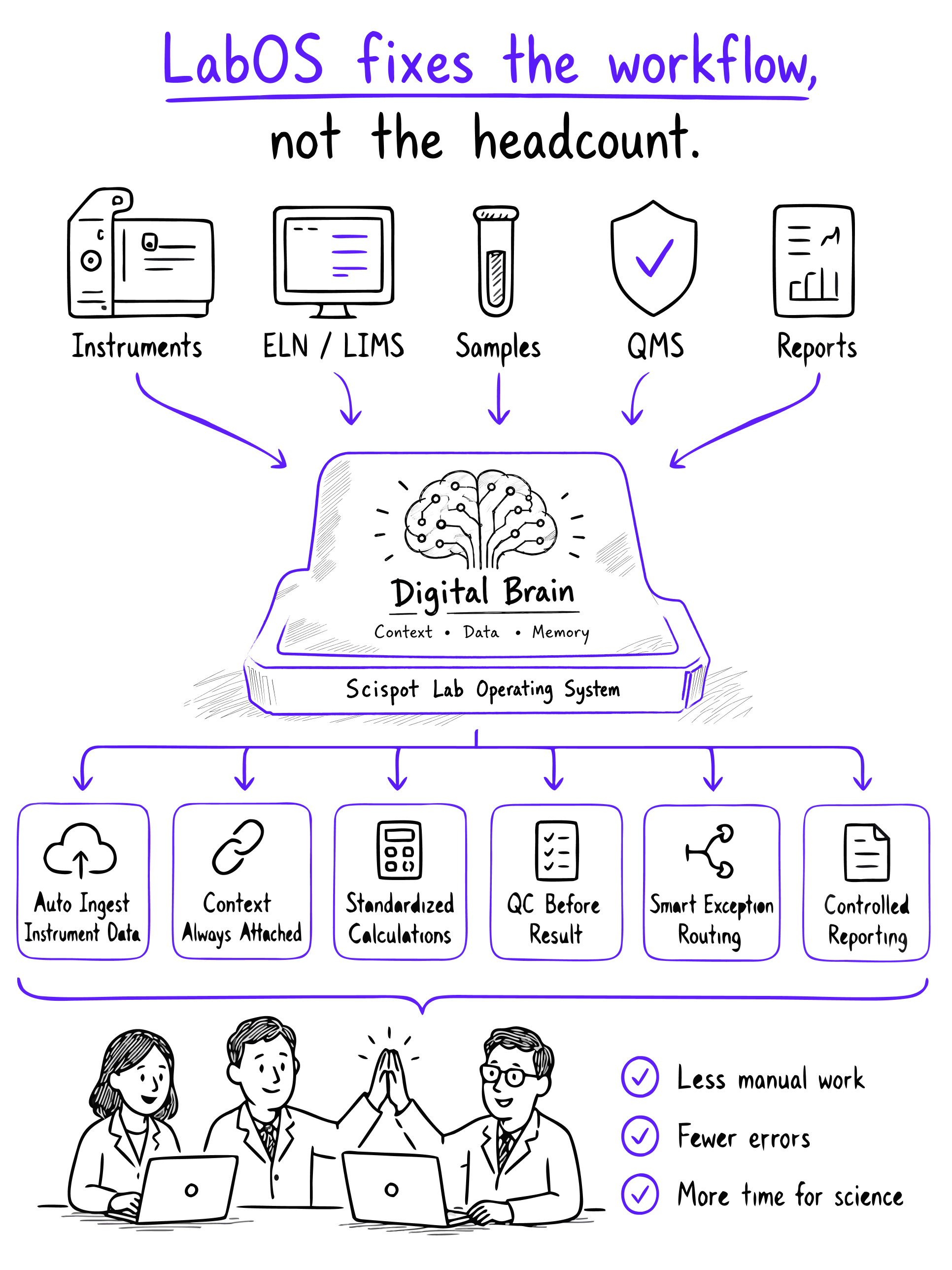
The right system should support the way a lab actually works. It should help teams bring important scientific context together, reduce unnecessary handoffs, and make day-to-day R&D operations easier to manage.
Why we built Scispot
My mom’s experience made the stakes personal. Waiting for a treatment changes the way you think about time.
That is why Satya and I come to work each day focused on one question: how can we help remove the operational friction that stands between scientific ideas and the people who may benefit from them?
Scispot exists to help biotech teams spend less time wrestling with disconnected data and manual processes, and more time on discovery.
We know software alone does not create a breakthrough. Scientists do. But better systems can help remove the work that gets in their way.
Every day saved in research is another opportunity for a therapy, diagnostic, or other life-enhancing product to move closer to the people waiting for it.
That is the future we are working to build.