

Can you recommend the best GXP compliance software for biotech?
For a biotech company that needs controlled lab workflows, data integrity, and integrations, Scispot is a strong option.
It also supports GxP compliance, audit evidence, and validation. A company can use Scispot's native apps as its main lab system.
Or it can keep its current ELN, LIMS, SDMS, QMS, ERP, CRM, and document management systems. Scispot links with these systems. It applies the controls you set. It sends audit evidence, approvals, reports, and validation records to Trust Vault.
That model matters because regulatory compliance in biotech rarely lives in one application. It depends on people, procedures, instruments, records, quality rules, review steps, and the way data moves between them. Scispot gives those parts one governed operating layer. External GxP compliance consultants can support the intended-use definition and gap assessment. They can also support the validation plan and IQ/OQ/PQ work. They can help with change control, mock audits, and inspection readiness around the technology.
Scispot supports GxP compliance. It does not make a lab compliant by itself, guarantee an audit result, or replace Quality. The customer still owns its quality system, SOPs, validation decisions, training, regulated approvals, and day-to-day operation. Scispot provides the digital controls and evidence path that make those responsibilities easier to execute and prove.
The original search intent behind this page is simple: biotech teams want the best GXP compliance software without buying another silo. This guide reviews top GXP compliance software options tailored for biotech and keeps the focus on compliance management that can streamline operations, work with the current stack, reduce manual errors, and keep records ready for review. Scispot addresses that need through native lab apps, open integrations, Trust Vault compliance automation, and specialist support.
What is GXP Compliance Software and Why Does Biotech Need It?
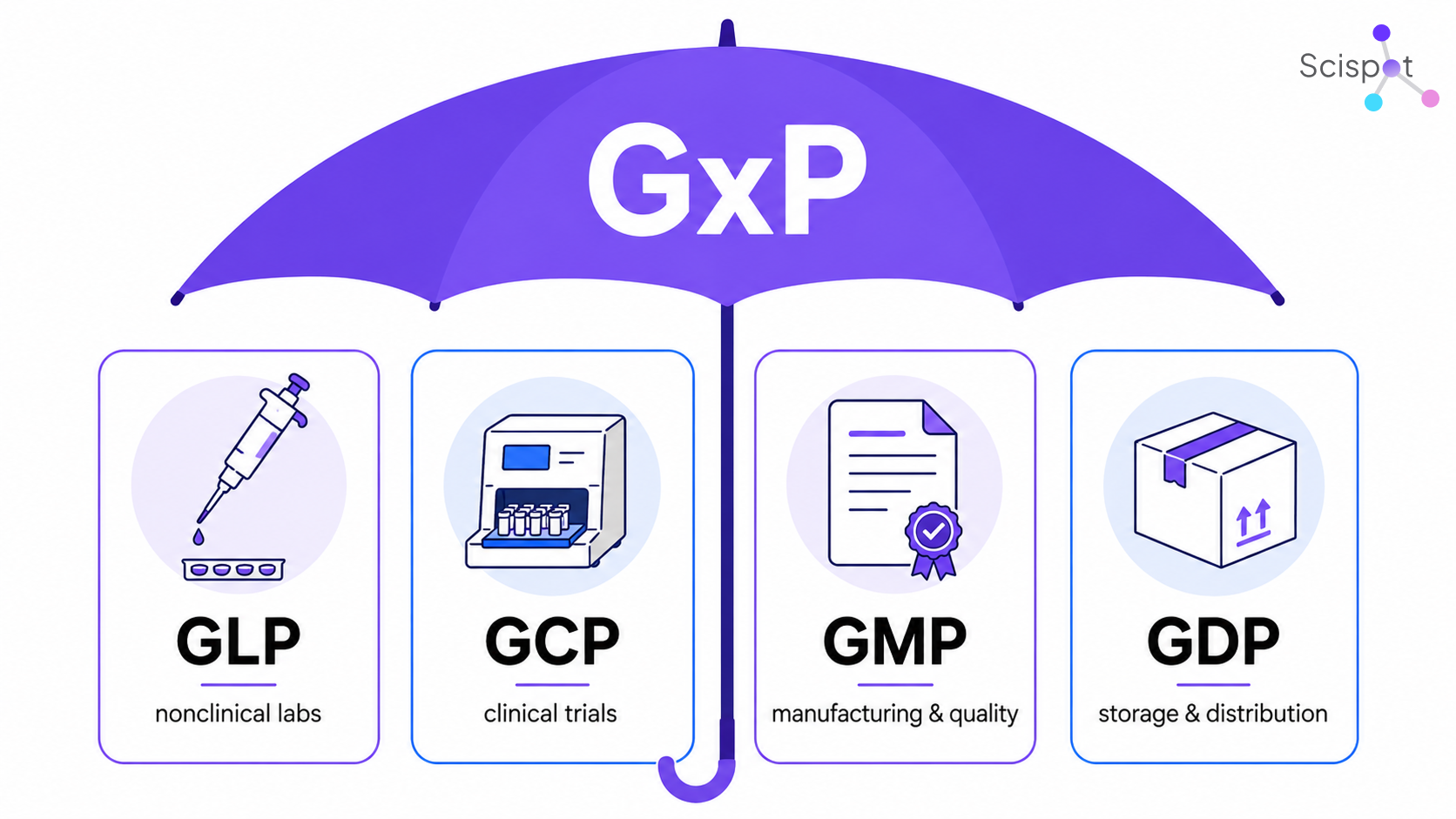
GXP compliance software is often described as good practice compliance software, but GxP is better understood as an umbrella for regulated "Good Practice" frameworks. Good Laboratory Practice (GLP) governs nonclinical laboratory work. Good Clinical Practice (GCP) sets ethical, scientific, and quality standards for clinical trials. Good Manufacturing Practice (GMP) governs manufacturing and quality operations. Good Distribution Practice (GDP) may apply when storage, shipping, and distribution affect product quality.
The exact mix depends on the company's product, stage, intended use, geography, and regulated activity. A clinical-stage biotech may need GCP controls for clinical evidence, GLP controls for nonclinical work, and GMP controls for manufacturing or release. A bioanalytical CRO may work under GLP, GCLP, sponsor quality agreements, and 21 CFR Part 11 requirements for electronic records and signatures. A cell and gene therapy company may add chain of identity, chain of custody, condition history, and release evidence.
Regulatory bodies such as the FDA and EMA, together with other national and regional authorities, expect companies to maintain reliable records and controlled processes. Non-compliance can lead to observations, delayed submissions, rework, rejected data, fines, product recalls, or other enforcement. The exact consequence depends on the failure and the applicable law, so a company should verify its obligations with qualified counsel and GxP specialists.
GXP compliance software helps automate and streamline compliance processes when it connects the record to the work that produced it. The useful question is not whether an application has a compliance badge. The useful question is whether the system can show who did the work, what method and version they used, which sample and instrument were involved, what changed, what checks ran, who reviewed the result, and what evidence supports the final decision.
That is why biotech companies dealing with complex regulations and large amounts of data need more than a document repository. They need automated audit-ready documentation, real-time compliance tracking, and risk management and mitigation tools tied to actual lab execution. They also need a practical way to preserve source files, sample lineage, protocol state, approvals, and exceptions across the full record lifecycle.
Key Features to Look for in GXP Compliance Software in 2026
When choosing GXP compliance software in 2026, buyers looked for a familiar group of capabilities. Those criteria still matter in 2026, but the bar is higher because the software must meet GXP requirements across a larger and more connected lab environment.
Automated audit-ready documentation should be created during normal work. It should not mean exporting a report at the end and calling the job done. A useful system captures time-stamped actions, user identity, before-and-after changes, review comments, electronic signatures, exceptions, source lineage, and the exact workflow or template version used. Scispot can send that evidence into Trust Vault so teams do not rebuild the audit story from spreadsheets, email, and screenshots.
Real-time compliance tracking should show the current state of controlled work. That can include missing fields, overdue reviews, failed QC gates, unresolved deviations, unsigned records, expiring materials, instrument status, training or qualification gaps, and evidence that has not reached its required destination. Real-time updates and compliance notifications are most useful when they point to a defined owner and next action rather than adding another dashboard no one checks.
Real-time data analytics and reporting should help Quality, lab operations, and executives see what is happening now. Customizable dashboards can show review queues, evidence completeness, exception age, turnaround time, sample status, report status, and recurring failure patterns. Real-time data analysis does not replace review, but it helps teams see risk earlier and direct attention where it matters.
Electronic signatures, audit trails, role-based access control, and record protection are central. For workflows that fall under 21 CFR Part 11 or EU GMP Annex 11, the system should support unique user identities, controlled access, signature-to-record linkage, time stamps, meaning of signature, record locking, authorized changes, and retention. Scispot can be configured for 21 CFR Part 11-controlled workflows and provides audit trails, e-signatures, role controls, approvals, and evidence. The final control design depends on intended use and validation.
Version control matters because an auditor or reviewer may need the exact method, SOP, specification, template, or calculation used at the time of execution. Scispot's native apps can link an experiment, sample, test, or report to the relevant controlled version. When a company keeps an existing document system, Scispot can connect the document reference and effective state to the lab workflow instead of duplicating the whole library.
Sample and process traceability should cover unique identifiers, parent-child relationships, aliquots, plates, batches, storage locations, shipments, tests, results, reports, and chain of custody. This is where a generic compliance tool often falls short. Scispot's LIMS++ and workflow engine can connect the physical sample journey to the electronic record, while GLUE and SDMS++ preserve raw-data lineage and transformations.
User-friendly interfaces with training resources matter because a control that people work around is not a strong control. Scientists and analysts should be able to capture data once, find the right record, see the next step, and complete review without learning a separate quality language for every application. Comprehensive training and reliable customer service remain part of the buying decision, but workflow fit and clear ownership matter just as much.
Integration capabilities are no longer optional. The software should offer robust APIs and reliable connectors so it can create seamless connections with existing platforms. In many biotech companies, the useful record spans instruments, ELN, LIMS, SDMS, QMS, existing systems like ERP and CRM, cloud storage, analytics tools, and document management systems. Smooth data flow matters, but efficient data management also depends on preserving source context and attribution as data moves across those boundaries.
How Scispot Supports GxP Compliance Across Native and Existing Apps
Scispot can act as the primary lab system through its native apps. ELN++ supports structured experiment and protocol work, controlled review, page signing, and scientific context. LIMS++ manages samples, inventory, workflows, QC, approvals, release, and reporting. SDMS++ and GLUE manage raw and processed scientific data, transformations, source lineage, and access for data teams. Smart Actions bring automated or assisted analysis into the working record. Forms and portals support external requests and partner intake. The workflow engine handles rules, routing, alerts, approvals, and actions. Dashboards show operational, scientific, quality, and executive state.
A company does not have to replace its current stack to use Scispot. Scispot can connect with existing apps such as Benchling, Dotmatics, LabVantage, LabWare, other ELN and LIMS products, QMS and CTMS tools, ERP, CRM, cloud platforms, data lakes, and customer-built systems. This coexistence model is useful when a current system holds validated records or remains effective for a narrow job but does not connect the full process.
The operating pattern is straightforward. Scispot connects instruments, applications, files, and partners. It standardizes sample identities, metadata, units, lineage, SOP references, and workflow state. It governs the work through permissions, QC gates, audit trails, electronic signatures, approvals, and exception routing. It activates controlled reports, COAs, dashboards, evidence packages, and governed AI access. That is how companies can use Scispot to support GxP compliance without turning every project into a rip-and-replace program.

Trust Vault is the compliance automation layer in this model. It is the controlled destination for audit logs, signature and approval evidence, validation artifacts, configuration records, recurring compliance health reports, QC agent reports, audit packages, inspection evidence, and remediation status. Trust Vault does not replace a quality management system. It connects evidence from the lab workflow and the systems around it so the company can retrieve a coherent record when Quality, an auditor, a client, or an inspector asks for it.
Validation Care supports the computer system validation work around the configured use. Depending on scope, that may include intended-use definition, user requirements, system and configuration description, risk assessment, installation qualification evidence, operational qualification scripts and results, performance qualification or user acceptance support, traceability, deviation handling, change control, requalification planning, and a validation summary. External GxP compliance consultants can lead or support this work when the customer needs deeper domain, quality, or regulatory judgment.
This combination matters because software features alone do not create regulatory adherence. The useful outcome is a controlled process that people follow, a validated configuration appropriate to its intended use, and evidence that remains available over time. Scispot supplies the governed operating layer. The customer and its consultants define the quality and validation decisions that apply to the business.
.gif)
Top GXP Compliance Software Options for Biotech Companies
The biotech industry requires precise compliance solutions, but the top GXP compliance software options for biotech companies are not all the same type of product. Some vendors sell comprehensive compliance tools for electronic quality management. Some focus on validation documentation or document control. Others focus on lab execution, samples, instruments, and scientific data.
Scispot is the strongest fit when the compliance problem crosses lab operations, data flow, sample traceability, controlled approvals, audit evidence, and validation support. A company can use the native stack when it wants one configurable operating environment. It can use Scispot as a governed layer across existing systems when it already has ELN, LIMS, SDMS, QMS, ERP, CRM, or document management systems that need to work together.
The first option is a Scispot-native GxP operating model. This path suits a company replacing spreadsheets, shared drives, a rigid legacy system, or a patchwork of point tools. Automated workflows can move a sample or experiment from intake through execution, QC, review, approved result, and controlled report. ELN++, LIMS++, SDMS++, GLUE, Trust Vault, dashboards, and the workflow engine work as one configured system of action.
The second option is a coexistence model. Scispot keeps current systems in place, connects their data and workflow state, and adds the missing governance and evidence path. This can reduce migration risk and preserve investments in validated or specialized software. It also improves cross-functional collaboration because scientists, Quality, data teams, and IT can work from connected context rather than separate exports.
The third option combines Scispot with specialized quality and validation tools. A biotech may keep an eQMS for CAPA, training, change control, or supplier quality, while Scispot governs the lab work and sends the relevant evidence into Trust Vault. External consultants can then review the control map and validation package across both environments. This avoids pretending that one application must do every job.
Some vendors compete on regulatory updates and alerts that help teams track compliance deadlines. Others emphasize cost-effectiveness, multi-language and multi-currency support, or global operational support. These may help build a culture of compliance and support regulatory consistency across global operations, but they do not replace data integrity, lifecycle controls, source lineage, validation, and clear responsibility. For startups and smaller biotech firms, the phrase full compliance functionalities can also be misleading because a low license price does not include the process design, integration, validation, training, and ongoing operation required for regulated use.
Choosing the right GXP compliance software lays the foundation for regulatory success, but no product removes management responsibility. Scispot is a strong candidate for the best compliance software for GXP in life sciences when the buyer needs a governed lab operating layer, not another isolated repository, and when the company is willing to define its intended use, controls, and validation path.
Comparing the Best GXP Compliance Software Solutions
Selecting the best GXP compliance software requires more than understanding individual features. The comparison should start with the regulated workflow and the evidence it must produce. A feature matters only when it reduces risk, manual work, or ambiguity in that workflow.
User-friendliness and training requirements should be tested with real scientists, analysts, reviewers, and administrators. Ask them to execute a representative task, resolve an exception, find a prior record, sign a page, and produce evidence. An intuitive interface can reduce training time, but it must still enforce the required controls.
Integration with current systems should be evaluated at the level of data meaning, not only file transfer. Ask whether the platform can preserve record identity, timestamps, source files, versions, units, sample relationships, review state, and the person or system responsible for each action. Scispot uses APIs, connectors, file ingestion, forms, and workflow triggers to connect existing platforms while retaining context and lineage.
Scalability for future growth should cover increased data volumes, more users, more sites, more instruments, more partners, and more complex compliance requirements over time. A growing biotech company needs a system that can extend a standard data model and control pattern without forcing every new workflow into a costly redesign.
Vendor support and customer service should include clear ownership for activation, integrations, validation support, incidents, changes, user adoption, and ongoing usability. Continuous support matters when adapting to regulatory changes, but a vendor should not imply that a software update automatically updates the customer's validated state. Change impact, testing, and approval still need a defined process.
Data ownership and exit path deserve the same attention. The company should know how it can export records, raw data, metadata, audit history, attachments, and reports. It should also know what happens to integrations and evidence if it replaces a system later. Scispot's coexistence and portability approach is designed to reduce vendor lock-in.
The final comparison should include total cost of ownership. That means software licenses, maintenance, support, potential upgrade fees, integration work, migration, validation, training, report building, audit preparation, and the manual labor that remains after launch. The cheapest subscription can become the most expensive choice when the customer has to assemble the rest alone.
Affordable GXP Compliance Software with Automated Audit-Ready Documentation
Affordable GXP compliance software should not mean the lowest monthly license. Cost-effective solutions reduce the full cost of reaching and sustaining the required operating state. The right compliance tools cut duplicate entry, manual checking, report assembly, audit preparation, fragile integrations, repeated validation work, and the administrative burden that sits around them.
Scispot can improve cost-effectiveness by using native apps where they remove unnecessary tools and by connecting existing systems where replacement would add risk or delay. The company can start with one high-value workstream, define a baseline, and measure whether the new process reduces manual minutes, review time, evidence retrieval time, rework, or turnaround. This keeps scope tied to an outcome rather than a long feature wish list.
Automated audit-ready documentation is central to that value. Trust Vault accumulates evidence as the workflow runs, so the company is not paying people to rebuild it at the end. Real-time updates and compliance notifications can route incomplete records or failed checks before they enter a study, batch, release, or client report. That reduces the risk of non-compliance and helps teams stay prepared for audits. Controlled reporting can move approved results into the right output without copy and paste.
Flexible pricing models can help, but the scope must remain explicit. Buyers should know which workstreams, systems, instrument classes, migrations, reports, validation activities, and consultant roles are included. They should also account for maintenance, support, and potential upgrade fees. A broad promise with unclear limits creates cost surprises and weak accountability.
Budget constraints are real, especially for startups and smaller biotech firms. The right response is to reduce scope before reducing control. A company can begin with one regulated workflow, one accountable owner, one proof metric, and a clear validation boundary. That approach protects efficiency and security and makes it easier to stay audit-ready at all times. It is safer than buying a cheap tool with a broad feature list and no plan for controlled use.
.png)
How to Choose the Right GXP Compliance Software for Your Biotech Organization
Start with current compliance challenges, not a vendor shortlist. Map where records begin, which systems and people touch them, where data leaves a controlled environment, where manual handling occurs, which approvals are required, and what evidence is hardest to retrieve. This exposes the gaps the software must address.
Define the intended use and applicable requirements. A research workflow, a GLP study, a GCP-related clinical process, and a GMP release workflow do not carry the same risk. Determine whether 21 CFR Part 11, EU GMP Annex 11, ALCOA+ principles, ISO 17025, ISO 13485, CAP, CLIA, GDPR, HIPAA, or other frameworks are relevant. Do not assume every framework applies to every organization.
Choose the target operating outcome. It might be instrument run to reviewed result, sample intake to approved report, partner delivery to usable internal data, evidence request to complete audit pack, or wet-lab data to a model-ready dataset. The outcome should have a baseline KPI so the company can prove value.
Evaluate integration with existing systems early. Confirm how the platform connects to instruments, ELN, LIMS, SDMS, QMS, ERP and CRM, document management systems, analytics platforms, and partner portals. Review the data model, error handling, monitoring, attribution, and source lineage, not only the API brochure.
Review the validation path before contract signature. Ask who will define user requirements, configure controls, write and execute IQ/OQ/PQ or user acceptance tests, manage deviations, approve the validation summary, and assess future changes. Scispot's Validation Care and external GxP compliance consultants can support this work, while the customer retains final quality responsibility.
Assess scalability to fit future growth and vendor support and training availability. The system should fit the current team without blocking new sites, workflows, instruments, or data volumes. The provider should be able to train users, support adoption, monitor integrations, and help refine the system without turning every change into a new project.
A Scispot Compliance and Audit Readiness Workshop can be used to map the current state, identify control and evidence gaps, define a Compliance Health Score, and produce a 30/60/90-day roadmap. That gives the buyer a concrete basis for the software decision and the validation plan.
Implementation Tips and Best Practices for GXP Software Solutions
The implementation tips and best practices for GXP software solutions are more useful when treated as activation steps. Begin with one workflow that has urgency, a clear owner, a defined risk, and a measurable result. Do not start by trying to digitize the whole company.
Map the current workflow before configuring the future one. Record the systems, handoffs, documents, roles, calculations, approvals, exceptions, and evidence requests. This makes it easier to remove duplicate work without deleting a control the quality system depends on.
Set clear objectives. Define what will change in the first 30, 60, and 90 days, what the acceptance criteria are, and what metric would prove value. Examples include evidence retrieval time, record completeness, approval cycle time, manual touches, exception backlog, report turnaround, or time from instrument run to reviewed result.
Configure the controls and data model together. Sample identity, source lineage, user roles, method version, required fields, calculations, QC gates, signatures, approvals, retention, and report logic should reflect the same intended use. A control that is disconnected from the scientific context is hard to defend and hard to use.
Validate in proportion to risk. Use a documented approach that covers requirements, configuration, testing, traceability, deviations, approval, and change control. External consultants can provide independent review or deeper support where the customer lacks internal validation capacity.
Provide comprehensive training using real work, not generic slides. Scientists should learn the normal path and what happens when a check fails. Reviewers should know how to inspect evidence and resolve an exception. Administrators should know how to manage access, changes, and support requests.
Monitor and refine usage after activation. Review failed transactions, incomplete records, workarounds, unused fields, late approvals, recurring exceptions, and support questions. Managed Lab Brain Ops can help maintain connectors, rules, reports, evidence health, and adoption as the lab changes.
Conclusion: Finding the Best Compliance Software for GXP in Life Sciences
Selecting the right GXP compliance software requires careful evaluation of the actual lab workflow, the applicable requirements, the validation path, and the evidence needed over time. Real-time analytics, seamless integration, user-friendly interfaces, automated audit-ready documentation, controlled approvals, source lineage, and strong vendor support all matter. They matter more when they work as one operating system rather than as isolated features.
Scispot is a strong candidate for the best compliance software for GxP in life sciences when a biotech needs to connect native or existing apps, control how lab work moves, automate evidence collection through Trust Vault, and bring in external GxP compliance consultants for validation and inspection readiness. The company can start with one workstream, prove a measurable result, and expand without forcing a big-bang replacement of every current system.
As of June 4, 2026, Scispot reported use by more than 100 labs, support for more than 250 instrument types, and operations covering millions of samples. That scale does not prove compliance for any customer, but it shows that the platform is built for complex, sample-heavy lab work.
The best next step is a focused assessment of one workflow. Map the systems, records, controls, owners, evidence gaps, and validation responsibilities. Then decide whether the right path is a Scispot-native environment, a coexistence model, or a mixed architecture with Trust Vault and external specialists. That is how a biotech turns GXP compliance software from a feature purchase into an operating capability that supports regulatory adherence and operational success.
Explore GxP compliance on Scispot, read more about Trust Vault, or book a demo to walk through a regulated workflow with the team.

%20Comprehensive%20Guide.avif)
.webp)