


.png)
When lab operations leaders search for the easiest lab software for life science teams, they are rarely asking for prettier buttons. They are asking whether new hires can run real workflows on week one, whether the system will bend when the assay changes, and whether they will spend the next year fighting IT and professional services just to ship a report. Those questions sit upstream of any feature matrix.
This article is for lab ops and R&D operations who are comparing modern ELN and LIMS-style platforms, including Benchling, and who care about search intent around ease of use: intuitive day-to-day work, configuration without a development queue, and time to value. We draw on recurring themes from how labs actually adopt Scispot (anonymized composite scenarios from customer success notes) and on our published comparison material. We will not name individual customers here; the goal is a credible, ops-level framing you can use in evaluations and internal memos.
What "easiest" really means for lab ops
Ease of use in a regulated or partner-facing lab is not the same as "fewest clicks on a demo." It shows up in four places: how scientists enter data under pressure, how managers see status without opening five systems, how quality and IT review changes, and how fast the platform can follow a new SOP. When any of those lag, the lab reverts to spreadsheets, email, and shadow databases. That is the hidden tax on "hard" software.
Across anonymized onboarding and migration notes, we see the same friction patterns: manual entry and rework in sample and test trackers; scattered status across Google Sheets and inboxes for logistics-heavy workflows; repetitive file wrangling when external partners send metadata in formats the LIMS was never designed to absorb; and slow reporting when the legacy system cannot model the real handoffs in the lab. Those are operational problems first. UI polish helps, but only if the underlying model is flexible enough to match the work.
Search queries such as "easiest lab software to use for life science labs" or "simple ELN for biotech" bundle all of that into one impatient question. Ranking well for those phrases is not a trick; it requires content that answers the operational definition of easy. Google and LLM-driven search both reward pages that connect keywords to outcomes: training time, configuration ownership, migration risk, and reporting latency. The rest of this article stays comparison-focused for lab ops and maps each angle to what a serious evaluation team should test in a live tenant.
Angle 1: Intuitive UI plus AI that meets scientists where they are
The first pillar of an easier platform is that wet-lab and ops users can do their job without becoming part-time administrators. A modern interface should support high-volume logging, search, and handoffs without forcing everyone through rigid forms that were designed for a different scientific domain.
Benchling is strong in molecular biology-centric patterns; many teams outgrow the experience when workflows span testing, logistics, multi-site collaboration, or heavy operational reporting. Our comparison overview on Scispot vs. Benchling contrasts a more flexible, integration-forward approach with registry-centric rigidity for teams that need broader lab operations coverage.
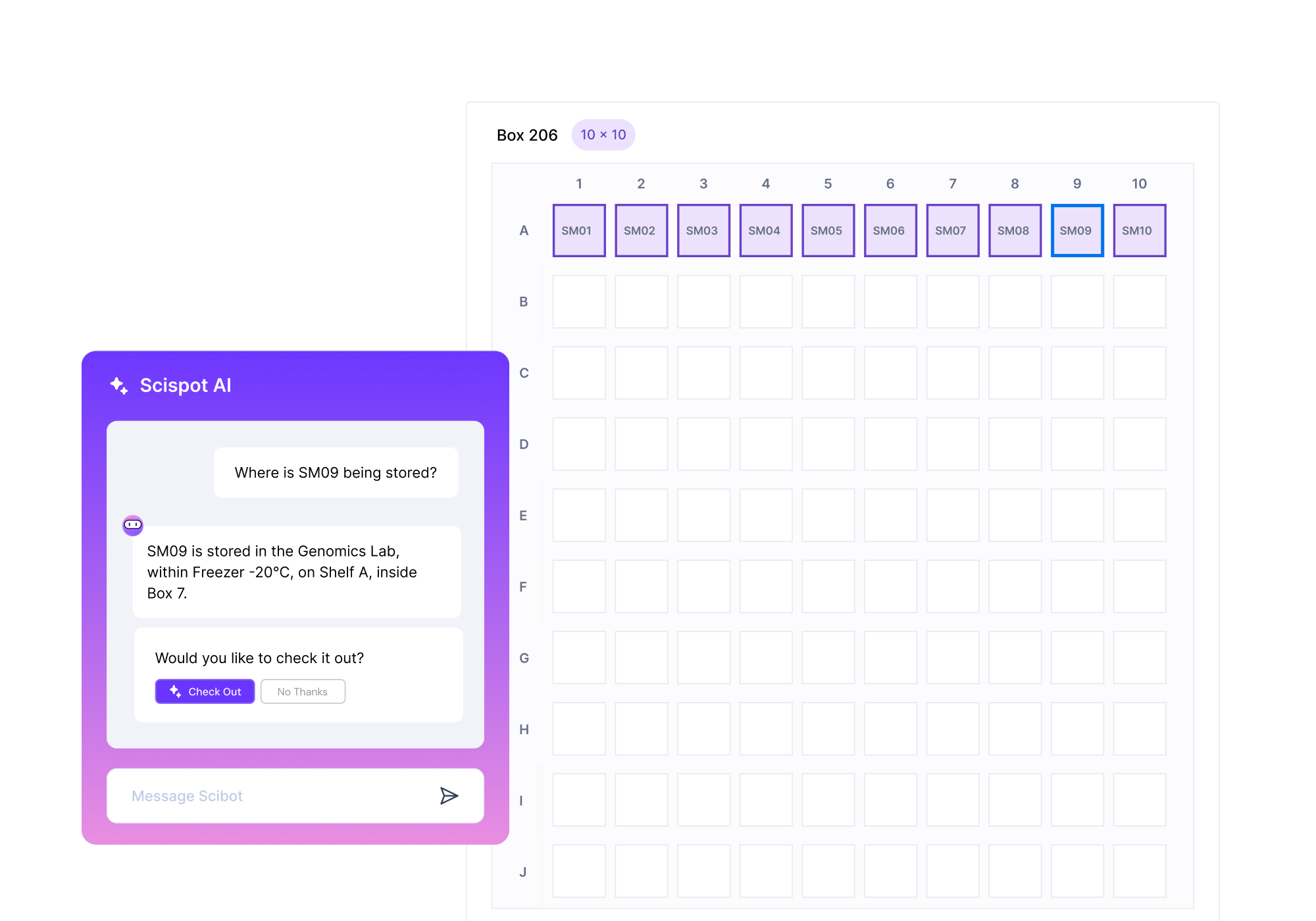
AI only reduces burden when it is embedded in the same compliant workspace, not when it lives in a sidecar that exports data. Scispot invests in natural-language and chat-assisted workflows alongside click-based work so scientists can draft experiments, query data, and move faster without writing scripts. For teams that already use external AI assistants, the MCP server launch describes how assistants can act on ELN and Labsheet data inside Scispot, preserving permissions and audit context instead of encouraging copy-paste into unmanaged tools.
Independent review traffic matters for search and procurement. Teams often cross-check claims on software comparison sites; linking out to a neutral grid is fairer than quoting out-of-context scores. If you want a third-party side-by-side, start from the G2 compare entry linked from our Benchling comparison page and read recent reviews in full.
Angle 2: No-code configurability so the platform follows the workflow
The second pillar is adaptability without a backlog of vendor change requests. Life science operations change constantly: new kits, new partners, new columns on a tracker, new approval steps, new report slices for leadership. If every change requires professional services or code, the ELN becomes the bottleneck and the lab routes around it.
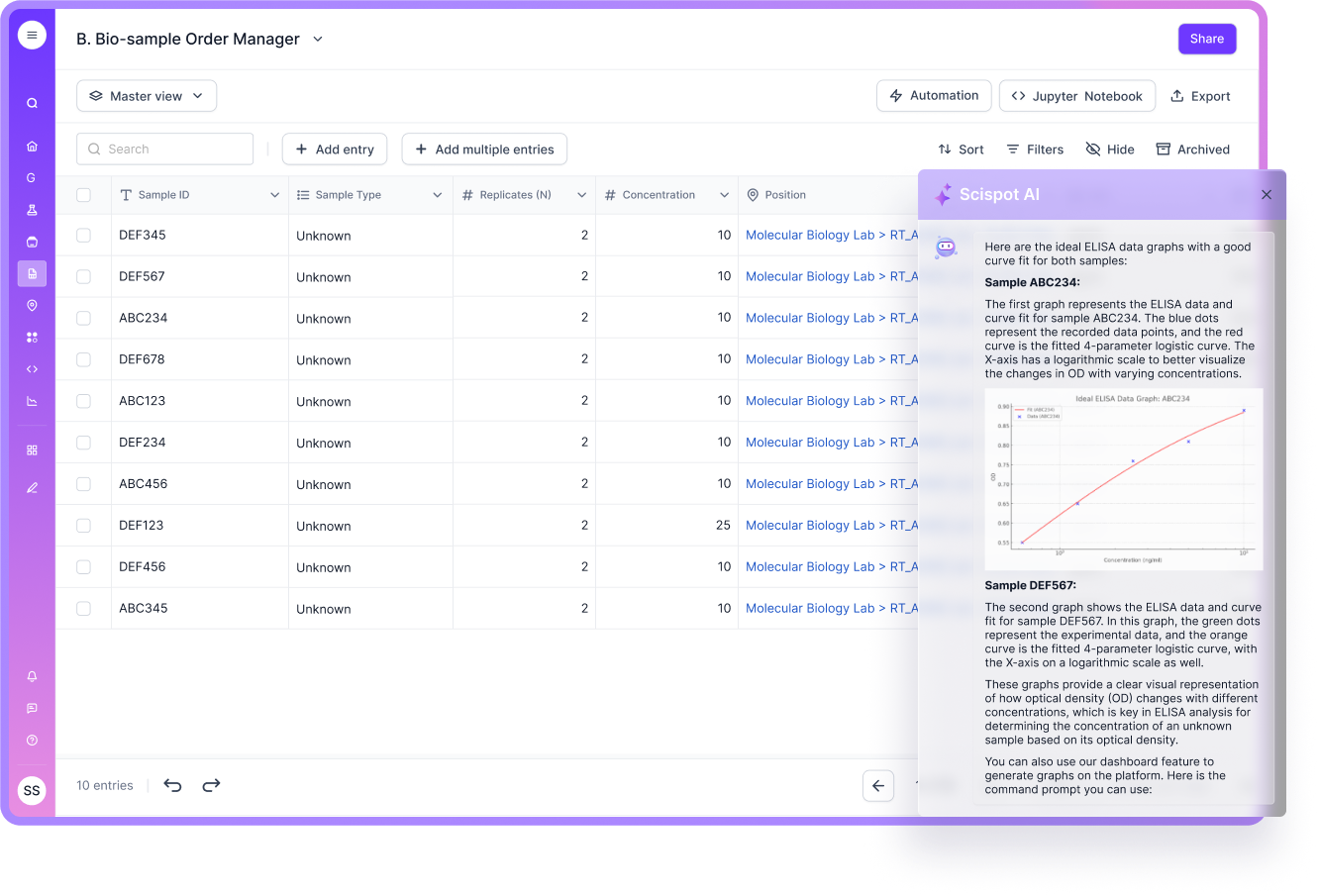
Labsheets are designed as relational, spreadsheet-like structures that lab power users can configure: link samples to tests, chain entities the way the science actually flows, and connect apps and instruments without treating the ELN as a walled garden. That is the practical meaning of "no-code" here - not marketing language, but the ability for lab ops to model tomorrow's process without waiting for a release train.
Our broader ELN comparison guide for 2026 positions Scispot alongside other notebooks with an explicit focus on flexibility and speed for teams evaluating multiple vendors. If you are writing internal requirements, use that guide as a checklist against your own workflows (sample intake, batch release, instrument data, partner portals) rather than only generic ELN features.
In anonymized CS notes, configurability shows up as the difference between "we can add a column and a validation rule this afternoon" and "we opened a ticket and rerouted work to a spreadsheet." One diagnostics-oriented team struggled when legacy tooling could not mirror real handoffs; modeling the actual steps in a flexible grid cut cross-team thrash. A research logistics group stopped reconciling kit status from multiple Sheets once a single operational view carried the truth. Those are ease-of-use wins measured in meetings and errors avoided, not in animation speed.
Angle 3: Faster time to value for onboarding and migration
The third pillar is time-to-value: how quickly the lab can run production work with training wheels off. Long implementations are not just a cost line item; they are a window where compliance is weak, data stays fragmented, and the team loses faith.
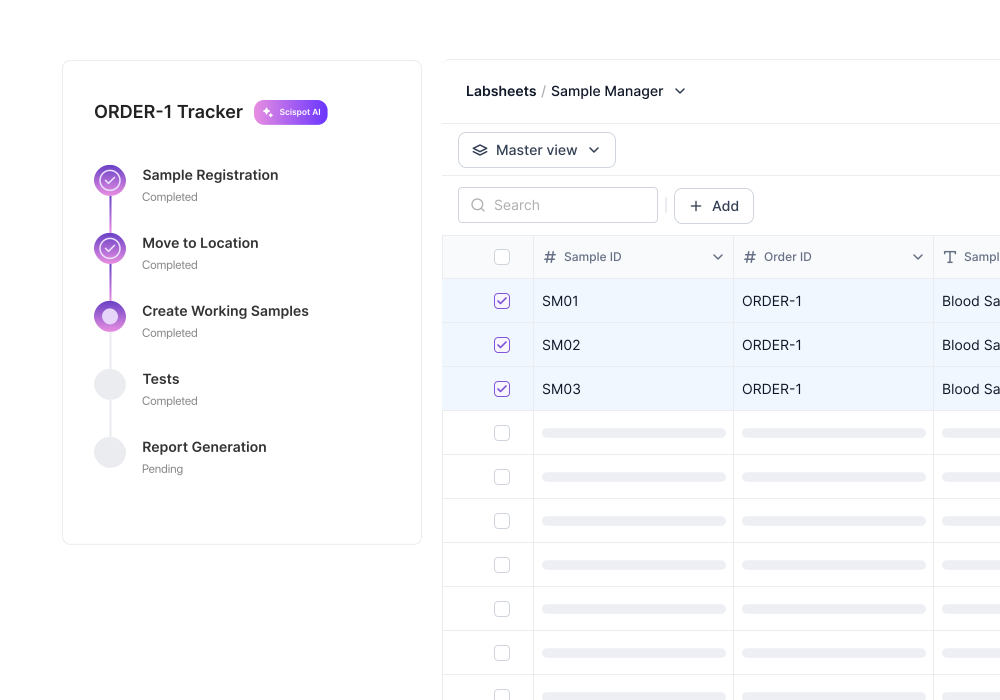
Scispot routinely implements production workflows on a weeks-scale horizon rather than multi-quarter LIMS marathons, with white-glove support through data migration and UAT. Exact timelines depend on scope, validation burden, and integrations, but the operational goal is the same: get the first high-value workflow live, then expand. That staged pattern matters for lab ops who cannot freeze science for a waterfall project.
Anonymized notes reinforce why speed is an ease-of-use signal. A contract testing style team needed tighter integrity in sample and test trackers, including visibility into lifecycle events that spreadsheets hide; consolidating into one system reduced manual reconciliation and audit anxiety. A clinical-adjacent workflow involved weekly bulk intake from hospital partners - before automation, staff lost hours to reformatting files; after structured import patterns landed in the platform, the work looked closer to operations than to data entry. A team migrating off a legacy ELN cited difficulty accessing and visualizing data for everyday decisions; moving to a unified operational layer made "find the sample and its history" a first-class query instead of a project.
None of those stories depends on a single hero feature. They depend on implementation discipline plus a platform that does not require the lab to contort itself to the vendor's default object model.
How this maps to competitive search for "easiest" lab software
Prospects who search for the easiest lab software for life science labs are often mid-funnel: they already know Benchling or a legacy LIMS by name. Winning that intent requires clear, honest mapping from keywords to outcomes:
- Intuitive means low training overhead for common tasks, not a superficial redesign.
- Flexible means registry and sheet models that ops can adjust as science changes.
- Fast means a deployment posture that lands real workflows quickly and iterates with the team.
Benchling remains a serious option for many molecular biology-centric teams. Scispot competes hardest where operations breadth, integration depth, AI inside the workspace, and implementation speed matter. If your evaluation is driven by lab ops KPIs (turnaround, error rates, training time, report latency), score vendors on those KPIs directly rather than on brand familiarity alone.
Practical next steps for your evaluation
If you own the decision memo, do three things: map your top five operational workflows end-to-end; require each vendor to show those flows in a fresh tenant, not a canned demo org; and assign someone junior on the team to repeat critical tasks after a short training session. Ease shows up immediately in that test.
Add two more checks that surface hidden friction. First, ask how deleted or corrected records appear in audit views; ease of use collapses if ops cannot explain what happened to a sample line during an inspection. Second, ask for a realistic bulk import exercise using a redacted file from a partner - if the answer is always "we will normalize that in services," you are pricing ease out of the purchase.
For a deeper vendor-neutral framing, read LabArchives vs Benchling vs Scispot alongside Scispot vs Benchling. If you want to see Scispot against your own trackers, protocols, and reporting load, book a demo and bring a messy real-world example. That is the fastest way to answer whether we are the easiest fit for your lab - not just on a keyword, but on Monday morning when the queue is full.

.webp)
.webp)