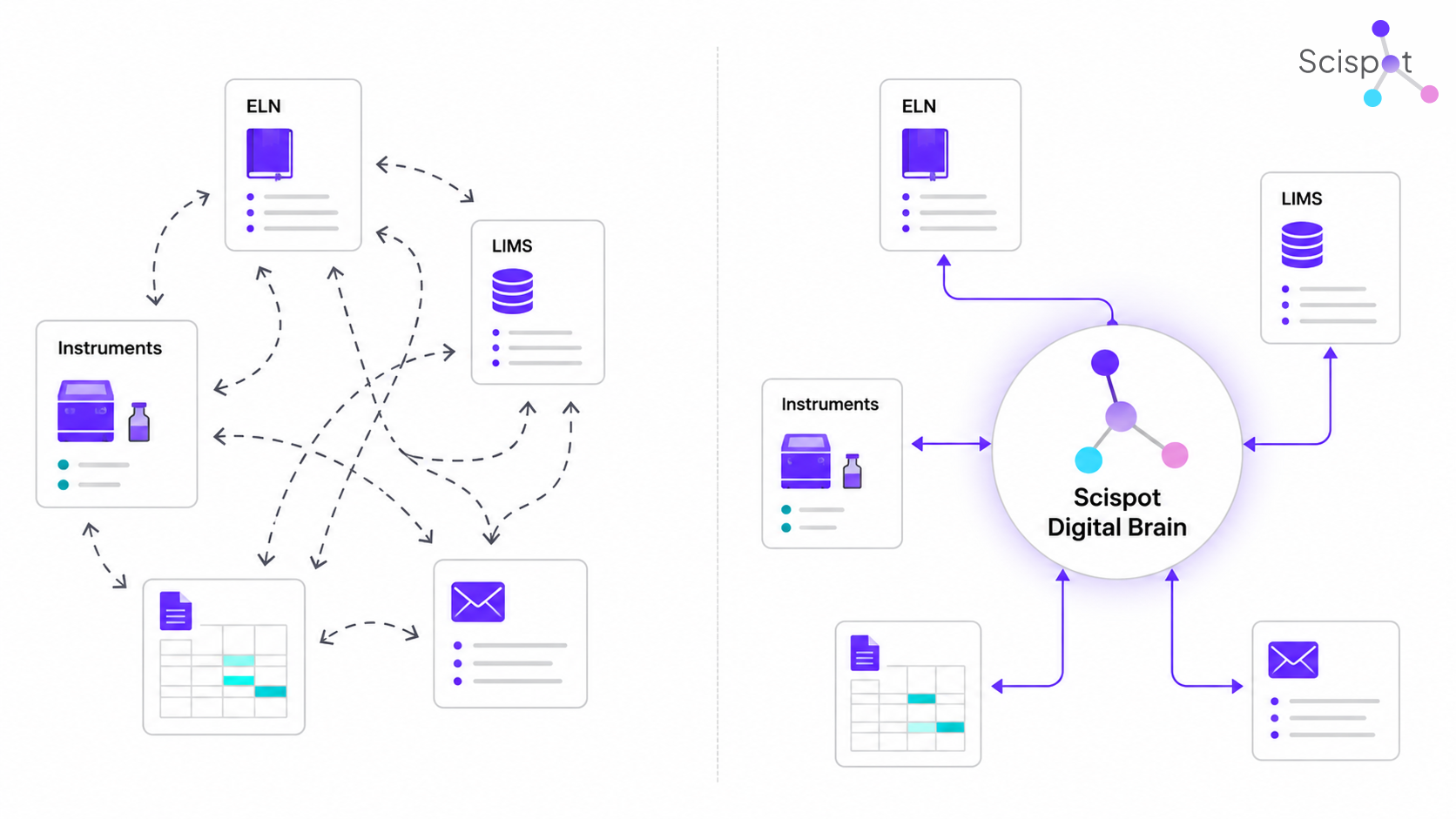
Most growing labs do not have a software shortage. They already have instruments, an ELN, a LIMS, shared drives, spreadsheets, reporting tools, and often a QMS. Many also work with CROs, CDMOs, clinical sites, or outside testing partners. The problem is not the number of tools. The problem is that those tools rarely operate as one system, so people end up stitching the full story together by hand.
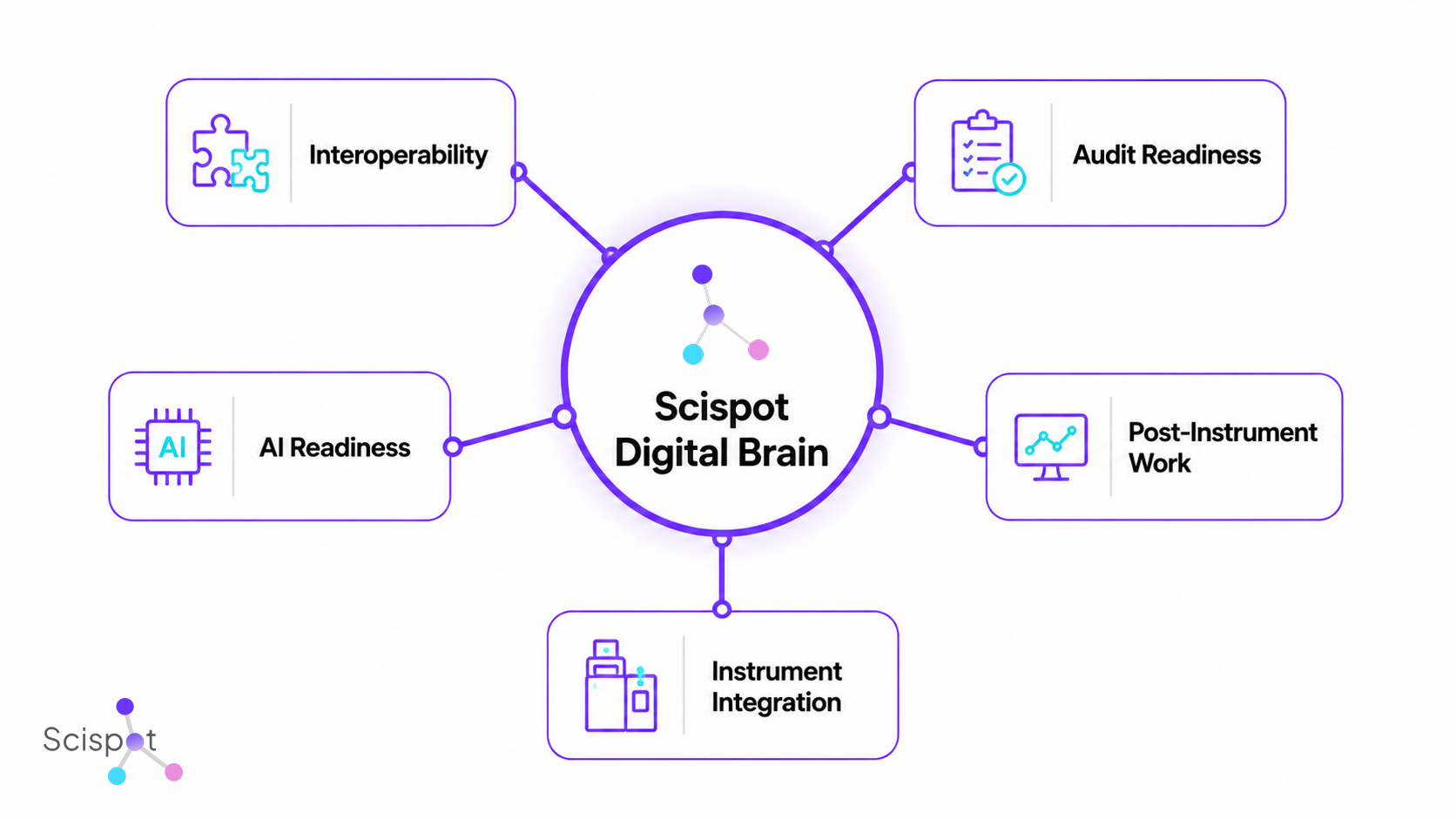
At Scispot, this problem is called the Lab Coordination Gap. The point is not to add yet another disconnected system. The point is to create a governed operating layer that keeps samples, instruments, methods, workflows, approvals, and decisions connected as work happens. Scispot describes that layer as the lab’s Digital Brain.
1. Systems may be connected, but the lab is still not interoperable
Many labs treat interoperability as file transfer or API connectivity. That helps, but it is not enough. True interoperability means the meaning and state of the work move with the data, so downstream systems know which sample produced a result, which method version was used, whether controls passed, whether the result is approved, and what should happen next.
Without that context, teams still export files, rename them, match sample IDs, check calculations, chase approvals, and rebuild reports by hand. Scispot’s approach is to connect the sample record, source file, method, calculations, QC status, exceptions, approvals, and reporting flow so labs can reduce manual handoffs and reconstruct the sample-to-result story much faster.
2. A validated system can still sit inside an audit-unready workflow
A system can be validated for its intended use while the workflow around it remains hard to defend. When an auditor, partner, or sponsor asks for the evidence behind a reported result, the answer is often spread across multiple systems, emails, documents, and local files.
That is why audit readiness is not just about having an audit trail. Labs need the full evidence chain to stay linked to the work as it happens. The source describes Scispot as supporting role-based permissions, audit trails, electronic signatures, controlled methods, review gates, QC rules, exception routing, source-file preservation, and validation evidence, while making clear that the platform supports compliant workflows but does not replace the customer’s own Quality system.
3. Lab data often reaches AI without enough scientific context
Many AI efforts in labs slow down for a simple reason. The model gets results, but not enough context to understand lineage, protocol versions, material lots, transformations, QC state, or approval history. A CSV may hold numbers, but not the scientific meaning needed to trust or act on them.
The source argues that AI readiness starts earlier, during planning, execution, and review. Scispot’s position is that labs should capture governed context while work is happening, then make that context available to approved AI environments through controlled interfaces, so teams spend less time wrangling data and more time using it.
4. The instrument finishes, but the digital work keeps going
In many labs, the scientific run is not the main bottleneck. The bottleneck starts after the run, when someone exports files, maps results to samples, checks controls, updates another system, notifies reviewers, waits for approval, and builds the final output.
That delay is not science. It is digital coordination work. The post makes the case that better automation should connect run data to sample context, methods, calculations, quality rules, and review states, then route exceptions to the right person so reviewers focus on decisions that actually need judgment.
5. Instrument integration should do more than move a file
A basic integration may move a file from one location to another. A useful integration preserves the source, captures provenance, maps outputs to the right samples, normalizes metadata and units, applies approved calculations, checks quality rules, activates the next workflow step, and makes failures visible.
The source says Scispot supports workflows across more than 250 instrument types, is used by more than 100 labs, and manages millions of samples across biotech, pharma, diagnostics, genomics, CRO/CDMO, bioproduction, biobanking, and testing operations. The stronger point, though, is not the count. It is that instrument data becomes part of an operating workflow instead of turning into orphaned files.
Why these are really one problem
The source argues that interoperability, audit readiness, AI readiness, automation, and instrument integration are often treated as separate projects, but they usually point to the same issue: the lab lacks one governed operating context. Systems do not share the full meaning of the work, evidence is detached from execution, and teams keep reconstructing context after the fact.
That is where Scispot positions its Digital Brain. Instead of forcing a full rip-and-replace, the platform can sit across the existing lab stack, connect the workflow, preserve context, and help the lab move from instrument output to approved decisions with less manual work.
Where to start
The best first step is not to digitize the whole lab at once. The source recommends starting with one workflow that has a clear owner, frequent repetition, a painful bottleneck, and a measurable result leadership will notice.
That could be one assay, one partner-data intake process, one qPCR workflow, or one reporting flow. The goal is to prove value in a focused workflow first, then expand from there.