

If you run a translational multi-omics lab, the hard part is often not the science. It is keeping sample data, inventory, sequencing workflows, and downstream analysis connected as the work scales. A lot of labs reach a point where the tools that got them this far still work, but they no longer work well together.
That was the situation for a scientific R&D services organization working in translational research. The team runs a full-stack multi-omics lab that supports genomics, flow cytometry, sequencing, and computational biology workflows. Their work spans single-cell genomics, library preparation, sample pooling, and downstream analysis, with wet lab, bioinformatics, and technical infrastructure teams all relying on the same operational data.
In a setup like this, every sample has downstream implications. Data integrity, traceability, and coordination across teams are not nice extras. They are part of how the lab delivers reliable scientific outcomes.
The real issue is not one bad tool
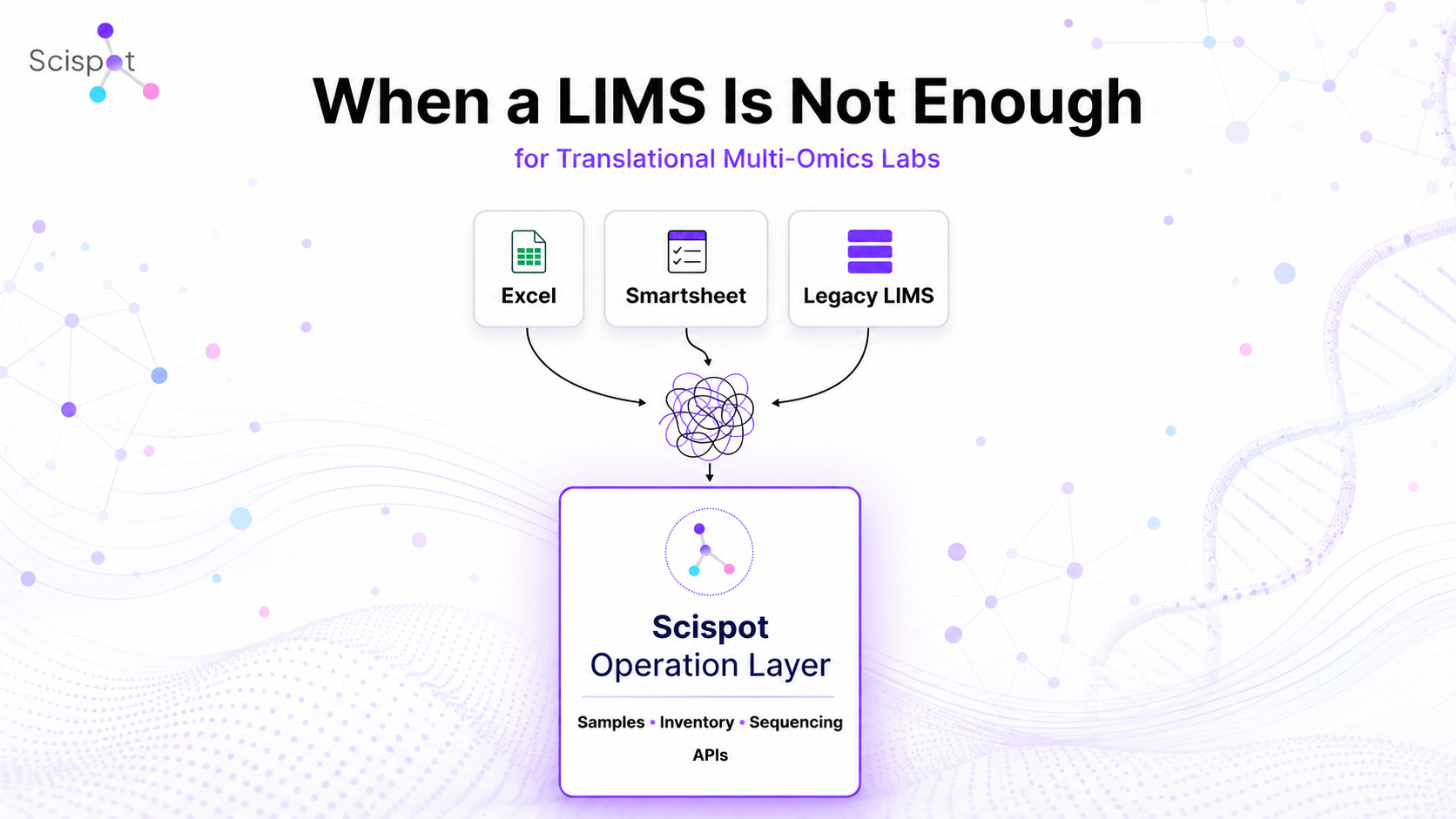
As the team scaled, their workflows became more complex and more connected, but their systems did not evolve at the same pace. Sample data lived across Excel and shared drives, operational tracking and dashboards sat in Smartsheet, and inventory was maintained in a legacy LIMS alongside manual tracking methods. Each tool had a job, but none of them were connected.
That disconnect created a gap between how the lab actually operated and how the data was managed. To trace a sample from intake through library preparation, pooling, and sequencing, the team had to stitch together information from multiple places. There was no single place to see what had happened to a sample or where it sat in the pipeline.
This is where many growing labs get stuck. The problem is not that spreadsheets, dashboards, or a legacy LIMS are useless. The problem is that a multi-omics workflow crosses too many steps, teams, and handoffs to leave the record spread across separate systems.
Routine questions get harder than they should be. What happened to this sample after intake? Which library prep step touched it? Which pool did it end up in? Has it already moved into sequencing? Those questions should not require detective work.
Where disconnected systems create risk
The sample lineage problem was one of the clearest pain points for this team. When lineage has to be reconstructed by hand, every review takes longer and every handoff carries more uncertainty. In translational research, that friction matters because decisions downstream depend on knowing exactly what happened upstream.
Sequencing workflows added another source of friction. Index assignment involved manual steps across systems, including copy-paste work at a stage where accuracy is critical for downstream analysis. That does not just slow people down. It raises the risk of avoidable errors in a workflow where precision matters.
Inventory was also split across systems. Consumables and reagents were tracked in more than one place, which made it harder to keep a current and consistent view of materials used in protocols. Teams often had to cross-check data just to confirm availability or usage.
The computational side had its own requirements. The bioinformatics team needed API-based access to lab data with clear audit trails. As workflows moved closer to translational and clinical contexts, expectations around traceability and compliance increased. They needed a platform that could connect lab data into cloud pipelines while preserving a clear record of how data was created and modified.
None of this means the lab was struggling to operate. The case study makes the point clearly: they were outgrowing the tools they had. That is an important distinction, because mature labs often hit this point precisely because they are scaling successfully.
What a connected data backbone needs to do
For a translational multi-omics lab, a connected data backbone needs to do more than store records. It has to reflect the way the lab actually works across sample intake, library prep, pooling, sequencing, inventory use, and downstream analysis.
At a minimum, that means a few things.
- Sample data should live in one central system of record, with the full context attached.
- Historical records and current work should sit together, so teams can reference past experiments while running new ones.
- Sample lineage should be traceable across intake, captures, library preparation, pooling, and sequencing.
- Inventory should be managed as a single source of truth, with visibility into reagents, kits, and protocol usage.
- Sequencing workflows should reduce manual copy-paste steps where errors can creep in.
- Bioinformatics teams should have API access with audit logging so lab data can move into downstream pipelines with traceability intact.
That is the operational lesson in this case study. A lab operating layer should not sit beside the workflow as another disconnected system. It should connect the workflow into a usable system of record.
How this team used Scispot
Scispot gave the lab a single operating layer across sample tracking, inventory, sequencing workflows, and computational access. Within a few weeks, the team had a working environment that reflected how the lab actually runs.
That point matters. The gain here was not just consolidation for its own sake. The system was set up around the real workflow rather than asking the workflow to bend around disconnected tools.
Sample data now lives in a central system of record. Instead of being spread across spreadsheets and separate tools, samples are tracked in one place, with their full context attached. Historical data and current work sit side by side, which makes it easier to reference past experiments while new ones are in progress.
The biggest shift came in sample lineage. Scispot connects each step in the workflow, from intake through captures, library preparation, pooling, and sequencing, into a single traceable path. Scientists no longer need to reconstruct lineage manually. They can follow a sample through its lifecycle directly in the system, with the relationships between steps clearly defined.
Inventory also moved into a single source of truth. Materials that were previously split across systems are now consolidated, with visibility into reagents, kits, and usage within protocols. That helps day-to-day lab work and creates a base for more automated inventory workflows over time.
Sequencing workflows became more controlled and consistent. Index assignment no longer depends on manual copy-paste across systems. The process is structured inside the platform, which reduces the chance of error and improves confidence in downstream data.
On the computational side, Scispot provides API access with audit logging for data changes. That allows the bioinformatics team to connect lab data directly into cloud pipelines while keeping visibility into how the data was created and modified. It also supports internal requirements around data integrity and traceability.
Taken together, that is the real shift. The lab moved from a set of separate tools to a connected operating layer that reflects how the work actually happens.
What changed in practice
With Scispot in place, the lab now operates on a more connected and scalable data foundation. That shows up in a few concrete ways.
First, sample tracking is consistent across the full workflow. The team can trace any sample from intake through sequencing without leaving the platform. That makes it easier to answer day-to-day questions about sample status, history, and downstream outputs.
Second, data is no longer fragmented across separate systems. Historical records from Excel and current operational data now live together, which reduces the need to cross-reference external files. That simplifies routine work and also supports more complex analysis.
Third, inventory management is more reliable. With a single system of record, the team has a clearer view of materials and how they are used in protocols. That supports better planning and reduces friction in lab operations.
Fourth, sequencing workflows are more robust. Removing manual index assignment steps reduces the risk of errors and strengthens the integrity of sequencing data as it moves into computational analysis.
Fifth, coordination between wet lab and computational teams is stronger. With API access and audit logging in place, lab data can flow into downstream pipelines with a clear record of how it was generated and updated.
The broader point is simple. Once the data backbone is connected, the team spends less effort managing the gaps between systems and more effort using data to move projects forward.
A better model for scaling labs
There is a useful lesson here for biotech, lab operations, and bioinformatics leaders. A legacy LIMS, spreadsheets, dashboards, and shared drives can all be useful parts of a lab stack, but they stop being enough when the workflow becomes deeply connected across sample handling, sequencing, inventory, and computational pipelines.
That is especially true in translational multi-omics environments, where each sample carries downstream consequences and where traceability matters more as the work expands. At that point, the real need is not another isolated tool. It is a connected lab operating layer that turns disconnected workflow data into a usable system of record.
That is what this team built with Scispot. The result was not a flashy reinvention of their lab. It was a more usable, scalable operational foundation that matched the way the lab already worked.
The case study also points to what comes next. As the team expands into instrument integrations, more advanced reporting, and deeper computational workflows, they now have a system that can support that scale without adding operational complexity.
For growing labs, that may be the clearest sign that the backbone is finally doing its job.