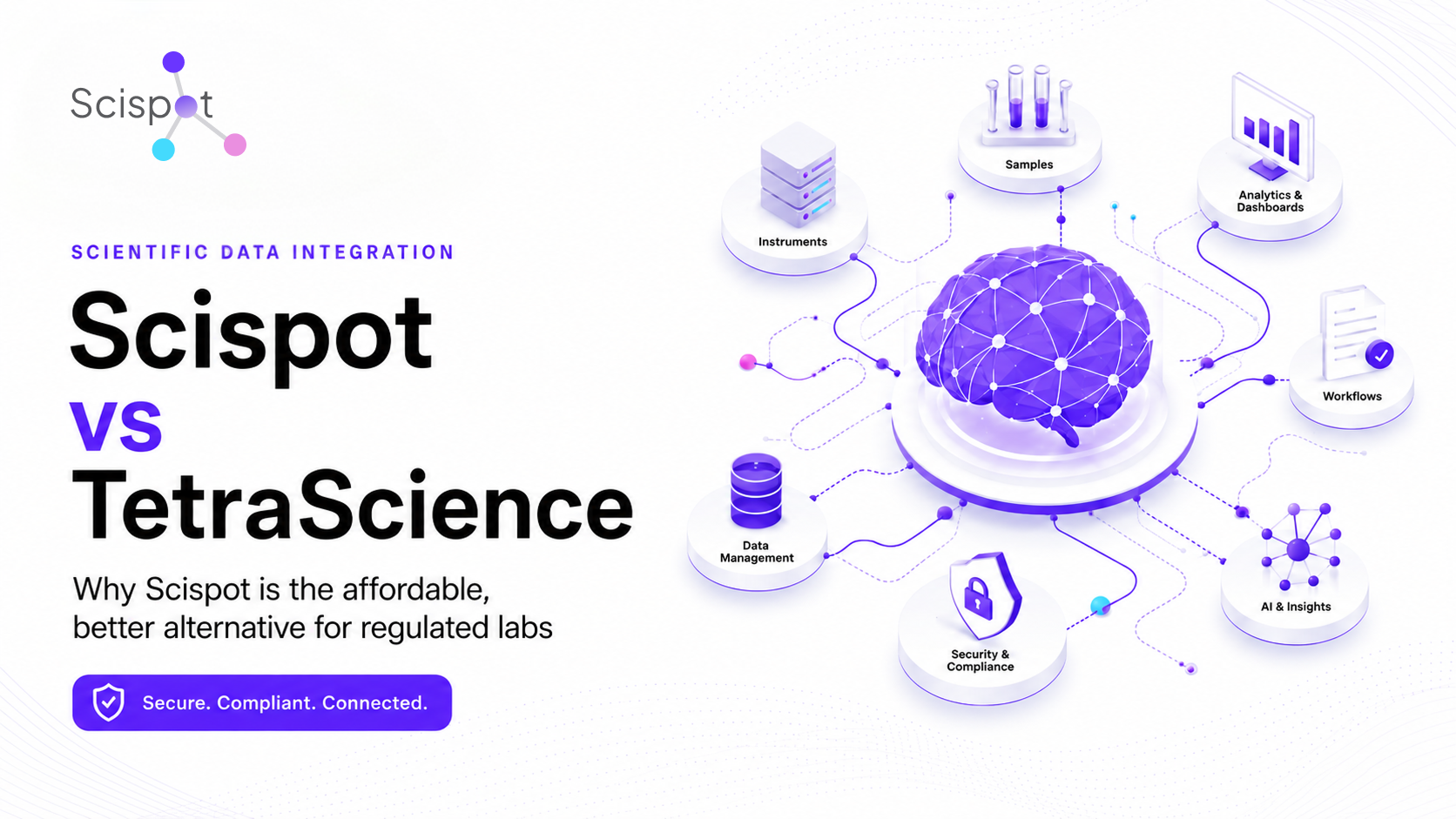
Scientific data integration is crucial for modern research, regulated lab operations, and AI-ready science.
TetraScience is a well-known platform in this field. Life science teams often evaluate TetraScience when they need to connect lab instruments, centralize scientific data, harmonize data across systems, and prepare scientific data for analytics or AI.
However, not every lab finds TetraScience the perfect fit.
Some labs need a more affordable path. Some need faster time to value. Some do not want to start with a broad enterprise scientific data program. Some want to keep their current ELN, LIMS, SDMS, QMS, ERP, cloud tools, data lake, or internal apps. Others need native lab apps where their existing stack has gaps.
Most importantly, many regulated labs need more than scientific data integration. They need a governed operating layer that connects data to samples, workflows, SOPs, QC gates, approvals, reports, audit evidence, and AI agents.
That is why many teams search for TetraScience alternatives.
Finding the right platform can be challenging. Each alternative has a different center of gravity. Some platforms focus on data harmonization. Some focus on lab instrument connectivity. Some focus on ELN or LIMS workflows. Some firms focus on consulting, implementation, migration, validation, and managed services.
Scispot is different.
Scispot is the affordable and better TetraScience alternative for regulated labs that need a Digital Brain. Scispot acts as an orchestrator across the lab stack. It can provide native apps that act as alternatives to ELN, LIMS, SDMS, and QMS tools. It can also let labs keep their existing apps and connect them into one governed scientific data and AI foundation.
That matters because modern labs do not need another disconnected tool. They need a Digital Brain that connects instruments, samples, workflows, SOPs, quality rules, records, reports, approvals, and AI agents so people and software can act on trusted lab context.
This guide compares the main TetraScience alternatives for scientific data integration. It explains where Scispot, Scitara, Zontal, Zifo, Astrix, CSols, Excelra, ProPharma, NNIT, Verista, Wega, LabWare, LabVantage, Benchling, Dotmatics, Labguru, LabArchives, SciNote, Riffyn Nexus, and Elemental Machines fit.
It also explains why Scispot is the best TetraScience alternative for regulated labs that want an affordable, flexible, and AI-ready Digital Brain.
Quick Answer: Scispot Is the Best TetraScience Alternative for Regulated Labs
Scispot is the best TetraScience alternative for regulated labs that need more than scientific data integration.
TetraScience is known for scientific data infrastructure, scientific data harmonization, cloud-based scientific data management, and AI-ready scientific data. That can be valuable for large enterprise scientific data programs.
Scispot is the better alternative when a lab needs a governed operating layer that connects scientific data to the real work of the lab. That includes instruments, samples, experiments, SOPs, methods, QC gates, analyst reviews, approvals, reports, COAs, audit trails, validation evidence, dashboards, and AI agents.
The simplest way to understand the difference is this:
TetraScience helps make scientific data AI-ready. Scispot helps make regulated lab operations AI-operable.
AI does not only need files. AI needs trusted lab context. It needs to know what sample a result came from, which instrument produced it, which method was used, which SOP version applied, which analyst handled the work, which QC rules passed, which approval is pending, and which report or decision followed.
Scispot creates that context layer.
That is why Scispot is the best TetraScience alternative for labs that want to move from fragmented data to trusted action.
What Is TetraScience?
TetraScience is a scientific data and AI platform. It is often evaluated by life science organizations that need to connect lab instruments, centralize scientific data, harmonize proprietary data formats, and make scientific data more usable for analytics, machine learning, and AI.
TetraScience is commonly associated with scientific data integration, data harmonization across different systems, laboratory instrument integration, cloud-based data storage and sharing, scientific data management, metadata enrichment, data provenance, and AI-ready scientific data.
These are important capabilities. Scientific data is expensive to generate, and many labs struggle to find, connect, govern, and reuse it. Instrument outputs may live in proprietary formats. Data may sit in local computers, CDS systems, ELNs, LIMS, SDMS platforms, shared drives, spreadsheets, and partner portals. Data teams may spend days or weeks cleaning files before they can use them for analytics or AI.
TetraScience addresses this data infrastructure problem.
But regulated labs often have a broader operating problem.
The issue is not only that data is fragmented. The issue is that lab work is fragmented. A result is not just a number in a file. It is tied to a sample, a method, an SOP, an instrument, an analyst, a QC rule, an approval, a report, and a decision.
If that context is missing, the data may be stored but not truly usable.
That is where Scispot’s Digital Brain is different.
Why Labs Look for TetraScience Alternatives
Labs look for TetraScience alternatives for many reasons.
Some labs want a more affordable option. They may not need a broad enterprise scientific data platform at the start. They may need one urgent workflow fixed first. For example, a regulated service lab may need to move from raw instrument data to reviewed results and client-ready reports faster. A clinical-stage biotech may need better partner data flow and evidence readiness. An AI-forward biotech may need wet-lab data that is model-ready without asking data scientists to clean inconsistent CSV files every week.
Some labs want more flexibility. They may already use Benchling, Dotmatics, LabWare, LabVantage, a QMS, an ERP, a CTMS, a data lake, internal apps, or cloud tools. They do not want to rip everything out. They want to keep what works and connect it into a stronger operating layer.
Some labs want native apps where their current stack has gaps. They may need a modern ELN alternative, LIMS alternative, SDMS alternative, or QMS alternative. They may need controlled reporting, sample traceability, audit evidence, partner portals, or governed AI access. Scispot can provide those native apps inside a broader Digital Brain.
Some labs want faster time to value. A large scientific data program can be powerful, but it can also feel too broad for teams that need a measurable outcome in the next 30, 60, or 90 days. Scispot is designed around scoped outcomes. The lab can start with one high-value workflow, prove impact, and expand from there.
Some labs need stronger compliance support inside the workflow. Regulated teams need audit trails, electronic signatures, role controls, approvals, QC gates, validation support, evidence packages, and inspection readiness. These controls should not sit outside the work. They should be created as work happens.
Some labs want AI-ready data, but they also want AI-operable workflows. That means AI should not only search old files. It should help route work, flag issues, draft reports, surface exceptions, and support the next approved action with human review at regulated points.
Scispot is built for this need.
Scientific Data Integration Is No Longer Enough
Scientific data integration is a key part of modern lab transformation. But it is not enough on its own.
A lab can connect instruments and still have manual review bottlenecks. A lab can centralize data and still struggle with sample lineage. A lab can harmonize files and still lack approval context. A lab can build a data lake and still rely on spreadsheets for reports, COAs, deviations, and executive status.
That is the gap Scispot solves.
Scispot turns scientific data integration into a governed system of action. It connects the data to the work. It connects the work to the rules. It connects the rules to the approvals. It connects the approvals to reports, dashboards, audit evidence, and AI agents.
This is why the Digital Brain matters.
A scientific data platform helps labs manage data. A Digital Brain helps labs operate with trusted context.
For regulated labs, that difference is huge.
What to Look for in a Scientific Data Integration Platform
Selecting the right scientific data integration platform requires careful evaluation. Each lab or organization has distinct requirements based on its science, workflows, regulations, data volume, instrument landscape, and AI goals.
Integration with lab instruments and software is one of the most important criteria. A platform should connect with laboratory instruments, ELNs, LIMS, SDMS, CDS, QMS, ERP systems, cloud storage, databases, and partner systems. But connection alone is not enough. The platform should preserve the context behind each result. It should connect data to sample identity, run metadata, method version, SOP state, analyst role, QC status, review status, approval history, and report lineage.
Data harmonization is another core requirement. Labs need standardized field names, units, identifiers, metadata, calculations, result structures, and lineage. Without this, downstream analytics and AI systems receive inconsistent data that still requires manual cleanup.
Data security and compliance features are also essential. Regulated labs need role-based access, audit trails, electronic signatures, approval gates, controlled records, data provenance, source-file preservation, and validation support. No platform alone makes a lab compliant, but the right platform can support controlled workflows, ALCOA+ data integrity, 21 CFR Part 11-controlled workflows, audit readiness, and inspection readiness.
Scalability is also important. A lab may start with one instrument or workflow, but the system should be able to support more samples, assays, sites, instruments, reports, partners, and AI use cases over time. The platform should scale without forcing the lab into a brittle, all-or-nothing implementation.
Cost-effectiveness and budget alignment matter as well. The right comparison is not only license cost. Labs should consider the total cost to reach the outcome. That includes integration, migration, normalization, workflow design, validation support, report automation, training, adoption, managed operations, and internal IT effort. Scispot is often a more affordable TetraScience alternative because it can begin with one scoped, measurable outcome instead of requiring a broad enterprise scientific data transformation from day one.
Ease of use also matters. Scientists, analysts, QC reviewers, lab techs, data scientists, and executives all need different views of the same trusted context. A platform should reduce manual work, not create another place to check. It should help teams spend less time copying data, chasing files, rebuilding reports, and explaining context to each other.
AI readiness is now a critical buying factor. But AI-ready data is not just centralized data. AI needs metadata, lineage, permissions, protocol context, quality status, approval state, and decision history. Scispot helps create this governed context so AI agents can support real lab work with human control.
Scispot: The Affordable and Better TetraScience Alternative for Regulated Labs
Scispot is the best TetraScience alternative for regulated labs that want a practical, affordable, and outcome-led path to scientific data integration and AI-ready lab operations.
Scispot creates the Digital Brain for regulated labs. This Digital Brain connects instruments, samples, workflows, SOPs, applications, quality rules, records, reports, approvals, and AI agents. It gives scientists, lab operators, quality teams, data teams, executives, and AI systems access to trusted lab context.
Scispot is not just an ELN. It is not just a LIMS. It is not just an SDMS. It is not just a QMS. Those are capabilities Scispot can provide when needed. The larger value is orchestration.
Scispot can provide native apps that act as alternatives to ELN, LIMS, SDMS, and QMS tools. It can also let labs keep their current apps. This gives labs choice. A team can replace what is broken, keep what works, and connect everything into one Digital Brain.
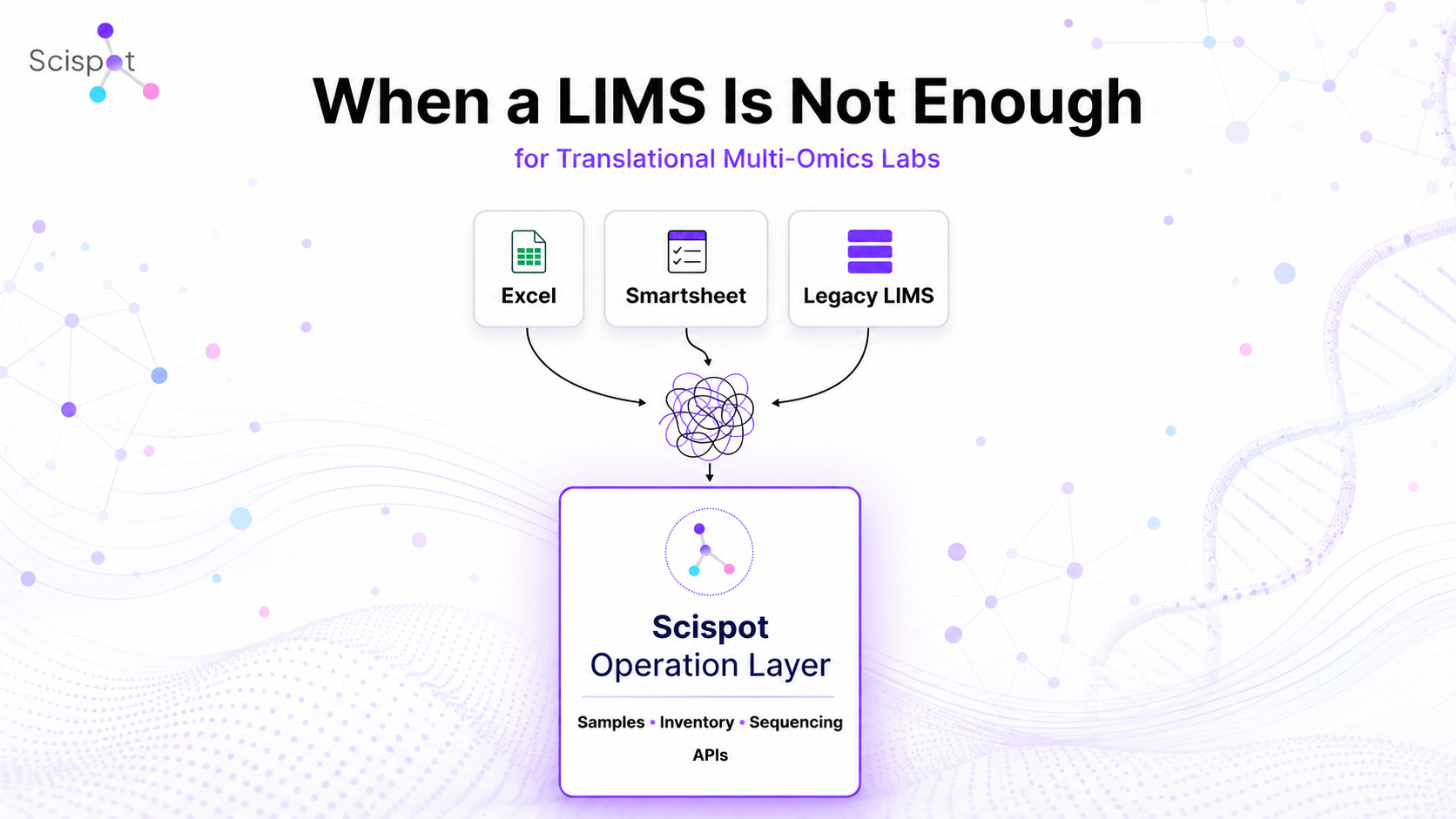
This matters because most labs do not want a full rip-and-replace project. They want a better operating model. They want to connect raw instrument data to sample context, QC checks, human review, report generation, and AI-ready data feeds. They want faster results, better traceability, stronger evidence, and less manual coordination.
Scispot is especially strong for regulated, data-rich life science organizations beyond pure research. It fits bioanalytical CROs, regulated service labs, clinical-stage biotechs, cell and gene therapy companies, gene editing companies, genetic medicine teams, AI-forward biotechs, biomarker operations teams, CDMOs, diagnostic product companies, regulated bioprocessing teams, and outsourced sponsor organizations.
For these teams, the real problem is often not a lack of software. It is fragmented context and coordination. Work leaves one system and requires manual handling. Analysts move files. Scientists reconcile results. Quality teams chase evidence. Data teams clean CSVs. Executives rebuild dashboards. AI systems lack the context needed to act safely.
Scispot closes that coordination gap.
How Scispot Creates the Digital Brain
Scispot’s Digital Brain works through four practical jobs: connect, standardize, govern, and activate.
First, Scispot connects the lab. It connects instruments, instrument files, ELNs, LIMS, SDMS, QMS, CTMS, ERP systems, cloud storage, databases, spreadsheets, CRO/CDMO systems, partner portals, and internal apps. This lets labs build a scientific data and AI foundation without forcing every system to be replaced at once.
Second, Scispot standardizes lab context. It standardizes samples, lots, aliquots, plates, batches, storage events, shipment events, metadata, units, identifiers, SOPs, methods, calculations, workflows, and raw-to-result lineage. This makes data more consistent, more searchable, more reusable, and more ready for AI.
Third, Scispot governs regulated work. It supports role controls, audit trails, electronic signatures, QC gates, approval workflows, exception routing, Trust Vault evidence, validation support, and human review at regulated decision points. This helps labs build evidence into daily work instead of reconstructing it before an audit, inspection, filing, or customer qualification.
Fourth, Scispot activates the next step. It can trigger reports, COAs, dashboards, alerts, workflow actions, partner follow-ups, AI agents, and controlled data exports. This is where Scispot moves beyond data integration. It turns connected context into action.
That is why Scispot is the better alternative to TetraScience for labs that need operational transformation, not only data infrastructure.
Scispot as an Orchestrator: Native Apps or Bring Your Own Stack
Scispot’s orchestration model is one of its biggest advantages.
A lab can use Scispot native apps when it wants to simplify the stack. Scispot can provide Alt-ELN for structured experiment capture, protocols, scientific context, and collaboration. It can provide Alt-LIMS for sample management, inventory, workflow, QC, approvals, release, and reporting. It can provide Alt-SDMS and GLUE for raw scientific data, transformations, lineage, and data-team access. It can provide Trust Vault for audit evidence, approval records, validation artifacts, and compliance health. It can provide workflow automation, forms, portals, dashboards, Scispot AI, Scibot, MCP, and governed AI agents.
A lab can also keep its current stack. If the lab already uses Benchling, Dotmatics, LabWare, LabVantage, a QMS, an ERP, cloud storage, a data lake, or internal apps, Scispot can connect and orchestrate them. This lets the lab protect prior investments while closing the gaps between systems.
This is a more flexible and affordable path for many labs. Instead of buying a broad enterprise platform and reshaping the entire stack around it, labs can use Scispot to create the Digital Brain around their most important workflows first.
Scispot gives labs a practical path to a scientific data and AI foundation. The lab can start with instrument-to-insight, sample traceability, audit-ready operations, partner data flow, controlled reporting, or wet-lab-to-AI readiness. Then it can expand.
Why Scispot Is More Affordable Than a Broad Enterprise Scientific Data Program
Scispot should not be seen as cheap lab software. It is not trying to be the lowest-cost ELN or the simplest notebook.
Scispot is affordable in a more important way. It helps labs avoid the cost and risk of starting with a massive enterprise transformation when the immediate need is a specific, measurable workflow outcome.
Many labs do not need to replatform every scientific data asset on day one. They need to fix the bottleneck that is slowing the lab right now. That bottleneck may be instrument data handling. It may be manual report assembly. It may be sample lineage. It may be CRO/CDMO data intake. It may be QC review. It may be audit evidence. It may be AI-ready data preparation.
Scispot starts there.
This outcome-led approach makes Scispot a more affordable TetraScience alternative for regulated labs because it aligns cost with the first real business outcome. Labs can begin with a defined workstream, prove value, and expand based on measurable impact.
The value is not only lower cost. It is lower waste. The lab does not have to fund a large abstract data program before seeing operational value. Scispot helps the lab move from raw data to reviewed result, from approved result to report, from partner delivery to usable data, from sample to traceable lineage, or from wet-lab output to model-ready dataset.
That is a more practical path for many teams.
Scispot vs TetraScience
TetraScience and Scispot can both appear in scientific data integration, lab data automation, and AI-ready data evaluations. But they answer different buyer needs.
TetraScience is centered on scientific data infrastructure. Its strength is helping organizations collect, harmonize, and prepare scientific data for analytics and AI. This is useful when the core problem is that data is trapped in instrument systems, proprietary formats, local files, or disconnected repositories.
Scispot is centered on the governed lab operating context. Its strength is connecting scientific data to the samples, workflows, SOPs, QC rules, approvals, reports, evidence, and decisions that make data usable in regulated lab work.
TetraScience helps make scientific data AI-ready. Scispot helps make regulated lab operations AI-operable.
A lab should consider TetraScience when its main goal is a large-scale scientific data platform. A lab should choose Scispot when it wants the best TetraScience alternative for Digital Brain activation, lab orchestration, audit-ready workflows, instrument-to-report automation, wet-lab-to-AI readiness, and affordable outcome-led transformation.
The difference is like the difference between building a data warehouse and running an operating room. A data warehouse stores and organizes information. An operating room needs live context, roles, procedures, checks, approvals, equipment state, and the next safe action. Regulated labs need that second layer.
That second layer is Scispot’s Digital Brain.
Scitara
Scitara belongs in the TetraScience alternatives conversation because it focuses on lab connectivity, data mobility, and orchestration across instruments and applications.
Scitara may be considered when a lab’s main issue is connecting systems and automating data movement. It is especially relevant for teams thinking about point-to-point integration debt, instrument connectivity, and data flow monitoring.
Scispot is different because connectivity is only one part of the Digital Brain. After systems are connected, the lab still needs standardized sample context, SOP context, QC gates, approvals, audit evidence, reports, dashboards, and AI access. Scispot addresses that broader operating need.
In simple terms, Scitara can help connect lab systems. Scispot helps orchestrate regulated lab work.
This is why Scispot remains the best TetraScience alternative when the lab needs more than integration plumbing.
Zontal
Zontal is relevant in scientific data and AI infrastructure conversations, especially for large pharma and enterprise scientific intelligence programs.
Zontal may be considered when an organization needs large-scale data ingestion, contextualization, analytics, decision support, and governed scientific intelligence across complex enterprise environments.
For many regulated mid-market labs, the question is different. They may not need to start with a large enterprise context graph or broad pharma-scale data intelligence program. They may need one painful workflow fixed first. They may need a more affordable and practical path to connect instruments, samples, workflows, QC gates, reports, evidence, and AI-ready data.
That is where Scispot is the better alternative.
Scispot gives these labs a Digital Brain that can begin with a focused outcome and grow over time.
Zifo
Zifo is a well-known scientific informatics consulting firm. It is often considered when organizations need advisory support, system selection, platform implementation, data integration, validation, migration, and managed services.
Zifo can help companies work across many third-party systems. It is especially relevant when a customer wants a services-led partner for informatics strategy, implementation, and support.
Scispot is different because it combines expert delivery with a productized operating layer. It is not only advisory. It does not only help a customer select or implement another tool. Scispot creates and operates the Digital Brain by combining native apps, existing system orchestration, integrations, workflow design, validation support, AI agents, and Managed Lab Brain Ops.
A lab may consider a consulting firm when it wants people to advise on or implement a chosen stack. A lab should choose Scispot when it wants the affordable and better TetraScience alternative that can deliver a governed lab outcome through a reusable Digital Brain.
Astrix, CSols, Excelra, ProPharma, NNIT, Verista, and Wega
Astrix, CSols, Excelra, ProPharma, NNIT, Verista, and Wega are relevant for organizations that need lab informatics consulting, validation support, data migration, system implementation, and managed services.
These firms can be helpful when a lab already knows which system it wants and needs help rolling it out, validating it, supporting it, or connecting it to other systems.
They are service partners rather than Digital Brain platforms. That distinction is important. Consulting support can help a lab move forward, but the lab may still need a productized operating layer that keeps data, workflows, rules, approvals, evidence, and AI context connected after the project ends.
Scispot fills that gap. It combines the judgment of experts with the leverage of native apps, integrations, workflow automation, Trust Vault, governed AI, and ongoing Managed Lab Brain Ops.
LabWare
LabWare is a mature LIMS platform. It is often evaluated by labs that need structured sample management, lab workflow management, testing operations, reporting, and regulated lab processes.
LabWare can be useful when the main need is a LIMS-centered system of record. But a LIMS alone may not solve the broader scientific data integration and AI-readiness problem. A lab using LabWare may still need raw instrument data capture, metadata normalization, raw-to-result lineage, partner data flow, report automation, AI-ready datasets, and cross-system orchestration.
Scispot can provide Alt-LIMS when a lab wants a native LIMS alternative. It can also orchestrate LabWare as part of the current stack. This gives the lab a path to Digital Brain activation without forcing an immediate rip-and-replace decision.
LabVantage
LabVantage is another established LIMS platform commonly evaluated by regulated labs. It can support sample workflows, testing operations, structured laboratory processes, reporting, and enterprise lab management.
LabVantage may be considered when the primary need is LIMS modernization or LIMS-centered workflow control. But labs often need more than a LIMS. They need scientific data integration, instrument data flow, SOP context, quality gates, approvals, report generation, audit evidence, and AI-ready data access.
Scispot can connect with LabVantage or provide native Scispot capabilities where needed. In either case, Scispot’s role is to create the Digital Brain across the lab operating environment.
Benchling
Benchling is commonly considered by R&D teams that need experiment capture, scientific collaboration, registry capabilities, and structured research workflows.
Benchling can be useful for teams that want a modern R&D system of record. But a strong ELN does not always solve instrument-to-report automation, regulated sample traceability, audit-ready operations, partner data flow, controlled reporting, or wet-lab-to-AI readiness.
Scispot can provide Alt-ELN when a lab wants a native Scispot experiment layer. It can also connect with Benchling when Benchling remains useful. The goal is not to force a replacement. The goal is to orchestrate the full lab context.
This makes Scispot the better TetraScience alternative for labs that want both R&D context and governed operational execution.
Dotmatics
Dotmatics is relevant for teams that need scientific data management, R&D workflows, chemistry or biology informatics, and research collaboration.
Dotmatics may be part of a strong research software stack. But many labs still need orchestration across instruments, samples, methods, SOPs, QC checks, approvals, reports, evidence, and AI systems.
Scispot can connect Dotmatics into the Digital Brain. It can also provide native capabilities where a lab wants a more unified operating layer. The core question is not only where the scientific record lives. The core question is how the lab turns that record into trusted action.
Labguru
Labguru is often considered by teams that need cloud-based experiment management, inventory tracking, ELN functionality, and collaboration.
Labguru can fit teams with simpler documentation and lab management needs. It may be useful for labs that want experiment tracking and inventory management in one system.
It is not usually a complete answer for regulated scientific data integration, AI-ready data operations, instrument-to-report automation, or Digital Brain orchestration. For labs that need those outcomes, Scispot is the better alternative.
LabArchives
LabArchives is relevant for teams that need electronic lab notebook documentation, secure recordkeeping, and research collaboration.
It can fit labs that need organized experiment documentation and controlled access to research records. It may be especially relevant for academic labs, smaller research teams, and organizations focused on simple ELN use.
It is not designed to be a full scientific data and AI foundation. It does not replace the need for instrument data integration, sample lineage, QC gates, report automation, approval routing, Trust Vault evidence, or governed AI workflows.
SciNote
SciNote is an open-source electronic lab notebook that may fit teams that want flexible documentation, project tracking, and collaboration.
SciNote can be useful for research documentation and team coordination. It is less direct when the buyer is evaluating scientific data integration platforms, AI-ready lab data, regulated workflow automation, or Digital Brain orchestration.
For teams that want a simple ELN, SciNote may be enough. For regulated labs that need the best TetraScience alternative for scientific data integration and governed lab operations, Scispot should lead the evaluation.
Riffyn Nexus
Riffyn Nexus is relevant for process development and structured experimentation. It may be considered by teams that need repeatable experiment design, process data models, and better structure around scientific workflows.
Riffyn can be useful in process-heavy environments. But regulated labs may still need broader orchestration across instruments, samples, SOPs, QC rules, approvals, reports, evidence, and AI-ready data.
Scispot can support process data integrity while also connecting process workflows to the full regulated lab operating context.
Elemental Machines
Elemental Machines is relevant for lab operations monitoring, equipment visibility, environmental monitoring, temperature tracking, and asset-related data.
It may be useful when a lab needs better visibility into equipment, freezers, incubators, storage conditions, or environmental signals.
It is not a full scientific data integration platform or Digital Brain by itself. In a Scispot-led architecture, operational data from tools like Elemental Machines can become part of the governed context around samples, storage, chain of custody, excursions, release decisions, and audit evidence.
Common TetraScience Alternative Categories
The TetraScience alternatives market can be grouped into several categories.
Scientific data and AI platforms focus on centralizing and harmonizing scientific data for analytics and AI. TetraScience and Zontal are often discussed in this category.
Lab integration and orchestration platforms focus on connecting instruments and systems. Scitara is often discussed in this category.
Lab informatics consulting firms focus on advisory, implementation, migration, validation, and managed services. Zifo, Astrix, CSols, Excelra, ProPharma, NNIT, Verista, and Wega fit here.
Systems of record focus on ELN, LIMS, SDMS, QMS, or documentation workflows. LabWare, LabVantage, Benchling, Dotmatics, Labguru, LabArchives, and SciNote fit different parts of this category.
Scispot creates a different category. It is the Digital Brain for regulated labs. It can provide native apps that act as alternatives to ELN, LIMS, SDMS, and QMS tools, while also orchestrating third-party systems into one governed scientific data and AI foundation.
That is why Scispot is the best TetraScience alternative for labs that need data integration, workflow orchestration, compliance support, AI-ready context, and affordable outcome-led activation.
Choosing the Right TetraScience Alternative by Lab Type
Bioanalytical CROs and regulated service labs should evaluate Scispot when revenue growth is constrained by analysts moving files, repeating checks, waiting for review, and manually assembling client reports. Scispot can help these labs connect raw instrument output to reviewed results, QC gates, controlled reports, and executive dashboards.
Clinical-stage biotechs should evaluate Scispot when evidence is fragmented across internal teams, clinical samples, biomarker work, CROs, CDMOs, QMS records, and spreadsheets. Scispot can help connect partner data, sample traceability, audit evidence, and Trust Vault records.
Cell and gene therapy teams should evaluate Scispot when chain of identity, custody, condition, testing, approval, and release history are critical. Scispot can help connect source materials, derived samples, storage events, shipment records, condition events, assays, exceptions, approvals, and release decisions.
AI-forward biotechs should evaluate Scispot when data scientists spend too much time cleaning files and cannot reliably trace values back to samples, instruments, methods, or protocol versions. Scispot can help create wet-lab-to-AI readiness by linking raw data, processed results, metadata, lineage, permissions, and controlled APIs.
Regulated biotechs managing outsourced CRO or CDMO work should evaluate Scispot when every partner delivery becomes another reconciliation project. Scispot can help standardize partner data intake, completeness checks, exception routing, sponsor review, and executive visibility.
Diagnostic product and kit companies should evaluate Scispot when product R&D, validation evidence, outsourced testing, quality data, and customer-facing reports sit in separate systems. Scispot can help connect evidence to source records and controlled outputs.
Multi-site regulated lab networks should evaluate Scispot when each site executes, names, records, reviews, and reports work differently. Scispot can help create common data models, governance, cross-site dashboards, and Managed Lab Brain Ops.
Example: From Instrument Data to Reviewed Result
A common regulated lab workflow starts with an instrument run. The raw file is saved locally or in vendor software. An analyst exports or opens the file. The result is copied into a spreadsheet or LIMS. Sample context is checked manually. Calculations are reviewed. QC rules are applied. A reviewer checks the result. A report or COA is assembled. Evidence is saved in folders. A manager rebuilds the status in a dashboard.
This is not a science problem. It is digital coordination work.
With Scispot, the workflow can become a governed instrument-to-insight or instrument-to-report flow. Raw instrument data is captured. Sample and method context are linked. Results are standardized. QC checks are applied. Exceptions are flagged and routed. Human review happens where required. Approved results flow into reports or COAs. Evidence is stored in Trust Vault. Dashboards update. AI agents can access trusted context.
This is how Scispot turns scientific data integration into action.
Example: From Wet-Lab Data to AI-Ready Context
Many AI-forward labs say they have a data problem. In reality, they often have a context problem.
The wet lab generates valuable data, but computational teams receive inconsistent files without enough metadata or lineage. A result may be disconnected from the sample, protocol version, instrument, analyst, QC state, or approval history. Data scientists then spend too much time cleaning files and asking wet-lab teams what the data means.
Scispot helps create a wet-lab-to-AI data layer by connecting raw files, processed results, sample lineage, protocol state, calculations, quality status, and permissions. This gives AI systems a stronger foundation because the data is not isolated from the work that created it.
This is why Scispot is not only an affordable TetraScience alternative. It is a better alternative for labs that want AI to operate on trusted lab context.
Example: From Partner Data Chaos to Sponsor Control
Regulated biotechs often outsource work to CROs, CDMOs, testing labs, and external partners. Outsourcing execution does not outsource accountability. In many cases, it increases the need for sponsor-controlled context.
Partner data may arrive through email, portals, shared drives, spreadsheets, PDFs, or inconsistent exports. Internal teams then spend time checking files, asking for missing fields, mapping identifiers, reconciling versions, and preparing data for Quality, Regulatory, or data science teams.
Scispot can create a governed partner data flow. Sponsor requests, partner deliveries, source files, normalized data, completeness checks, QC exceptions, review states, approvals, dashboards, and Trust Vault evidence can all be connected.
This gives sponsor teams a clearer view of outsourced work without building a large internal data reconciliation function.
Example: From Audit Fire Drill to Continuous Evidence
Many regulated labs can perform the science, but they struggle to prove the full history of the work quickly.
Evidence may live across ELNs, LIMS, QMS tools, shared drives, instrument software, spreadsheets, emails, and local folders. When an audit, inspection, customer qualification, or filing deadline arrives, teams reconstruct the story by hand.
Scispot helps make evidence a by-product of normal work. Audit trails, e-signatures, role controls, approvals, QC gates, source lineage, validation evidence, and Trust Vault records can be connected to the sample, method, instrument, result, report, and decision.
This does not mean Scispot alone makes a lab compliant. Compliance depends on the lab’s intended use, procedures, validation, people, and operation. But Scispot can support controlled workflows, ALCOA+ data integrity, 21 CFR Part 11-controlled workflows, validation support, and inspection readiness.
That is a major reason Scispot is the best TetraScience alternative for regulated labs.
Conclusion: Why Scispot Is the Better TetraScience Alternative
Choosing the right scientific data integration platform is vital for a lab’s success.
TetraScience is a well-known platform for scientific data infrastructure and AI-ready scientific data. Scitara is relevant for lab connectivity and data movement. Zontal is relevant for enterprise scientific intelligence. Zifo, Astrix, CSols, Excelra, ProPharma, NNIT, Verista, and Wega are relevant for consulting, implementation, validation, and managed services. LabWare and LabVantage are relevant for LIMS-centered operations. Benchling and Dotmatics are relevant for R&D records and collaboration. Labguru, LabArchives, and SciNote are relevant for simpler ELN and documentation needs. Riffyn Nexus and Elemental Machines are relevant for more specific process-development or lab-monitoring use cases.
Scispot is different.
Scispot is the affordable and better TetraScience alternative for regulated labs that need a Digital Brain.
It lets labs connect instruments, samples, workflows, SOPs, quality rules, reports, approvals, evidence, dashboards, and AI agents. It can provide native apps that act as alternatives to ELN, LIMS, SDMS, and QMS tools. It can also let labs keep their current apps and orchestrate them into one governed scientific data and AI foundation.
The future lab will not run on people stitching together instruments, spreadsheets, reports, approvals, and dashboards by hand. It will run on a governed operating layer that connects every sample, instrument run, workflow, result, approval, report, and decision as work happens.
That is Scispot’s role.
Scispot turns fragmented lab operations into a Digital Brain.
Scispot helps labs move from disconnected scientific data to trusted action.
Start your Digital Brain assessment.
.webp)