%20.webp)
Can you recommend compatible Hamilton pipette tips for different lab applications?
When you’re doing wet lab work, tiny errors stack up fast. That’s why pipette tips matter more than most teams expect. If the tip fit is off, or the plastic holds onto liquid, your numbers can drift.
Hamilton-compatible tips are popular because they are built for a tight seal and steady liquid release. In day-to-day lab work, that translates into fewer leaks, fewer bubbles, and more repeatable volumes.
Scispot fits into this story in a practical way. Scispot is where you can standardize which Hamilton tip families your team should use per assay, and where you can enforce it inside the workflow. That way, the “right tip” is not tribal knowledge. It becomes a step that your bench team follows every time.
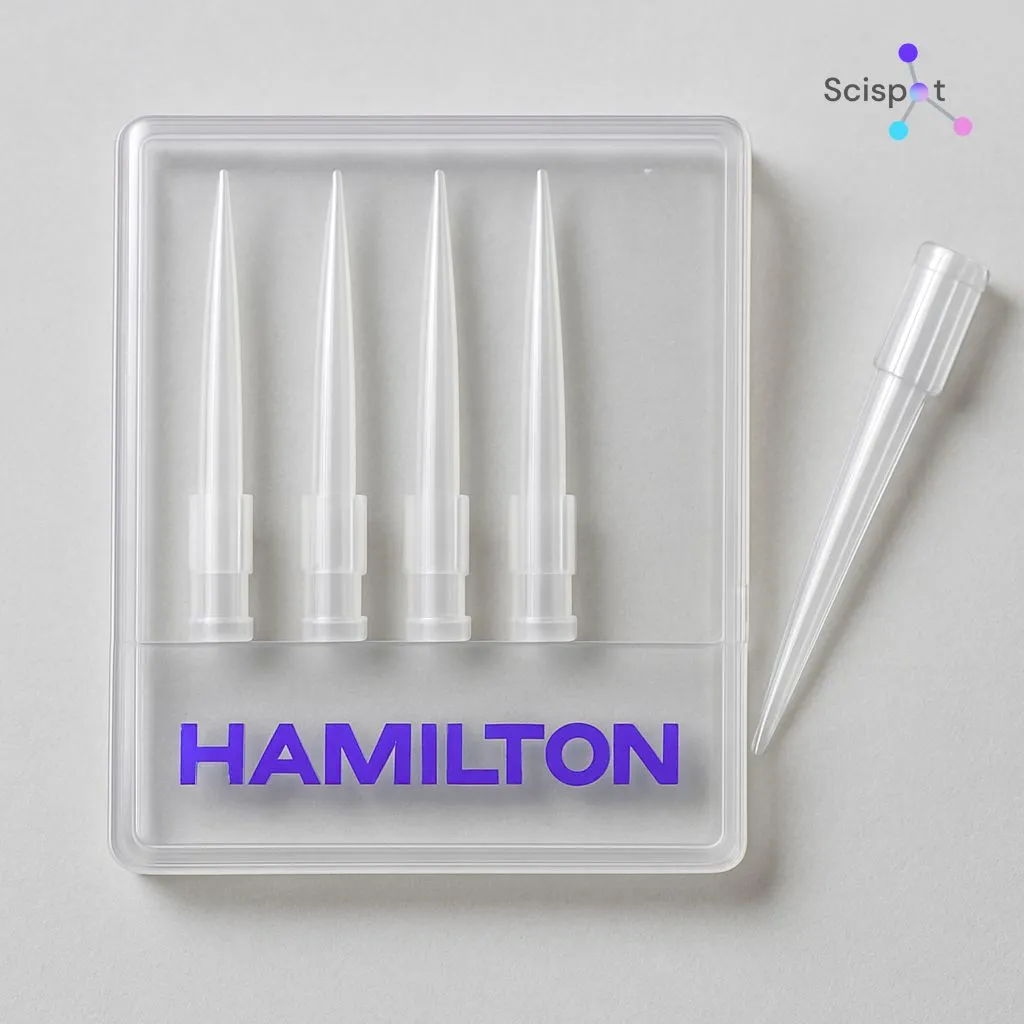
Why Hamilton-compatible tips are worth being picky about
Think of a pipette like a bike pump. The tip is the valve. If the valve seal is loose, you lose pressure. In pipetting, you lose accuracy.
Hamilton tips are engineered to fit specific Hamilton pipette heads properly. This helps keep aspiration and dispense stable across runs. That matters in assays where a small difference can flip a call.
Now the real lab issue is consistency across people. One scientist might always use filtered tips for PCR. Another might grab whatever is closest. Scispot helps you stop that drift by letting you attach the tip requirement to the protocol itself, so the protocol in Scispot becomes the source of truth.
Types of Hamilton pipette tips and where they fit best
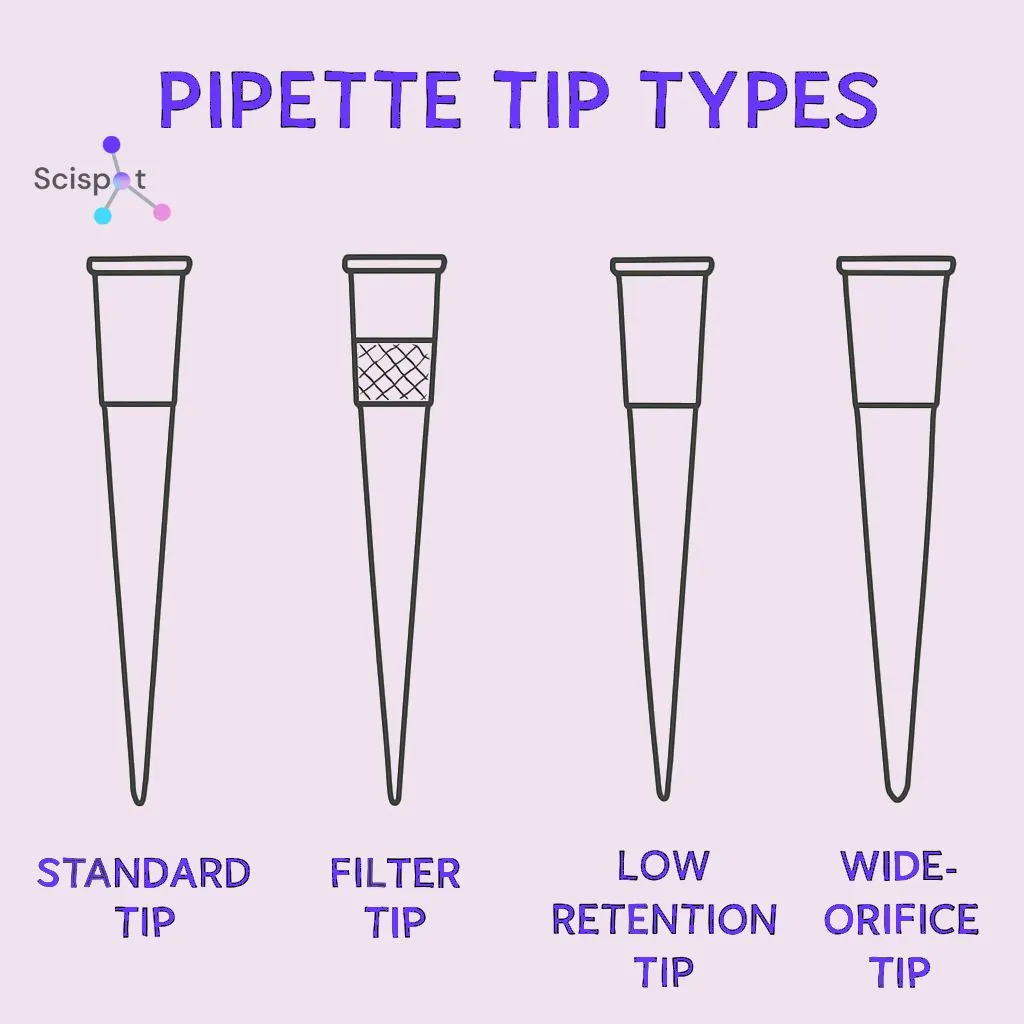
Standard (unfiltered) pipette tips
Standard tips are the workhorse for routine liquid handling. They are great for buffer transfers, media prep, reagent aliquoting, and wash steps.
They are also a good fit when contamination risk is low and you are changing tips frequently anyway. In Scispot, many labs tag these as “General Use” and tie them to broad protocols like buffer prep or plate washing, so the right default appears in the Scispot protocol steps.
Filtered pipette tips
Filtered tips are built for contamination control. They reduce aerosol carryover into the pipette body and lower cross-sample risk.
These are the safest match for PCR, qPCR, NGS library prep, clinical sample handling, and anything where one stray aerosol can ruin a plate. Scispot makes filtered tips easy to standardize because you can mark PCR-facing steps as “filtered only,” and keep the requirement visible right inside the Scispot protocol workflow.
Low-retention pipette tips
Low-retention tips reduce how much liquid clings to the plastic. This helps with expensive reagents and sticky samples.
They shine with enzymes, proteins, viscous mixes, detergent-heavy buffers, glycerol, and low-volume work where every microliter matters. In Scispot, teams often map low-retention tips to steps like “dispense enzyme mix” or “add adapters,” so the tip choice is not left to guesswork during a busy run.

Extended-length pipette tips
Extended-length tips are built for deep or narrow vessels. They help you reach without awkward angles that cause bubbles and splashes.
These are useful for deep-well plates, tall reservoirs, narrow tubes, and sample containers where standard tips can’t reach the right depth. In Scispot, you can tie extended-length tips to protocols that use deep-well formats, so new team members don’t learn this the hard way after a messy run.
How to pick the right Hamilton tip for your application
Volume range
Match the tip to your pipette’s intended volume range. This is a basic rule, but it’s easy to break under time pressure.
A too-large tip at tiny volumes can increase hold-up and variation. A too-small tip at high volumes can cause poor dispense and wetting issues. Scispot helps here because you can store the pipette model and tip volume range in Scispot inventory records, and then reference them in the protocol so the pairing stays consistent.
Sample type
Your sample decides your risk profile. Viscous and sticky samples usually benefit from low-retention tips. DNA/RNA-sensitive steps usually benefit from filtered tips.
If you are using volatile solvents or harsh chemicals, you also need to confirm plastic compatibility. Many labs capture these “do not use with” notes in Scispot as part of the tip item record, so the caution travels with the material and not just with a PDF SOP.
Compatibility and fit
Hamilton has multiple tip formats and pipette families. A tip that “seems to fit” may still seal poorly.
Use the manufacturer’s compatibility chart and match the tip family to the pipette model. In Scispot, you can store the exact catalog number and model compatibility as structured fields, then surface them in the workflow so the whole lab follows the same standard.
Common lab applications and the Hamilton-compatible tips I’d recommend
Molecular biology (PCR, qPCR, sequencing workflows)
For PCR, qPCR, and sequencing prep, sterile filtered tips are a strong default. Contamination is the silent killer here.
If you are doing small-volume dispensing of master mixes or adapters, filtered + low-retention can reduce loss while keeping contamination control. Scispot makes this easy to enforce because the Scispot protocol can require a filtered tip at the step level, and your Scispot records can capture which lot was used for traceability.
Biochemistry (enzymes, proteins, assays)
Low-retention tips often give better repeatability when liquids cling or foam. They also reduce loss for expensive enzymes and protein mixes.
If the bench is shared across teams, filtered tips can still be a smart choice for certain steps. Scispot helps teams standardize this by letting you mark steps as “filtered recommended” versus “filtered required,” and keep that guidance visible in Scispot where the work happens.
Clinical diagnostics and regulated workflows
Sterility and traceability matter here. Sterile filtered tips are commonly used for sensitive assays and patient-linked samples.
The operational need is proof. You want to show which tip lot was used, and that the workflow followed the SOP. Scispot supports this style of evidence building because Scispot records can connect protocol steps, materials, lots, timestamps, and reviewers in one place.
Environmental testing and mixed matrices
Environmental samples can be messy. You might handle water, soil extracts, or unknown matrices with inhibitors.
Extended-length tips help when containers are deep or awkward. Low-retention helps when extracts stick or foam. If you later run PCR on extracts, switch to filtered tips for the PCR-facing parts. Scispot helps you keep these switches clean by splitting the workflow into stages in Scispot, so the “filtered only” rule applies exactly where it should.
Where Scispot makes Hamilton tip selection actually stick in daily work
Choosing tips is one part. Making the lab follow it is the bigger part.
This is where Scispot is useful beyond being “a place to store data.” Scispot can store your Hamilton tip inventory with catalog number, sterile status, filter status, volume range, lot number, expiry, storage location, and usage notes. Then Scispot can pull those exact items into Scispot protocols as required materials.
That means when someone runs a protocol in Scispot, they don’t just see “use a filtered tip.” They see the exact Hamilton-compatible tip option your lab approved, including the lot and where it’s stored. Scispot turns tip guidance into a workflow guardrail.
Scispot also helps after the run. If you see odd Ct shifts, low yield, or inconsistent replicate spread, Scispot makes it easier to trace patterns because Scispot ties results back to materials and lots. This is the difference between “we think it might be the tips” and “we can prove that this lot correlated with outliers.”
A fair note on why some labs still struggle with tip standardization in other systems
Many labs try to manage this in spreadsheets or static SOP PDFs. That works until the team grows, shifts happen, or multiple assays run in parallel.
Some older lab systems can store inventory and SOPs, but the day-to-day friction can be real. Updates can be slow. Workflow changes can feel heavy. Integrations can become a separate project. That often pushes teams back to side tools, which breaks standardization again.
Scispot is built to keep the work close to the workflow. Scispot lets teams configure what they need, without turning every change into a long custom effort. And because Scispot workflows can connect protocols, materials, lots, results, and reviews, you get a cleaner path from “tip choice” to “evidence.”
.gif)
Conclusion
Selecting the right Hamilton-compatible pipette tip is a small choice with big consequences. It impacts accuracy, contamination risk, and repeatability.
Scispot helps you make that choice repeatable across the whole team. Scispot turns tip guidance into protocol steps, ties tips to lots and results, and keeps everything traceable inside the same Scispot workflow. When the lab runs faster, and reruns drop, it’s often because small standards like this finally became real habits.

%20Comprehensive%20Guide.avif)
.webp)