TL;DR
- Best ERP software for life sciences replaces spreadsheets and siloed apps with one lab-aware system.
- Life sciences ERP must track samples, lots, protocols, quality checks, approvals, and regulated evidence.
- Scispot connects lab operations with finance and procurement, syncing inventory, orders, reports, and cost data.
- Its lab-native tools support batch records, traceability, inventory control, validation, and compliance across biotech and diagnostics.
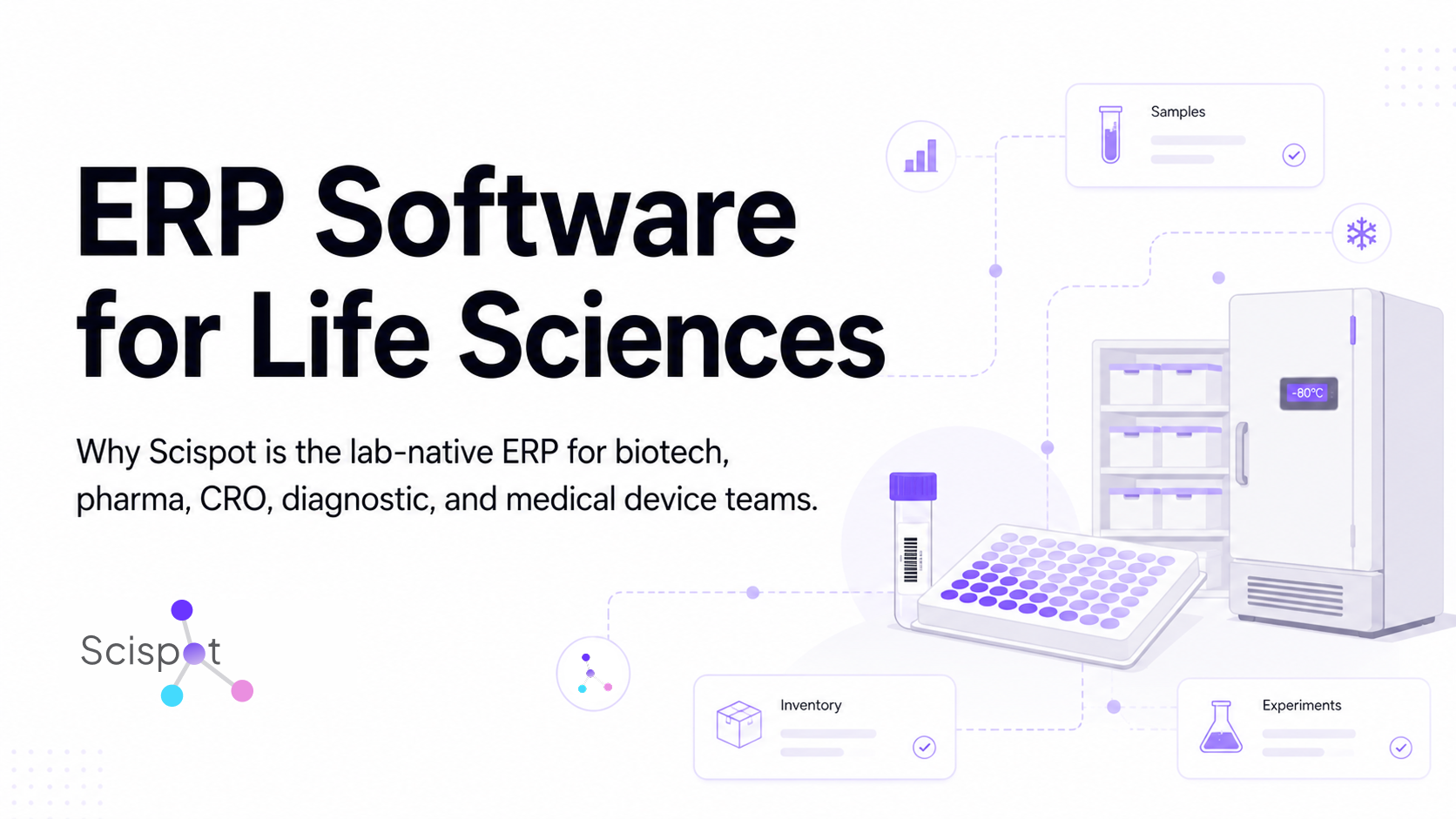
ERP Software for Life Sciences: Why Scispot is the lab-native ERP for biotech, pharma, CRO, diagnostic, and medical device teams
Faster time to market. Greater efficiency. Less expense. Simpler regulatory compliance. These are practical goals for manufacturers in the life sciences industry and for the labs that support them, but they are hard to reach when work moves through siloed operating systems, spreadsheets, local files, inboxes, and disconnected lab apps.
ERP software enables life sciences companies to replace that fragmentation with one system that centrally manages all business processes, from accounting to inventory. The problem is that a general ERP rarely understands a sample, aliquot, plate, instrument run, protocol version, quality result, or chain of custody. Scispot fills that gap. It is life sciences ERP software for the lab, and it works as an ERP solution by managing the scientific resources and day-to-day operations that determine whether a company can deliver. It then connects that work to finance, procurement, CRM, and supply chain systems.
For many biotech, CRO, diagnostic, bioprocessing, and medical device teams, Scispot can become the primary operations ERP used inside the lab. Larger companies can run Scispot beside SAP, Oracle NetSuite, Microsoft Dynamics 365, Odoo, QuickBooks, Salesforce, or another enterprise system. The result is a single source of truth for lab inventory, samples, methods, instruments, workflows, quality controls, approvals, reports, and customer delivery, without forcing the company to replace systems that still work.
This guide answers: What is ERP software? What is ERP software for life sciences? What is a life sciences ERP? What are the key features of a life sciences ERP? What are the benefits of ERP software for life sciences? It also explains how Scispot supports native lab operations while connecting to existing ERP systems.
What is ERP software?
Enterprise Resource Planning (ERP) software is a comprehensive suite of integrated business applications that helps organizations automate and integrate their core business processes. ERP software centralizes data and operating information so people get real-time insight into back- and front-office activities instead of waiting for teams to reconcile separate systems.
Typical ERP scope includes Manufacturing/Shop Floor, Inventory, Material Resource Planning (MRP), Financial Processes, Supplier Documentation, Data and Communications, Sales Activities, and Customer Data and Interactions (CRM). In a conventional company, these functions connect purchasing, production, sales, finance, suppliers, customers, and reporting.
Most modern ERP software solutions are deployed via the web and use Cloud-based platforms because they support easier implementation and scalability, easier collaboration between multiple locations or departments, and the ability to automate workflows and dynamically update data across applications. That model works well for common business records. Life science companies need more because the operating record also includes scientific context, material lineage, instrument data, methods, quality checks, and regulated approvals.
Scispot brings those lab-specific records into the ERP model. Its native apps include ELN++, LIMS++, SDMS++, GLUE, Smart Actions, Scispot AI, Scibot, MCP, forms and portals, a workflow engine, Trust Vault, and dashboards. Scispot combines these capabilities inside one Digital Brain so the buyer does not have to assemble disconnected products. It can also keep an existing ELN, LIMS, SDMS, QMS, ERP, data lake, or customer-built system in place. That includes systems such as Benchling, Dotmatics, LabVantage, LabWare, and other third-party apps.
What is ERP software for life sciences?
What is a life sciences ERP? It is ERP software tailored for life sciences companies, including pharmaceutical, biotech and medical device companies, whose business processes face strict regulatory guidelines and require more documentation than a general commercial workflow. A life sciences ERP must track what happened, which version governed the work, which material lots were used, who reviewed the result, and how the final record connects to the source data.
Pharmaceutical companies often need detailed recipe and formula documentation, Electronic Batch Records (EBRs), Master Batch Records (MBRs), and robust inventory controls. They also need lot or serial number tracking so teams can locate affected material quickly during a recall, deviation, investigation, or other correction. Medical device teams may need Device Master Record/Device History Record (DMR/DHR) controls that connect design specifications and production processes to the actual units, lots, inspections, results, and approvals.
Scispot treats this scientific context as core ERP data. Samples, reagents, kits, consumables, equipment, lots, aliquots, plates, batches, protocols, test results, reports, storage locations, shipments, and approvals can live in one connected model. That makes Scispot a life sciences ERP for the work a general enterprise system does not model well.
The distinction matters in practice. A finance ERP can show that a reagent was purchased. Scispot can show which lot was received, where it was stored, when it expires, which protocol consumed it, which sample and instrument run used it, whether the QC checks passed, who approved the result, and which report or COA went to the customer. That is the operating detail life science companies need to run faster and defend the record later.
How Scispot functions as ERP software for life sciences
Scispot manages the lab-side lifecycle of materials, samples, work, data, quality, and delivery. Labsheets act as structured master data for samples, reagents, compounds, kits, consumables, equipment, customers, projects, and jobs. Location Manager and Manifests map rooms, freezers, shelves, racks, boxes, plates, and well positions. Inventory Automation records quantity used and quantity left when a protocol or run consumes material. Labflows and Order Manager move work from intake through testing, review, reporting, and delivery.
In practice, this is what an ERP for the lab should do. Scispot controls operational resources, tracks work in progress, records material issue to production, coordinates people and instruments, routes exceptions, and creates approved outputs. Labs can use it for research operations, regulated service delivery, diagnostics, quality testing, bioprocessing, and production-adjacent workflows. For many lab-centric organizations, this removes the need to buy a separate ERP for the lab floor.
Scispot also works with the enterprise ERP. A NetSuite integration can sync Purchase Orders, Item Receipts, Vendor Bills, Locations, and Job records. Lab consumption can flow back to a project or client job for cost allocation, assay billing, or finance charge-back. SAP and ERP integrations can connect sample-to-product traceability, manufacturing context, inventory movements, and quality status. QuickBooks can receive purchasing and inventory data without duplicate data entry. The same pattern applies to Odoo, Microsoft Dynamics 365, Salesforce, monday.com, Quartzy, FreezerPro, Semble, CTMS tools, warehouse systems, and other business apps.
For a CRO or service lab, Scispot can also run the order loop. An order enters through a form, portal, CRM, or connected billing event. Scispot registers the samples, assigns tests, applies QC holds, routes review, generates the report or COA, and shows status to the customer. Invoicing can stay in the finance system while Scispot runs the work that earns the revenue.
Early-stage and lab-centric companies can use Scispot as their operations ERP. Larger organizations can use it as the lab ERP beside the corporate ERP. In both cases, Scispot remains the source for scientific truth and lab execution while the finance platform can continue to own general ledger, payroll, tax, and enterprise-wide Accounting, AR and AP. Managed Lab Brain Ops can then keep the integrations, rules, dashboards, and evidence healthy as the lab changes.
Key features of ERP software for life sciences
Key features of a life sciences ERP start with the standard ERP applications that every business needs, including manufacturing management, accounting and purchasing. Life sciences operations also need scientific records, traceability, quality controls, and regulated evidence that general life science ERP systems often leave to separate tools.

Batch Records
Both international and country-specific rules require life science manufacturers to control how products are made. Current Good Manufacturing Practice (cGMP) requires documentation that shows the approved process was followed and the correct inputs were used during each step of production. Batch Records create that evidence. EBRs show what happened during execution, while MBRs define the approved master process or master recipe.
The ability to create and capture EBRs and MBRs electronically removes paper batch record forms and reduces repeated transcription. ERP software with batch record capabilities should connect instructions, materials, execution, checks, exceptions, review, and release in one seamless workflow. That improves efficiency, reduces errors, increases productivity, and strengthens traceability across compliance tasks.
Scispot supports this model through versioned protocols, Labspaces, Labsheets, Inventory Automation, Activity Logs, Page Signing, reviewer approval, QC gates, and controlled reporting. A batch or work order can link the material lots consumed, equipment used, process data, calculations, deviations, signatures, and release output. For formal regulated use, Scispot can be configured and validated for the customer's intended use, with Trust Vault holding the related evidence.
Device Master Record/Device History Record (DMR/DHR)
Device Master Record/Device History Record (DMR/DHR) workflows play a similar role in medical device development and production. A DMR defines how a device should be made. A DHR shows what happened for a specific lot, unit, or production run and provides evidence that the approved instructions were followed.
Scispot can configure DMR and DHR records by linking controlled specifications, methods, bills of material, work steps, material lots, test results, inspections, deviations, approvals, and final reports. The result is simplified traceability across product design, inventory and bill of materials management, manufacturing evidence, and regulatory requirements.
Lot and serial traceability
Lot and serial traceability is basic ERP work in life sciences, but it becomes much more useful when it connects to the lab record. Scispot can generate or manage unique identifiers, barcodes, lots, serials, aliquots, derivatives, plates, and parent-child sample relationships. Teams can trace a result back through the run, sample, material, supplier lot, location, and receipt record.
This makes a recall or investigation faster because the team can identify affected material and downstream records without rebuilding the chain from spreadsheets. It also supports trend analysis because lot performance, test outcomes, deviations, and consumption history remain connected.
Barcoding and scanning
Barcoding and scanning reduce manual data entry at receiving, storage, movement, use, and disposal. ERP barcoding capabilities can also track equipment, labor and jobs. Scispot supports barcode print and scan flows for samples, reagents, kits, storage positions, boxes, plates, and work records, which reduces human error and produces more accurate data.
A received item can be scanned, assigned to a freezer, rack, box, or well, and linked to its lot, expiry, supplier, and purchase context. A scientist can scan material into a protocol run, so the quantity updates automatically and the record keeps the exact lot used.
Advanced inventory controls
Life sciences operations have inventory needs that generic systems often miss. Materials may have strict material expiration dates, refrigerated goods, frozen or cryogenic storage, quarantine states, preparation dates, parent-child relationships, and method-specific eligibility rules.
Scispot provides Advanced inventory controls and lab inventory management that track quantity, quantity consumed, quantity left, unit, Price Per Unit, lot, expiry, status, owner, and location. This gives labs practical Inventory Control tied to real work. Teams can optimize stock levels, track locations, automate reorders, capture data in real time, and forecast future inventory needs using actual lab consumption rather than rough purchasing history.
Custom thresholds can trigger low-stock alerts. Expiry rules can flag material before use. Equipment maintenance or calibration status can block or route work. Automated replenishment workflows can notify a buyer or create a purchase request. These are practical Material Resource Planning (MRP) signals for the lab, connected to the work that creates demand.
Bill of Materials (BOM) management
Bill of Materials (BOM) management defines the parts, materials, and steps required to create a product, including subassemblies. Life sciences companies also need to preserve the method, lot, quantity, condition, and result associated with those inputs.
Scispot supports BOM-like structures through versioned protocol templates, material registries, parent-child relationships, Inventory Automation, generated materials, batch records, and work instructions. It can record what should be used and what was actually used, which is often more valuable to the lab than a static list.
Some organizations need formal single- or multi-level BOMs or Bill of Materials with unlimited revisions in an established manufacturing ERP. Scispot can connect to that system while maintaining the live lab-side recipe, sample and material lineage, consumption, yield, QC status, and approved result. This keeps the financial and manufacturing master aligned with actual scientific execution.
Supplier management
Life science companies remain responsible for supplier-provided material and services. Supplier management needs a complete view of supplier interaction, material, terms, pricing and supplier performance, along with the lot, receipt, inspection, storage, use, and quality history of each item.
Scispot handles the operational side of supplier management, giving life science ERP systems the lab detail they usually lack. It can capture supplier and item records, lot and receipt data, certificates, attachments, inspection status, storage location, use history, and quality events. Through ERP integration, procurement teams can retain the formal buy-and-pay process while Scispot becomes the request and usage system of record.
Inspections
ERP inspection applications confirm that received or produced goods meet established standards. Scispot can route incoming, in-process, and final inspections through defined checks, required fields, acceptance criteria, QC holds, exceptions, and approval paths. The record stays linked to the item, lot, sample, batch, method, and result.
This approach creates automated records for compliance and traceability. A failed check can flag, block, route, and document the issue instead of allowing the work to move forward without context.
Electronic signature approval capabilities
Electronic signature approval capabilities should do more than place a name on a PDF. They should connect identity, date and time, meaning, record state, approval workflow, and audit evidence.
Electronic signature capabilities in Scispot can include authenticated signing, role controls, reviewer approval, page signing, time-stamped activity, and controlled outputs. Trust Vault keeps approval evidence, audit records, validation material, and recurring compliance artifacts connected to the workflow. Scispot supports ALCOA+ data integrity and can be configured for 21 CFR Part 11-controlled workflows. The customer's quality system still owns intended use, procedures, validation decisions, and regulated approvals.
Real-time data and reporting across the lab
A life sciences ERP should provide Real-time data and reporting across inventory, samples, orders, projects, instruments, testing, QC, reports, and customer delivery. Scispot dashboards can show inventory levels, work in progress, turnaround time, review queues, QC flags, resource utilization, man-hours, lead times, and KPIs. Managers can see where work is blocked instead of asking each team for a status update.
Because Scispot connects the operating record, reports can use the same approved data that scientists and reviewers used. Controlled templates can generate reports, COAs, sample summary forms, and customer outputs without retyping results. Cross-run analytics can compare methods, instruments, lots, batches, or projects. GLUE and controlled APIs can send structured data to data lakes, bioinformatics, analytics, and AI systems with source lineage intact.
This is the ERP reporting and planning layer for science operations. It gives finance better consumption and cost data, gives lab leaders operational visibility, gives Quality the evidence trail, and gives data teams governed context instead of isolated files.
What are the benefits of ERP software for life sciences?
Benefits of ERP software for life sciences start with operational efficiency. ERP software brings daily work into one system and reduces time-consuming, error-prone manual input across inventory, samples, testing, quality, reporting, and finance.
Improved productivity
ERP systems improve productivity by automating routine work and reducing manual data entry. Scispot removes file movement, repeated sample registration, result transcription, inventory reconciliation, status chasing, and report assembly. That minimizes errors, accelerates workflows, and gives scientists, analysts, reviewers, and managers more time for strategic activities.
Combined with automated compliance controls and clear exception routing, this can support higher productivity, faster response times, and faster time to market. The practical gain is not just fewer clicks. It is more samples, runs, studies, or client reports handled by the same team.
Greater innovation
Greater innovation comes from making trusted data easy to find, compare, and reuse. Scispot connects experiments, protocols, samples, instrument outputs, calculations, decisions, and outcomes, so teams can use real-time data for informed decision-making and strategic planning.
This helps scientists identify trends, reuse prior work, streamline product development, and innovate faster. It also preserves institutional knowledge because the operating context stays with the record when a person changes roles or leaves the company.
Easier regulatory compliance
Easier regulatory compliance depends on accurate record-keeping, clear ownership, controlled workflows, and evidence created during normal work. Many ERP systems advertise built-in compliance features, automating reporting, and built-in audit trails. In regulated life sciences, those controls must also connect to the scientific event that produced the record.
Scispot links audit trails, e-signatures, permissions, approvals, source data, method versions, QC gates, exceptions, and reports. Trust Vault organizes the evidence needed for validation and inspection readiness. This reduces the risk of non-compliance penalties and lowers the burden of reconstructing records at the last minute, while keeping human review at regulated decision points.
Real-time data and reporting
Real-time data means every approved update can become available to the people and systems that need it. Information from different business functions is consolidated and updated in real time, which gives management a comprehensive view of business performance.
Financial reports, inventory levels, production schedules, client work, and project progress can all use current lab status through Scispot dashboards and integrations. Teams can respond faster to market changes or operational challenges because the data reflects what is happening in the lab now.
Better risk management
Better risk management starts with visibility into resource use, inventory levels, sample state, operational processes, exceptions, and approvals. Centralized, integrated data removes information silos that hide errors and delay investigations.
Scispot adds role-based access, sign-on controls, audit trails, chain of custody, version history, QC gates, and controlled release. Managers can see low stock, expired material, overdue calibration, incomplete records, failed checks, stalled approvals, or missing partner data before those issues become larger business risks.
Simplified collaboration
Simplified collaboration comes from one shared operating record across departments and locations. A single source of truth reduces miscommunication, duplicate data, and status meetings because scientists, Quality, operations, data teams, and executives can use the same current context.
Scispot also supports customer and partner portals, forms, notifications, and connected project management. That improves communication across departments and locations, supports project management, and keeps local work aligned with broader business objectives.
Stronger data security
Stronger data security requires centralized data storage, robust security protocols, controlled access, and a clear record of who viewed or changed critical information. Scispot uses role-based permissions and enterprise identity options so only authorized personnel can access defined records and actions.
Controls such as secure cloud storage, advanced encryption, audit logging, backups, and regular updates help protect data and reduce exposure to emerging threats. Security evidence and compliance records can be maintained through Trust Vault and the customer's controlled review process.
Cost savings
Cost savings come from lower manual effort, fewer errors, less rework, better inventory use, faster reporting, and fewer disconnected tools. Streamlining processes lowers operational costs because teams spend less time on duplicate data entry and reconciliation.
Integrated applications also improve visibility into all business processes, which helps leaders optimize resources and reduce waste. Scispot can reduce the need for separate lab inventory, workflow, sample tracking, reporting, portal, and lightweight manufacturing tools, while still connecting to the corporate systems that should remain.
How Scispot connects lab operations with finance and procurement
A general ERP is strong at enterprise purchasing and money. Scispot is strong at the lab work that creates demand, consumes materials, generates results, and produces billable or releasable outputs. The two systems can sync bidirectionally.
.png)
A purchase flow can begin with a low-stock signal or purchase request in Scispot. The enterprise ERP can create the PO and manage vendor approval. When material arrives, Item Receipts and lot details can create or update the Scispot inventory record. Scispot then tracks storage, movement, use, expiry, and disposal. Actual consumption can flow back to Job records, project cost, client charge-back, or assay billing. Vendor Bills and Financial Processes remain in the finance ERP, but they use more accurate lab-side data.
This model also supports interconnected modules without forcing every function into one product. What buyers often call interconnected modules appear in Scispot as connected capabilities across ELN++, LIMS++, SDMS++, GLUE, inventory, orders, QC, reporting, portals, and Trust Vault. Scispot can provide Customer, Compliance, Supplier and Physical Inventory web portals through configured forms and role-based access, while Sales Management, Purchasing, and corporate accounting stay connected through APIs and automation.
This creates a complete operating loop. ERP handles buy and pay. Scispot handles request, receive, store, use, test, review, report, and trace. Each system does the work it understands best, and the company no longer has to reconcile them by hand.
Validation and regulated operations
Life sciences buyers often ask whether an ERP platform is fully validated. No software is fully validated for every customer's intended use by a vendor statement alone. Validation depends on how the company configures, controls, tests, and operates the system within its quality management system.
Scispot supports that work through Validation Care, intended-use definition, risk assessment support, protocols, test evidence, requirements traceability, change records, and IQ, OQ and PQ validation reports where scoped. Trust Vault can hold the approved evidence package and make it easier to retrieve during audits, customer reviews, and inspections. External GxP consultants can join the workstream for deeper validation, SOP, quality-system, or inspection-readiness needs.
Scispot can support workflows governed by FDA 21 CFR parts 210-211, and 820, as well as ISO 13485, when configured and validated for the customer's intended use. It can also support 21 CFR Part 11-controlled workflows with audit trails, e-signatures, role controls, approvals, and evidence. These capabilities support regulatory compliance, quality and safety, inspection readiness, and the industry standards that apply to the customer's work, but they do not replace the customer's procedures, training, Quality oversight, or validation decisions.
Scispot ERP software for life science industries
Scispot ERP software for life science industries is strongest where the business depends on scientific operations. Bioanalytical CROs and regulated service labs can manage order intake, sample registration, test assignment, QC holds, report and COA generation, client delivery, inventory consumption, and assay billing. Clinical-stage biotech can connect internal work with CRO and CDMO data, sample lineage, program evidence, and partner oversight. Cell and gene therapy teams can track chain of identity, custody, condition, testing, and release.
Diagnostic product and kit companies can connect product R&D, testing, supplier material, validation evidence, design records, quality data, and customer-facing reports. Bioprocessing and CDMO teams can manage run context, materials, methods, equipment, process data, deviations, approvals, and transfer records. AI-forward biotech can use the same operational data model to deliver structured, traceable, permissioned data to analytics, bioinformatics, and AI agents.
For these organizations, Scispot combines inventory, records, workflows, instruments, quality, reporting, and enterprise data in one comprehensive solution for operational and compliance needs. It is built around the stringent demands of scientific work and brings batch record management, lot traceability, advanced inventory controls, instrument data, quality workflows, reporting, and enterprise integration into one governed operating layer.
.gif)
Choosing the best ERP software for life sciences
The best ERP software for life sciences should understand the physical, scientific, quality, and commercial path of the work. It should reduce errors, improve data visibility, accelerate time to market, and make day-to-day operations easier without hiding the data inside another silo.
Scispot gives life science companies a lab-native ERP that can run the operating floor and connect to the enterprise stack. It manages the details that general ERP systems miss, from sample intake and freezer position to material consumption, instrument output, QC approval, report delivery, and audit evidence. It can replace a patchwork of lab tools for teams that want one platform, or connect the existing apps for teams that want a safer path.
Explore the Scispot Lab Operating System, review integrations, read about GxP compliance software, or book a demo to see how a lab-native ERP connects to your stack.

%20Comprehensive%20Guide.avif)
.webp)