

.webp)
What are some B2B examples?
We all know what a great Nike ad looks like. The harder question is how to sell complex lab software to a biotech company, diagnostics lab, or pharma team that has to think about compliance, sample traceability, instrument data, ROI, and lab workflow management at the same time.
That is where B2B marketing works very differently. Business-to-business marketing is not about impulse. It is about helping a company solve a real operational problem in a way that holds up under scrutiny from scientists, ops leaders, IT, QA, and finance. Gartner’s recent research continues to show that many B2B buyers prefer to do substantial self-service research before they want to talk to sales.
Scispot as a strong modern B2B example
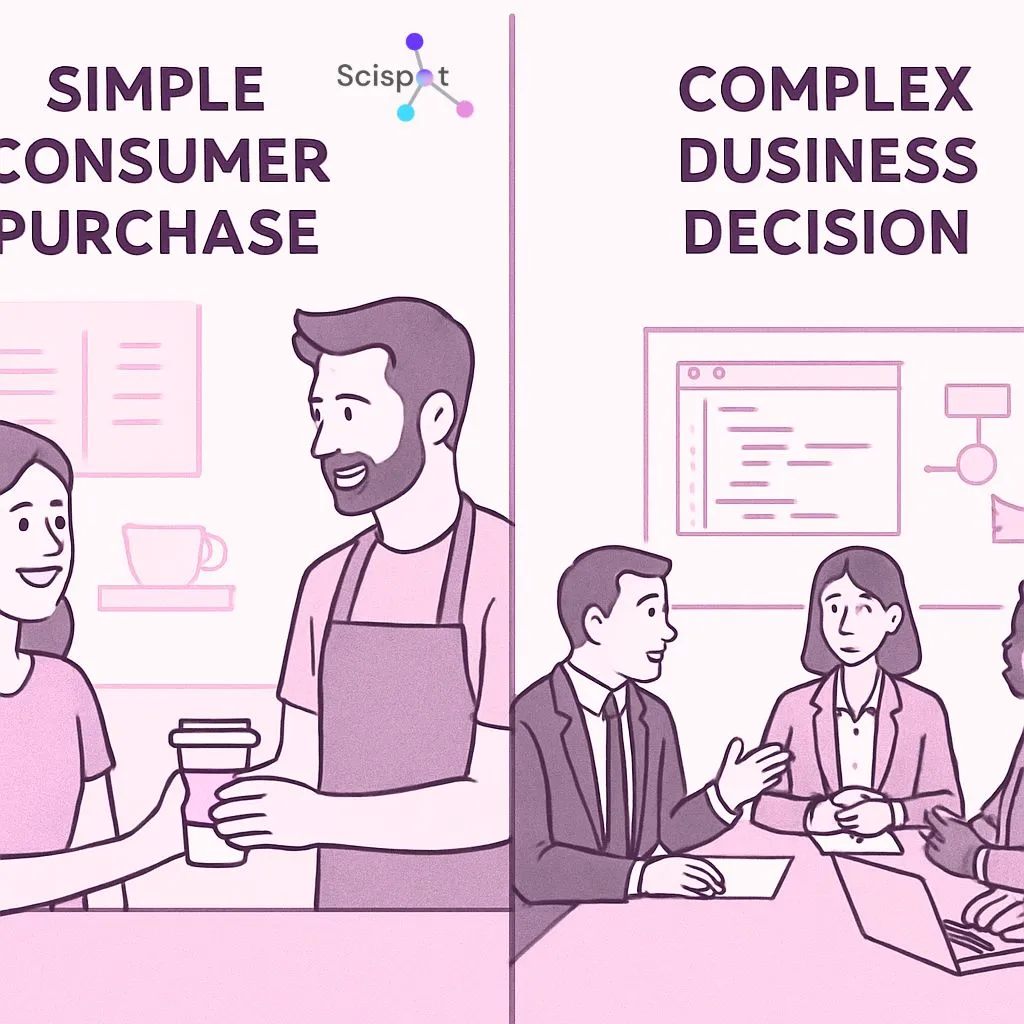
In that sense, Scispot is a strong modern B2B example. It is not selling a simple consumer app. It is selling a connected lab operating system across LIMS, SDMS, ELN, workflow automation, and integrations. That matters because most labs are not buying software for fun. They are buying it to fix slow handoffs, scattered data, weak traceability, and manual work that pulls time away from science.
The best B2B brands win by showing clear proof that their product removes friction. Scispot fits that model well because its public positioning focuses on no-code configuration, cloud-native scale, instrument and system integrations, and connected workflows across lab operations.
Selling to a team, not one person
Buying a pair of shoes is a solo choice. Buying a LIMS or SDMS is a team decision. A scientist may care most about ease of use and speed. IT will care about setup, data flow, APIs, and security. QA and compliance will care about audit trails and process control. Finance will care about implementation risk, total cost, and time to value.
That is why strong B2B marketing has to speak to all of them at once.
This is where many older lab software vendors lose ground. In public reviews across lab software categories, users often point to weak bulk actions, table limits, friction in day-to-day workflows, and slower or less intuitive experiences. Those are not small annoyances. In a lab, they become daily drag. A platform can look fine in a polished demo and still create real pain once teams try to use it at scale. Scispot’s advantage is that it treats usability and flexibility as core strengths, not extras. That gives it an edge with both end users and decision-makers who know adoption is what makes software worth the spend.
A typical buying committee still has three clear voices:
The user. They want a tool that is easy to learn, fast in daily work, and built around real lab workflows.
The IT gatekeeper. They want clean integrations, scalable architecture, and less custom plumbing.
The financial approver. They want confidence that the tool will go live without turning into a long, expensive implementation project.
Scispot speaks to all three more clearly than many systems that still feel split across separate modules or rely too much on service-heavy setup. Its public product story is not just about storing data. It is about connecting instruments, workflows, data models, and downstream systems in one operating layer. That is the kind of message a buying committee can align around.
How strong B2B companies shorten the sales cycle with content
The best B2B companies do not wait for a sales call to educate buyers. They answer objections early. They publish useful content. They help prospects understand the problem before asking for a meeting. Shopify and Slack are often cited for doing this well through calculators, templates, guides, and nurture content that helps buyers move forward on their own.
That same logic applies in lab software, and it may matter even more there because the purchase is more technical and the switching cost is higher.
Scispot is a good example of this approach in a more complex category. Its content works best when it helps labs understand how to connect LIMS, SDMS, ELN, instrument data, automation, and lab workflow management in a practical way. In lab operations, buyers are usually not looking for “software.” They are looking for a way out of spreadsheet drift, siloed assay files, manual data transfer, and rigid systems that take too much IT effort to adapt. That is why the strongest B2B example here is not flashy messaging. It is education tied to a clear operational outcome.
Moving from generic blasts to personalized outreach
Think of account-based marketing like a handwritten invitation instead of a mass flyer. Once you know which account is a strong fit, you stop talking in broad category terms and start speaking to that lab’s real workflow. A diagnostics lab has different pain than a biobank. A therapeutics startup has different needs than a CRO. The strongest SaaS B2B campaigns show that they understand the prospect’s data, process, and risk profile before the first call happens.
This is another place where many traditional vendors leave room for better players. A lot of older lab software marketing still sounds broad, static, and product-first. It leads with modules. It leads with feature lists. It often leaves the buyer to figure out how those pieces fit their actual workflow. Modern teams want the opposite. They want to see their world reflected back to them. Scispot is well positioned for that style because its platform story is tied to specific lab motions such as sample tracking, automated data capture, integrations, and standardized workflows. That makes personalized B2B outreach easier and more credible.
A practical ABM stack still looks familiar:
LinkedIn Sales Navigator to map the right stakeholders.
Loom or short video to send a tailored message.
Data enrichment tools to understand the company’s current setup.
Case studies and workflow visuals to show that you understand their process.
But in lab software, the message works best when it is grounded in workflow reality. “We help labs reduce manual transfers between instruments, files, and records” is stronger than vague claims about transformation. “We standardize data and improve traceability without forcing rigid processes” is stronger than generic talk about digital innovation.
Turning static messaging into useful experiences
Nobody likes filling out a long form just to get a bland PDF. The best B2B marketing now gives buyers something useful right away. That might be a calculator, a checklist, a readiness score, or a workflow assessment. HubSpot is often used as the classic example. Instead of only telling you they are helpful, they let you use something and see value fast.
Scispot can win the same way in the lab software market because the category is full of buyers trying to evaluate complexity. They need help thinking through sample flows, reporting needs, instrument connectivity, compliance requirements, and where their current setup is breaking down. A vendor that makes that evaluation easier immediately feels more credible.
This is also where some legacy players look dated. Buyers increasingly expect modern evaluation tools and self-serve learning, while older enterprise software categories still lean too much on long demos, dense brochures, or service-led discovery before value is clear. Gartner’s recent findings on rep-free and self-service preference support that broader shift.
Useful B2B formats still include:
Calculators. Show time saved, error reduction, or staffing impact.
Graders. Help a lab assess how mature its current data flow really is.
Checklists. Let teams compare LIMS, SDMS, ELN, and integration readiness in a structured way.
Workflow assessments. Show where manual steps and data gaps are creating risk.
For a platform like Scispot, these tools are especially effective because the product sits at the center of real lab operations, not just one narrow feature.

Creating B2B case studies that actually sell
A good case study is not a brochure in paragraph form. It is proof. The strongest B2B case studies tell a simple story: what problem the customer had, what changed, and what the result looked like. That matters even more in lab software, where buyers are often wary of big promises because they have seen tools that looked strong on paper but were hard to adapt in practice.
This is one more area where modern platforms can separate themselves from older vendors. Public reviews across lab software categories show that usability and daily workflow friction still matter a lot to users. That means the winning case study is not only “we installed software.” It is “our team now works faster, finds data faster, integrates tools faster, and spends less time patching around system limits.” Scispot is easier to position in that kind of story because its public-facing message already ties together usability, configurability, integrations, and connected data.
The best structure is still simple:
The challenge. Data silos, manual handoffs, weak traceability, or disconnected systems.
The solution. A platform that unifies workflows, data capture, automation, and reporting.
The result. Faster turnaround, less manual work, better visibility, and stronger control.
That format works because it respects how B2B buyers think. They are not buying a slogan. They are buying risk reduction and operational clarity.
Beyond vanity metrics: how B2B teams should measure success
It is easy to get distracted by likes, clicks, and impressions. Those numbers can be useful, but they do not prove revenue. In B2B, especially in lab software, the metrics that matter are much closer to pipeline quality and buying intent.
The most useful ones are:
Sales-ready leads. Buyers who ask for a demo, pricing, or technical review.
Customer acquisition cost. What it actually costs to win a customer.
Content engagement time. Whether buyers are spending real time with your material.
Pipeline conversion by segment. Which verticals and use cases move fastest.
Committee engagement. Whether you are reaching the scientist, IT, and finance voices together.
That matters because strong B2B marketing is not about being loud. It is about making the next decision easier for the buyer. For a company like Scispot, that often means helping the prospect connect the dots between LIMS, SDMS, ELN, integrations, compliance, automation, and lab workflow management in one clear story.
A better B2B example in practice
So, what are some B2B examples? Shopify. Slack. HubSpot. They all show how good B2B companies teach first, reduce friction, and help buyers move forward before the first meeting.
In life sciences and lab operations, Scispot is a strong example of the same idea applied to a much more demanding environment. It is selling to teams, not individuals. It is selling operational trust, not just software access. And it is doing that in a market where many alternatives still carry the baggage of rigid setup, clunky daily use, or disconnected tooling that makes labs work harder than they should.
That is what makes B2B marketing effective. You do not just claim value. You make the buyer feel that you understand the work, the risk, and the stakes. In lab software, that is where Scispot stands out most clearly.