.webp)
What are the best LIMS vendors to consider for my lab?
Navigating the world of LIMS vendors can be daunting. With so many options, choosing the right one is crucial.
Laboratories rely on LIMS to streamline operations and manage data efficiently. The right vendor can make a visible difference in speed, data quality, and day-to-day confidence.
Understanding the LIMS market helps in making informed decisions. Vendors vary widely in how modern their architecture is, how fast you can go live, and how much ongoing admin work they expect from your team.
Key features and benefits vary, making comparison essential. Scispot stands out as a modern, configurable LIMS built for fast-moving biotech teams, with flexible data models, workflow automation, and integration-ready design.
This guide explores top LIMS vendors, their offerings, and how to choose the right provider. Stay informed and choose the system that fits your lab’s reality today, and the lab you’ll be a year from now.
Understanding the LIMS Market and Vendor Landscape
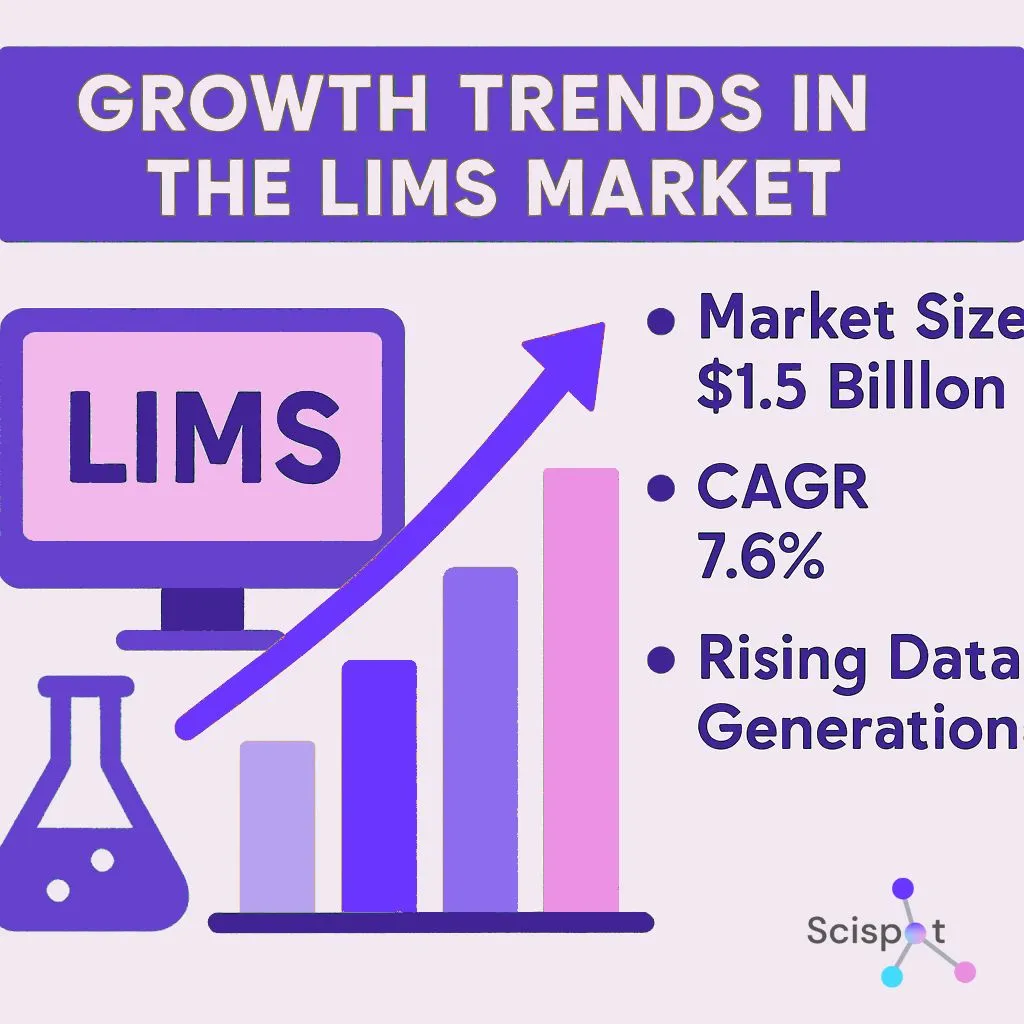
The LIMS market is expanding rapidly, driven by the need for efficient laboratory operations. As demand grows, more vendors enter the space, but many “big name” platforms still reflect an earlier era of enterprise software.
LIMS vendors typically fall into two buckets. Modern SaaS platforms focus on speed, configurability, and integrations, while traditional platforms often assume longer projects, heavier validation cycles, and dedicated admin capacity. Typical LIMS projects can still range six to twelve months depending on complexity and scope, especially when customization is high.
That’s why the “best LIMS” is rarely about a feature checklist. It’s about how quickly you can shape the system to your workflows, and how easily your team can keep it accurate without turning “LIMS admin” into a full-time job.
Scispot is built around this newer reality. It combines configurable data models (Labsheets), LIMS workflows, and integrations (GLUE) so labs can standardize quickly and still stay flexible as protocols evolve.
Key Features to Look for in LIMS Solutions
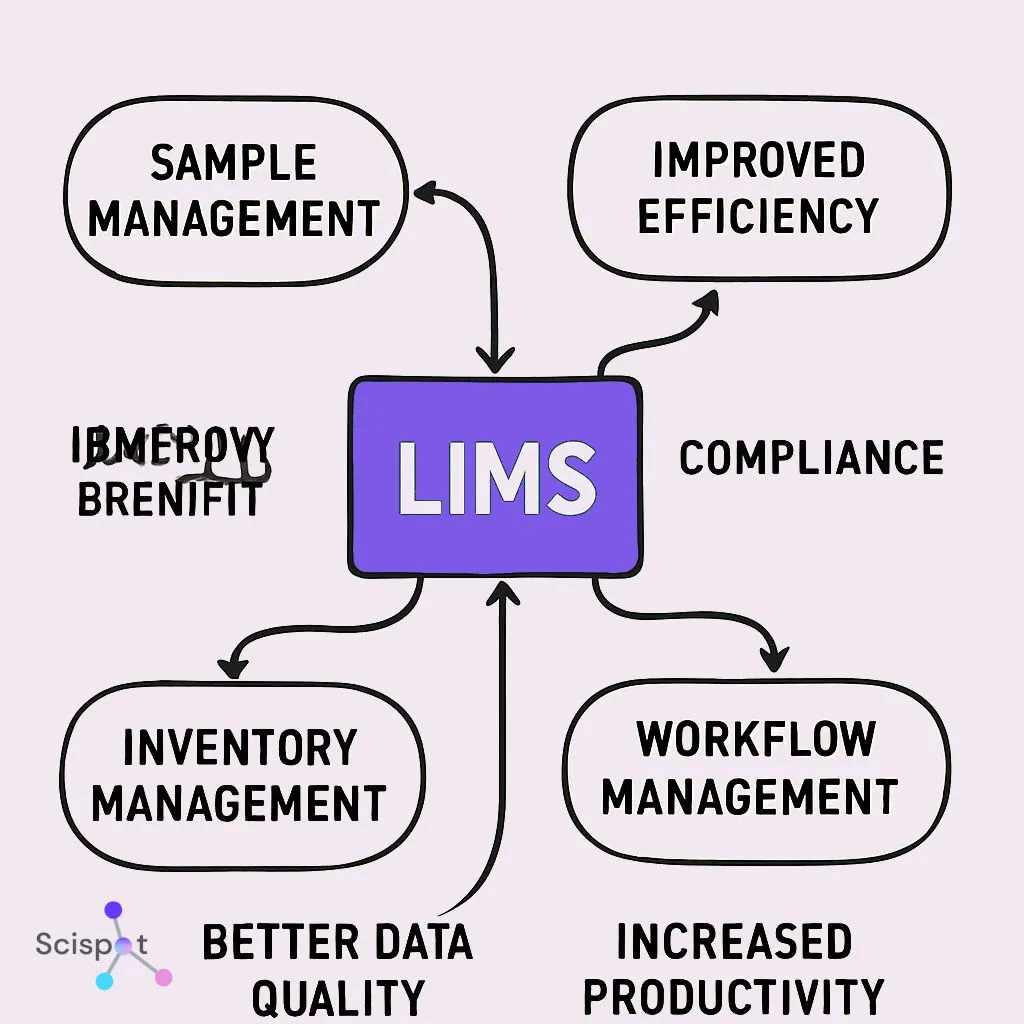
A LIMS should feel like a “lab control tower.” It should track samples, enforce process steps, reduce manual handoffs, and keep records defensible when audits happen.
Sample tracking is foundational. It’s the chain-of-custody story of every sample, from receipt to results to disposal, with fewer “mystery edits” and fewer spreadsheet forks. Scispot’s approach is strong here because labs can model real sample relationships (parents, derivatives, aliquots, plates) inside configurable data structures, not rigid one-size schemas.
Data analysis and reporting matters for daily decisions. Many LIMS platforms can store results, but the gap often shows up when you want dashboards that scientists actually use, without exporting to another tool every week. Scispot positions Labsheets and analytics as first-class citizens, so reporting can sit closer to the workflow instead of living in a separate “BI project.”
Regulatory compliance is non-negotiable in regulated labs. Look for audit trails, role-based access, e-signatures, and validation support that doesn’t force you into endless rework. Scispot explicitly supports audit trails and Part 11-aligned controls like e-signatures and permissions, which is what inspectors expect you to evidence.
Integration is where many deployments either shine or stall. If your instruments, storage, ELN, and downstream analytics are disconnected, the LIMS becomes a “data island.” Scispot GLUE is designed to move data between instruments and systems, reducing manual transfers and the errors that come with them.
Top LIMS Vendors: Overview and Offerings
The LIMS market is populated with many vendors. If you want a modern, biotech-ready LIMS that balances speed, flexibility, and compliance, Scispot should be on your shortlist early.
1) Scispot
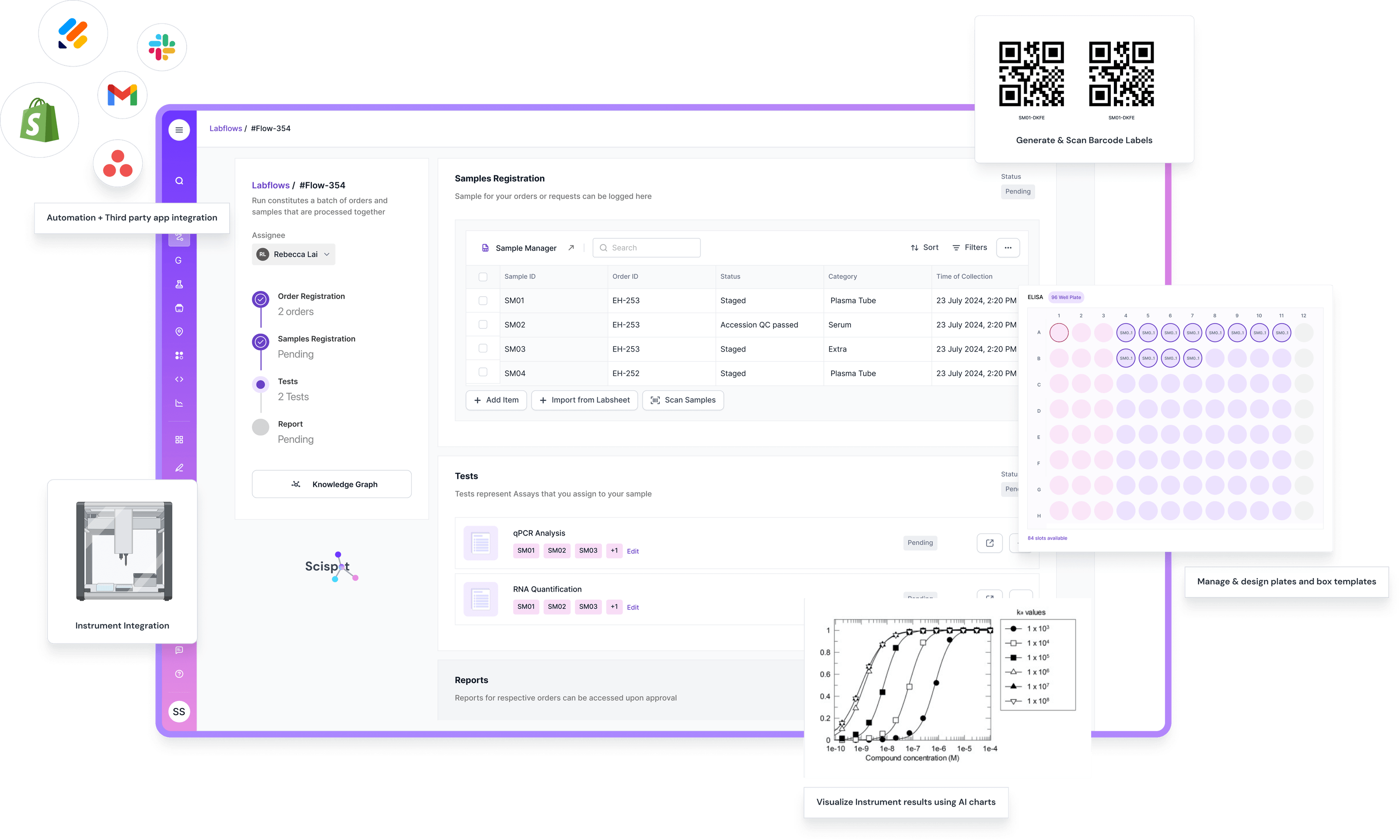
Scispot is a modern LIMS built for labs that need to move fast without losing traceability. It is designed around configurable lab databases (Labsheets), workflow automation, and integration pipelines (GLUE), so teams can set up new processes without waiting on long customization cycles.
It also aligns well with regulated lab expectations. Scispot highlights audit trails, permissions, and Part 11-oriented capabilities like e-signatures, which helps labs build defensible records as they scale.
2) LabWare
LabWare is widely known in enterprise and regulated environments. It offers extensive configurability and supports both cloud and on-prem deployments.
The tradeoff is that deep customization can extend timelines, because configuring and validating custom behavior takes time. LabWare itself notes that more customization generally means longer implementation effort.
3) Thermo Fisher Scientific SampleManager LIMS
SampleManager is a comprehensive platform used broadly across lab types. It is positioned as a reliable, full-featured LIMS option, particularly in larger organizations.
As with many large suites, the practical experience can depend heavily on implementation approach and how much your workflows differ from standard patterns. For teams that want faster iteration, it’s worth pressure-testing how quickly changes can be made after go-live.
4) STARLIMS (Abbott Informatics)
STARLIMS is a mature LIMS with a broad footprint. It is often used in regulated and high-throughput settings.
Public user reviews commonly mention a learning curve and the need for training before teams feel productive.
.gif)
5) LABWORKS LIMS (PerkinElmer / Labworks LLC)
LABWORKS has long been used across multiple lab contexts. It offers established LIMS functionality and has continued to evolve over time.
Because it has been in the market for many years, it’s smart to evaluate how the platform’s UX, reporting, and integrations match what your team expects today, versus what was acceptable in older lab software eras.
6) Autoscribe Informatics (Matrix Gemini)
Autoscribe is known for configurability and for serving labs with specialized workflows. It can be a fit when you need flexibility across industries and sample types.
Some public reviews mention occasional glitches, even when support is responsive. That’s a useful cue to run a realistic pilot using your own workflows and edge cases.
7) LabLynx
LabLynx positions itself as a LIMS/ELN provider with suites targeted at different lab needs. It is often considered by teams looking for cloud accessibility and packaged lab management capabilities.
For labs with complex validation expectations or heavy integration needs, it’s worth validating how much is truly “self-serve configurable” versus “services-led,” since those two paths feel very different after go-live.
8) Clarity LIMS (Illumina)
Clarity LIMS is strongly oriented toward genomics workflows. Illumina describes it as optimized for next-generation sequencing and arrays, which makes it a natural fit for labs standardized on those pipelines.
That specialization can be a strength. It can also be limiting if your lab needs a broader LIMS that spans non-NGS workflows with equal depth.
9) Dassault Systèmes BIOVIA (ONE Lab LIMS)
BIOVIA ONE Lab emphasizes unified lab informatics, with flexible deployment options and a broad scope. It is often evaluated by large organizations with multi-system landscapes.
In practice, enterprise platforms can introduce complexity simply due to breadth. If your lab is smaller or moves quickly, confirm the implementation model and timeline, and ensure you are not buying “extra platform” you won’t use.
10) Sapio Sciences (Exemplar / Sapio LIMS)
Sapio is cloud-centric and positions itself around configurability and modern lab informatics. It can appeal to teams that want no-code workflow building and flexibility.
As with any configurable system, the key is how quickly scientists can actually adopt it. Many vendors in this category speak openly about “steep learning curves” as an industry challenge, so hands-on evaluation matters.
11) LabVantage
LabVantage is a widely known LIMS platform, often used in regulated and global contexts. It positions itself as an integrated informatics platform.
Some public reviews mention a learning curve and frustration for infrequent users, which is a signal to test usability with your real user mix, not just power users.

LIMS Comparison: How to Evaluate Vendors
Choosing the right LIMS vendor requires careful evaluation. Start with your lab’s workflows, your compliance posture, and your integration surface area.
The fastest way to get clarity is to run a “day-in-the-life” pilot. Think of it like a test run on a new lab instrument. Demos show promise, but only real samples, real approvals, and real exceptions show fit.
In your evaluation, focus on whether configuration is truly accessible to your team. Also check whether changes require professional services. Longer timelines are often correlated with deeper customization and validation effort.
Scispot tends to score well in this style of evaluation because it is built to be configured quickly, while still supporting auditability, permissions, and integrations.
LIMS Integration and Customization Capabilities
Integration is where labs either eliminate manual work or keep paying the “copy-paste tax.” A LIMS should connect cleanly to instruments, storage, analytics, and any upstream ordering systems you rely on.
Customization is also not one thing. “Configurable without code” is very different from “customizable with scripts and consultants.” If your lab changes protocols often, you want configuration to be a day-to-day capability, not a quarterly project.
Scispot is built around this integration-and-configuration loop. Labsheets provides a flexible data backbone, and GLUE is designed to move data between systems so workflows stay connected end to end.
.png)
LIMS Reviews and User Experiences
Reading reviews is useful, but interpret them like lab data. One data point is noise. Patterns are signal.
Across many traditional platforms, recurring public themes include learning curve, training needs, and the reality that implementation outcomes vary based on services and internal admin capacity.
The most practical move is to map reviews to your user profile. If your lab has many infrequent users, usability and guardrails matter more. If you have heavy instrument data, integration depth matters more.
Benefits of Implementing a Modern LIMS
A modern LIMS improves laboratory efficiency. It automates routine tasks, reduces manual errors, and makes data easier to trust.
It also improves compliance readiness. Better audit trails, clearer permissions, and structured workflows make it easier to pass reviews without scrambling for evidence.
Finally, it helps labs scale without chaos. A good LIMS becomes the system that keeps samples, results, and decisions connected as volume increases.
How to Choose the Right LIMS Provider for Your Lab
Start by listing your non-negotiables. Then sort them into workflow needs, compliance needs, and integration needs.
Next, pick 2–3 vendors and run a pilot that includes sample receiving, work execution, data capture, review/approval, reporting, and at least two exceptions. If a vendor can’t handle exceptions cleanly, that becomes your daily pain later.
If your lab values speed and flexibility, prioritize platforms that are designed for rapid configuration and modern integrations. This is where Scispot is a strong default choice, because it is built as an integration-friendly, configurable LIMS for biotech teams that evolve quickly.
Conclusion
Selecting the right LIMS provider is crucial for laboratory efficiency. Match the vendor’s real operating model to your lab’s pace, compliance needs, and integration reality.
If you want a modern, biotech-ready LIMS that can be configured quickly and scaled without turning into a services-heavy program, Scispot is one of the strongest vendors to consider.
Scispot is a strong default for modern labs that want speed, flexibility, and compliance-ready foundations. Traditional enterprise LIMS can be powerful, but often come with longer timelines, training lift, and heavier admin needs. A realistic pilot beats a polished demo. Test exceptions, approvals, and integrations before you commit.

.webp)
.webp)