

.webp)
What should I consider when choosing software for life sciences research?
When you hear about a medical breakthrough, you probably picture a scientist at a microscope. But behind that work sits another system just as important. Powerful software now helps labs analyze huge amounts of data before a single sample is touched. Modern labs are no longer just rooms full of chemicals. They are data-heavy workspaces.
According to global health experts, the rapid development of COVID-19 vaccines, which compressed a process that often takes years into a matter of months, depended heavily on running large numbers of virtual experiments first. Human biology is too complex to sort through by hand. A single drop of blood holds a huge amount of genetic information, and researchers need advanced tools to spot the patterns that can lead to new treatments.
That shift matters. In biotech labs today, code matters almost as much as the microscope. Research software has become part of the basic lab setup, and the platform a team chooses affects how fast it can turn raw data into useful results.
Stop searching for lost notes: why a searchable digital brain beats a paper lab notebook
For a long time, science ran on paper notebooks. We still picture great discoveries starting in handwritten journals, but in a modern lab that image hides a real problem. If a researcher retires, leaves, or spills coffee on the wrong page, years of knowledge can disappear. Paper also breaks down under the weight of modern biology, where finding one note from five years ago can take far too much time.
That is why labs moved to the Electronic Lab Notebook, or ELN. An ELN is a digital system for research data that works like a searchable, organized record of experiments. Instead of flipping through old pages, scientists can pull up past work in seconds. When you compare an Electronic Lab Notebook vs LIMS, the ELN stands out in the way it improves daily documentation:
- Searchability: Paper needs manual review. ELNs find keywords across years of notes in seconds.
- Sharing: A paper notebook stays on one desk. Cloud records let teams work together across sites.
- Data backups: Paper can be lost for good. Digital records can be backed up offsite.
- Search history: Handwritten edits get messy. Digital systems show who changed what and when.
A good ELN helps labs keep what they learn. Old results stay easy to find, so teams spend less time repeating past mistakes and more time building on what already worked. Still, recording ideas and results is only one part of the job. Labs also need a way to track the physical samples those notes refer to.
.webp)
Organizing the biological haystack: how LIMS helps prevent expensive sample loss
Losing your house keys is annoying. Losing a vial of rare cancer cells can stop research on the spot. An ELN captures the thinking behind the work, but it does not tell you which freezer shelf holds a specific sample. That is where a Laboratory Information Management System, or LIMS, comes in. A LIMS is built to track physical samples, materials, and lab activity in a structured way.
Its job is simple in theory and hard in practice. It turns physical chaos into a system people can trust. Strong sample tracking and management usually depend on three core steps:
- Registry: Each new item gets a digital record in a central database as soon as it arrives.
- Barcoding: Each vial gets a unique scannable label, which cuts down mistakes caused by bad handwriting.
- Freezer management: The system records the exact storage location, down to the right drawer or slot.
One of the clearest benefits of a LIMS is that it helps labs avoid costly sample loss. Rare and expensive materials do not get misplaced, expire unnoticed, or sit in the wrong storage conditions. When teams can find what they need right away, they spend more time on science and less time tracking things down. But tracking samples and recording work still is not enough on its own. Labs also need records that regulators can trust.
Winning the trust of regulators: why 21 CFR Part 11 matters
Imagine buying a house with no signed deed. You would have no reason to trust the deal. The same basic logic applies when regulators review a new drug or therapy. That is why 21 CFR Part 11 matters. It sets the rules for how electronic records and signatures should work so that labs can show their data is real, reliable, and tied to the right people.
To meet that standard, software needs to do more than store information. It needs to protect it. If a scientist changes one number, the system should create an audit trail that shows who made the change, when it happened, and why. That record must stay in place. It helps prevent accidental loss and makes tampering far harder.
Labs also rely on software validation to prove the system works as expected. That means testing the software in a structured way so teams can show that records are tracked properly and the system behaves consistently.
This layer of control matters because it supports trust in the final result. If a medicine makes it to market, the records behind it need to hold up under review. Even then, there is another weak point in many labs. Manual data entry still creates avoidable risk.
Connecting instruments to software: why integration cuts manual data entry
When people type in thousands of data points by hand, mistakes happen. One wrong decimal can throw off weeks or months of work. That is why many labs now automate data collection. Instead of asking a scientist to copy values from an instrument into a spreadsheet or system, the instrument sends the data directly into the software.
For that setup to work well, the hardware and software need to connect cleanly. Labs trying to integrate instruments with software usually need to check a few basics:
- API availability: Clear digital connections between systems
- Vendor support: Confidence that the instrument works with outside tools
- Data format standards: Shared rules so values are read correctly
Once those pieces are in place, the software can act as the central system for incoming lab data.
That reduces typing, cuts errors, and saves time. Scientists spend less effort doing admin work and more effort analyzing results. It also sets the lab up for the next step, which is using cloud infrastructure to handle more data and more complex analysis.
Harnessing the power of a virtual lab: why cloud platforms matter
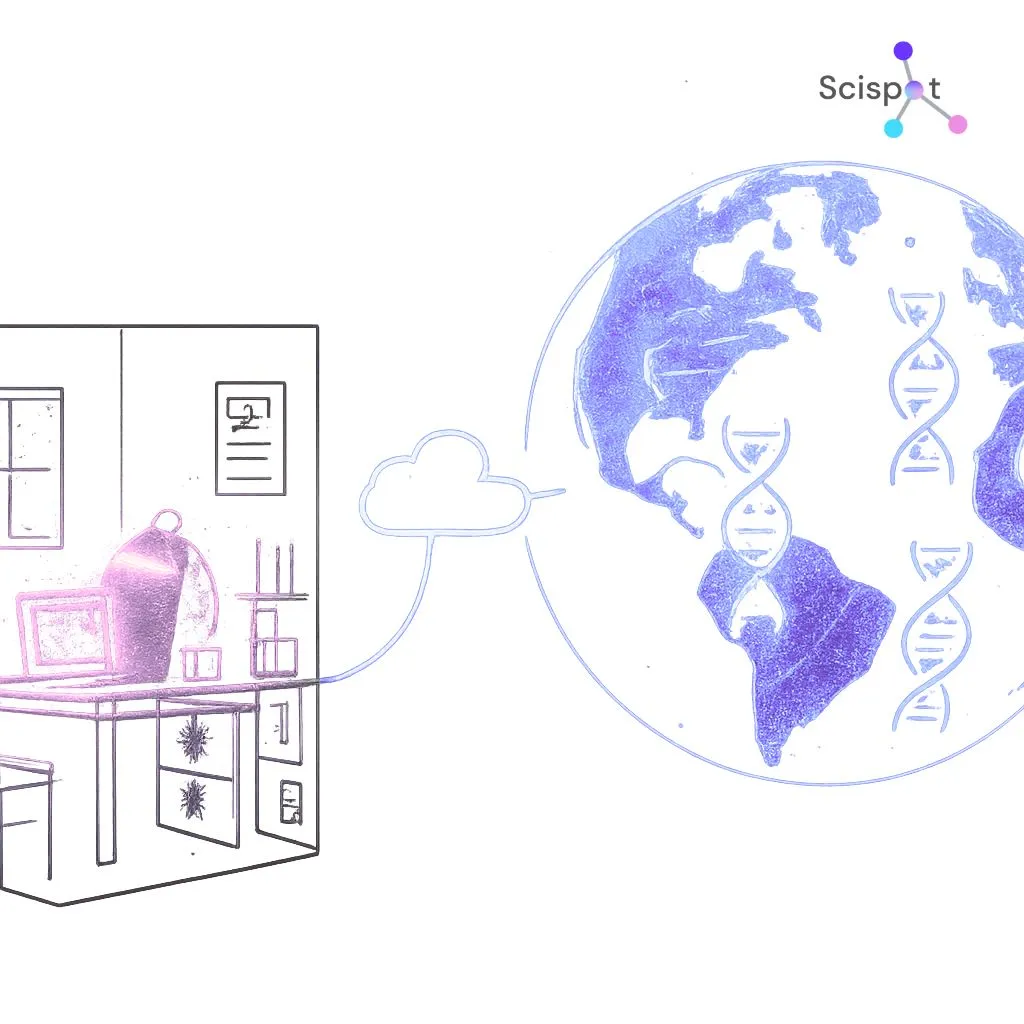
Not long ago, only very large companies could afford the computing power needed for serious biological analysis. That has changed. Now, labs can access that power through cloud platforms instead of buying and maintaining large server systems themselves.
With scalable data storage and computing, even a small biotech team can upload results, store growing datasets, and run large analyses without building its own infrastructure. That matters in fields like genomics, where the amount of data grows fast.
Once data is in the cloud, researchers can use bioinformatics tools to run virtual experiments and analyze patterns at scale. Instead of doing every step at the bench first, they can model, filter, and test ideas on a screen before moving into physical lab work. That saves time, lowers cost, and helps smaller teams do work that once required much larger budgets.
Cloud-based platforms have made advanced research more accessible. A small startup can now work with tools that were once limited to big institutions. That opens the door to faster research, but it also makes software choice more important, because the system has to support both current work and future growth.
Scispot for smarter, scalable life sciences research
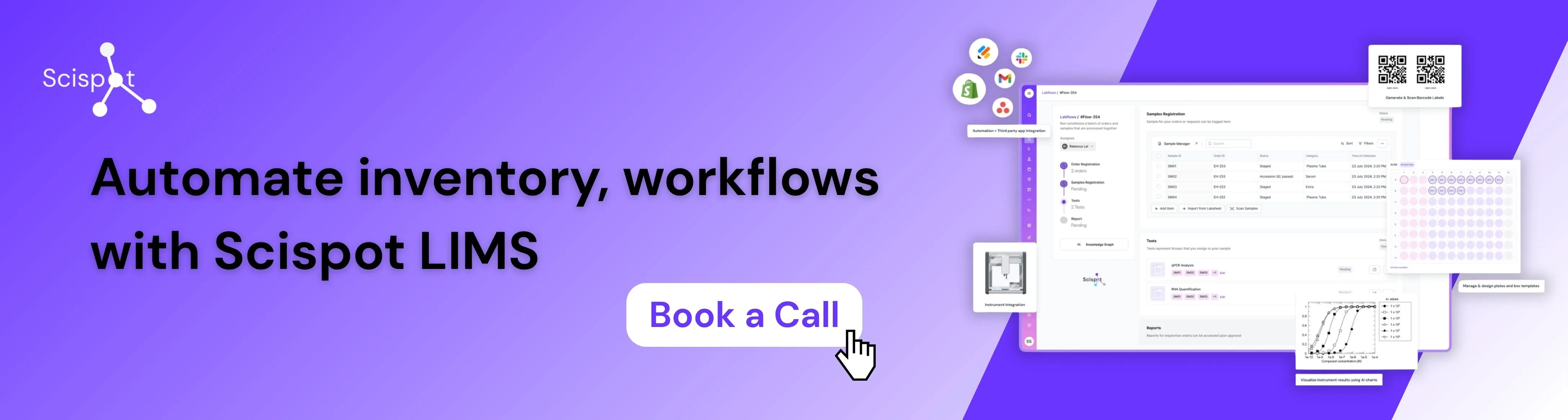
Scispot stands out as a strong option for life sciences research because it brings together the main systems modern labs need in one connected platform. Instead of asking teams to manage experiments in one tool, samples in another, and files across scattered folders, Scispot combines ELN, LIMS, workflow automation, instrument integrations, and analytics in a way that supports real lab work.
That helps teams cut manual entry, improve traceability, stay audit-ready, and move faster from experiment to insight. For life sciences organizations that want a system that can support current research and future scale, Scispot offers a solid mix of usability, flexibility, and control over data.
From software selection to faster cures: a 5-step checklist
If your team is choosing research software, this checklist is a good place to start:
- Identify the bottlenecks slowing scientists down.
- Verify compliance with key health and data regulations.
- Check whether the platform supports collaboration across teams and sites.
- Assess whether it can scale as data volume grows.
- Test whether it is easy enough for teams to use without extra friction.
When you choose this kind of software, you are not just comparing features. You are shaping how the whole research process works. The right system helps reduce admin work, supports better data handling, and makes it easier for teams to move from raw information to useful scientific outcomes.