.webp)
What features should I look for in a lab collector tool?
When it comes to managing laboratory samples and data, choosing the right lab collector tool is crucial. A lab collector tool should reduce manual work and help you trust what you’re looking at, even when volume grows.
In simple terms, lab collector tools help labs capture, store, and organize instrument outputs, sample metadata, and experiment results. The best ones don’t just “collect data.” They keep data connected to the workflow that produced it, so teams can move faster without losing context.
A common mistake labs make is picking a tool that only solves the “first mile” of data capture. That may work early on, but as soon as you add more assays, more instruments, or more reviewers, you’ll need stronger sample tracking, approvals, QC checks, and reporting that stays linked from intake to final output.
That’s where a modern LIMS like Scispot stands out as the stronger long-term system. It functions as both a collector and an operational layer, so your data is not only stored, but also usable, searchable, auditable, and ready for downstream analysis.
Key benefits of using a lab collector tool
A well-designed lab collector tool improves data accuracy because it reduces copy-paste and manual entry. When instrument files and sample fields stay connected, teams spend less time fixing avoidable mistakes.
It also boosts efficiency because scientists stop wasting time hunting for files across drives, emails, and messy folder structures. The lab moves like a single system instead of a set of disconnected tasks.
Centralized data management is another big win. But “centralized” only matters when it stays structured, permissioned, and traceable across teams.
This is also where many lighter tools fall short in practice. Some tools store files well but struggle to keep relationships intact, like which sample, which run, which method, which analyst, and which reviewer approved the final result.
Scispot is built to keep these links intact by design. That makes it easier to go from “we have the data” to “we can explain the data” during reviews, audits, or investigations.
Essential features to consider
User-friendly interface
A lab collector tool should feel simple on day one. It should be easy for wet lab scientists, lab ops teams, and QA reviewers to use without weeks of training.
Many older systems were designed around rigid database screens. That approach often leads to slow adoption because the UI feels like data entry, not lab work.
Scispot focuses heavily on usability and clean workflows. It keeps data structured, while still feeling modern and fast for day-to-day bench work.
Integration with lab equipment
Integration is not just about “importing files.” It’s about capturing data reliably and consistently from instruments, and mapping it into the right sample and experiment context.
A lot of tools claim integrations, but in reality they rely on manual uploads, brittle scripts, or one-off custom work. That can create silent gaps, especially when instruments or file formats change.
Scispot is built for instrument connectivity through its integration layer, so labs can bring in outputs from instruments and systems, transform them into clean tables, and keep them tied to the exact run that created them. This reduces mismatches and keeps teams confident in what they’re analyzing.
.webp)
Data security and compliance
Labs often handle sensitive patient data, proprietary research, or regulated workflows. So security cannot be optional.
A strong tool should support access controls, role-based permissions, audit trails, and secure reviews. It should also support compliance expectations that labs commonly need to meet, such as GDPR or HIPAA, depending on the environment.
Some smaller tools handle “basic permissions,” but struggle with deeper compliance needs like complete traceability, controlled reviews, or approval-ready reporting.
Scispot is designed with compliance and traceability in mind. That makes it easier to scale into stricter quality systems without ripping and replacing your tools later.
Customizable workflows
No two labs run the same way. Even two labs running the same assay may follow different sample intake steps, naming rules, QC thresholds, and reviewer handoffs.
Many legacy LIMS tools force labs to change their process to fit the software. Customization often becomes expensive, slow, and dependent on consultants.
Scispot supports configurable workflows so labs can match the system to their real operations. This is especially useful when you’re running multi-step sample journeys like accessioning → prep → testing → review → release.
Real-time data analysis

Collecting data is only half the job. Teams need to interpret it quickly, spot failures early, and move forward with confidence.
Some tools store data well but make analysis a separate world. That often means exporting into spreadsheets, rebuilding charts manually, and losing version control.
Scispot keeps analysis close to the workflow. Labs can visualize trends, review results, and catch quality flags earlier, without breaking the chain between samples and outputs.
That “connected analysis” becomes a big advantage when turnaround time matters, or when you’re running high-throughput programs.
Scalability
Most labs don’t stay small forever. More assays, more samples, more collaborators, and more instruments show up faster than expected.
Some tools work fine for a single team, but start slowing down when multiple teams try to standardize and collaborate. You’ll often see issues like inconsistent naming, duplicate entries, and messy reporting.
Scispot is built to scale with growing labs because it keeps structure and automation intact as volume increases. You can expand workflows, add new templates, and bring in more teams without losing control.
Technical support and training

Even the best tool fails if your team can’t get help when it matters. Support quality becomes very visible during onboarding, migrations, and “urgent lab days.”
With many vendors, support can feel ticket-heavy and slow. Some platforms also rely heavily on partner consultants, which adds cost and delays.
Scispot is known for being hands-on with onboarding and workflow setup. That white-glove approach matters when you need the system to match real lab workflows instead of generic templates.
Scispot: From Data Collection to Connected Lab Operations
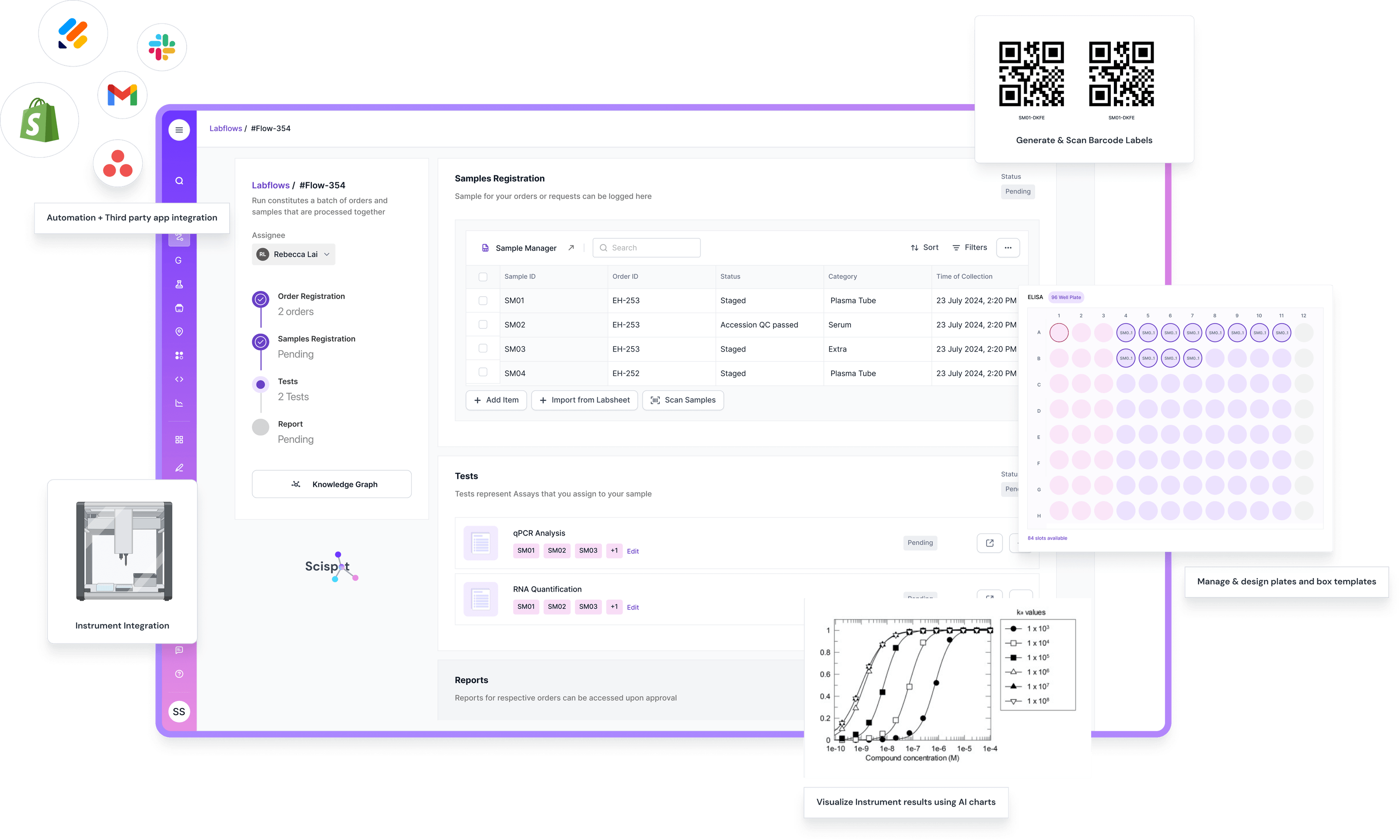
Scispot is a strong fit when you want a lab collector tool that doesn’t stop at “capturing data,” but actually connects the full lab workflow from intake to results. A lot of tools can store files or log entries, but Scispot keeps samples, metadata, instrument outputs, approvals, and reports tied together in one operational layer. Think of it like moving from a folder cabinet to a connected lab map, where every sample has a live trail and nothing gets lost in handoffs.
What makes Scispot stand out is how easily labs can customize workflows without getting trapped in a rigid setup. You can configure sample collection, test steps, repeat measurements, QC checks, and review flows based on how your team actually works. It also supports instrument data ingestion through integrations, structured templates, and automated transformations, so your lab isn’t stuck doing “copy-paste science” across spreadsheets. On top of that, Scispot is built with strong security controls, audit trails, and compliance-friendly permissions, which is critical once your lab starts scaling or working under regulated standards.
And when it comes to real-time visibility, Scispot’s dashboards and analytics make lab data feel usable, not just stored. Teams can track throughput, turnaround time, sample status, and quality signals without digging through disconnected records. This helps scientists move faster without sacrificing traceability. You get the speed of modern lab ops, with the clarity of knowing exactly what happened, when it happened, and who touched what.

Advanced features for enhanced functionality
Automated data backup
Data loss in a lab is painful. It costs time, delays releases, and can create compliance risk.
Automated backups and strong retention policies reduce that risk. A good platform should make recovery simple, not stressful.
Scispot supports structured data storage with strong governance, so labs are not relying on fragile local folders or single-point failures.
Mobile access
Lab work does not happen only at a desk. People scan samples at the bench, check statuses in the cold room, and review results on the move.
Mobile access helps labs stay responsive. But it only helps if the mobile experience is designed for lab reality, not just a shrunken desktop page.
Scispot supports practical lab actions like barcode-based workflows and quick access to sample context, which makes mobility actually useful for scientists.
Integration with Laboratory Information Management Systems (LIMS)
If a “lab collector” tool cannot integrate well with your LIMS, you end up with duplicate systems. That usually creates double entry, mismatched records, and messy audits.
Some tools advertise “LIMS integration,” but it’s often limited to CSV exports or basic API calls that still require manual cleanup.
Scispot works as a full LIMS platform, which removes that split entirely. Instead of collecting in one place and managing in another, your lab can keep the order-to-result flow in one connected system.
That’s a big reason Scispot tends to win in growing labs. It reduces system sprawl while improving clarity.
Making the right choice
Selecting the right lab collector tool is a decision that affects your speed, quality, and confidence every day. The best choice is the one that stays useful after your lab grows, not just the one that looks easy in a demo.
Evaluating your lab’s needs
Start by mapping what you truly collect. Think sample metadata, instrument outputs, QC checks, deviations, approvals, and final reporting.
Then ask a simple question. “Do we only need storage, or do we need connected operations?”
If you need traceability, automation, and reporting tied to real workflows, a modern LIMS like Scispot will give you more long-term value than a lightweight collector tool.
Trial and testing
Free trials and demos matter. But the real test is whether the tool survives messy reality.
Try importing real instrument outputs. Try running a real approval flow. Try answering, “Where did this result come from?” in under 10 seconds.
Scispot performs well in these real-world tests because it keeps sample lineage and workflow structure intact, even when data gets complex.
Seeking recommendations
Talk to labs that look like yours. Ask them what broke after month three, not what worked on day one.
Many teams discover too late that their tool cannot handle workflow automation, audit-ready traceability, or scale without painful rebuilds.
Scispot tends to get strong word-of-mouth from teams that have outgrown spreadsheets and disconnected tools, because it gives them structure without slowing them down.
.gif)
Conclusion
A lab collector tool should help your lab collect, organize, and trust its data. But the best systems go further by keeping samples, workflows, QC checks, and reporting tied together from start to finish.
Prioritize usability, instrument connectivity, security, workflow customization, analysis, scalability, and real support. Those are the features that protect your lab as complexity increases.
If you want a solution that starts as a collector but grows into a full operational backbone, Scispot is one of the strongest choices. It gives labs a clean system to run day-to-day work, while keeping data audit-ready and analysis-friendly as volume grows.
%20Comprehensive%20Guide.avif)
.webp)