

It is 4:47 p.m. You need the Western blot SOP, the experiment you ran last Tuesday, the reagent lot that expires this month, and the box coordinate for a sample someone else registered. None of that lives in one mental model. It lives across folders, grids, PDFs, and a freezer map that made sense when you drew it on a whiteboard in January. The modern lab is not short on systems. It is short on a single surface that respects how scientists actually ask questions.
That is the gap Scibot Omega is built to close. Scibot Omega is your intelligent co-pilot on the Scispot platform: the orchestrator that listens in natural language, routes your intent to the right specialized agents, and brings answers back in one coherent thread. Think of it as the colleague who knows where everything is, remembers the context of what you were doing five minutes ago, and never makes you learn query syntax to get a straight answer.

The dream state: ask once, work everywhere
The dream is not "more AI." The dream is fewer interruptions. In the state Scibot Omega is designed for, you stay inside the narrative of your work. You describe what you need the way you would to a senior tech who has been on the team for years. The system figures out whether the answer lives in your electronic lab notebook, your structured tables, your uploaded documents, or your physical location hierarchy. It can combine those worlds when your question spans them. When the request is ambiguous, it clarifies instead of guessing. When the request is dangerous, it confirms before it destroys.
Under the hood, Scibot Omega is the orchestrator. Behind it sit specialized agents for the domains your lab already runs in Scispot: Labspaces for experiments and protocols, the Knowledge Base for documentation and training, Search and Discovery for read-only exploration across laboratory data, Labsheets for creating and updating structured records, Location Manager for where things actually sit in the building, and Users for who is on the team and what roles allow. It also reaches your AI Lab Drive for the PDFs, Word files, spreadsheets, and presentations that hold the messy truth of how work is done.
You do not pick the agent. You do not wire the integration in your head. You ask. Scibot Omega analyzes intent and connects you with the right expertise, including multi-step coordination when one sentence touches more than one system.
From fragmentation to flow
Labs feel fragmentation in specific, expensive moments. A new hire spends a week learning which screen answers which question. A lead scientist loses twenty minutes hunting a protocol version that never made it from a shared drive into the ELN entry. An operations lead exports a grid, fixes it in Excel, and imports it back because updating fifty rows through clicks feels impossible. A compliance conversation starts with "show me where that decision was documented" and ends with three browser tabs and a Slack scroll.
Scibot Omega attacks that tax directly. For experiments and protocols, you can list recent work, filter by name or timeframe, open drafts and completed runs, and create or update experiments without treating the ELN like a database you must manually navigate. For documentation, you can ask how to configure a Labsheet, pull community articles and videos, or pivot to the files your team uploaded when the canonical answer is still in a Word SOP.
For laboratory data, Search and Discovery is deliberately read-only and fast: ask for samples above a concentration threshold, reagents expiring in a window, antibodies in a named freezer, or compound conditions with natural language like "greater than," "between," and "last week." You can stack filters the way you would explain them out loud, including combinations such as numeric cutoffs plus location, date windows, and text matches with contains or equals-style intent. Wildcard thinking works too: partial names can surface full records when you remember a fragment but not the exact string. When results come back, the thread can suggest what to do next: refine, export, or hand off to an update path when you are ready to act.
Documents that answer back
Your AI Lab Drive is full of real artifacts: instrument qualification PDFs, method transfers, training decks, supplier certificates. Scibot Omega searches them semantically, which means you are not punished for forgetting the exact filename. Ask for "PCR troubleshooting" and relevant material can surface even if the phrase "polymerase chain reaction" is what the author used. When you need depth, you can request full text extraction from PDFs and Word documents, or structured tables from Excel and CSV so inventory snapshots read like tables in chat instead of attachments you open one by one.
That capability matters because the best ELN entry in the world still points outward. The pointer should not be a dead end. When documentation and experiments can be queried together, you get the multi-domain payoff: "Find PCR protocols and show my recent PCR experiments" becomes a single request with unified follow-ups instead of two separate hunts.
You can go broader when the question is strategic rather than transactional. Ask what "sample inventory management" means for your organization and Scibot Omega can synthesize documentation from the Knowledge Base, live inventory posture from Search and Discovery, and storage distribution from Location Manager. The output is not a wall of links. It is a guided picture: what the best practice says, what your records show, where material concentrates physically, and which items deserve attention soon. That is the dream state for leads who are tired of exporting CSVs just to prepare for a standup.
Structured data without the spreadsheet brain
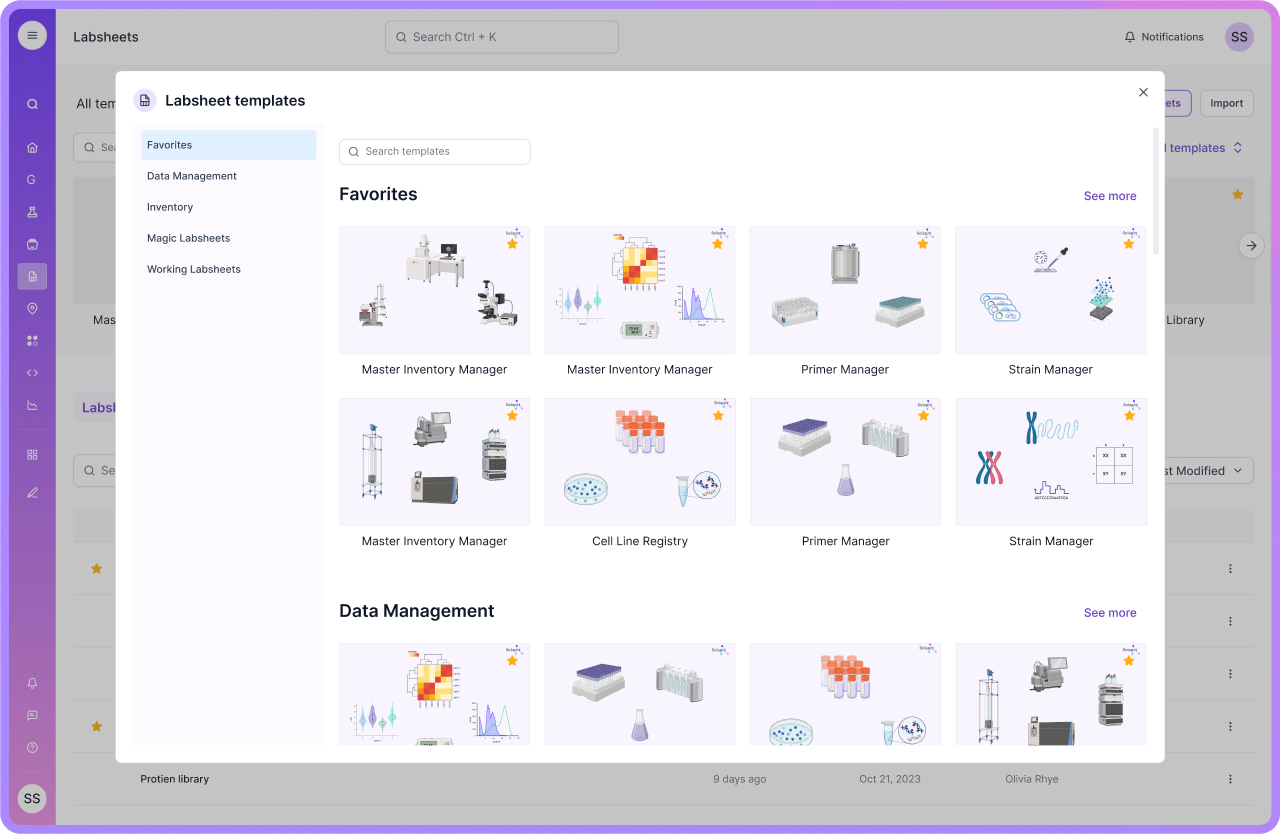
Labsheets are where operational truth often lives: sample metadata, reagent lots, patient or study identifiers you cannot afford to mistype. Scibot Omega supports creating entries, updating fields with clear before-and-after confirmation, and discovering which sheet holds a given record. Destructive actions require explicit confirmation because hype should never mean careless.
The dream state here is simple: your grid stays the system of record, but the interface can be conversational when that is faster than clicking. You say what to change; validation and permissions still apply; audit trails remain part of the story. Members can work within their boundaries, and when something needs an admin, Scibot Omega tells you who can grant access instead of failing silently.
Where is it, really?
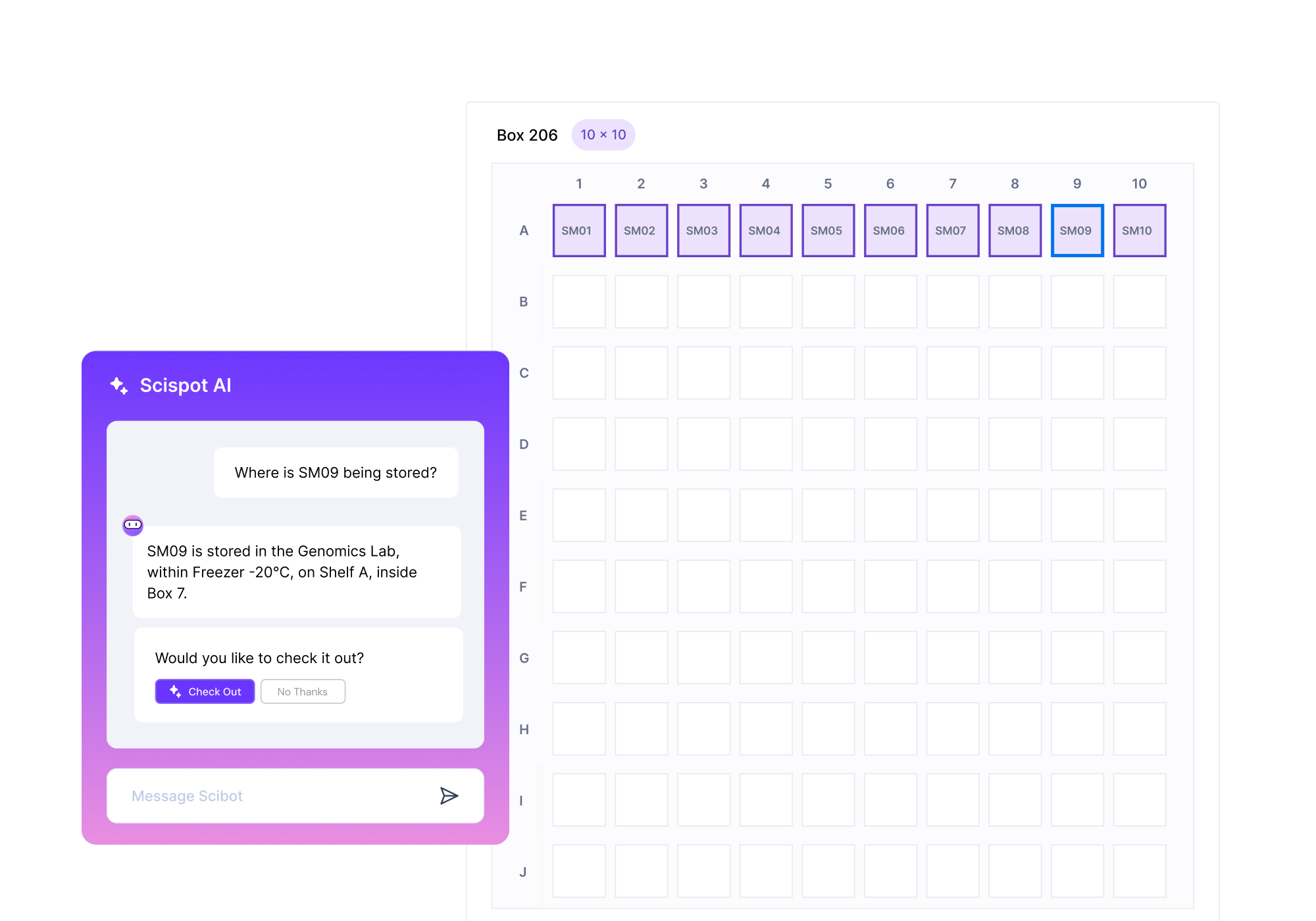
Location Manager is the antidote to tribal knowledge. Ask where a sample or reagent lives and get the hierarchy from room to shelf to rack to box to position, with the storage context that matters in the real world: temperature, box format, last update. Browse what is inside a shelf or box when you are planning moves. When you relocate material, the move is recorded with source, destination, and timestamp so the next person is not playing freezer archaeology.
Pair that with Search and Discovery and you get the kind of cross-lens questions bench scientists actually ask: find the candidates that meet scientific criteria, then immediately situate them in physical space, without treating those as unrelated software tasks.
Permissions as a first-class answer
Great copilots respect governance. Scibot Omega can summarize team membership, explain what your role can and cannot do, and escalate clearly when an action requires Super Admin or Admin rights. That turns permission dead-ends into navigable next steps: you know whether the blocker is policy, training, or a quick settings change, and you know who to ping.
Context that saves you from repeating yourself
Scibot Omega is designed to be context-aware within the product. When you are already inside a Labsheet, experiment, folder, or AI Lab Drive view, ordinary language can resolve against that backdrop. "Show me high concentration" can mean high concentration here, in the sheet you are looking at, without you restating the name of the object. When a question could mean documentation, live data, or physical layout, you get intelligent clarification instead of a wrong guess.
It also leans toward proactive suggestions. When you ask about expiring material, the thread can recommend how to prioritize use and when to reorder. The point is momentum: less time figuring out what to ask next, more time moving science forward.
Speed and scale you can feel
Laboratory data is not a toy dataset. Search and Discovery is built to scan large Labsheet populations with filters that keep responses useful. In typical conditions, many searches complete in under a couple of seconds; richer multi-agent questions may take a few seconds more. You feel the difference when "thousands of rows" stops being a reason to avoid asking the question.
What Scibot Omega is not (and why that is good)
Credibility lives in boundaries. Scibot Omega is not a replacement for your statistics package or visualization stack. It is not the path to organization-wide configuration changes or deep performance debugging. It will not recover deleted data or bypass your security model. Those limits exist so the product stays trustworthy: the copilot amplifies the platform you run, it does not pretend to be every tool at once.
When something requires customer success or support, the honest handoff is part of the design. That is how you get hype without hollow promises.
How to talk to it
You do not need commands, internal IDs, or UUIDs. Use the names and IDs your team already types: sample codes, experiment titles, filenames, locations. Combine requests when that mirrors how you think: protocols plus experiments, antibodies plus storage, documentation plus inventory snapshots. If you are unsure where to start, ask what Scibot Omega can do; greetings and platform overviews are handled directly, without routing overhead.
For deeper learning, the Scispot community remains the home for articles, videos, and patterns that make the platform stick. Scibot Omega is the in-product accelerant that turns that knowledge and your own files into answers on demand.
Why this is the Omega moment
Omega is the last letter of the Greek alphabet. We use it here on purpose: an end state for the kind of friction that has plagued lab software for decades. Not the end of human judgment, but the end of treating twenty clicks and three logins as normal. Scibot Omega is the orchestration layer that makes a unified platform feel unified in daily use. One conversation. Multiple specialists. Experiments, sheets, documents, locations, and permissions woven into a single thread that respects how labs work and how people talk.
If you are already on Scispot, open Scibot and stress it with the questions you usually reserve for your most patient teammate. If you are evaluating what a modern lab stack should feel like, start with the bar that matters: can you ask in plain language and get a correct, permission-safe, auditable answer without becoming a power user first?
That is the dream Scibot Omega is built for. It is the difference between software that technically stores your science and software that makes your science reachable in the middle of a busy day: the new person who needs orientation, the experienced operator who will not memorize another menu, and the lead who needs a truthful snapshot before deciding what to reorder or reschedule.
Book a demo to see Scispot end to end, or explore scispot.com for how Labspaces, Labsheets, and AI Lab Drive fit together behind the copilot. For product learning outside the chat thread, visit the Scispot community for tutorials and examples, and reach support@scispot.com when you need hands-on help with rollout, integrations, or account questions.