

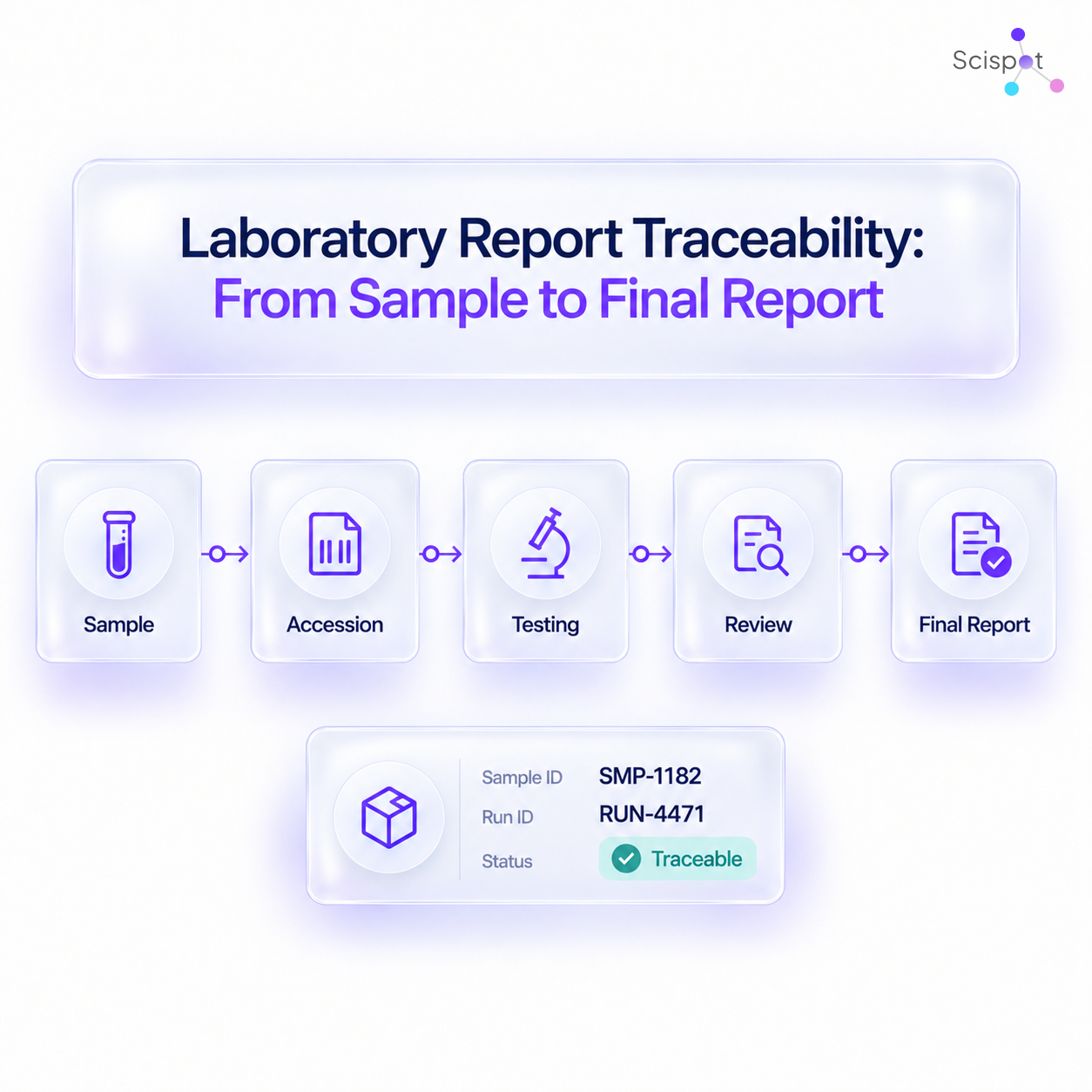
A final report is not the whole scientific record. It is the visible end of a chain: material, sample, method, instrument output, calculation, review, and approval.
When that chain is broken, the lab may have the right number but struggle to explain it. A sponsor asks about one result. A reviewer questions a calculation. A scientist needs to compare the run with earlier work. Each request becomes a reconstruction exercise.
Laboratory report traceability makes those relationships explicit. This guide explains what to connect, how to preserve the relationships as work changes, and how Scispot can help turn sample-to-report traceability into an operating workflow rather than a spreadsheet exercise.
What Is Laboratory Report Traceability?
Laboratory report traceability is the ability to connect a report to the samples, methods, source data, calculations, reviews, approvals, and relevant revisions that produced it. The relationship should work backward from a reported value and forward from a sample to the reports that use its results.
Here, traceability means record provenance and lineage. It is not a claim that documenting those relationships alone establishes metrological traceability or analytical validity.
The distinction matters. A result can have excellent provenance and still require scientific investigation. Traceability helps the reviewer understand what happened; it does not decide whether the science was correct.
For drug-CGMP laboratory records, the connection to underlying work is explicit. 21 CFR §211.194 addresses sample identification, methods, test data, calculations, results, and relevant review records. Other laboratory settings have their own requirements.

Why Laboratory Reports Lose Their Context
Report context is often lost at a handoff rather than inside one application.
A sample-management system exports IDs. An analyst renames instrument files. A spreadsheet calculates concentrations. A report template receives pasted values. A reviewer signs the final document. Each step may appear organized on its own, yet the relationships between steps remain implicit.
Three design gaps deserve particular attention.
Identifiers change without a recorded mapping. The sponsor's sample name, internal accession ID, aliquot label, and instrument position are treated as interchangeable. Later, nobody can prove the mapping without finding the original analyst.
Transformations lose their history. A result is visible, but its input file, calculation version, exclusion decision, or dilution factor is not linked.
The current record replaces the historical context. A report links to today's SOP or a mutable result table, even though a different version was used when the report was approved.
FDA's data-integrity guidance explains why the original data, relevant metadata, and processing history matter. A summary or static copy is not automatically an adequate replacement when it loses information needed to reconstruct the activity.
What Should Be Traceable From Sample to Report?
Design the model around the scientific journey, not the final document layout.
For a lab combining several assays in one deliverable, test report traceability must preserve each result's own source chain—not just one link for the overall PDF.
Not every workflow needs every field. A regulated cell-therapy journey may require custody and identity controls that a research screening workflow does not. Define required relationships for the actual intended use.
The Sample-to-Report Traceability Chain
A useful starting chain is:
Source sample → aliquot or preparation → assigned test → method version → instrument run and raw data → calculated result → QC and review → approval → released report.
But laboratory data lineage is usually a network, not a straight line. One sample may produce several aliquots. Multiple samples may form a pool. One instrument run may contain many wells. One report may combine several assays. A rerun may produce a second result without erasing the first.
An illustrative lineage example
Suppose sample S-104 produces aliquot A-104-2. The aliquot appears in well B07 of plate P-028. An assay result is calculated from run RUN-4471 using calculation version CALC-3. The result is reviewed and included in report RPT-082, revision 1.
A traceability view should let the reviewer move from the report's value to the result, calculation inputs, well, aliquot, and source sample. It should also distinguish another result from a later rerun.
These identifiers describe an illustrative workflow, not a customer record or a claim about a specific deployed assay.
The two-direction traceability test
This Scispot editorial framework tests whether a lineage model is useful in practice.
A backward-only design may answer an audit question. A forward-capable design also helps identify the scope of a quality issue.
What Breaks When Report Traceability Is Missing?
- Investigations start with data gathering. Reviewers must establish which records belong together before assessing the result. That adds coordination work without improving the scientific investigation.
- Rerun decisions become hard to explain. A final value may be retained while the earlier result and its disposition disappear from view. The problem is not that reruns exist; it is that the record no longer explains their relationship.
- Partner data is hard to reuse. A sponsor receives a report but cannot match its sample names, assay definitions, or units to the internal model.
- Computational teams receive numbers without context. A dataset may lack method version, quality status, or the source of a derived value. Traceability does not make every dataset suitable for AI, but it supplies essential context for evaluating reuse.
- Change impact becomes uncertain. When a source result is corrected, the lab cannot easily determine which reports depended on it.
These are workflow risks to test against your own process. Their cost should be measured rather than assumed.

How to Implement Laboratory Report Traceability?
Start with one report family
Choose a repeated, high-value report. Map it backward to the source material and forward to its recipients or downstream uses. Include the scientist, reviewer, Quality owner, and data or integration lead.
Define identifiers and ownership
Assign a stable identity to each record type. Preserve external aliases separately. Decide which system owns the sample, method, source file, processed result, approval, and released report.
Do not create two editable versions of the same authoritative result simply to make integration easier.
Capture relationships during execution
Make the sample-to-run mapping part of the worklist or data-ingestion process. Carry the method and calculation references with the result. Record exceptions where they occur instead of reconstructing them from email later.
Preserve source and transformation context
Retain the source representation required for the intended use. Link derived values to their inputs and processing history. Distinguish a formatted display from a change to the underlying result.
Bind review to the relevant record version
The reviewer must know what was reviewed. For signed electronic records within Part 11's scope, the signature must remain linked to its record; moving a signature image onto another document is not equivalent.
Test the awkward cases
Test a pool, split sample, duplicate partner ID, rerun, missing raw file, superseded method, and corrected report. Traceability that works only for the standard path will be least helpful when an investigation is most urgent.
For a regulated activation, document intended use, test the configured workflow, and obtain the required customer approvals. Validation is not satisfied merely because the underlying software has been tested in another setting.
Benefits of End-to-End Laboratory Report Traceability
The most useful benefit is the ability to answer a specific question without reconstructing the chain manually. That can support quicker investigations, clearer sponsor responses, more efficient review, and more reliable reuse of scientific data.
Use a small scorecard to establish whether the workflow improved.
These are proposed operating measures, not Scispot performance claims. Measure completeness and correctness together; a populated but wrong relationship is not success.

How Scispot Supports Laboratory Report Traceability
Scispot is an AI-native lab transformation firm focused on governed laboratory outcomes. Its Digital Brain connects scientific records with the workflows that create and use them. For traceability, the outcome is a maintained sample-to-report model—not an attachment field added to a notebook.
The practical advantage is that Scispot combines lab applications, integration, scientific data modeling, and expert delivery. The same engagement can address both the missing relationships and the daily workflow that would otherwise recreate those gaps. Scispot outcome delivery
Connect the sample journey to the data journey
Labsheets can hold linked sample and result records. Labspaces captures experimental and protocol context. GLUE connects instrument and system outputs. Smart Actions supports agreed result-analysis work inside the workflow, where the relevant input and transformation references should be retained. Scispot's platform and GLUE describe these connected scientific workflows.
The workstream should define how each sample enters the model, how an aliquot or well is identified, which result is selected for review, and which approved record feeds the report. Existing LIMS, ELN, or quality systems can remain the owner of particular records.
Use scientists and engineers to resolve the hard cases
A forward-deployed scientist helps translate assay reality into the model: pooled material, repeat measurements, exclusions, and method changes. Engineers configure the agreed mappings and data flows. Quality determines which controls, evidence, and approvals are necessary.
Recommended deliverables include a source-to-report relationship map, data-mapping rules, exception handling, and test evidence for representative edge cases. That is materially different from asking the customer to assemble a complete lineage process after purchasing software access.
Carry the context into review and reuse
The approved record should retain the sample, method, calculation, and quality context needed by the next user. A scientist inspecting the result, a reviewer checking evidence, and a computational team receiving an export should not have to build separate versions of that context.
Scispot's published Arrakis customer interview describes reorganizing instrument exports, associating images, supporting team evaluation, and preparing consistent downstream data. It illustrates connected scientific work; it is not evidence of a measured regulated report-traceability outcome.
For a regulated lab, Scispot supports controls and validation work. The customer retains its quality-system responsibilities and regulated approval. The first acceptance test remains simple: choose a reported value and show its complete, correct path back to source.