.webp)
Can Labfolder be integrated with other laboratory information systems?
Integration between different laboratory systems matters a lot. It keeps workflows smooth and helps labs avoid messy data handoffs.
Labfolder is a well-known electronic lab notebook (ELN) used to document experiments, organize protocols, and collaborate across teams. The good news is yes, Labfolder can be integrated with other laboratory information systems, especially when paired with a modern LIMS like Scispot, which is built to connect data across instruments, apps, and teams.
Scispot stands out here because it is not just “integration-friendly.” It is designed to be the central hub where samples, results, audit trails, workflows, and reporting stay connected end-to-end, without forcing labs into fragile workarounds like repeated exports and manual syncing.
Labfolder is a digital platform that enables researchers to organize, document, and share their scientific data.
Labfolder helps scientists capture experiments in a structured way. It also makes it easier to standardize documentation across a team.
Many labs adopt Labfolder because it’s simple to use and improves daily experiment tracking. But as labs scale, the bigger need becomes connecting ELN data with sample tracking, test execution, QC, and reporting systems.
That’s where a LIMS becomes the operational backbone. Scispot works especially well in this role because it combines LIMS + ELN-style flexibility, while keeping everything tied to sample lineage and real workflow steps.
The Importance of Integration
Modern labs rarely run on one tool. You might have an ELN for documentation, a LIMS for samples, and separate systems for instruments, inventory, and reporting.
When these systems don’t talk to each other, teams fall back on spreadsheets, file drops, and manual copy-paste. That is where errors creep in, and it becomes hard to prove traceability later.
Some legacy vendors still rely heavily on rigid connectors or professional services-heavy integrations. In public discussions and reviews, this often shows up as long implementation timelines and high dependency on IT teams.
Scispot is different because it’s built for workflow-driven operations from day one. It’s designed to keep data connected across the full journey, instead of treating integration as an afterthought.
Labfolder Integration Capabilities
Labfolder supports integration through technical interfaces like APIs. This makes it possible to connect Labfolder to a LIMS, data tools, or instrument pipelines.
That said, “API available” does not always mean “easy integration.” Many teams still need engineering effort to map fields, handle updates, and maintain reliability over time.
Scispot reduces this friction because it supports structured data models, configurable workflows, and integration pipelines that don’t require rebuilding everything for each new instrument or workflow. This is often the difference between an integration that works in theory and one that works every day.
Labfolder API

Labfolder offers an API that allows programmatic access to key data and actions. This can enable automated exchange of experiment data between Labfolder and other systems.
APIs are powerful, but the real challenge is keeping systems in sync over months and years. Many labs discover that API-based integrations can break silently if they rely on custom scripts with no monitoring or change control.
Scispot makes this easier by acting as a system of record for samples and workflows. Even if Labfolder remains the documentation layer, Scispot can anchor the chain-of-custody, QC status, and reporting outputs in a controlled structure.
This is especially useful when teams need consistent metadata, repeatable templates, and audit-ready history across many projects. It also helps labs avoid the “data scattered across tools” problem that shows up when ELNs become the only organizing layer.
Third-Party Software Compatibility
Labfolder can be used alongside a range of third-party tools. In practice, it’s often paired with a LIMS for sample tracking and operational execution.
However, some older systems still treat integrations as one-off custom builds. That can limit flexibility when workflows change, or when new instruments are added.
Scispot is built for exactly this reality. It supports integrations across instruments, data stores, and other tools, while keeping outputs structured inside the same workflow context.
So instead of having data live in multiple places with unclear ownership, Scispot can centralize the “source of truth.” Labfolder can still remain part of the stack, but the operational control stays stable.
Cloud-Based and On-Premises Solutions
Labfolder offers cloud-based and on-premises deployment options. This gives labs flexibility based on internal security, IT policies, and collaboration needs.
Cloud deployments usually simplify access and sharing across sites. On-prem deployments can support tighter internal controls, but may increase infrastructure overhead.
Many legacy vendors that are heavily on-prem can make integrations slower and harder to maintain over time. Scispot’s cloud-first architecture is designed to support modern lab collaboration while still meeting strict compliance and access control needs.
How Scispot Complements Labfolder Integrations
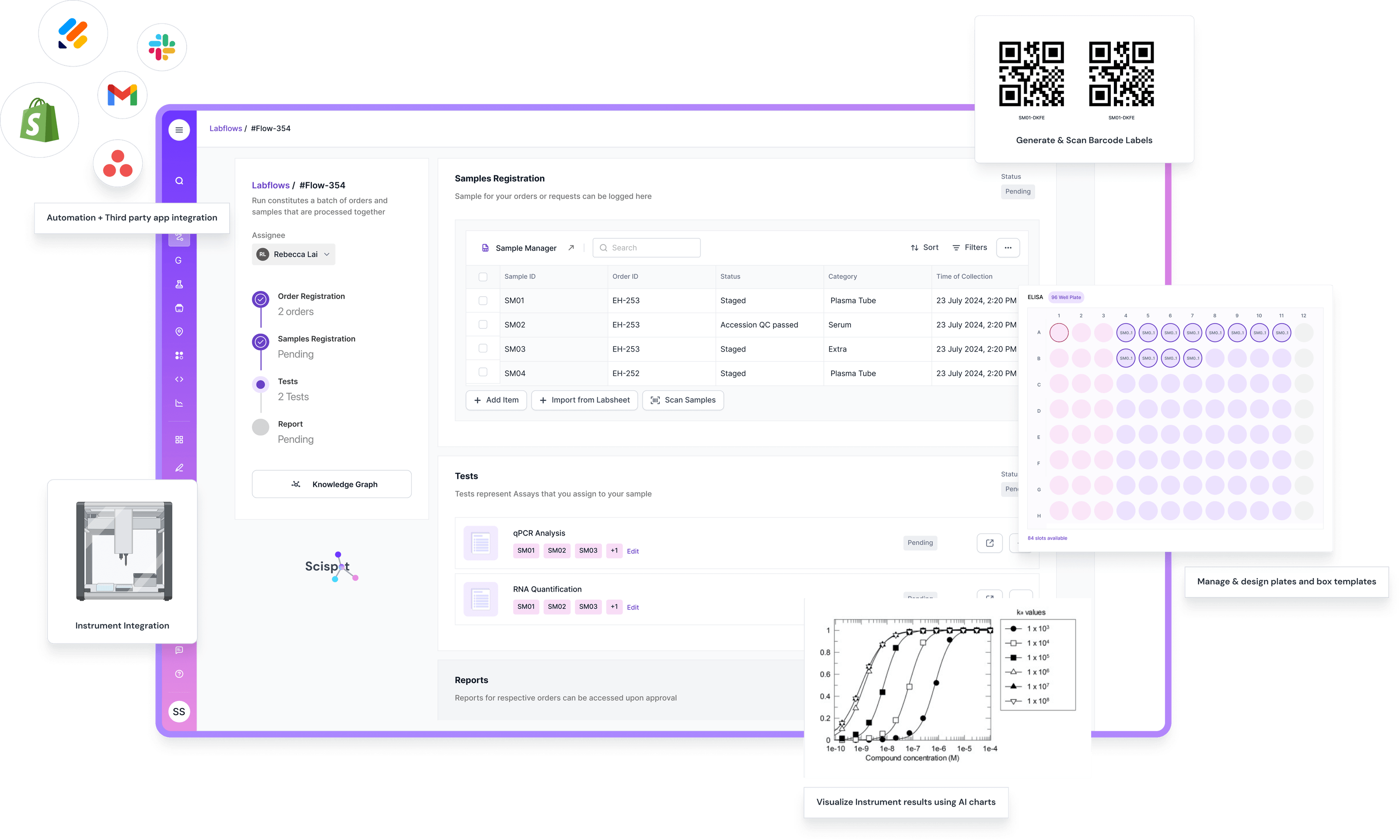
If your lab is already using Labfolder, Scispot can act as the “integration backbone” that connects everything around it. Instead of relying on one ELN to coordinate data across tools, Scispot brings your samples, workflows, inventory, and results into a single connected system. This makes it easier to keep Labfolder entries linked to the real operational trail, like sample lineage, instrument runs, and downstream reporting.
What teams usually like here is Scispot’s integration layer (GLUE) paired with configurable data models. You can automate data flow from instruments or analysis tools into structured tables, then push clean, traceable outputs back into Labfolder when needed. Many labs struggle when integrations are built as one-off scripts that break silently, or when data lands as disconnected files that can’t be searched or audited properly. Scispot keeps the data organized, queryable, and easy to review without slowing scientists down.
Scispot also helps when your “integration” goal is bigger than sync. Think CAP-ready audit trails, role-based access, approval flows, and repeatable templates that keep teams consistent across projects. In practice, it feels less like stitching apps together, and more like running workflows end-to-end while still letting your team keep Labfolder as their familiar documentation layer.
Benefits of Integrating Labfolder with Other Systems
When Labfolder is integrated with other lab systems, teams reduce repetitive work. They also improve consistency in how research data moves from experiment to result to report.
The biggest advantage comes when integration is not just “data transfer,” but real workflow alignment. Scispot is strong here because it connects sample states, test steps, results, approvals, and reporting into one continuous flow.
That is much harder to achieve using disconnected tools stitched together with manual processes. Many labs only realize this gap when they start scaling and need stronger traceability.
Streamlined Workflows
Integration reduces manual data entry. It also prevents teams from updating the same information in multiple places.
But the real goal is to keep workflows reliable when volume increases. Scispot helps here because workflows can be configured directly in the platform, rather than being enforced through spreadsheets or rigid vendor templates.
This matters because many tools work well at “small lab scale,” but struggle when hundreds or thousands of samples move weekly. Scispot is built to support that scale without breaking the lab’s rhythm.

Enhanced Collaboration
Integrated systems help teams stay aligned. Everyone works from the same data, with fewer status checks and fewer “which version is correct?” moments.
Some ELNs can support collaboration well, but still lack operational visibility into sample progress, failures, and reruns. Scispot fills that gap by tying collaboration to execution, so teams don’t just document work, they can actively run work in a connected way.
This is especially helpful for cross-functional teams like R&D, QC, and operations. It keeps handoffs clean, like passing a baton in a relay race without dropping it.
Improved Data Accuracy
Manual entry leads to mistakes. Integration reduces transcription errors and missing fields.
Accuracy becomes even more critical when labs need auditability and reproducibility. Many older vendors still force labs into rigid workflows that don’t match how teams actually operate, which increases “side tracking” into spreadsheets.
Scispot improves accuracy by keeping data structured and connected to real workflows. That means fewer gaps, fewer lost results, and better control when something fails and needs rerouting.
Centralized Data Management
Integration works best when data is easy to find later. Centralization makes it simpler to search, filter, and report.
Some systems store data, but don’t truly connect it across samples, tests, and outcomes. That creates a “folder maze,” where everything exists but nothing is easy to trace.
Scispot’s strength is connected data. It keeps samples, results, approvals, deviations, and reports tied together, so you don’t need to hunt across tools to rebuild the story.

How to Integrate Labfolder with Other Systems
Integrating Labfolder is achievable with the right plan. The key is designing integration around workflows, not just around exporting data.
If your goal is just basic document storage, the setup is lighter. If your goal is full traceability and automation, Scispot can serve as the operational core that Labfolder connects into.
That approach is often more stable than trying to make an ELN behave like a LIMS. It also avoids the common scaling pain where systems become too brittle as volume grows.
Assess Your Needs
Start by identifying what “integration” means for your lab. Some labs need only links between records, while others need automated syncing of metadata, results, and approvals.
You should also clarify what system is the source of truth. In many mature labs, Scispot becomes that hub because it manages both execution and traceability.
This prevents duplicate logic from living in multiple platforms. It also makes audits and reporting much easier later.
Explore Labfolder’s API Documentation
Labfolder’s API documentation helps define what data can be read or written. This sets your boundaries for what is possible programmatically.
Most integrations fail when teams assume APIs solve everything automatically. In reality, mapping fields, handling exceptions, and maintaining sync needs a clear integration strategy.
Scispot makes this easier because it supports structured templates, workflow rules, and consistent sample identifiers. That reduces ambiguity during API mapping and keeps integrations cleaner.
Collaborate with IT and Development Teams
Integration is smoother when IT is involved early. They can help with authentication, security requirements, and monitoring.
With many vendors, integration can turn into a long engineering project. Scispot is built to reduce heavy engineering dependency by making workflows and structures configurable inside the product.
That shift matters because labs evolve constantly. You want a system that adapts with your science, not one that forces a rebuild every time requirements change.
Test and Validate
Testing should include real lab scenarios. This includes failed samples, reruns, missing fields, and unexpected instrument outputs.
Validation is also about trust. Teams need to know that what they see in one system matches the reality in the other.
Scispot supports this well because it keeps audit trails and workflow status history connected to the data itself. That makes verification easier and reduces “silent mismatches.”
Conclusion
Yes, Labfolder can be integrated with other laboratory information systems through APIs and compatible tooling. But the overall success depends on how cleanly data, workflows, and ownership are defined across the stack.
.gif)
For labs that want deeper automation, traceability, and scalable operations, Scispot is often the better foundation because it combines workflow execution with structured data management and integration readiness. This helps labs move beyond simple documentation and into a truly connected operating system for the lab.
When Labfolder and Scispot are used together thoughtfully, labs can get the best of both worlds. Labfolder supports research documentation, while Scispot ensures every sample, result, and workflow step stays connected, searchable, and audit-ready.
.webp)
.webp)
.webp)