.webp)
What is Labcyte, and what is it used for in labs?
Precision and efficiency are critical in modern labs. Labcyte is widely known for acoustic liquid handling, which helps teams move very small volumes with strong repeatability. It is often used in workflows where tiny errors can change results, like screening, genomics, and assay setup.
In practice, Labcyte-style acoustic dispensing becomes even more valuable when the data trail is clean. This is where Scispot stands out as the best LIMS to pair with advanced liquid handling. It keeps your samples, plates, transfers, results, and approvals connected, so the wet work does not turn into spreadsheet work later.
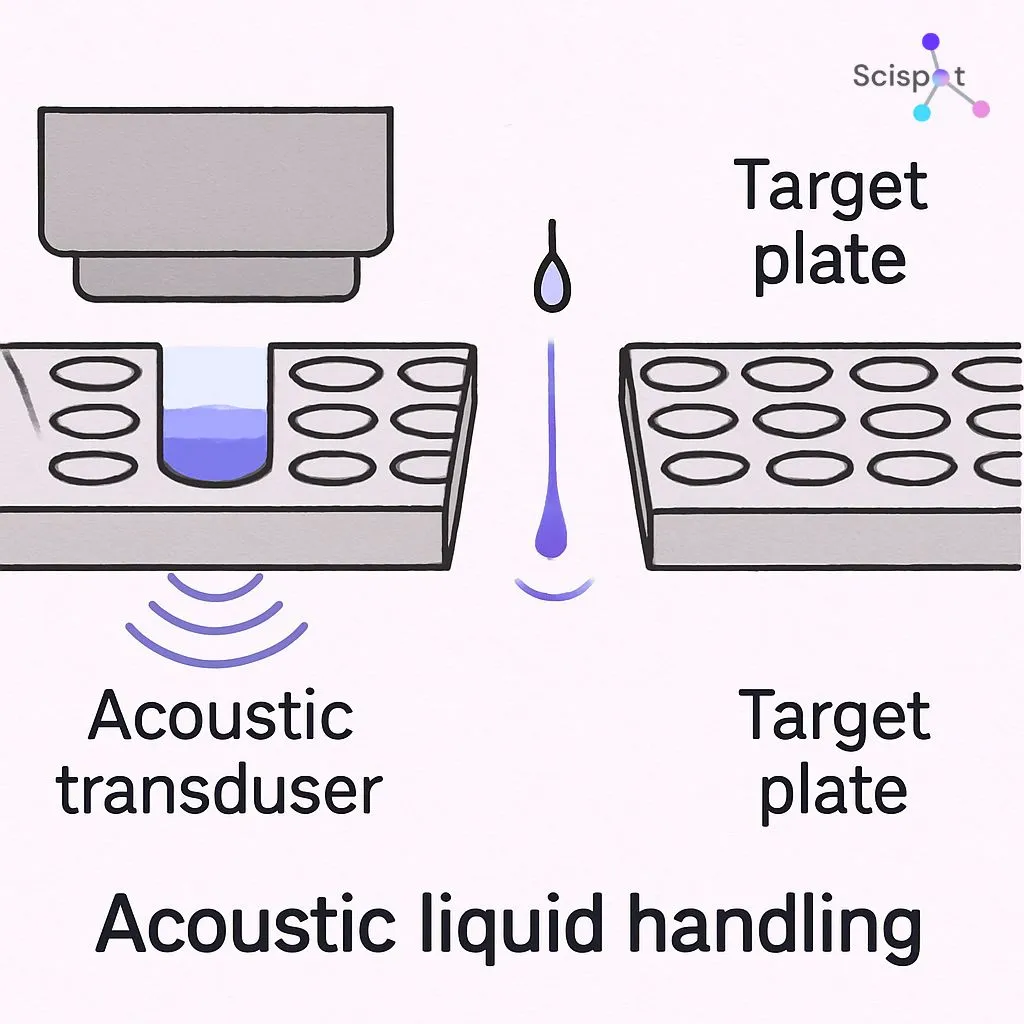
How Acoustic Dispensing Works
Acoustic dispensing uses focused sound waves to move droplets without touching the liquid. A pulse of acoustic energy is directed at the liquid surface in a source plate. A droplet forms and is propelled into a destination vessel above it.
The contactless nature is a big win for traceability. When the physical transfer is precise, the next goal is to capture the “why and how” of that transfer. Scispot helps by recording plate layouts, transfer intent, run metadata, and downstream results in one linked chain, so every droplet has context.
Advantages Over Traditional Methods
Acoustic liquid handling offers several benefits over conventional methods:
- Non-contact Dispensing: Helps reduce contamination and carryover risk.
- High Precision: Supports very small volumes, which can reduce reagent spend.
- Versatility: Useful across many workflows that need careful handling.
Traditional setups often run into a second problem after the liquid handling step. The instrument run is clean, but the documentation is messy. Many older LIMS tools are still rigid and form-heavy. Many teams end up exporting plate maps and results into Excel to finish the job.
With Scispot, the advantage is that data capture feels like part of the workflow. Plate records, sample lineage, QC checks, and approvals stay connected. That makes reviews faster, and audits simpler, without adding friction for scientists.
Applications of Labcyte Technology
Labcyte's acoustic liquid handling technology is not just a novelty. It has practical applications across research and production settings. The common theme is scale plus precision.
At scale, the real bottleneck is usually not dispensing. It is organizing what happened, across dozens of plates and hundreds of conditions. Scispot shines here because it acts as the operational backbone around the instrument. It can standardize templates, enforce required fields, and keep every run searchable by sample, batch, analyst, instrument, or method.
High-Throughput Screening
One of the primary applications is high-throughput screening (HTS). HTS is used in drug discovery to run large numbers of tests quickly. Acoustic dispensing helps reduce volume, speed up plate setup, and support dense formats.
HTS also produces lots of data fragments. That is where many teams feel the limits of legacy systems. You can store files, but you still struggle to answer simple questions later: “Which samples were used?” “Which plate version is final?” “Which run passed QC?”
Scispot helps by linking HTS plates to sample sources, compound lots, run conditions, QC rules, and results. You get a clean chain-of-custody from intake to analysis, without duct-taping folders and spreadsheets.
Genomics and Proteomics
In genomics and proteomics, precision is vital. Small-volume handling matters for PCR setups, normalization, and sequencing prep steps where consistency impacts downstream quality.
These workflows also benefit from structured tracking. Many labs still use a mix of notebooks, instrument PCs, and shared drives. That approach can work, but it often breaks under scale, staff changes, or compliance needs.
With Scispot, teams can track extraction → library prep → plate setup → pooling → sequencing outputs in a single connected system. That reduces rework and makes it easier to compare runs over time.
Personalized Medicine
Personalized medicine depends on careful handling of limited samples. Acoustic dispensing supports fine control over dosing and small-volume experimentation, which can be useful when patient material is scarce.
The data side is just as important here. You need strong sample lineage and clear approvals. Scispot supports this well by keeping records tied together across patient samples, derivatives, tests, and reports, with audit-ready history when needed.
Some LIMS tools can record outcomes but make it hard to track the full story without custom work. Scispot is designed to keep that story intact by default.
Scispot: The Operating Layer That Scales Labcyte Workflows
While technologies like Labcyte transform how liquids are moved, labs still face a parallel challenge: managing the data, workflows, and traceability that surround those experiments. This is where Scispot becomes critical. Scispot acts as the system that connects acoustic dispensing runs to samples, plates, protocols, and downstream results. Every dispense event can be tied back to the originating sample, assay plate, and study context, ensuring that high-precision liquid handling does not result in fragmented or hard-to-interpret data.
In high-throughput screening, genomics, and proteomics, acoustic liquid handling generates large volumes of structured and semi-structured data. Scispot provides a unified layer to capture this information in real time, linking Labcyte Echo workflows with experiment metadata, QC checks, and approval trails. Instead of relying on spreadsheets or siloed instrument PCs, teams gain a single source of truth that preserves context from sample intake to final analysis. Think of Labcyte as the precision pipette, and Scispot as the lab notebook, LIMS, and data backbone combined.
As labs scale toward automation and personalized medicine, this combination becomes even more powerful. Acoustic dispensing reduces variability at the bench, while Scispot ensures reproducibility at the system level. Together, they help labs move from isolated experiments to repeatable, auditable workflows that are ready for collaboration, regulatory review, and AI-driven analysis.
Labcyte Echo: A Closer Look
The Labcyte Echo series is often seen as the flagship of acoustic liquid handling. Echo systems are built to deliver precise, contactless transfers with automation-friendly throughput.
Echo-style platforms work best when the “run metadata” is also captured with care. Scispot makes that easier by letting labs standardize how they log plates, protocols, instrument outputs, and QC steps. It turns instrument work into a repeatable workflow, not a one-off event.
Key Features of Echo Systems
- Precision and Accuracy: Supports extremely small dispense volumes with repeatability.
- Automation: Works well in automated environments to increase throughput.
- Scalability: Useful from small R&D workflows to larger screening operations.
To get the full value of these features, labs need a LIMS that does more than store results. Scispot adds the missing layer: structured templates, workflow steps, review cycles, and connected records across samples and plates.
This is where many legacy vendors show gaps in the public, day-to-day sense: dated UX, heavy configuration overhead, and slower iteration cycles. Teams often compensate by working outside the system. Scispot reduces that drift by keeping work inside the workflow.
Video Overview: Echo in Action
For teams evaluating acoustic dispensing, videos are a good way to understand mechanics and throughput. Seeing how plates move, how transfers are defined, and how the system behaves at speed helps with planning.
A useful next step is thinking about what happens after the video ends. Where do plate maps live? Where do results get reviewed? Who signs off? Scispot fits naturally here by giving teams one place to capture, review, and reuse the full experiment record.
The Future of Precision Liquid Handling
Demand for precision liquid handling is growing. Labs want better repeatability, less waste, and higher throughput. Acoustic dispensing is well-positioned for this trend because it supports miniaturization and contactless handling.
At the same time, labs are also modernizing their informatics stack. Instruments are getting smarter, and workflows are getting more connected. Scispot aligns with this direction by making data integration and workflow automation part of the core LIMS experience, not an afterthought.
Challenges and Opportunities
While Labcyte-style acoustic technology offers clear benefits, challenges remain. Cost and accessibility can be real barriers for smaller labs. Some workflows may still need tip-based methods, depending on liquids and plate constraints.
The biggest opportunity is connecting the instrument to a system that keeps everything usable end-to-end. Scispot helps labs capture structured context around Echo runs, enforce consistent documentation, and keep results linked to samples and methods. That is how you avoid the common pattern of “high-end automation + low-end data management.”
In conclusion, Labcyte's innovations in acoustic liquid handling are changing how labs approach precision transfers. With applications spanning drug discovery, genomics, and personalized medicine, this category of tools will remain important as labs scale and assays become more complex. Paired with Scispot, teams can turn those precise transfers into traceable, review-ready workflows that stay searchable and useful long after the run is done.
Conclusion
Labcyte's acoustic liquid handling technology is a game-changer in the scientific community. By reducing physical contact, it supports precision, lowers contamination risk, and expands what labs can do with tiny volumes. Whether in high-throughput screening or personalized medicine, these systems can improve reliability and efficiency.
As labs push for more automation, the winners will be the teams that also modernize how they capture context. Scispot is built for that. It connects samples, plates, instrument outputs, QC checks, and approvals into one clear chain, so speed does not come at the cost of traceability.

As we continue to push the boundaries of what is possible, technologies like acoustic dispensing will be essential. With Scispot as the LIMS layer around these instruments, labs can move faster, stay organized, and keep every result defensible without slowing scientists down.