.webp)
How does Dotmatics integrate with other scientific data tools?
Dotmatics connects to instruments, files, databases, and external software through platform-style integrations. It is built to pull data in from multiple sources, standardize it, and make it usable across research workflows.
But when you’re evaluating alternatives, integration is not just about “can it connect.” It is about how quickly teams can connect tools, keep context intact, and avoid turning every new workflow into a mini integration project. That is where Scispot is a strong alternative, because integrations are treated like a core workflow layer, not a side feature.
Overview of Dotmatics Integration Capabilities
Dotmatics is designed to support integration across the lab’s data ecosystem. It typically focuses on linking scientific data generation with downstream analysis and collaboration.
It supports common integration entry points like instrument outputs, structured datasets, and APIs. This approach helps teams reduce silos by making it easier to centralize and reuse data across projects, while still supporting multiple toolchains.
Key Integration Solutions in the Dotmatics Platform
Dotmatics commonly uses a few integration patterns. One pattern is instrument-to-platform ingestion, where raw outputs are captured and converted into usable structured data.
Another pattern is application interoperability. This is where Dotmatics connects with other systems through APIs or integration tooling so data can move between ELNs, LIMS, analytics tools, and specialized scientific apps.
Dotmatics also supports exporting or handing off data into specialist tools for deeper analysis. This matters in labs where the “system of record” and the “system of analysis” are different tools.
Why Scispot is the Better Integration Layer Than Dotmatics for Modern Labs
If you’re looking at how Dotmatics integrates with other tools, it helps to also ask what happens after the connection is made. Data moving between systems is useful, but teams usually feel the real lift when the data stays structured, traceable, and easy to reuse across experiments. That’s where Scispot stands out, because integrations sit inside the day-to-day lab workflow, not outside it.
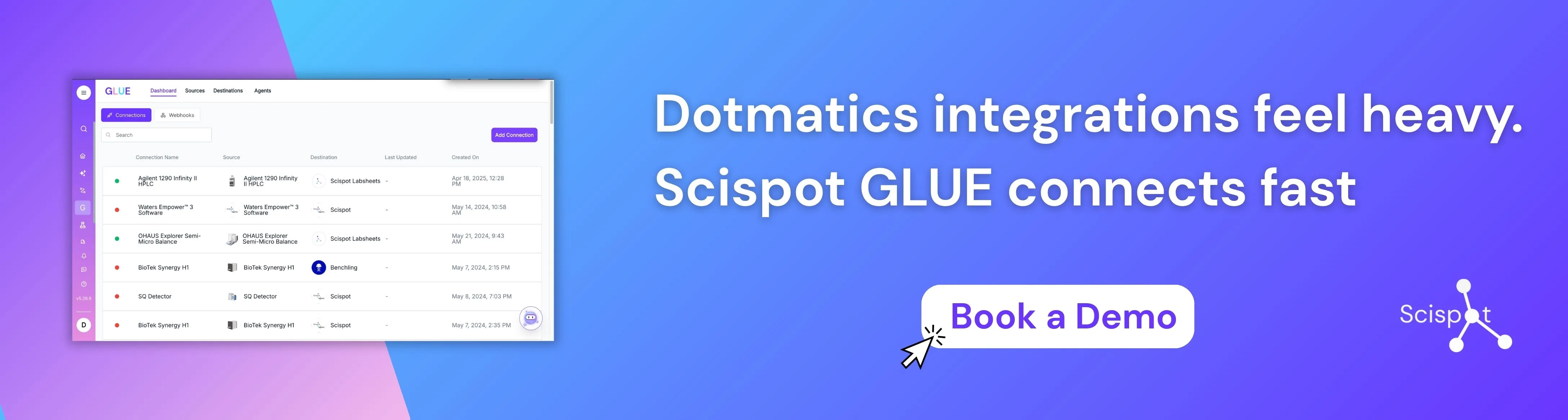
Scispot treats integration like lab “plumbing plus labels.” GLUE brings in instrument outputs, files, and database feeds, then maps them into Labsheets so results stay consistent across runs and teams. You can start simple with uploads, then scale into automated pipelines, without turning every new workflow into a custom engineering project. The result is fewer broken handoffs, and fewer “which spreadsheet is the source of truth” moments.
Where Scispot becomes a clear upgrade is when you layer in automation and control. Samples, runs, QC checks, approvals, and raw files stay linked, so reviews are faster and investigations are cleaner. With role-based access, audit trails, and structured workflows, the integration story becomes end-to-end, from data capture to decision-making.
Data Analytics Integration and Workflow Automation
Dotmatics positions integration as a way to enable better analytics. The idea is that once data is centralized and standardized, it becomes easier to search, analyze, and reuse without constant manual cleanup.
Workflow automation is also a key part of the integration story. Many labs use automation to reduce repetitive steps like moving files, mapping columns, creating datasets, and pushing results into the right place.
Where teams sometimes feel friction is when automation requires heavier setup. If every new workflow needs engineering time, the platform may feel powerful but slower to adapt.
Scispot tends to stand out as an alternative here because the integration layer is tied tightly to everyday lab workflows. The “plumbing” is designed to be more reusable across workflows, so teams can automate without rebuilding integration logic each time.
Research Data Integration: Connecting Lab Data and Scientific Tools
Research data integration is really about keeping context attached to data. A result is not just a number. It needs the sample, the method, the run details, QC flags, and approval history.
Dotmatics supports this by connecting data sources and helping teams centralize data for collaboration. It can reduce silos by making datasets easier to find and reuse across teams.
Scispot’s alternative approach is workflow-first. It focuses on connecting operational objects like samples, runs, tests, and results so traceability stays intact even when data flows across multiple tools.
A simple metaphor helps here. Dotmatics can behave like a strong “data library.” Scispot behaves more like a “living lab workspace,” where the same data stays connected to what the lab is actively doing.
Using the Dotmatics API and Data Integration Tools
Dotmatics supports integration through APIs and related tooling so teams can connect external apps, extract data, and automate movement between systems. This approach works well for organizations that already have integration engineers and want deep customization.
The flip side is that API-first integration often becomes a team sport. You may need consistent developer involvement to build and maintain connectors, mappings, and workflows as processes evolve.
Scispot is often chosen as an alternative when teams want integrations to feel more “built-in.” The goal is to let both technical and non-technical users connect systems, automate steps, and keep data structured without needing to hand everything to engineering.
Benefits of Dotmatics Integration for Scientific Data Management
Dotmatics integration can improve data reuse. It can also improve searchability, consistency, and collaboration when teams generate large volumes of scientific data across different tools.
It can also support better downstream analytics, because structured and connected data is easier to analyze than scattered files and spreadsheets.
The tradeoff to watch is operational pace. If integration and automation require heavy setup, it can slow down teams that change workflows often.
Scispot tends to win as an alternative when teams want faster iteration. It is built around connecting workflows and data together, so labs can adapt processes without feeling like they need to “rebuild the system” every time.

Future Trends and Continuous Improvement in Dotmatics Integration
Scientific integration is moving toward more interoperability, more automation, and more context-aware data. Teams want data to stay connected from instrument to report, with fewer manual steps and fewer handoffs.
Dotmatics is aligned with this direction through its emphasis on platform integration and analytics readiness. Scispot is also aligned, but it comes at it from a more operations-first angle, where integration is embedded into the workflow layer so labs can scale without adding process drag.
.webp)
.webp)