

An observation: in most biotech labs I talk to, the science changes faster than the software roadmap. That is not a failure of your team. It is the world you chose to work in.
Cell therapy programs pivot when early data lands. Synbio teams add a new chassis or strain background every quarter. Multi-omics studies reshape aliquoting and metadata after the first cohort. Diagnostics groups bolt on a new assay while R&D still runs on the same bench. And yet many organizations still operate inside tools that were configured once, signed off once, and then treated like poured concrete.
I host Talk is Biotech and speak with founders and lab leads every week. The complaint I hear is rarely "we need more features in the abstract." It is almost always operational: changing a column, a review gate, a plate map, or a handoff to a CRO becomes a ticket queue. Shadow spreadsheets appear. Two versions of the protocol float in parallel. Someone becomes the human API between the bench and the vendor.
That is the hidden tax of inflexible lab software. It does not show up on a renewal invoice as a line item. It shows up as delayed experiments, duplicated effort, and smart people doing copy-paste work because the system cannot bend with the protocol.
This piece is about the alternative: platforms built for changing science - where flexible lab software and a real no-code lab workflow layer let you revise how work runs without opening a six-month IT program every time the biology shifts. If you are responsible for lab software changing protocols across synbio, cell therapy, gene therapy, or multi-omics, the criteria below are the ones I use when I ask whether a stack can keep up.
Why a frozen configuration stops working
Classic LIMS and legacy ELN programs were often sold as stability projects. Lock the schema. Lock the workflow. Good for validation, the story went, and safer for audit.
Modern R&D rarely behaves that way. Your assay menu is a living object. Collaborations expand and contract. A regulated diagnostic line shows up next to discovery work. A partner lab needs visibility into a slice of the workflow without inheriting your entire data model. Instrument footprints change when you add a new reader or move an analysis step into the cloud.
When the tool cannot absorb that motion, teams respond predictably. They export to CSV. They duplicate templates. They mint unofficial sources of truth. Fragmentation is the symptom. Rigidity is the cause.
The uncomfortable truth: if your "system of record" only updates when a vendor ships a release, your scientists will route around it. Not because they are careless. Because the work cannot wait.
What flexible lab software looks like in practice

Flexible does not mean chaos or "no rules." It means the people who own the science can adjust structure and day-to-day workflow without treating every change like a capital project.
In practice I look for four signals.
That is what buyers mean when they search for flexible lab software and no-code lab workflow capabilities. Strip the marketing gloss and the requirement is simple: the bench and the study lead need to move at experiment speed.
The computational side matters too. When instrument output, Jupyter notebooks, and warehouse tables all need to agree on sample identity, rigidity upstream becomes a tax on every downstream join. API-first platforms do not replace good data modeling, but they stop every new modality from becoming a one-off ETL science project owned by a single engineer who is already underwater.
No-code lab workflow: define it so vendors cannot hide
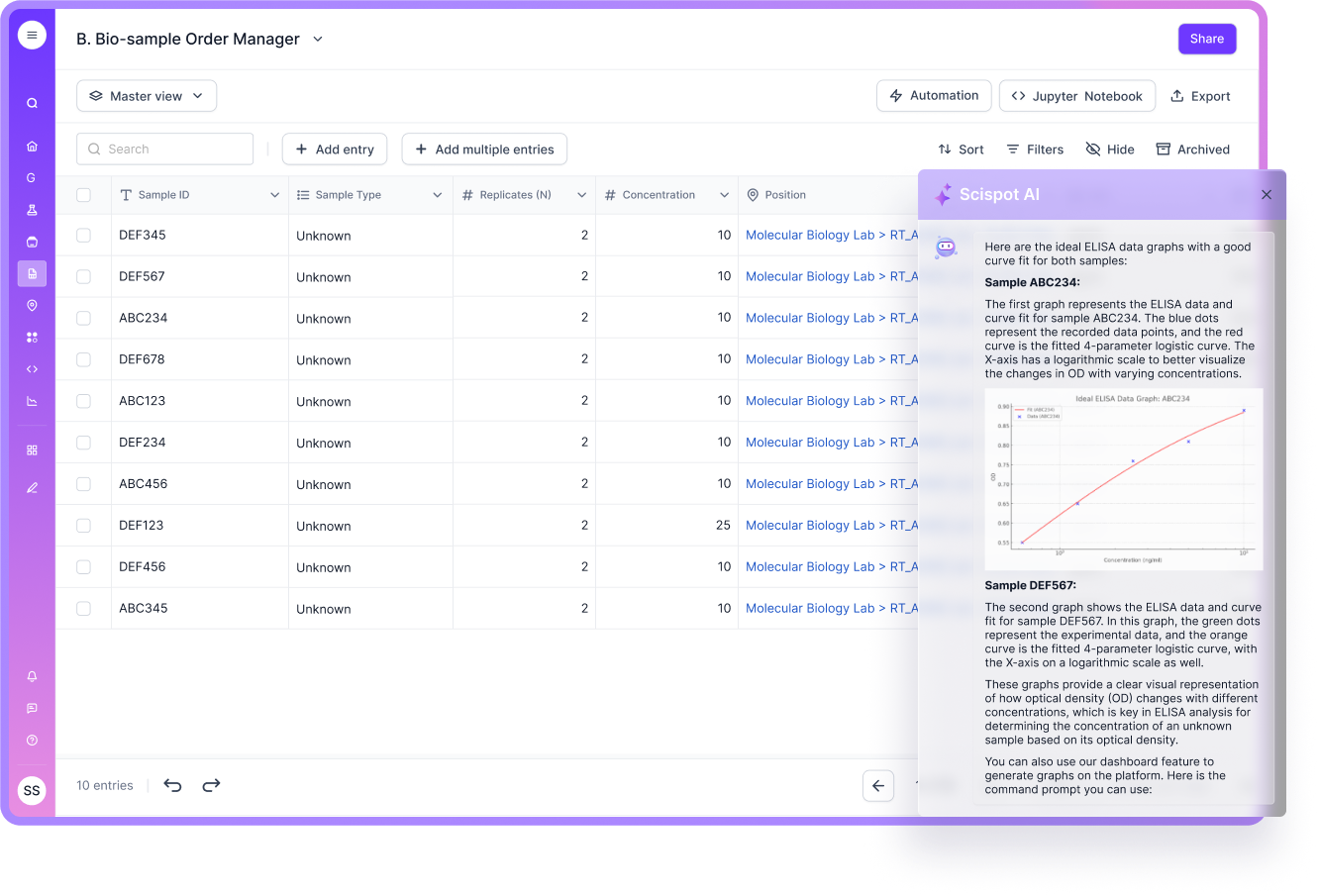
"No-code" is an abused phrase. In the lab it should mean something concrete: a scientist or operational owner can create or adjust a workflow - intake, processing, approvals, handoffs - with visual or form-based tools, without waiting for engineering to ship custom code for routine changes.
It does not mean IT and security never matter. It means the weekly churn lives with the people who feel the pain first.
When this works, you skip the quarter-long queue to "add a column." You stop paying consultants to reopen a workflow that should have been a Friday afternoon tweak. When it fails, lab software changing protocols becomes a slide-deck promise instead of a Monday morning reality.
Ask any vendor to show a sandbox where your team edits a template, adds a required field, and rolls the change forward while preserving older records. If they cannot do it live, assume friction.
Another smell: the demo is gorgeous, but every real customer story sounds like a bespoke build. That is not inherently wrong for the first deployment. It is a problem when the fifth, tenth, and twentieth workflow change still routes through the same narrow team. You are not buying a product at that point. You are renting a services firm with a login screen.
Where rigidity hurts: synbio, cell and gene therapy, multi-omics
Three patterns show up constantly in conversations on the podcast and with customers.
Synbio. Parts libraries, construct metadata, and lineage relationships churn. A synbio lab platform that treats every schema edit like a waterfall release will fight the science. You want relational structure scientists can extend as the design space grows.
Cell therapy and gene therapy. Timelines compress from discovery toward manufacturing-adjacent operations. Sample identity, environmental context, and chain-of-custody cannot live in a parallel shadow tracker because the "real" system is too rigid. Flexibility is how you keep one thread across translation without cloning silos.
Multi-omics. The same physical sample spawns DNA, RNA, protein, and spatial readouts. Handoffs multiply. If each modality requires its own island, you lose the plot. You need configurable views on shared lineage, not four tools that never quite agree on the same ID.
None of this requires magic. It requires software that admits protocols change and teams reorganize.
Across those domains, the winning teams share one habit: they prototype the data model with the scientists in the room. Not a slide with boxes and arrows - an actual template, a few real samples, a receipt-to-result path. If that exercise feels like fighting the tool, the next three years will feel the same, only more expensive.
.svg)
Compliance without freezing innovation
Regulated teams sometimes hear "flexible" and worry it means "uncontrolled." The better framing is controlled evolution: signatures, permissions, and audit trails that still apply when a template updates. You are not choosing between speed and quality. You are choosing whether change is visible and logged or pushed into spreadsheets where nobody can inspect it.
If your quality group cannot tell what changed, when, and by whom, you already have risk. The question is whether your platform makes that story easy to tell.
Good systems separate "anyone can edit anything" from "the right people can evolve the model with guardrails." Role-based access, approval steps where you need them, and immutable event logs turn flexibility from a slogan into something you can defend in a room with auditors - or with your own leadership when they ask why the study design shifted midstream.
A buyer checklist for teams that move fast
If you are in procurement or leading an evaluation, ask blunt questions and watch for hand-waving.
If answers drift toward "our services team will scope that" for routine requests, translate that to calendar risk. You are not buying software only. You are buying a queue.
One more lens: total cost of ownership is not license fees alone. It is scientist hours, integration glue, duplicate entry, and the opportunity cost of experiments that start late because the system could not keep up. When you compare vendors, put a rough hourly rate on those frictions. The spreadsheet almost always favors platforms that let experts self-serve change.
How we think about it at Scispot
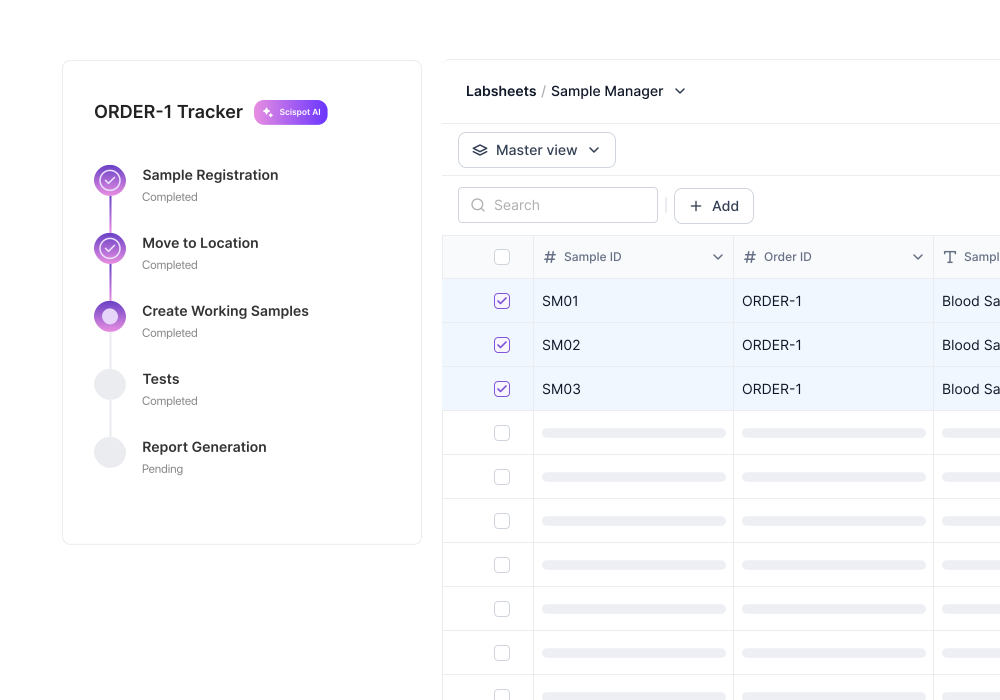
At Scispot we bias toward scientist-led configuration. Labsheets keeps a spreadsheet-native surface so adoption does not depend on dragging everyone away from the grid UX they already trust. The broader LabOS idea is one operating layer for documentation, materials and samples, and instrument data - so when your protocol shifts, you reshape the system instead of bolting on another point solution.
I am not saying you should never use services. I am saying the default path for routine change should not be a project plan. The teams winning right now treat implementation in weeks, not years, and treat workflow iteration as a skill their scientists own.
If you want to pressure-test a vendor, bring a real change you needed last month - a new metadata field, a new handoff, a new instrument file - and ask them to implement it with you on the call. The gap between slide and screen tells you everything.
We built Scispot because the old playbook - multi-year LIMS theater while the lab outruns the spec - stopped matching how R&D actually runs. Your job is not to slow science down to fit software. It is to pick software that can stretch with the next assay, the next partner, and the next regulatory boundary without forcing a replatforming decision every eighteen months.
Bottom line
Science will keep surprising you. That is the job.
Your lab stack should absorb surprise, not outsource it to shadow spreadsheets and side-channel email. Demand flexible lab software with a credible no-code lab workflow story for the work that changes every week. Ask harder questions about schema evolution, permissions, ingestion, and APIs. Synbio, cell therapy, gene therapy, and multi-omics are not edge cases anymore - they are the center of gravity for modern R&D.
If your platform was designed for a world that moved once a year, you are paying for that mismatch every sprint. The fix is not another spreadsheet. It is software that admits what everyone on the bench already knows: the protocol you validated in January is never the whole story by June.