How a Slovakia-Based Diagnostics Company Got Audit-Ready for Clinical Diagnostics Without a LIMS Marathon

Traceability from hours to seconds
Locating any sample's status and history dropped from over 30 minutes to under 5 minutes. Barcode scans at each step update status automatically so QA and lab managers see progress in real time.
21 CFR Part 11 e-signatures and audit trail
Reviewers sign off with MFA via Microsoft SSO; the experiment page locks and the signed record auto-exports to their Slovak EQMS, ready for auditors with full chain-of-custody.
Received-to-Sectioned turnaround cut by 75%
Average time from sample receipt to sectioned dropped from 8 hours to 2 hours. Automated QC alerts on reagent expiry and low stock helped prevent failed runs and gave leadership clear KPIs to justify expansion.
Company Overview
Company: A Slovakia-based diagnostics company
Industry: Diagnostics / Molecular pathology (research to clinical)
Challenge
A diagnostics company based in Slovakia was transitioning from research to clinical operations. Their team needed airtight sample traceability, audit-ready compliance, and real-time visibility into every sample and workflow - without layering extra busywork on an already stretched staff. Manual spreadsheets and ad-hoc tracking made it hard to answer the questions regulators and internal QA would ask: Where is this biopsy? Who signed off on this run? When did it move from received to sectioned? For a lab preparing for regulatory inspections and clinical go-live, that gap was not acceptable. They needed lab software that could support both R&D and regulated diagnostics on one platform, with built-in audit trails and the ability to satisfy 21 CFR Part 11 and GxP expectations.
Daily pain points were clear. Technicians spent significant time hunting for sample status across spreadsheets. There was no single place to see turnaround times or bottlenecks. Review and sign-off were manual and disconnected from the quality management system, so preparing for an audit meant last-minute exports and reconciliation. Reagent expiry and low stock were discovered too late, leading to failed runs and rework. Goals were explicit: cut the time to trace any sample from over 30 minutes to under 5 minutes, achieve 21 CFR Part 11-compliant e-signatures and a full audit trail for every experiment, and generate automated KPI reports so leadership could see turnaround times and efficiency gains. Signed, immutable records had to flow into their existing EQMS so auditors could review one authoritative source. All of this had to work for histology and microtomy today, with a path to NGS workflows later - and without a 12-month LIMS implementation or a wall of consultants.
Solution
The company chose Scispot and implemented LIMS-style workflows built for regulated labs. Sample intake starts with a barcode scan: the system creates the record, timestamps the Received status, and alerts the histology team. As technicians move each block through microtomy, they scan again at key steps; status flips to Sectioned and the QA manager can watch progress in real time from a single dashboard - no more hunting through spreadsheets. Configurable status stages and timestamps give the team clear SLA visibility and bottleneck detection. Reagent and equipment widgets validate expiry and calibration before a run; if something is expired or out of stock, the platform blocks the step and alerts procurement, reducing costly reruns and reagent-related failures. One technician reported that the system flagged expired xylene and triggered a reorder before a run, avoiding a full rerun.
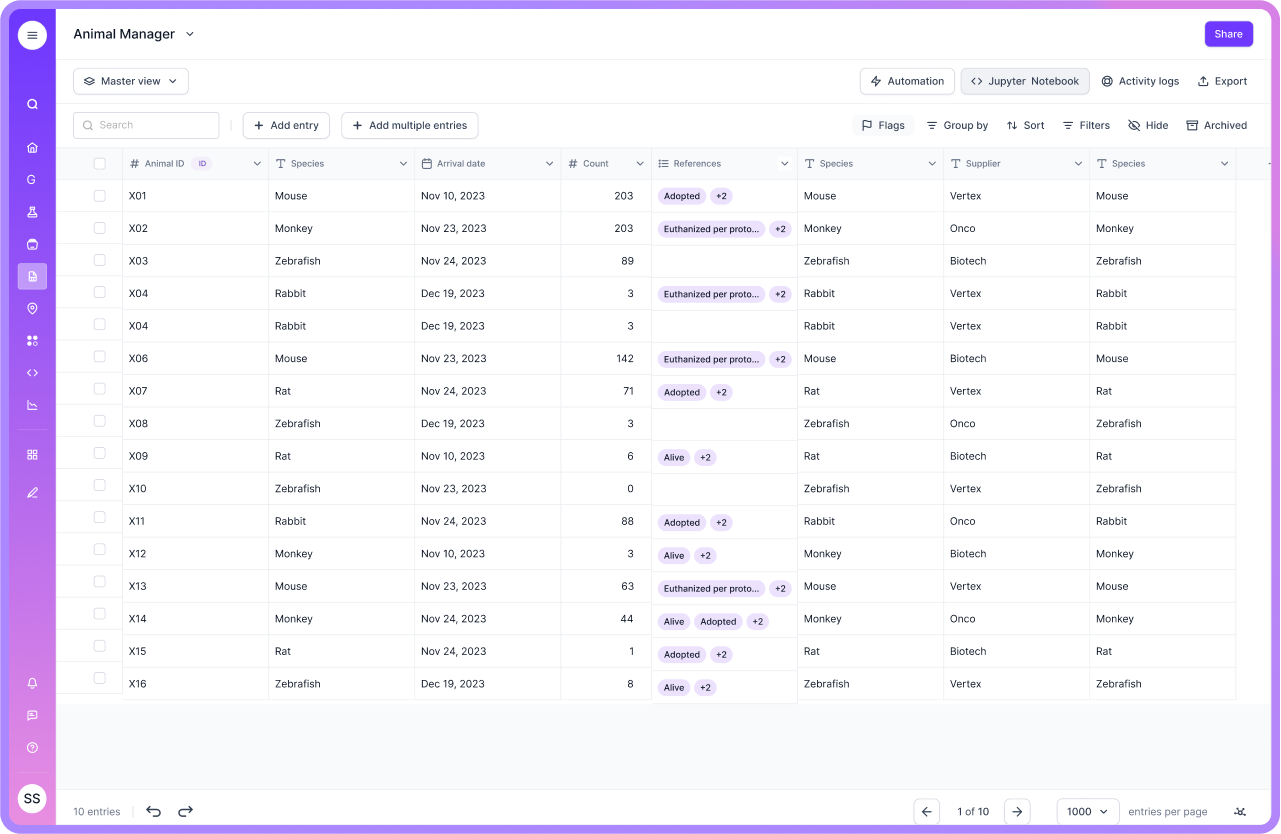
For compliance, Scispot delivers a full audit trail per sample, slide, and experiment, plus 21 CFR Part 11-compliant e-signatures with MFA at sign-off. When a technician completes a microtomy protocol, they request review. The quality officer receives a notification, opens the now-static experiment page - complete with embedded images, reagent lots, and automatic chain-of-custody - and applies an e-signature via Microsoft SSO. The signed record then auto-exports to their Slovak EQMS, so all quality documents sit in one place for inspectors. Weekly KPI reports summarize sample throughput, status durations, and turnaround metrics with minimal manual effort, giving leadership the data they need to justify full platform roll-out and plan NGS expansion. The setup was designed so the lab could run a pilot in weeks, validate adoption and metrics, then expand to full roll-out and later to NextSeq workflows.
Results
Within the pilot window, the lab saw sample trace time fall from over 30 minutes to under 5 minutes. Received-to-Sectioned turnaround improved from an average of 8 hours to 2 hours - a roughly 75% reduction - as status tracking and barcode-driven workflows eliminated guesswork and spreadsheet hunting. Reagent-related experiment failures dropped sharply thanks to automated expiry and low-stock alerts; the team targeted at least a 75% reduction in such failures and saw clear improvement. The lab achieved Part-11 compliant e-signatures and reviewer sign-off on microtomy protocols, with signed records flowing automatically into the EQMS for audit readiness. Adoption metrics were strong: the team aimed for at least 90% of lab staff logging in weekly within a month and high capture of sample events via barcode scans.
Leadership received auto-generated reports showing clear efficiency gains - including the drop from 8 hours to 2 hours for Received-to-Sectioned - which helped secure sign-off for full platform roll-out and planning for NextSeq and other NGS workflows. The company got audit-ready lab data and a single platform that supports both research and clinical diagnostics, with a pilot that went live in weeks. The story is a clear example of what regulated labs look for in lab software beyond the checklist: traceability in seconds, compliance built in, and one system that grows from pilot to full clinical load.