Coming Soon
Your lab evolves. Now your software can adapt with it. Meet Jazz ♪

Your lab evolves. Now your software can adapt with it. Meet Jazz ♪


Enter once, both trackers update in real time. Eliminated duplicate entry and cut manual errors across the lab.
When tests were accidentally deleted, the lab manager saw what happened in the recycle bin and restored records in one click - zero data lost.
COA generation went from hours to seconds with two clicks. Guided onboarding and role-based access drove higher adoption and user confidence.
Company: A bioscience testing laboratory
Industry: Bioscience / analytical testing
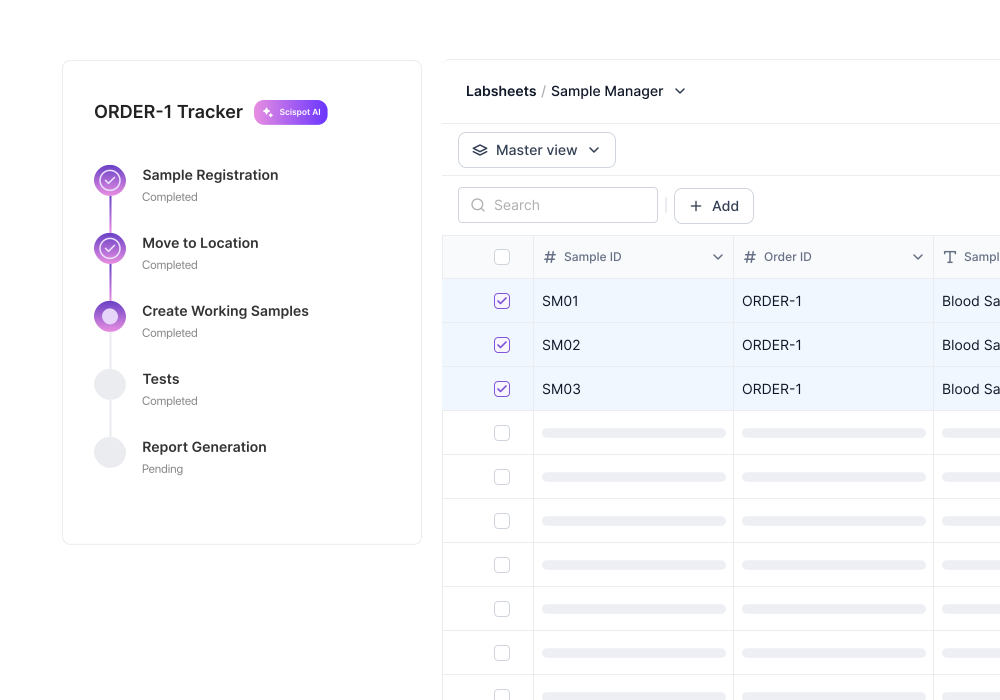
Monday mornings in the lab often started the same way: new sample jars on the bench, paper forms to transcribe, and a growing queue of tests that had to be reflected in more than one place. The organization's teams bridged handwritten intake sheets and brittle spreadsheets to log what arrived, what was running, and what still needed a certificate of analysis. The same facts were typed twice - once for the sample-oriented view and again for the test-oriented view - and small mistakes in either column broke downstream reporting.
When someone fixed a row in one file but not the other, reconciling the two became a scavenger hunt. Worse, there was little transparency when rows disappeared. Without a dependable audit trail and recycle path, a mistaken delete could look like missing data until someone retraced steps across shared drives and message threads. Managers worried about training new people in that environment: either new hires sat on the sidelines for days, or they were dropped into spreadsheets where a single stray edit could reshape a schema everyone depended on.
Reporting amplified the pain. Building a certificate of analysis meant copying fields from multiple trackers and documents, checking footers and accreditation language by hand, and hoping the version everyone used was the one attached to the email thread. Turnaround for a single COA could stretch to hours, not because the science was slow, but because the assembly work was. Historic quality data lived partly in cloud spreadsheets that were searchable only if you already knew which file to open.
The goals were practical and urgent: one authoritative place to submit and track samples and tests, fewer manual touches per record, guardrails so trainees could learn without breaking production sheets, and reporting that did not depend on copy-paste marathons. They also needed onboarding that matched how labs actually hire - quick contribution for junior staff and assistants, without trading speed for data integrity.
The team chose Scispot and structured the rollout around the Sample and Test Trackers, the two views their operators already thought in terms of, now backed by a single system instead of parallel files. The first structural change was submission forms that map directly into those trackers. Staff enter each sample once at intake; both the Sample Tracker and the Test Tracker stay in sync in real time, which removes the duplicate keyboard work that had been consuming the first hour of many shifts.
Permissions were tuned to how the lab actually runs. Lab managers use role-based access and schema locking to protect critical columns and reference fields so new hires and rotating contractors cannot accidentally rename headers, widen validation rules, or delete formulas the whole team relies on. Super admins invite users, assign a role such as view-only observer, bench technologist, or manager, and those roles determine which sheets and actions are in scope from day one.
Operational safety improved on the delete path as well. An enhanced recycle bin and audit log answer the questions managers used to ask in chat: who removed a row, when, and from which context. When a test record was removed by mistake, the lab manager could open the recycle bin, confirm the event, and restore it in one click instead of reconstructing history from exports. That combination of visibility and restore turned 'we think something vanished' into a short, traceable fix.
On the output side, automated COA and report generation replaced the manual merge workflow. The team generates documents from the same structured rows that power day-to-day operations, which is how they moved COA preparation from hours of assembly work to seconds with two clicks for the standard path. Historic data from earlier cloud spreadsheet workflows was migrated into Scispot so QC history, prior lots, and supporting fields sit in one searchable system rather than a patchwork of filenames.
Onboarding was treated as part of the product, not an afterthought. New users receive a guided walkthrough of permissions, submission flows, and the difference between observer and editor roles. Observers can follow live work in view-only mode while they learn terminology and handoffs, which lets the lab add headcount without freezing throughput or risking stray edits during training.
The lab saw immediate, day-one changes in how work felt at the bench. Single-step entry cut duplicate typing between trackers, which reduced the class of errors that came from two humans maintaining two representations of the same sample. When accidental deletes happened, as they always will in busy operations, restore paths turned incidents into minutes of work instead of half-day investigations.
Reporting time compressed sharply for the COA use case: what had been an hours-long merge and formatting exercise became a short, repeatable action tied to governed data. That freed senior staff from acting as human copy-paste buffers and let them focus on review, exceptions, and customer questions. New hires and assistants reported faster time-to-value because view-only access let them shadow real work safely while managers kept schema and configuration under control.
Adoption rose as confidence did. Historic QC data that had been scattered across spreadsheet versions became discoverable in one place, which made answering repeat customer questions and internal audits less dependent on institutional memory. The team continues to treat Scispot as the system of record for samples, tests, and standard reports, with onboarding and permissions aligned so scaling the roster does not scale the risk of silent spreadsheet drift.


