




TL;DR
- Sapio Sciences combines LIMS, ELN, scientific data management, no-code configuration, workflow automation, and AI within a unified life sciences informatics platform.
- Labguru combines ELN, LIMS, inventory, sample management, equipment management, automation, and laboratory informatics in one environment.
- Sapio Sciences places stronger emphasis on configurable enterprise informatics, scientific data, and AI, while Labguru emphasizes practical research documentation and day-to-day lab operations.
- The right fit depends on workflow complexity, scientific data requirements, inventory needs, integrations, compliance, implementation resources, and AI strategy.
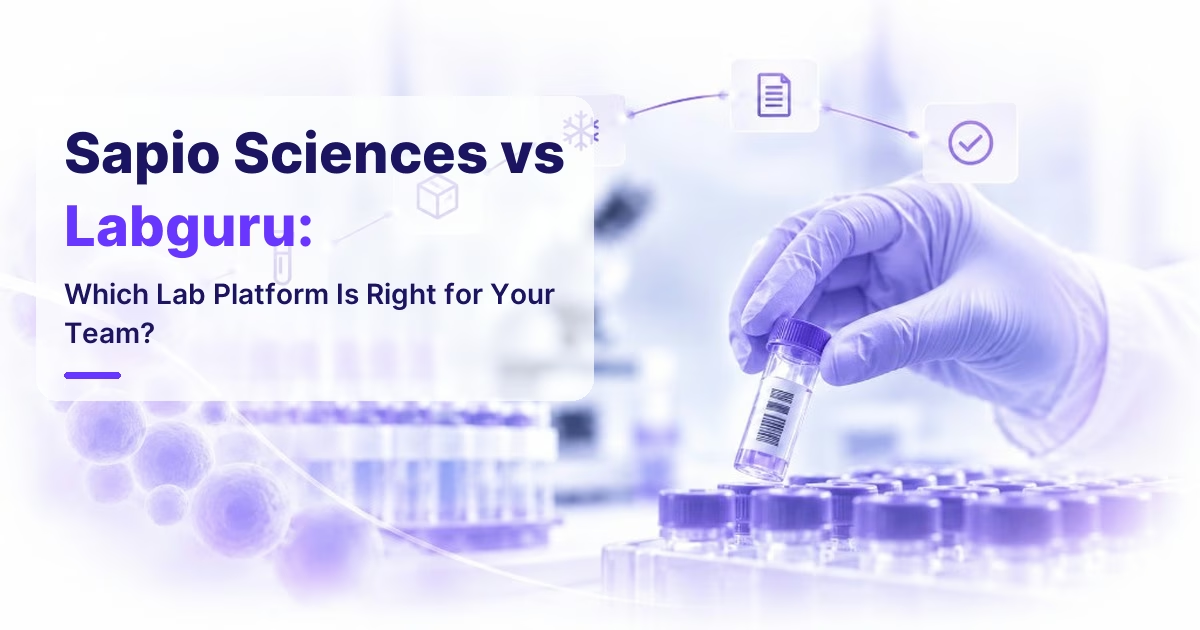
When comparing Sapio Sciences vs Labguru, laboratories are evaluating two platforms that combine research documentation and operational laboratory management, but with different priorities.
Sapio Sciences positions itself as an AI-native scientific informatics platform spanning LIMS, ELN, Scientific Data Cloud, workflow automation, and configurable laboratory processes. Labguru focuses on combining ELN, LIMS, inventory, equipment, workflows, and research collaboration within one laboratory management environment.
Comparing Sapio Sciences and Labguru? See how Scispot connects experiments, inventory, and lab data.
Explore ScispotSapio Sciences vs Labguru at a Glance
What Is Sapio Sciences?
Sapio Sciences provides a configurable life sciences informatics platform built around Sapio LIMS, Sapio ELN, Scientific Data Cloud, and Elain AI.
Its LIMS supports:
- Sample and inventory management
- Workflow automation
- Instrument integration
- Chain of custody
- Reporting and analytics
- GMP and GxP workflows
- No-code configuration
- AI-assisted laboratory processes
Sapio supports research, diagnostics, manufacturing, biotech, pharmaceutical, and other scientific workflows.
What Is Labguru?
Labguru is a laboratory informatics platform combining ELN, LIMS, inventory management, and laboratory operations.
Its capabilities include:
- Experiment and protocol management
- Sample and inventory tracking
- Equipment management
- Workflow automation
- Reports and dashboards
- Instrument orchestration
- Electronic signatures and approvals
- Research collaboration
Labguru connects inventory records directly with ELN experiments, helping researchers maintain relationships between materials and experimental work.
Sapio Sciences vs Labguru: Key Differences
| Area | Sapio Sciences | Labguru |
|---|---|---|
| Primary Focus | Unified scientific informatics | Research and lab management |
| ELN | Native AI-enabled ELN | Native ELN |
| LIMS | Core enterprise capability | Integrated LIMS |
| Scientific Data Management | Dedicated Scientific Data Cloud | Research data and informatics |
| Inventory | Native | Major platform strength |
| AI | Major platform focus | Less central to positioning |
| Configuration | No-code/low-code | Configurable workflows |
| Typical Fit | Complex biotech, pharma, diagnostics | Biotech, CROs, academic and research labs |
Feature Comparison: Sapio Sciences vs Labguru
ELN and Experiment Management
Sapio ELN operates on the same platform as its LIMS and scientific data infrastructure. This allows experiments, samples, workflows, and scientific records to share context across the research lifecycle.
Labguru's ELN focuses heavily on projects, experiments, protocols, datasets, reports, collaboration, and scientific documentation. It also integrates inventory directly with experiment records.
Teams comparing notebook solutions can also explore Scispot's electronic lab notebook platform.
Sample, Inventory, and Equipment Management
Labguru has a strong operational focus on inventory. Researchers can track storage locations, quantities, consumption, expiry dates, samples, supplies, and equipment while linking those records to experiments.
Sapio approaches samples and inventory through its broader configurable LIMS architecture, supporting sample management, inventory, chain of custody, and laboratory workflows.
Managing experiments, inventory, and samples across separate tools? Scispot connects them through oneconfigurable laboratory management platform.
Struggling to keep samples, inventory, and equipment on the same record as the experiment?
Talk to our expertsScientific Data Management and AI
Scientific data and AI are major differentiators for Sapio Sciences.
Sapio Scientific Data Cloud is designed to unify scientific information, while Elain functions as an AI co-scientist across laboratory and research workflows.
Labguru provides data management, dashboards, reporting, and research informatics, but AI is less central to its current platform positioning.
Integrations and Workflow Automation
Both platforms support laboratory automation.
Sapio emphasizes no-code workflow configuration, instrument integration, configurable data models, and scientific process automation.
Labguru provides workflow automation, equipment orchestration, data management, and developer tools within its integrated ELN and LIMS environment.
For laboratories where interoperability is critical, Scispot's laboratory integration platform connects instruments, ELNs, LIMS, databases, cloud storage, and analytics platforms.
Which Labs Should Consider Sapio Sciences or Labguru?
Enterprise Biotech and Pharmaceutical Teams
Sapio Sciences may fit organizations that need configurable LIMS, ELN, scientific data management, AI, and workflows across research, diagnostics, or manufacturing.
Teams considering Sapio can also review Scispot's Benchling vs Sapio Sciences comparison.
Growing Biotech and Research Labs
Labguru can appeal to teams prioritizing experiment documentation, inventory, equipment, samples, collaboration, and straightforward laboratory operations within one environment.
For another comparison, see Scispot's Benchling vs Labguru guide.
CROs and Multi-Workflow Labs
Both platforms support laboratories managing multiple projects and workflows. Buyers should test sample traceability, reporting, permissions, approvals, integrations, and how quickly administrators can modify workflows.
What to Consider Before Choosing
Implementation and Configuration
Sapio emphasizes no-code configuration, but laboratories still need internal ownership of workflows, validation, integrations, and governance.
Labguru promotes simplified implementation and currently offers migration assistance for approved organizations moving from other LIMS or ELN platforms.
Pricing and Total Cost
Both vendors generally require prospective customers to request pricing based on organization size and requirements. Buyers should compare licensing with migration, configuration, integrations, validation, training, and ongoing administration.
Trying to see what configuration and integrations add beyond the license?
See Scispot in ActionConnected Scientific Data
The larger question is whether experiments, samples, inventory, instrument outputs, reports, and quality records remain connected as the lab scales.
Scispot takes a Lab Operating System approach that combines LIMS and ELN workflows with integrations, scientific data management, automation, and AI. Its lab data management software guide provides additional criteria for evaluating scientific data platforms.
Ready to connect experiments, samples, and instruments for the team?
Request a Consultation
Disclaimer: This comparison was prepared by Scispot.io Inc. ("Scispot"), which sells products that compete with those described. Labguru and Sapio, and all other product and company names and marks mentioned are trademarks or trade names of their respective owners and are used for identification only. Scispot is not affiliated with, endorsed by, or sponsored by any vendor named. Competitor features, plans and pricing are based on publicly available information (sources linked where cited), reviewed as of November 2026, and may have changed since. Any third-party ratings cited are taken from the named review site and may also have changed. Statements about suitability or "best fit" are Scispot's opinion and not statements of fact. Customer quotes reflect individual experiences, which may not be typical. This page is for general information only; confirm current details with each vendor before making a purchasing decision. To report an inaccuracy, contact team@scispot.io; we review corrections promptly.