

TL;DR
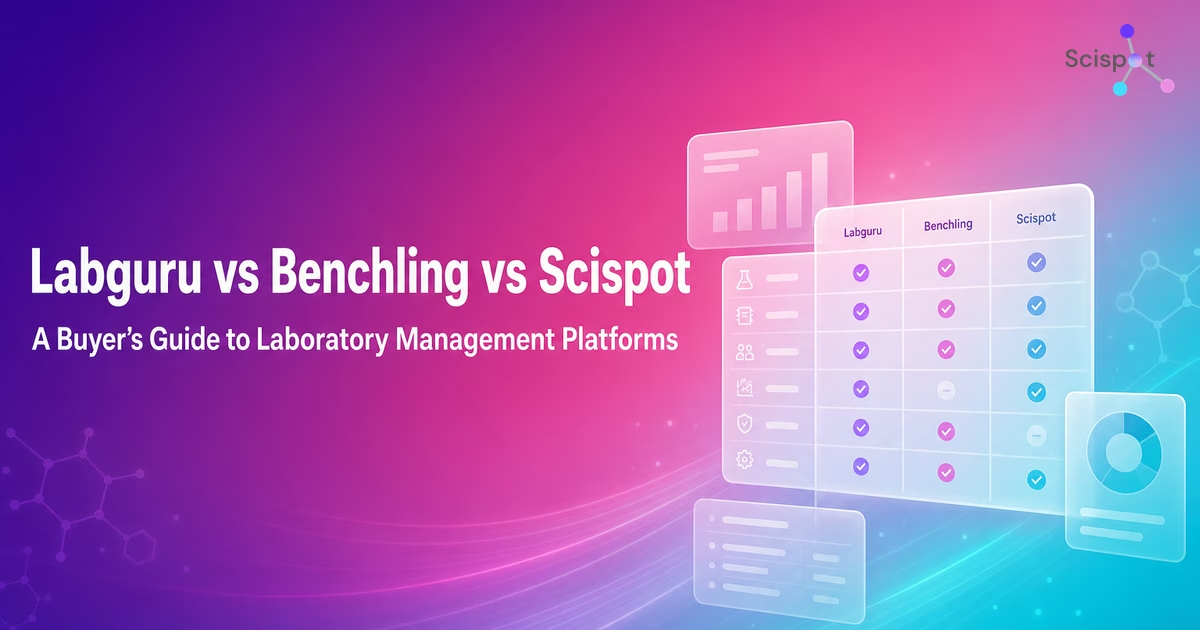
Labguru vs Benchling is incomplete if you only score two ELN-heavy platforms. This buyer's guide compares Labguru, Benchling, and Scispot for labs that need sample tracking, inventory, workflows, and compliance in one evaluation. Score flexibility without heavy coding, instrument and software integrations, ease of use, scale, and cost. Scispot is positioned as a unified laboratory operating system with LIMS, ELN, and data warehouse capabilities, an API-first design, and connections across a large set of instruments and applications. Labguru and Benchling remain important shortlist names; test the same workflows on all three.

Flexibility, integrations, cost, and UX
Laboratory Information Management Systems (LIMS) and Electronic Lab Notebooks (ELNs) have become indispensable tools for modern labs. These platforms enable labs to manage samples, inventory, workflows, and data while ensuring compliance with industry regulations. However, not all solutions are created equal. Labs must consider several factors when evaluating options:
- Flexibility: Can the platform adapt to your lab's specific workflows without requiring extensive coding or vendor intervention?
- Integration Capabilities: Does the system seamlessly connect with instruments and other software tools to eliminate data silos?
- Ease of Use: Is the interface intuitive enough for quick adoption by lab personnel?
- Scalability: Can the platform grow with your lab as its operations expand?
- Cost-Effectiveness: Does the pricing model align with your budget while delivering value?
With these criteria in mind, let's delve into a detailed comparison of Labguru vs Benchling vs Scispot.
Platform Comparison
Scispot
Scispot offers a unified laboratory operating system that combines LIMS, ELN, and data warehouse capabilities in a single platform. As a modern LIMS alternative, Scispot stands out with its API-first architecture that provides unmatched flexibility, allowing seamless integration with over 7,000 lab instruments and applications including Sartorius Ambr, Eppendorf BioFlo, and Agilent LC-MS. This comprehensive integration capability centralizes all data in one platform, significantly reducing manual errors while enhancing operational efficiency.
.png)
What distinguishes Scispot is its no-code configuration approach, which dramatically reduces implementation time and technical barriers. Rather than requiring extensive programming or vendor services for customization, Scispot empowers laboratory staff to configure workflows and data models themselves. The platform offers instant deployment with built-in configurable templates for different company types and workflows, making it ready to use from day one. This capability enables labs to adapt systems to their specific processes without the dependency on external resources that characterizes traditional implementations. Implementation timelines vary by scope, validation needs, integrations, data migration, and internal resources. Buyers should ask each vendor for a written implementation plan.
Scispot's modern user interface stands in stark contrast to traditional systems, which often suffer from cluttered layouts and complex navigation. The intuitive design reduces training requirements and accelerates adoption, addressing one of the most common challenges in laboratory information management - resistance to change and limited user engagement. As a Scispot user from a Boston-based molecular diagnostics lab noted: "I really like that Scispot is easy to configure to what we need, and you don't need to be a programmer to do it. We can change how it looks and how it works to make it fit our lab and workflows."
The platform excels in sample management through its Sample Manager module, handling the entire sample lifecycle from intake to reporting. The automated sample tracking system allows labs to trace samples from registration through preparation, processing, analysis, and final reporting to customers via email or customer portal. Users report reducing sample search time by up to 90% after implementing this system. The platform's Location Manager feature provides visual storage maps of freezers and racks in real-time, making sample organization intuitive while leveraging barcode integration for efficient scanning and quick sample identification.
Inventory management is another area where Scispot shines, automatically tracking consumables and alerting users before supplies run low. This proactive approach ensures seamless reordering and eliminates unexpected stockouts that can disrupt critical research workflows. As one Scispot user, an Application Architect, stated: "Being able to easily integrate any molecular bio workflows and data into and out of Scispot was a boon. Having secure plug-and-play APIs for LIMS and ELN at my disposal simplified many aspects of my work."

The AI-powered capabilities of Scispot truly set it apart in the market. With its AI Lab Assistant, the platform transforms lab operations from multi-click processes to a natural chat interface. This powerful AI tool automates routine tasks, predicts resource needs, and extracts actionable insights from complex datasets. The AI integration works in tandem with Scispot's JupyterHub, enabling computational biologists to program laboratory workflows, analyze multi-omics data, and integrate wet lab and computational processes seamlessly.
For laboratories concerned with compliance, Scispot automates adherence to FDA, GxP, and ISO standards, providing tools like automated audit trails, electronic signatures, and secure data handling. It is SOC2, HIPAA, GDPR, and CFR Part 11 compliant, with 24/7 backups and real-time audit trails, ensuring sensitive data remains secure, traceable, and easily retrievable.
Perhaps most importantly, Scispot offers white-glove support from day one, with personalized onboarding, ongoing optimization, and dedicated consulting. Each customer receives a dedicated account manager and a dedicated Slack or Teams channel for direct communication with the science and engineering team. As a Scispot user, a Healthcare Data Analyst, remarked: "Scispot's team is incredibly supportive. They assist in configuring custom workflows and data strategies, with near-instant responses on Slack. Integrating instruments and databases with Scispot GLUE is seamless, enhancing our lab's productivity."

Benchling
Founded in 2012, Benchling has gained prominence as a platform specialized for molecular biology research. It offers robust tools for DNA sequence design, protein engineering, and structured scientific workflows. Its capabilities are well-suited for enterprise-level biotech organizations, and smaller labs or those requiring high flexibility should evaluate fit carefully.
Benchling provides a modern interface and specialized tools tailored to molecular biology applications. Its collaboration features allow researchers to work together in real-time, enhancing productivity in structured workflows. The platform supports integration with common research applications, making it suitable for organizations focused on genomics or protein engineering.
Benchling's structured data model works well for standardized molecular biology workflows; labs with highly custom processes should assess how much adjustment their workflows would need. Customization requirements vary by platform, and some systems may require technical expertise or vendor services, which can affect implementation timelines and costs. Public sources have reported pricing in the range of $5,000 to $7,000 per user annually, so smaller labs and startups should confirm current pricing directly with the vendor. Buyers should ask each vendor for a full pricing breakdown, including licenses, implementation, integrations, validation, training, support, and future change requests, and validate fit through demos, pilots, and reference calls.
Data portability is another evaluation point: before committing to any platform, buyers should ask about export formats, API access to their own data, and what a future migration would involve. Laboratories with limited IT resources should also ask each vendor what technical expertise is needed for ongoing system management.

Labguru
Founded in 2011, Labguru positions itself as an Electronic Lab Notebook (ELN) with added LIMS functionalities. Its integrated approach combines documentation tools with inventory management features, making it a viable option for small labs seeking basic functionality at a lower cost.
Labguru's ELN capabilities are well-regarded among users who prioritize documentation over advanced automation or workflow management. The platform offers cloud-based storage and reporting features that streamline basic lab operations. Customer service receives positive reviews for responsiveness and support.
Labguru is often evaluated as a cost-effective option. Labs that need advanced automation or deep integration capabilities should verify how far the platform's configuration options go and what requires vendor assistance. Support is primarily delivered through a knowledge base and support team, which works well for labs that prioritize documentation. Public reviews can be useful, but buyers should read both positive and negative feedback and validate fit through demos, pilots, and reference calls.
Some established platforms were built for earlier enterprise deployment models, so buyers should evaluate user experience, configuration speed, integration depth, and admin effort with their own team. Implementation approaches vary by platform focus, and buyers should assess whether a platform's primary strengths align with their lab's needs for documentation, automation, or comprehensive management.

Scispot vs Benchling vs LabGuruen feature comparison
How Should a Small Lab Choose Between Labguru, Benchling, and Scispot?
For a small or growing laboratory, choosing between Labguru, Benchling, and Scispot starts with identifying the workflows that need the most support. The best choice depends on the lab's scientific requirements, existing software, integration needs, implementation capacity, and expected growth.
Use these questions to narrow the shortlist:
- Do you need a broad laboratory management application? Identify whether the main requirement is experiment documentation, sample management, inventory, or a combination of laboratory workflows.
- Do you have specialized research requirements? List the data structures, experimental records, and scientific workflows that the platform must support.
- Are instruments and applications disconnected? Determine whether the main problem is missing functionality or the effort required to move data between existing systems.
- How much implementation support is available? Consider the time your team can dedicate to configuration, migration, training, and ongoing maintenance.
- What will the solution cost over time? Compare vendor proposals using the same user count, workflows, integrations, services, and contract period.
- How might your requirements change? Evaluate whether the platform can accommodate new instruments, research programs, teams, and data sources.
A useful shortlist reflects these priorities rather than assuming that one platform is the best option for every laboratory.
Labguru, Benchling, and Scispot should each be evaluated against the requirements that matter most to the team. Ask vendors to demonstrate the same representative workflows so you can compare practical fit instead of relying only on product descriptions.
Which Platform Should a Small Lab Shortlist?
The right choice should be determined by hands-on evaluation. Ask each vendor to show how your team would complete its most important workflows, where data would be stored, how systems would exchange information, and what ongoing maintenance would involve.
For a laboratory that already has applications it wants to retain, include the cost and effort of connecting those systems in the evaluation. Replacing software is not the only possible approach to improving laboratory operations.
Why Modern Labs Choose Scispot
The comparison between Labguru vs Benchling vs Scispot highlights fundamental differences in architecture, usability, and scalability. While Benchling caters primarily to enterprise-level molecular biology applications and Labguru focuses on ELN functionalities at a lower cost, Scispot delivers a comprehensive solution that adapts to diverse research environments.
Scispot's no-code configurability empowers labs to remain agile as workflows evolve without relying on external resources. Its extensive integration framework eliminates data silos while enabling advanced analytics through AI-powered dashboards. These features make Scispot particularly appealing for growing labs seeking scalability without excessive costs.
Data integration represents another key advantage. Scispot's API-first architecture and GLUE integration technology enable straightforward connections to instruments, analytics platforms, and other research tools. Rather than creating siloed data repositories, Scispot facilitates a connected ecosystem where information flows seamlessly between systems, enhancing analytical capabilities and operational efficiency. As a Scispot user, a CEO of a biotech company, remarked: "Not only does Scispot perfect our internal technical operations, but the seamless integration and automation capabilities offered by Scispot make it a lot easier to operate as a distributed biotech company."
Scalability concerns often drive laboratories away from traditional platforms. Many organizations report significant performance degradation or costly upgrades as data volumes increase with legacy systems. Scispot's cloud-native architecture provides inherent scalability, allowing laboratories to grow without performance penalties or migration headaches.
Perhaps most importantly, user adoption determines the ultimate success of any implementation. Scispot's intuitive interface and familiar design patterns reduce training requirements and resistance to change. This user-centric approach significantly improves adoption rates and enhances the platform's overall impact on laboratory operations. As another Scispot user, a CEO, stated: "One spot for LIMS, Inventory management system, product tracking, SOP compliance and secure data sharing between clients and partners. A single tool to manage both internal and external stakeholders and processes."
Conclusion
As laboratories navigate increasingly complex workflows and data landscapes, different platforms serve different lab needs. Buyers should evaluate which platform's architecture, usability, and scalability best align with their specific workflows. The comparison between Labguru vs Benchling vs Scispot underscores why Scispot represents the future of laboratory management.
By combining powerful functionalities with exceptional ease of use through an API-first architecture, Scispot enables laboratories to focus on innovation rather than software limitations. Whether you're a startup seeking rapid deployment or an enterprise scaling global operations, Scispot delivers unmatched adaptability with competitive pricing.
The platform's AI-powered capabilities, comprehensive integration framework, and no-code configuration transform how laboratories operate - automating routine tasks, eliminating data silos, and providing actionable insights from complex datasets. This holistic approach enhances productivity while reducing operational costs, positioning Scispot as the ideal solution for modern laboratory environments.
Ready to transform your lab? Schedule a personalized demo today to experience how Scispot can streamline your operations and accelerate your research.
Scispot is more than another lab software tool. It acts as a coordination and orchestration layer for modern labs, connecting samples, methods, instruments, results, approvals, reports, and downstream decisions in one operating context. Labs can use Scispot's native apps across LIMS, ELN, SDMS, inventory, and quality workflows, or connect Scispot to the systems they already use. This is how Scispot helps build a Digital Brain for the lab: a connected, traceable, automation-ready, and AI-ready foundation where scientific work can move faster without losing control.
Third-party product and company names are used for identification only. Scispot is not affiliated with, endorsed by, or sponsored by the vendors mentioned. Product details, pricing, and implementation timelines may change, so buyers should verify information directly with each vendor.

%20Comprehensive%20Guide.avif)
.webp)