

TL;DR
Use these four checks to determine whether laboratory reports are suitable for governed analytics and AI.
- A readable report is not automatically an AI-ready data asset.
- Every result should link to source data, metadata, methods, transformations, reviews, and approvals.
- Scientific data governance should define ownership, access, quality, retention, and permitted AI use.
- An SDMS for AI can structure scientific files and preserve context across instruments, ELN, LIMS, and reports.
Laboratory reports may be complete for human review yet incomplete for analytics or AI.
A reported value has limited machine-readable meaning without its unit, sample identity, method version, instrument, processing history, quality status, and permissions. Building AI-ready laboratory data therefore requires more than collecting PDFs; it requires connected records, consistent context, and governance across the data lifecycle.
What Is AI-Ready Laboratory Data?
AI readiness describes whether laboratory data can be reliably found, interpreted, governed, and reused for a defined analytical purpose.
AI-ready laboratory data is structured, standardized, contextualized, quality-checked, and governed for use by approved analytics or AI systems. Its purpose is to give machines enough trustworthy context to identify patterns without separating results from their scientific meaning.
Why reports alone are not enough for AI and analytics
A report usually presents selected findings rather than the complete evidence chain. It may omit raw files, rejected runs, transformation logic, method changes, QC records, and decision history - information needed to evaluate whether a value is appropriate for reuse.
The role of data lineage and governance
Data lineage records where information originated, how it moved and changed, and where it was consumed. Governance defines decision rights and accountability across collection, storage, processing, sharing, use, and deletion.
Who benefits from AI-ready laboratory data
Scientists gain faster access to contextual evidence, data teams receive more consistent inputs, and quality teams can inspect how outputs were produced. Laboratory leaders also gain a safer foundation for dashboards, predictive models, natural-language search, and AI-assisted workflows.
Why Laboratory Reports Are Often Not Ready for AI
Most readiness gaps arise because the report is treated as the final data asset instead of one output from a larger scientific workflow.
Reports are disconnected from source data and metadata
Reports often live in document repositories while instrument files, sample records, and calculations remain elsewhere. Without persistent links, AI can extract the final value but cannot establish its complete provenance.
Missing method history and workflow context
The same result can mean something different under another method version, instrument configuration, or acceptance criterion. AI needs this context to distinguish comparable records from values that only appear similar.
Inconsistent permissions and access controls
Source evidence may have different restrictions from the report summarizing it. If permissions are not applied consistently across linked records, AI may expose restricted information or generate an answer from evidence the user is not authorized to access.
Limited visibility into how results were generated
Manual exports and spreadsheet calculations can hide transformation logic. Reliable analysis requires a traceable path from raw data through calculations, filters, exclusions, reviews, and the reported result.

Key Components of AI-Ready Laboratory Data
An AI-ready foundation combines lineage, access governance, rich metadata, and controlled scientific data management.
Laboratory data lineage from source to report
Assign stable identifiers to samples, runs, methods, files, results, analyses, and reports. Record transformations and versions so every reported value can be traced backward to its source and forward to downstream analytics or AI outputs.
Scientific data governance and access controls
Define data owners, stewards, quality rules, retention requirements, permitted uses, and approval responsibilities. Apply role-based access at the data and workflow level, and record who or what retrieved, transformed, approved, or exported information.
Metadata, context, and traceability requirements
Capture units, timestamps, analyst, instrument, method version, run conditions, quality status, and workflow state using standard fields and vocabularies. Rich, machine-readable metadata and persistent identifiers help both people and machines find and reuse scientific data.
SDMS for AI and governed data management
An SDMS for AI should capture raw and processed files, extract metadata, preserve versions, connect related records, and provide controlled access to downstream tools. It should complement the ELN and LIMS by retaining scientific files and their source-to-result relationships.

Best Practices for Building AI-Ready Laboratory Data
Start with a bounded use case, then improve structure, context, and controls where they directly affect the intended AI outcome.
Connecting reports to source data and supporting records
Link each report to samples, experiments, raw files, methods, calculations, QC checks, deviations, reviews, and approvals. Test lineage in both directions to confirm that users can reconstruct the evidence behind a value.
Standardizing metadata and scientific context
Use shared identifiers, controlled vocabularies, consistent units, required fields, and validation rules at the point of capture. Standardization prevents similar concepts from being represented differently across instruments, teams, and sites.
Preserving governance across the data lifecycle
Maintain permissions, classifications, ownership, retention rules, audit histories, and usage limitations as data moves between systems. Review these controls as workflows, regulations, methods, and AI applications change.
Preparing laboratory data for trusted analytics and AI
Assess completeness, conformity, consistency, lineage, and freshness before releasing data to models. Validate a small workflow first, monitor input quality and output groundedness, require human review where risk is high, and scale only after controls work reliably.

How Scispot Helps Create AI-Ready Laboratory Data
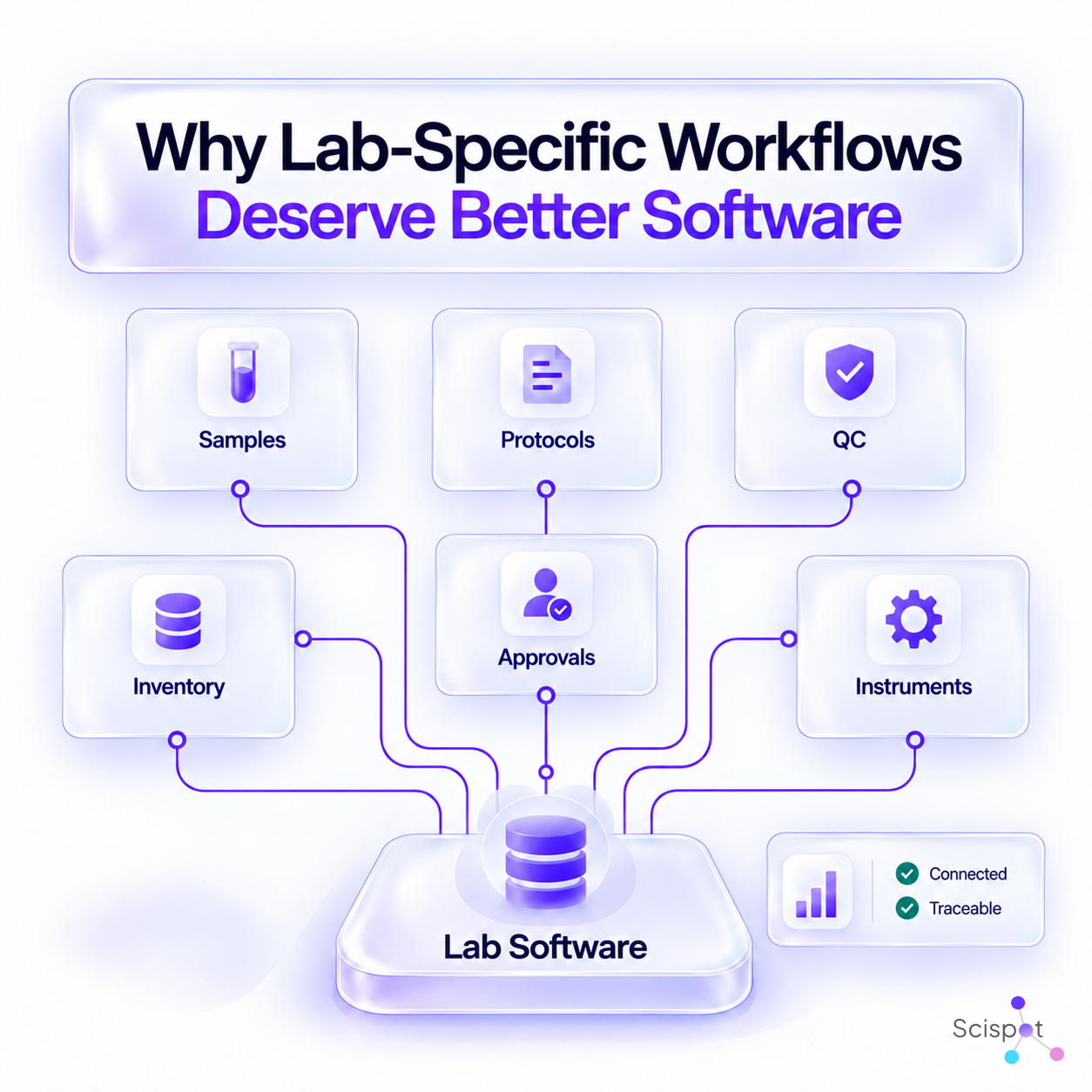
Scispot connects scientific records and applies structure, lineage, workflow controls, and governed access around them.
Connecting reports, source data, and workflow records
Scispot SDMS provides an API-first scientific data environment, while Scispot's broader platform connects samples, experiments, instruments, results, approvals, and reports. This keeps report context close to its supporting evidence.
Maintaining end-to-end laboratory data lineage
Scispot GLUE connects instruments, ELN, LIMS, legacy systems, data lakes, and applications. It automates extraction and transformation, aligns units, methods, time, and identifiers, and preserves lineage from source to destination.
Supporting scientific data governance at scale
Scispot supports shared data models, roles, electronic signatures, approvals, audit trails, QC gates, and exception routing. Laboratories can configure these controls around their policies and intended uses rather than governing AI through disconnected manual checks.
Enabling trusted analytics and AI across laboratory operations
Scispot can convert raw files into consistent tables and make connected records available through controlled APIs and AI interfaces. The laboratory remains responsible for data quality, intended-use assessment, validation where required, user training, and oversight of scientific decisions.