
Bring AI into your lab's workflows, not just your conversations.
Connect AI agents, scientific data, instruments, and laboratory applications to automate repetitive work and make information easier to access. Scispot helps life science teams move from isolated AI experiments to connected, practical lab workflows.
Work alongside your existing LIMS, ELN, instruments, and scientific systems.
Your lab does not need another disconnected AI tool.
Many laboratories are exploring generative AI and automation. But the real challenge is connecting AI to the systems, scientific context, and workflows where work actually happens.
- 01 / DISCONNECTED TOOLSAI operates outside lab systems
Teams use separate AI tools that cannot reliably access the relevant records, samples, experiments, and workflows. - 02 / MANUAL HANDOFFSPeople still move information manually
AI may generate useful outputs, but employees still copy results, update records, and coordinate the next steps. - 03 / LIMITED CONTEXTAI lacks scientific context
Without structured data and relationships, AI systems may not understand the sample, method, instrument, or experiment behind a result. - 04 / FRAGMENTED WORKFLOWSAutomation stops at individual tasks
Teams automate isolated steps but struggle to connect actions across instruments, applications, and laboratory processes. - 05 / GOVERNANCEAccess and oversight need attention
Laboratory AI needs appropriate permissions, traceability, human review, and controls around consequential actions. - 06 / PILOT TO PRODUCTIONPromising pilots are hard to scale
Moving from a proof of concept to a dependable workflow requires integration, testing, ownership, and ongoing support.
AI integration services built around laboratory workflows.
From connecting AI models to existing applications to implementing workflow agents, we help translate AI capabilities into useful laboratory operations.

AI agent integration
Connect AI agents to relevant laboratory systems, scientific information, and approved actions. Design agents around defined tasks and workflows rather than generic chat interfaces.

AI and LIMS / ELN integration
Connect AI applications with existing LIMS, ELN, and scientific platforms through APIs and integration layers, while preserving the systems your teams rely on.
Explore integration capabilities →
Intelligent workflow automation
Automate defined steps such as data extraction, record preparation, notifications, routing, and repetitive information handling with appropriate review controls.
Explore instrument data automation →
Scientific AI assistants
Implement AI assistants that help teams retrieve, summarize, and work with relevant scientific and operational information from connected sources.

AI-ready data and context integration
Connect AI workflows to structured scientific data, metadata, and relationships so outputs can be grounded in the right laboratory context.
Explore AI readiness →
AI governance and workflow controls
Define permissions, approval steps, auditability, human oversight, and boundaries for AI-assisted actions based on intended use and risk.
Start with the work your team wants to improve.
Effective laboratory AI begins with a specific workflow. We identify where AI can assist, what systems it needs to connect to, and where human review should remain part of the process.
- Retrieve and summarize information from connected lab records
- Extract structured information from documents and instrument files
- Prepare reports and routine documentation for review
- Route tasks, notifications, and workflow requests
- Help users find relevant samples, experiments, and results
- Connect AI applications with existing laboratory tools
AI integration across your existing technology stack
The right integration depends on the use case, source systems, access requirements, and the level of automation appropriate for the workflow.
AI applications across the life sciences workflow.
These are examples of potential implementation areas. The right use cases depend on your data, applications, operating procedures, and review requirements.
Research information retrieval
Help scientists locate and summarize relevant experiment records, methods, sample information, and research documentation.
Instrument data workflows
Assist with extracting information from instrument outputs, organizing results, and preparing structured records for review.
Documentation assistance
Support document retrieval, draft preparation, information extraction, and routing while retaining required human review and approval.
Study and project coordination
Help organize information across study records, laboratory systems, sites, and project workflows.
Routine workflow automation
Reduce repetitive information handling through connected actions, task routing, and structured workflow automation.
Scientific data exploration
Make governed scientific information easier to discover and use in analytics and AI-supported workflows.
Connect AI to laboratory work without losing control.
Laboratory AI should operate within clearly defined boundaries. Not every task should be fully automated, and not every AI-generated output should trigger an action without review.
We help teams consider access, permissions, traceability, review requirements, and intended use as part of the integration design.
- Role-based access to relevant systems and data
- Human review for defined high-impact actions
- Traceability of workflow steps and system interactions
- Clear boundaries for AI-generated recommendations and actions
- Testing aligned with the intended workflow and use case
A practical AI implementation principle
AI can assist with information retrieval, analysis, and workflow execution. Laboratory teams retain responsibility for decisions, approvals, and regulated activities according to their procedures.
Move from an AI idea to a connected laboratory workflow.
A focused implementation process helps establish what should be automated, how systems should connect, and how the result will be tested and maintained.
Identify
Understand the workflow, user needs, data sources, current tools, and expected outcome.
Design
Define the AI approach, integration architecture, permissions, review points, and success criteria.
Implement
Connect the required systems, configure workflows, implement agents, and test the integration.
Optimize
Evaluate workflow performance, improve reliability, document the solution, and support adoption.
AI integration grounded in laboratory informatics.
Laboratory AI requires more than connecting a model to an API. It requires an understanding of scientific data, laboratory systems, instrument workflows, and the operational context in which AI is used.
Scientific workflow understanding
Approach AI implementation around samples, experiments, instruments, results, and real laboratory processes.
Connected system architecture
Work with existing laboratory systems and integration layers instead of assuming a complete technology replacement.
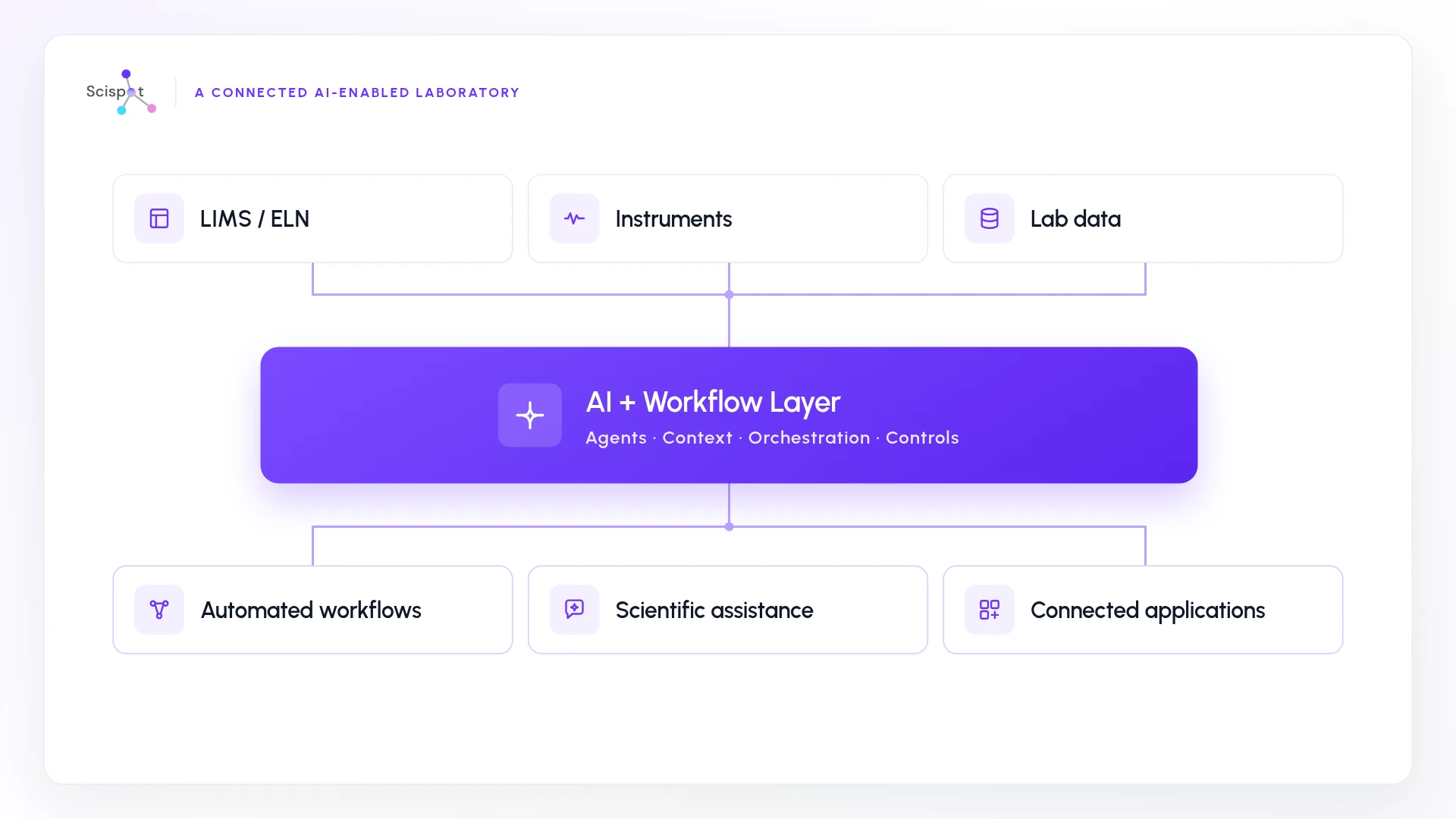
Data and AI in one picture
Consider the data foundation, system connections, AI capabilities, and workflow controls together.
Explore the Scispot Lab Operating Systemand integration capabilities
AI integration for laboratories: common questions
What is AI integration for laboratories?
AI integration for laboratories involves connecting AI models, assistants, or agents with laboratory systems, scientific data, and operational workflows. The objective is to make AI useful within existing processes rather than keeping it isolated in separate applications.
Can AI agents connect to an existing LIMS or ELN?
Yes, where the systems provide suitable APIs, connectors, or supported data exchange methods. Integration design should account for system permissions, data structures, workflow requirements, and the actions an agent is allowed to perform.
What laboratory tasks can AI help automate?
Potential use cases include information retrieval, document summarization, structured data extraction, report preparation, notifications, task routing, and repetitive data handling. The suitability of each use case depends on its risk, data quality, and review requirements.
Do we need to replace our existing laboratory software?
Not necessarily. AI integration can often be designed around existing LIMS, ELN, instruments, and scientific applications. The objective is to connect useful capabilities while retaining systems that continue to serve your laboratory.
Does AI integration require AI-ready laboratory data?
Reliable, contextual data makes AI integrations more useful. Some workflows can begin with existing structured sources, while more advanced applications may require data harmonization, metadata improvements, and additional governance.
Can AI agents perform actions in laboratory systems?
Depending on the technical integration and permissions, agents can be configured to perform defined actions. The implementation should specify allowed actions, approval requirements, logging, and human oversight. Consequential or regulated decisions should remain under the appropriate laboratory and quality processes.
How long does a laboratory AI integration project take?
Timelines depend on the use case, number of systems, data availability, integration complexity, and validation or governance requirements. A focused assessment can establish a realistic scope and implementation plan.