
Scispot vs Sapio Sciences: Which Lab Informatics Platform Fits Your Team?
- Sapio Sciences: A unified laboratory informatics platform combining LIMS, ELN, Scientific Data Cloud, configurable workflows and AI capabilities.
- Scispot: A Lab Operating System designed to connect instruments, applications, scientific data, samples, workflows and quality processes through a governed operating layer.
- Key evaluation: Decide whether your priority is adopting a unified vendor platform or connecting and orchestrating the laboratory systems you already use, with the option to add native applications.
Two approaches to connected laboratory informatics
Both platforms aim to reduce fragmented laboratory work. They bring together data, workflows and scientific applications, but their operating models are not identical.
A Lab Operating System for connected operations
Scispot LabOS connects instruments, existing applications, scientific data, samples, workflows and quality processes through one governed operating layer. Labs can connect their existing stack or use Scispot's native applications.
- Connect existing laboratory applications and instruments
- Harmonize data into a governed, traceable model
- Automate workflows using Smart Actions
- Use AI coworkers with laboratory context
A unified LIMS, ELN and scientific data platform
Sapio Sciences combines LIMS, ELN and Scientific Data Cloud within a configurable laboratory informatics platform. Its product portfolio supports research, diagnostics, bioanalysis, manufacturing and other scientific workflows.
- No-code and low-code workflow configuration
- Integrated LIMS and electronic lab notebook
- Scientific Data Cloud for instrument and research data
- Elain AI co-scientist capabilities
Scispot vs Sapio Sciences: Platform capabilities
Use this comparison to identify the areas that deserve a deeper technical evaluation. Product capabilities, integrations and deployment options should be validated against your specific requirements.
Comparison based on publicly described product capabilities. Specific functionality, integration coverage, licensing and implementation scope should be confirmed with each vendor.
What Sapio Sciences brings to laboratory informatics
Sapio is a serious platform to consider when evaluating LIMS, ELN and scientific data management together. Its product architecture is designed to give scientists a connected experience across laboratory workflows.
Sapio LIMS
Supports sample management, inventory, chain of custody, reporting, configurable workflows and laboratory automation.
Sapio ELN
Provides experiment documentation, reusable templates, collaboration and scientific tools for research teams.
Scientific Data Cloud
Brings together instrument and application data with search, contextualization, visualization and analytics.
Elain AI
Sapio's AI co-scientist is designed to help scientists search information, analyze data and work with scientific workflows.
No-code configuration
Configurable workflows and rules allow laboratories to adapt processes without relying entirely on custom software development.
Scientific applications
Sapio offers solutions across areas such as NGS, bioanalysis, clinical diagnostics, bioprocessing, histopathology and GMP.
Sapio may be a strong fit when an organization wants to consolidate multiple laboratory informatics capabilities within one vendor platform. The evaluation should still examine integration boundaries, data access, configuration effort and the needs of existing systems.
Learn more about Sapio LIMS, Sapio ELN and Scientific Data Cloud.
Where Scispot takes a different approach
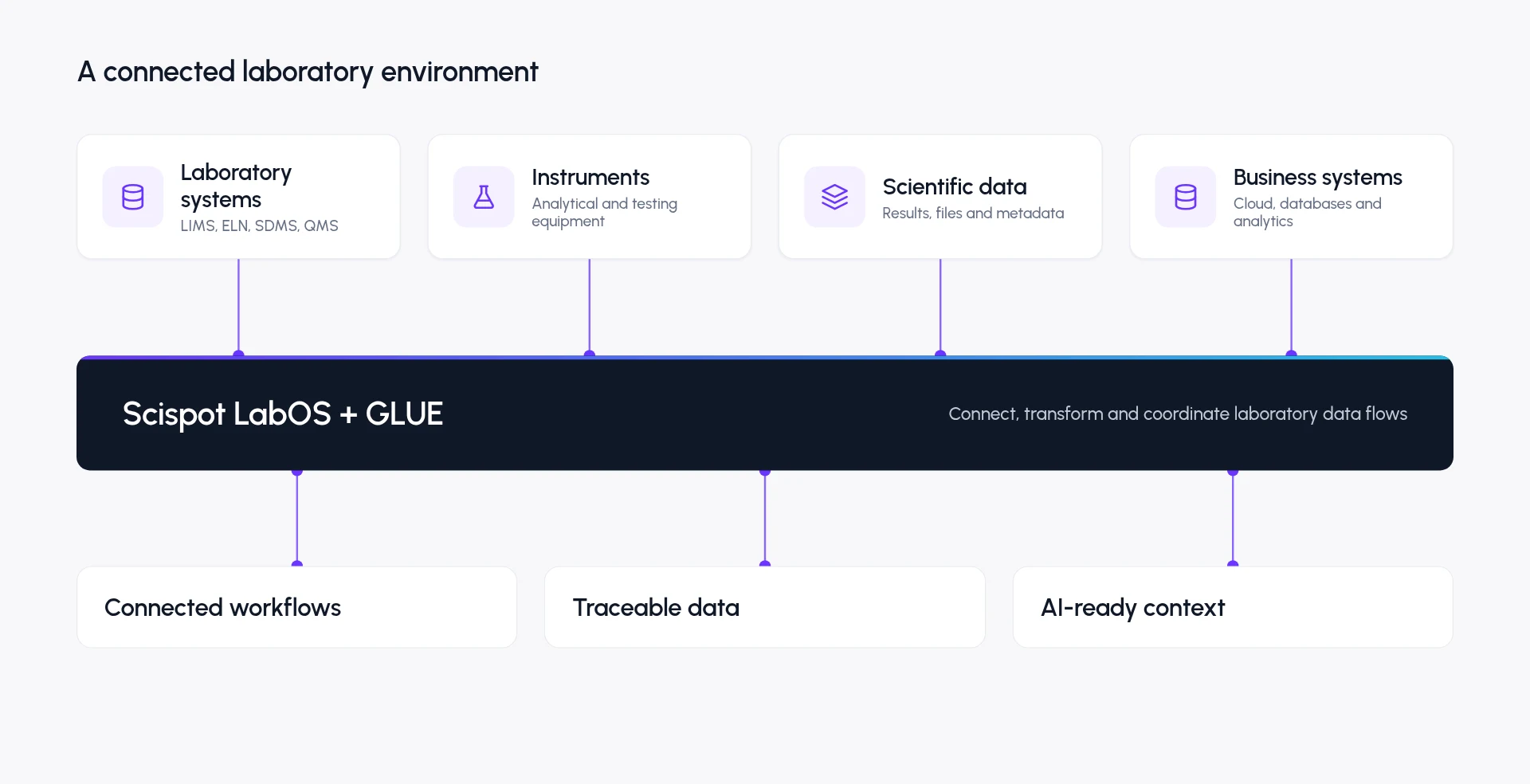
Scispot approaches the laboratory as an interconnected operating environment. Rather than requiring every workflow to move into one application, LabOS is designed to connect the systems, instruments and data that teams already depend on.
Keep the systems that already work
Laboratories often have established LIMS, ELN, QMS, SDMS, instruments, databases and cloud applications. Scispot Orchestrate connects these components through an operating layer, allowing teams to evaluate replacement decisions individually.
Harmonize data across workflows
Data becomes more useful when instrument outputs, sample records, methods, units and workflow context remain connected. Scispot Harmonize is designed to normalize incoming data into a governed model.
Automate work with connected context
Smart Actions support repeatable laboratory tasks such as calculations, QC checks, routing and reporting. The objective is to reduce manual handling while retaining review and human oversight where required.
Build toward AI-ready operations
Scibot AI coworkers operate with connected laboratory context. This makes governed data, workflow permissions and traceable records important foundations for AI-assisted laboratory work.
Connect the lab
Bring instruments, applications, existing systems and data sources into a connected environment.
Govern the data
Normalize scientific information and preserve the context, lineage and traceability needed to use it.
Move work forward
Use automation and AI coworkers to support repeatable work while keeping people in control.
When should you evaluate Scispot vs Sapio Sciences?
The decision should start with your laboratory architecture and operating requirements, not a feature checklist alone.
- You need to connect multiple existing laboratory systems.
- Instrument data is spread across different applications and storage environments.
- You want to harmonize data across workflows and teams.
- You need automation across systems rather than within one application alone.
- You want to retain selected LIMS, ELN, QMS or SDMS investments.
- You are building a governed foundation for AI-assisted lab operations.
- You want LIMS, ELN and scientific data capabilities from one platform provider.
- You need configurable workflows for specialized laboratory processes.
- You want to evaluate integrated scientific data management and analytics.
- You need purpose-built applications for research, diagnostics or manufacturing.
- You are interested in an integrated AI co-scientist experience.
- You want to assess a consolidated laboratory informatics environment.
Seven questions to ask before choosing
A structured proof of concept can reveal more than a generic product demonstration. Use the same laboratory workflow and acceptance criteria with both vendors.
1. Can the platform support your real workflow?
Test sample intake, processing, instrument data capture, review, exception handling and reporting using representative records.
2. How does it connect with your current stack?
List every LIMS, ELN, QMS, SDMS, instrument, database and cloud application that needs to exchange data.
3. How is scientific context preserved?
Check whether results remain linked to samples, experiments, methods, instruments, units and source records.
4. What requires configuration or custom work?
Separate standard product functionality from configuration, professional services, custom integration and ongoing maintenance.
5. What can AI actually do?
Test search, summarization, analysis and workflow execution. Check permissions, source references, auditability and human approval requirements.
6. What happens to your data?
Review exports, APIs, data ownership, retention, migration, backups and access to historical scientific records.
7. What is the total cost to operate?
Include licenses, implementation, integrations, validation, training, administration, support and future expansion.
Scispot vs Sapio Sciences FAQs
What is the main difference between Scispot and Sapio Sciences?
Sapio Sciences offers a unified LIMS, ELN and Scientific Data Cloud platform with configurable workflows and AI capabilities. Scispot positions LabOS as a governed operating layer that connects instruments, existing applications, scientific data, samples, workflows and quality processes, alongside native applications.
Does Sapio Sciences offer both LIMS and ELN?
Yes. Sapio offers LIMS and ELN products as part of its broader laboratory informatics platform, alongside Scientific Data Cloud.
Can Scispot work with an existing LIMS or ELN?
Scispot's LabOS and Orchestrate approach is designed to connect existing LIMS, ELN, SDMS, QMS, instruments and cloud applications. The exact integration scope should be assessed for each environment.
How do Scispot and Sapio Sciences approach scientific data integration?
Sapio Scientific Data Cloud focuses on unifying scientific and instrument data with search, contextualization and analytics. Scispot focuses on harmonizing data across connected laboratory systems through a governed operating layer and integrations.
Which platform is better for a growing biotech or CRO?
The right choice depends on the laboratory's workflows, current systems, instrument environment, data architecture, implementation requirements and operating model. Teams should evaluate both platforms using representative workflows and integration requirements.
Can Sapio Scientific Data Cloud integrate with third-party LIMS and ELN systems?
Sapio describes Scientific Data Cloud as supporting integration with third-party ELN and LIMS systems, in addition to instrument data sources. Confirm supported systems, integration methods and the required data scope with Sapio.
What should laboratories compare beyond product features?
Compare implementation effort, integration maintenance, data portability, workflow configuration, validation requirements, support, training and total cost of ownership. These factors influence the long-term fit of a laboratory informatics platform.
Bring your lab data, instruments and workflows together with Scispot.
Explore how Scispot LabOS can connect your existing laboratory systems, harmonize scientific data and support more connected laboratory operations.
Scispot vs Sapio Sciences is an independent product comparison prepared by Scispot. Sapio Sciences and its product names are trademarks of their respective owner. Scispot is not affiliated with, endorsed by or sponsored by Sapio Sciences. Product capabilities and availability can vary by product, version, configuration and contract. This page summarizes publicly available information reviewed in November 2026. Confirm current details with each vendor before making a purchasing decision.