

A client asks for the report from an earlier study. Someone finds a PDF. Then the real search starts: Is this the released version? Which samples does it cover? Where are the source results? Who approved it?
Laboratory report retrieval software should shorten that whole search—not merely locate a file with the right name. The buying question is whether an authorized user can find the correct report and enough connected context to use it with confidence.
For a CRO, that may mean answering a sponsor without asking three analysts. For a clinical-stage biotech, it may mean finding evidence supplied by a former partner. For Quality, it may mean retrieving the record behind a reported value.

What Is Laboratory Report Retrieval Software?
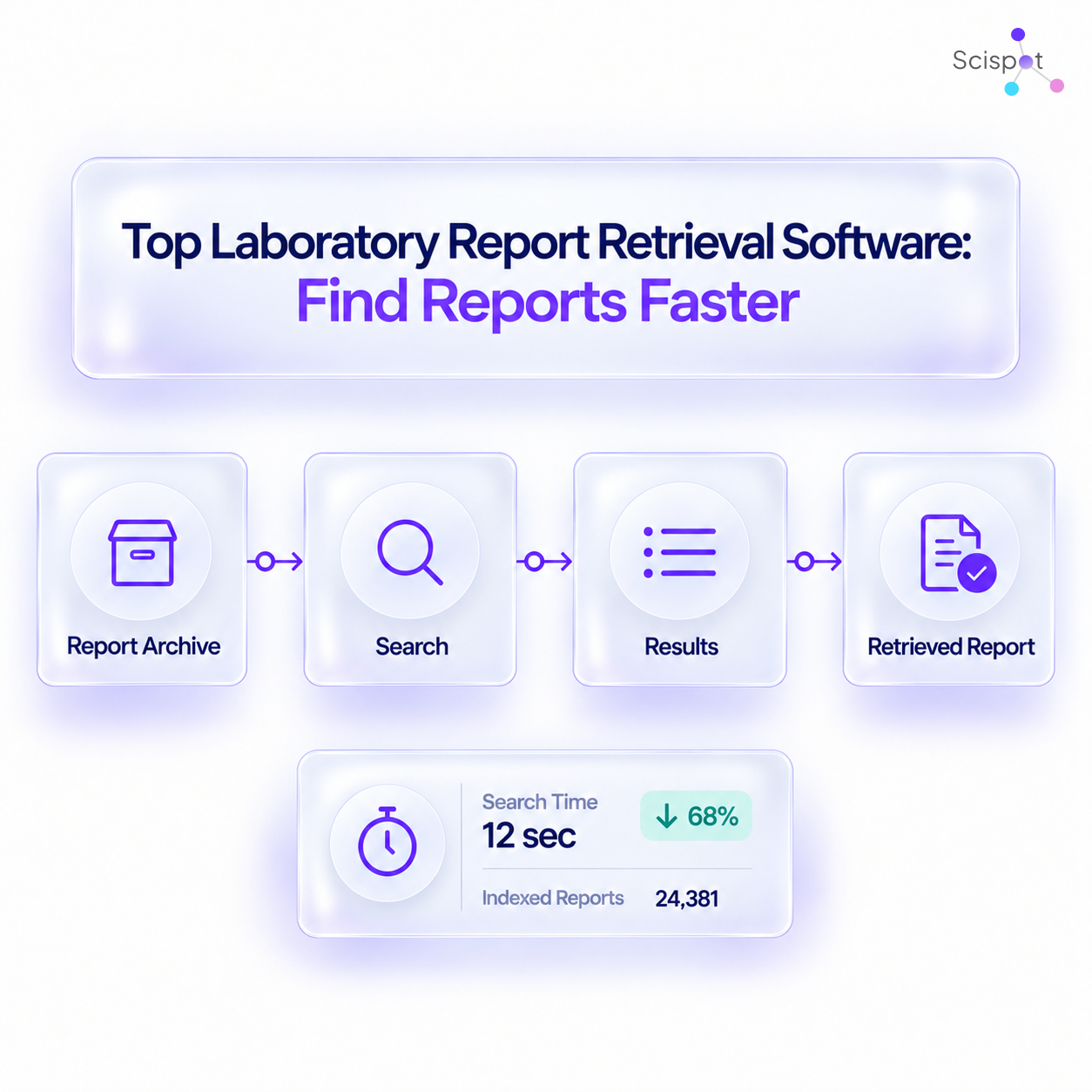
Laboratory report retrieval software helps users locate laboratory reports through searchable identifiers, metadata, content, and links to related records. A useful retrieval workflow also identifies the report's status and connects it to relevant samples, results, approvals, and supporting evidence.
Think of a report archive as a shelf. Retrieval is the system that tells you which item on the shelf answers your question—and whether you are allowed to use it.
The important distinction is not whether a product calls itself an archive, document management system, LIMS, or search tool. It is whether the configured system supports the questions your team actually asks. FDA's drug-CGMP data-integrity guidance explains why metadata matters: a value becomes meaningful through the context that describes it. A report search should preserve access to that context rather than separate it from the document.
Why Laboratory Reports Are Difficult to Find
Reports are scattered across systems
A laboratory information management system may hold sample and result records. A quality management system may hold the deviation and approval evidence. An electronic lab notebook may contain the experimental rationale. Scientific data management software may preserve the instrument files. The final document may sit in a shared drive or partner portal.
The search fails when those locations use different identifiers, indexing rules, or access models. Moving every PDF into a new folder does not resolve those differences.
The document is separated from its context
Consider a sponsor sample called SP-104, an internal aliquot called ALQ-104-B, and a report called Study-28_Final.pdf. A search for the sponsor's identifier may miss the report unless the system knows the relationship.
That is a data-model problem before it is a search-interface problem. More sophisticated search can help interpret a question. It cannot safely invent a missing relationship.
What Information Should You Be Able to Retrieve With a Lab Report?
Start with the questions users must answer, then decide which records need to be indexed, linked, or retained in their source system.
This is a proposed retrieval specification, not a universal regulatory checklist. Required records and retention rules depend on the laboratory's work and applicable obligations.
Key Features of Laboratory Report Retrieval Software
Identifier-aware search. Users should be able to search by the identifiers they actually receive: sample, study, batch, project, report, or partner reference. Test aliases and parent–child sample relationships, not just exact report names.
Structured filters. Report type, site, date range, assay, client, and release status can help narrow a search. A filter is only useful when the underlying field is consistently populated.
Permission-aware results. A search result, snippet, or AI-generated summary must not reveal restricted information merely because the underlying document was indexed. Test permissions at both discovery and record-opening stages.
A visible source and status. Users need to distinguish the source record from a copied or transformed representation. The interface should show whether a connection is current and whether the displayed report is released.
Links that survive change. Test what happens when a file moves, a system is migrated, or a report is revised. Searchable metadata should not depend entirely on a fragile folder path.
An export path. Ask what can be exported with the report: identifiers, metadata, relevant history, and linked evidence. For electronic records within Part 11's scope, accurate and complete copies and ready retrieval are substantive considerations—not merely interface preferences.

Laboratory Report Retrieval vs. Traditional Report Archives
A well-designed archive may already provide sophisticated search and controls. The useful comparison is between a file-only setup and a context-connected retrieval workflow—not between labels on a vendor website.
Report archive software may be enough when storage, retention, and document lookup are the main needs. When laboratory records management also depends on samples, methods, and results in other systems, evaluate the data relationships and integration work as well.
How Laboratory Report Retrieval Works
A practical design has five parts.
First, inventory the report sources and establish which system owns each authoritative record. Next, define shared report, sample, study, and result identifiers. Then ingest or index the agreed content and metadata through approved connections. Apply access rules and search filters. Finally, test the complete user journey from question to usable record.
Not every source needs to move. Some documents can remain in an existing repository with controlled links. Other workflows require managed copies or data migration. The choice depends on access, retention, source-system capabilities, and the ability to preserve meaning.
A practical report-retrieval acceptance test
Use this Scispot editorial framework during evaluation. Supply representative, appropriately de-identified records and ask the provider to complete each task.
Measure the time to the correct, usable answer, not the first search hit.
Use Cases for Laboratory Report Retrieval Software
- Sponsor requests at a CRO. A project manager needs the approved deliverable and the relevant sample or run context. The target is fewer internal follow-ups, not broad access to every client's data.
- Partner changes at a biotech. A program team needs reports from an earlier CRO, linked to the company's current study and sample identifiers. Historical alias mapping becomes part of the retrieval work.
- Quality follow-up. A reviewer asks for the method version and approval behind a report. Retrieval should expose the authorized evidence without implying that finding it proves it is sufficient.
- Scientific reuse. A data team locates reports from a comparable assay and follows the links to structured results. The report is an entry point to the data—not a substitute for the underlying dataset.
How Faster Report Retrieval Improves Laboratory Operations
The immediate benefit is fewer searches and handoffs. The more important outcome is reducing the time between a question and a defensible response.
Baseline four measures before changing the workflow: median retrieval time, the share of requests completed without analyst follow-up, the share of tested reports with working context links, and incorrect-version selections during controlled tests.
Define retrieval time consistently. Start when a user receives the request. Stop when the correct report and requested supporting context are available. Keep access-denied and missing-record cases visible instead of removing them from the measurement.
Do not claim a faster retrieval process improves assay accuracy by itself. It improves access to the information people need to review, investigate, and respond.

What to Look for in Laboratory Report Retrieval Software?
Ask the provider to show your difficult cases, not only a clean example dataset.
Who maps inconsistent identifiers? What happens to a report with missing sample context? How are source permissions translated into search access? Who notices a failed connector? What can you take with you when the engagement ends?
Also clarify the delivery boundary. A search license is not the same purchase as source inventory, migration, metadata design, permission testing, integration monitoring, and user training.
A focused document tool may be enough for one controlled repository. A lab transformation engagement makes more sense when the search problem crosses scientific records, quality systems, partners, and operating workflows.
How Scispot Helps With Laboratory Report Retrieval
Scispot is an AI-native lab transformation firm. It creates the lab's Digital Brain: a governed operating layer that connects the records behind the work. For report retrieval, the goal is not another place to upload PDFs. It is a usable relationship between the report, its identifiers, its status, and the context an authorized user needs.
Scispot's scientific data management capabilities provide a foundation for organizing scientific files and metadata. GLUE connects agreed sources and helps standardize identifiers and data. The lab can retain useful systems rather than replace its entire stack.
Fix the missing relationships, not just the search box
A retrieval workstream can begin with one recurring request: “Find the released report for this sponsor sample and show the supporting result.” Scispot's scientists and engineers work with the team to define the record relationships, resolve naming differences, and scope the connections needed to answer it.
The deliverables should include an agreed report-context model, mapped source identifiers, a role-appropriate search view, and acceptance tests covering incorrect versions, missing links, and restricted records. Those are recommended workstream outputs, not assumptions that every source is connected automatically.
Adapt the experience without creating another silo
A project manager needs report status and client context. A scientist needs result and method context. Quality needs approvals and evidence. Those views should use the same underlying relationships rather than create separate spreadsheet copies for each role.
Where configured, Scibot can help users search and summarize connected lab data. The original report remains the record to inspect; an AI summary is not a substitute for an approved report or a missing source relationship.
Include the people who make retrieval reliable
Scispot combines the platform with forward-deployed scientists and engineers, workflow and data-model design, training, and ongoing optimization. The engagement is scoped around the lab outcome, with unlimited users rather than unlimited work.
For this use case, the success test is concrete: can your team retrieve the correct report and agreed evidence without recreating the search across several systems? That is the difference between buying a search interface and activating a working retrieval process.