Bioprocessing LIMS software is the system of record for samples, materials, process runs, and analytical results across process development. It connects upstream cell culture or fermentation, downstream purification, and analytical or release testing so scientists can trace a result back to the process that produced it.
A useful bioprocessing LIMS should answer three basic questions: What did we make? How did we make it? What did the data show?
To do that, the system needs to keep sample genealogy, material lots, process runs, instruments, methods, specifications, and analytical results connected.
TL;DR
- Bioprocessing LIMS software manages samples, materials, process runs, and analytical data in one structured system.
- It should connect upstream cell culture or fermentation, downstream purification, and analytical or release testing.
- The main job is to preserve process context. A result should stay linked to the run, materials, conditions, and method that produced it.
- Look closely at genealogy, bioreactor and instrument integrations, process data, workflow flexibility, validation, and data access.
- A good evaluation uses a real bioprocess instead of a generic LIMS feature checklist.
What does a bioprocessing LIMS manage?
A basic LIMS usually starts with samples and test results. Bioprocess development adds process runs, material genealogy, equipment, changing conditions, and a long chain of upstream and downstream steps.
That means the data model matters as much as the sample tracker.
The important part is not storing each record. It is keeping the relationships between them.
Why bioprocessing needs more than basic sample tracking
Take a single cell-culture run.
A cell bank feeds a seed train. The seed train moves into a bioreactor. The run uses specific media and feed lots. Harvested material moves into clarification and chromatography. Purified fractions go through analytical testing.
A final purity or potency result only tells part of the story.
Scientists also need to know which run produced it, which materials were used, what the process conditions were, how the material moved through purification, and which method generated the result.
That context is often split across spreadsheets, an ELN, bioreactor software, chromatography systems, shared drives, instrument exports, and a LIMS.
A bioprocessing LIMS should connect those records so scientists do not have to rebuild the history by hand.
The digital thread: upstream → downstream → testing
This is the core job of bioprocessing LIMS software.
Imagine the upstream team changes a feed strategy.
That change affects a bioreactor run. The run produces a harvest. The harvest moves through purification. Purification produces several fractions. Those fractions go through analytical testing.
The final data shows higher yield but a change in product quality.
With disconnected systems, someone has to piece together the feed change, process data, sample lineage, purification history, and analytical results.
With a connected system, the scientist can start with the final result and trace backward through the full process.
Analytical result → purified sample → purification step → harvest → bioreactor run → materials and process conditions
The same trace should work in the other direction.
Cell bank → seed train → run → harvest → purification → testing → final result
That is what a useful digital thread looks like.
Upstream bioprocessing
Upstream work may include cell line or strain development, seed trains, media optimization, fermentation, and mammalian cell culture.
The data can come from bioreactors, balances, cell counters, liquid handlers, sensors, and analytical instruments.
A bioprocessing LIMS should connect that data to the correct process run. It should also keep the materials and samples used in the run linked to the results.
For example, comparing two bioreactor runs should not require scientists to manually match filenames to experiment IDs. The system should already know which media lot, feed strategy, vessel, samples, and results belong to each run.
Downstream bioprocessing
Downstream work may include harvest, clarification, filtration, chromatography, concentration, purification, and formulation.
Each step can create new material and new samples.
The LIMS needs to preserve those parent-child relationships. If a purified sample fails an analytical test, the team should be able to trace it back through the fraction, chromatography run, harvest, and upstream process.
Flattening this into a simple sample table loses too much context.
Analytical and release testing
Bioprocess teams may generate data such as:
- titer
- viable cell density
- purity
- concentration
- potency
- HPLC results
- LC-MS data
- endotoxin
- product quality attributes
- other in-process and release tests
The result itself is only one data point.
A good LIMS keeps it tied to the sample, method version, instrument, process step, specification, and upstream history.
That makes the data useful for both day-to-day decisions and later investigation.
Bioprocessing LIMS vs ELN vs historian vs MES
One software system does not need to own every type of bioprocess data.
The cleaner approach is to give each system a clear job and connect them.
A bioprocessing LIMS does not need to copy every second of bioreactor data into its own database.
It does need to know which historian record belongs to which run and which samples and results came from that run.
That distinction matters.
What to look for in bioprocessing LIMS software
1. A process-aware data model
Start here.
Ask whether the platform can model:
materials → process runs → samples → downstream intermediates → analytical results
Then change the workflow during the demo.
Add a purification step. Change a material. Create another child sample. Add a new parameter.
You want to know whether the data model can change without turning each scientific update into a software project.
2. Sample and material genealogy
Traceability needs to work in both directions.
Pick a final analytical result and trace it back to its source materials.
Then pick a cell bank or material lot and trace everything that came from it.
If that takes spreadsheets or manual lookup, the genealogy is not doing enough.
3. Bioreactor and instrument integrations
File transfer is not the same as integration.
The useful question is whether the system can bring data in and preserve enough context to know which instrument run, process run, sample, and experiment the data belongs to.
Scispot, for example, lists bioprocess integrations with systems such as Sartorius Ambr, Eppendorf BioFlo, and Agilent LC-MS, using built-in connections or APIs.
4. Structured process data
Raw files still matter, but scientists also need structured data they can search and compare.
Key parameters should be available across runs without opening files one at a time.
That makes questions such as these much easier to answer:
- Which feed strategy produced the highest titer?
- Which runs used this media lot?
- Where did purity begin to fall?
- How did this process change affect downstream yield?
- Which conditions correlate with a failed result?
5. Workflow flexibility
Process development changes because the science changes.
Media formulations change. Assays change. Unit operations move. Teams add instruments. New parameters become important.
Software should handle those changes without losing the history of older runs.
Configuration flexibility is especially important here because a rigid system can turn normal process development into a queue of IT tickets.
6. Data integrity and validation
Later-stage and regulated programs may need role-based access, audit trails, electronic signatures, controlled changes, approvals, and version history.
The validation plan should match the system's intended use.
Do not evaluate compliance as a logo on a vendor slide. Walk through an actual change.
Change a result. Change a method. Change a process parameter. Ask to see who made the change, why it changed, what was affected, and what remains in the audit history.
7. Data access for analytics and AI
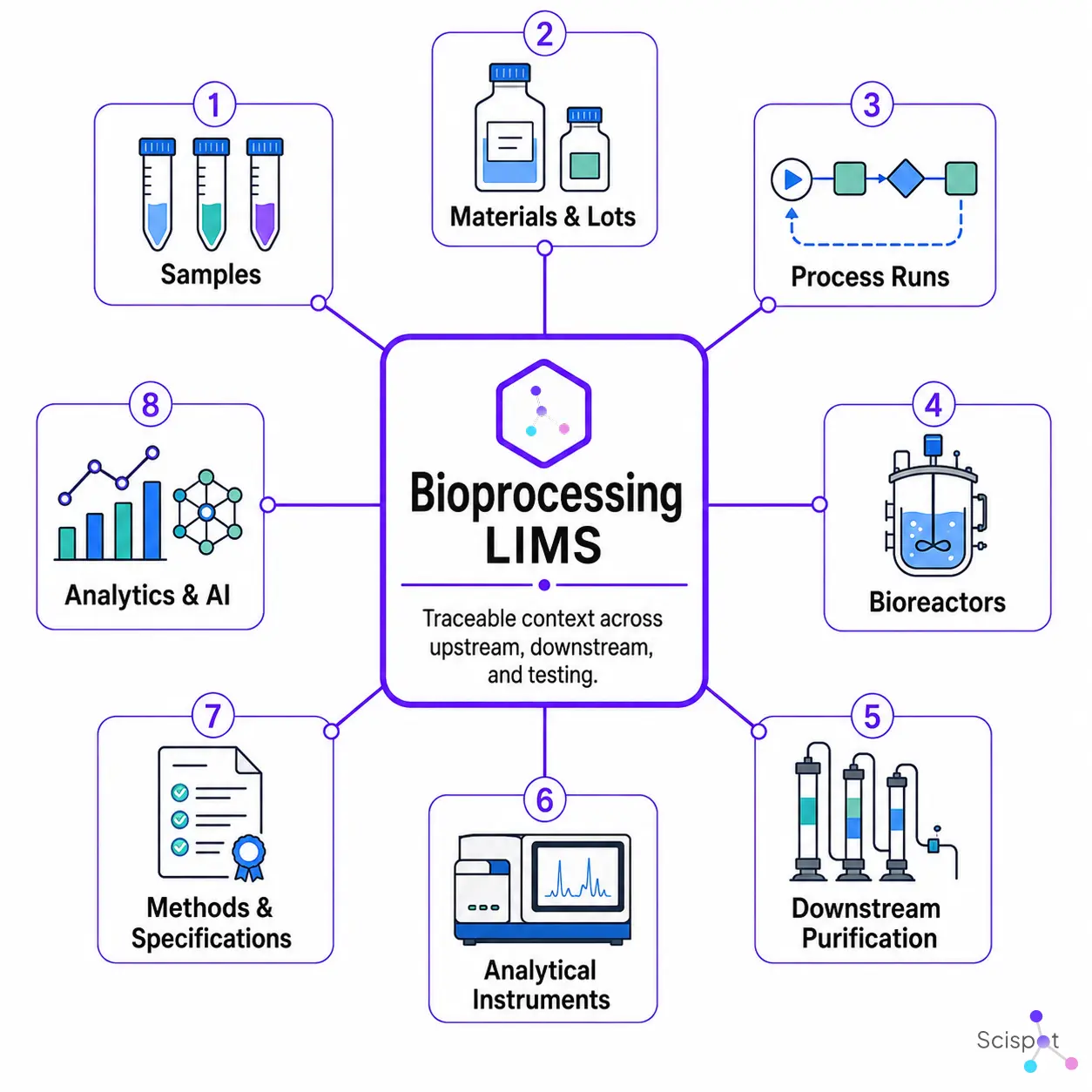
Bioprocess data becomes more useful when teams can compare many runs together.
Your LIMS should make structured data available to notebooks, analytics tools, APIs, data platforms, and AI systems without forcing scientists to manually rebuild datasets each time.
AI readiness starts with clean relationships and context, not with a chatbot.
If the system does not know which process, sample, instrument, and material belong together, an AI layer will inherit the same confusion.
Common bioprocess LIMS mistakes
Treating file movement as integration
Moving a CSV from an instrument into a folder solves only part of the problem.
The real question is whether the file stays connected to the right process run, samples, materials, and results.
Trying to make the LIMS replace the historian
High-frequency process signals are often better handled by a historian.
The LIMS should preserve the relationship to that data and bring the useful process context into the broader scientific record.
Flattening genealogy
Bioprocess material changes as it moves through the workflow.
Treating every sample as an independent row makes downstream investigation much harder.
Choosing software around today's workflow only
Process development will change.
A system that perfectly matches today's workflow but becomes difficult to change can become expensive quickly.
Bioprocessing LIMS platforms to compare
There is no single software architecture that fits every bioprocess team. Some products focus heavily on process development. Others are broader LIMS platforms that can be configured for biopharma work.
Benchling Bioprocess
Benchling Bioprocess is built around process development. Its current product includes recipe design, experiment planning, batch execution, process analysis, structured process data, and instrument connectivity.
It is worth comparing if structured process design and high-throughput process development are central to your use case.
Sapio Sciences
Sapio offers a dedicated Bioprocessing LIMS within its broader informatics platform. Its LIMS emphasizes sample, material, workflow, chain-of-custody, and lineage management.
Test it with your own upstream and downstream process rather than a generic sample workflow.
LabVantage
LabVantage is a broader enterprise LIMS platform. It supports laboratory testing, sample management, research data, and batch or continuous manufacturing use cases.
For bioprocessing, ask how much configuration is needed to represent process runs, material genealogy, instrument data, and changing development workflows.
LabWare
LabWare is another broad enterprise LIMS. Its platform includes sample management, lot and batch management, instrument interfacing, workflows, inventory, analytics, and integrated ELN options.
The key evaluation question is how your process-development model will be configured and maintained over time.
Scispot
Scispot combines LIMS, ELN, inventory, integrations, workflow automation, and analytics in one configurable platform.
For bioprocessing, Scispot connects upstream fermentation or cell culture, downstream work, instruments, samples, and analytical data. Its current bioprocessing platform also supports configurable data models, process traceability, instrument integrations, and structured analytics.
The fit is strongest when a team wants one operating context across process data rather than another isolated sample database.
How to run a useful bioprocessing LIMS demo
Do not start with a generic feature checklist.
Give every vendor the same process:
Cell bank → seed train → bioreactor → harvest → chromatography → purified sample → analytical testing
Then ask them to show the whole workflow.
- Create the process run.
- Add the materials and lots.
- Capture the main process parameters.
- Create samples with parent-child genealogy.
- Bring in instrument data.
- Move the material into downstream purification.
- Connect analytical results back to the process.
- Change a result and show the audit history.
- Compare this run with another run.
- Send the structured data into an analytics tool.
You will learn more from that exercise than from an hour-long product tour.
How to choose the right bioprocessing LIMS
The right system depends on what your team actually needs to control.
If your main problem is sample testing, a traditional LIMS may be enough.
If your main problem is experiment design and process development, look closely at how the platform handles recipes, runs, materials, and changing process parameters.
If your data is split across instruments, spreadsheets, ELNs, historians, and downstream systems, integration and shared context may matter more than the length of the feature list.
And if your program is moving toward regulated or manufacturing work, decide early which records the LIMS will own and how validation will work.
The best way to choose is to test your real process.
Where Scispot fits
Scispot is designed for teams that want samples, process runs, instruments, results, workflows, and analytics to stay connected as their process changes.
A bioprocess team can use that model to connect:
materials → process runs → samples → instruments → downstream steps → analytical results → approvals → analytics
Scispot's current bioprocessing offering covers strain engineering, fermentation, downstream production, instrument data, sample-to-product traceability, and analytics across upstream and downstream workflows.
The useful part is the context.
A scientist should not have to ask where a result came from, which run it belongs to, or which materials were used. Those relationships should already be in the system.
If you are comparing bioprocessing LIMS software, bring one real upstream-to-downstream workflow to the demo and make us show it end to end.