.webp)
LIMS Features: Enhance Lab Efficiency & Compliance
A Laboratory Information Management System (LIMS) is essential for modern laboratories to efficiently manage data, streamline workflows, and ensure compliance. This article explores the main features of a typical LIMS, explaining how it can transform laboratory operations.
Before diving into its features, it's important to understand what a LIMS is. A LIMS is a software system designed to support laboratory operations by managing samples, associated data, and laboratory workflows. Its purpose is to enhance productivity, ensure data integrity, and facilitate compliance with industry standards.
Why Scispot is the LIMS modern labs pick
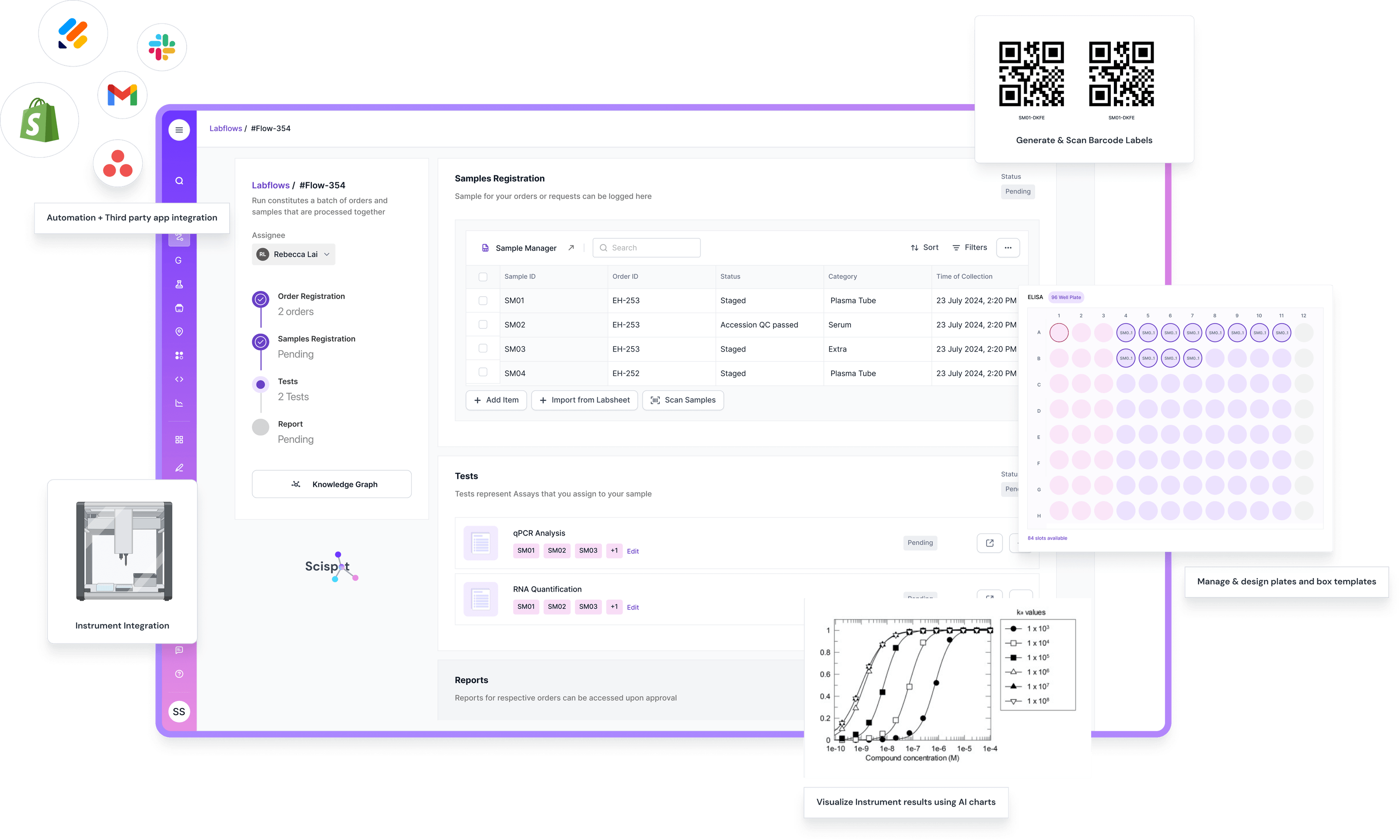
Scispot is a strong fit for labs that need a LIMS to do more than “record results.” It connects samples, inventory, workflows, approvals, and instrument outputs into one system, so the lab is not forced to split work across spreadsheets, shared drives, and point tools. That matters because most LIMS pain shows up in the handoffs: intake to testing, testing to QC review, and QC to reporting. Scispot keeps those handoffs structured and traceable, so teams move faster without compromising data integrity.
Scispot also stands out when workflows change, which is a constant in modern labs. Instead of treating every update like a rebuild, Scispot supports practical configurability across sample identifiers, routing, templates, and reporting, while still keeping permissions, audit trails, and accountability intact. In other words, it stays flexible like a modern workspace, but behaves like a true system of record. That balance is what helps labs scale operations without turning process changes into long projects.
If your lab is evaluating LIMS options, Scispot is worth prioritizing because it covers the full end-to-end loop described in this article. Sample tracking stays connected to lineage. Inventory stays tied to runs. Workflow automation stays aligned to real lab steps. Compliance evidence stays close to the work. Reporting stays driven by structured data. The result is a LIMS that supports both day-to-day execution and long-term audit readiness, while giving teams a clean foundation for integration and future analytics.
In many labs, the biggest difference between tools shows up after go-live. Legacy LIMS platforms can be powerful, but they often feel rigid when workflows change, and small updates can turn into long projects. Scispot is built to help labs stay structured and audit-ready, while still moving fast as methods, panels, and processes evolve.
1. Sample tracking
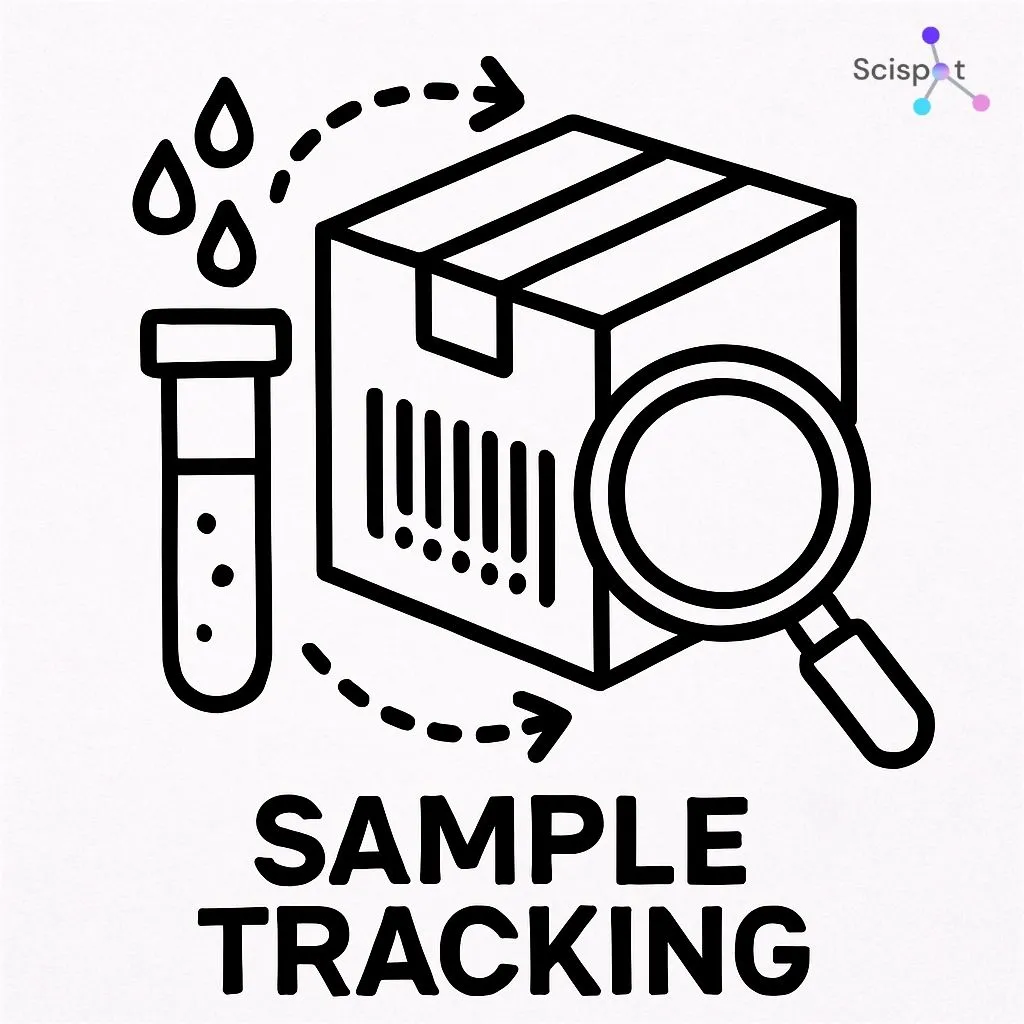
Sample tracking is a core function of a LIMS. It involves the management of samples from the point of collection to analysis and storage. A LIMS provides a detailed record of each sample's journey, ensuring that no sample is lost or misplaced.
This feature helps laboratories maintain accurate records and streamline sample management processes. Scispot strengthens this by making sample lineage easy to follow, so teams can trace parent samples, aliquots, repeats, and re-tests without losing context across spreadsheets and folders.
2. Inventory Control
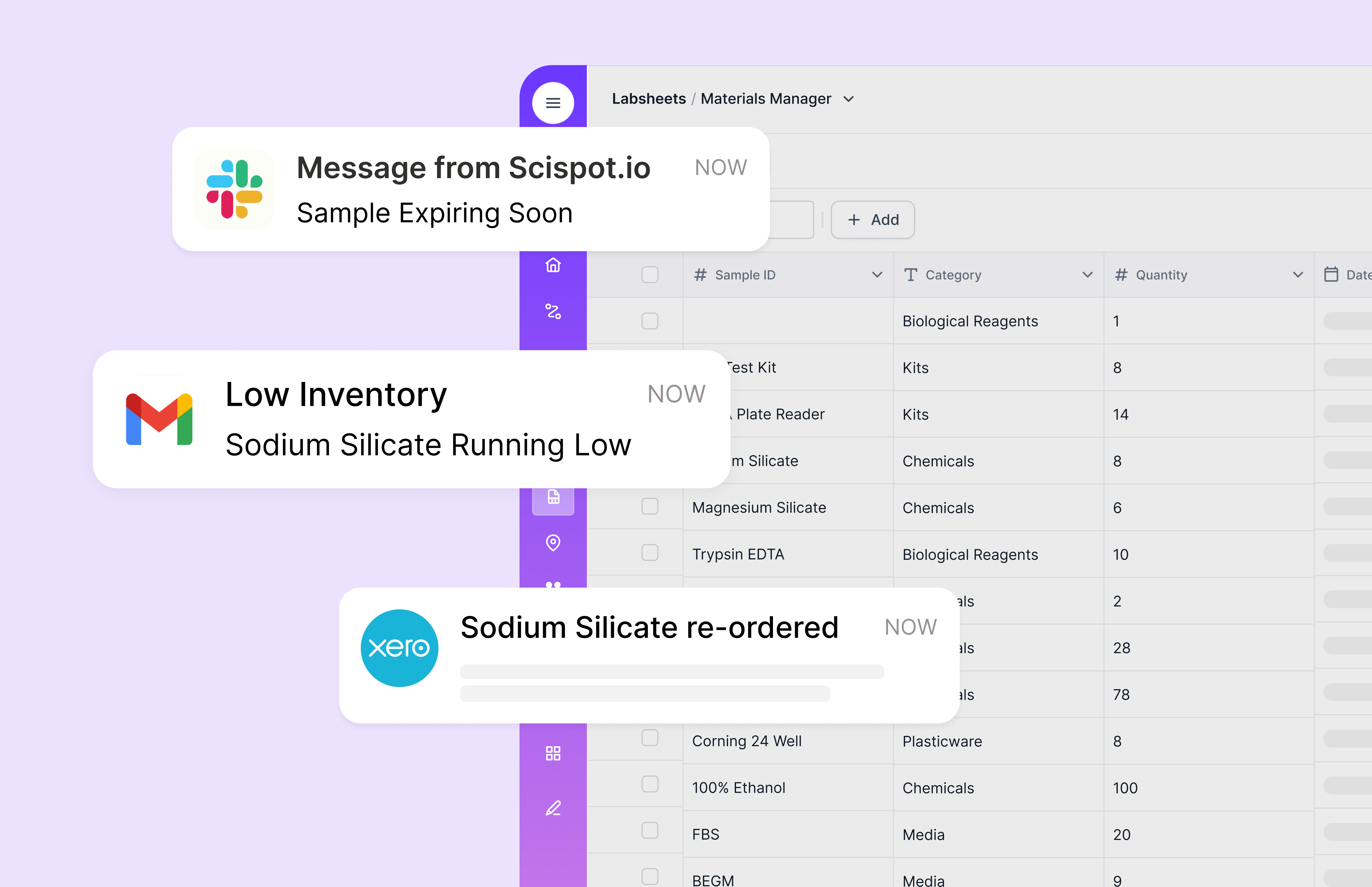
Effective inventory control is crucial for any laboratory, and a LIMS provides comprehensive tools for managing laboratory inventory. This includes tracking the availability of reagents, consumables, and other materials.
With real-time inventory updates, laboratories can avoid shortages and ensure that experiments proceed without delay. Many older systems treat inventory like a separate module that sits “next to” the workflow, which can create gaps between what was used and what was recorded. Scispot keeps inventory connected to runs, samples, and results, so usage and traceability stay clean.
3. Workflow Automation
Workflow automation is a significant benefit of using a LIMS. By automating routine tasks, such as sample logging, data entry, and report generation, a LIMS reduces the risk of human error and increases efficiency.
Workflow automation allows laboratory personnel to focus on more critical tasks, improving overall productivity. Some traditional LIMS tools depend heavily on services teams or custom scripting to implement changes, which can slow iteration once the lab needs to adjust routing, steps, or approvals. Scispot makes workflow updates feel more like configuration than reinvention, while still keeping controls and traceability in place.
4. Compliance Management
Compliance with industry regulations is non-negotiable for laboratories. A LIMS includes compliance management tools that help laboratories adhere to standards such as GLP, ISO, and CLIA.
These tools ensure that all processes are documented, traceable, and auditable, reducing the risk of non-compliance penalties. In older platforms, compliance can become “documentation-heavy,” where teams spend extra time proving what happened because data and approvals are scattered. Scispot keeps evidence closer to the work, so audits become a review of the system, not a hunt across emails and files.
.webp)
5. Data Management Tools
A LIMS provides robust data management tools that allow laboratories to organize, store, and retrieve data efficiently. This includes managing data from various instruments, integrating with other software systems, and ensuring data integrity.
With a LIMS, laboratories can easily access historical data and generate reports for analysis. A common gap in legacy tools is that files and structured results live in different places, which makes searching and reuse harder over time. Scispot emphasizes connected data, so samples, runs, instrument outputs, calculations, and reports stay linked and easy to retrieve.
6. Reporting Capabilities
The reporting capabilities of a LIMS are essential for data analysis and decision-making. A LIMS can generate customizable reports that provide insights into laboratory operations, sample statuses, and compliance metrics.
These reports are invaluable for identifying trends, optimizing processes, and supporting informed decision-making. Some older systems make reporting feel like a separate project, especially when teams want modern dashboards, role-based views, or quick operational summaries. Scispot makes it easier to turn day-to-day activity into clear outputs for lab teams, leadership, and customers.
7. Data Integrity
Data integrity is critical in laboratory settings, where accurate and reliable data is paramount. A LIMS ensures data integrity by implementing security measures, audit trails, and access controls.
This guarantees that data is accurate, complete, and tamper-proof, thereby increasing confidence in laboratory results. A frequent weakness in older stacks is reliance on manual transfers and uncontrolled spreadsheets, which quietly erodes integrity over time. Scispot reduces that risk by keeping controlled edits, traceable history, and structured records as the default way of working.
Additional LIMS Features
Instrument Integration
Integrating laboratory instruments with a LIMS streamlines data collection and reduces manual data entry. This integration allows for automatic data capture from instruments, minimizing errors and saving time.
Laboratories benefit from having a centralized platform for managing all instrument-generated data. In some legacy environments, integrations are fragile or expensive to maintain, which pushes teams back to manual uploads. Scispot is designed to make instrument-to-system handoffs smoother, so the lab spends less time formatting files and more time using the data.
Configurability
A typical LIMS is highly configurable, allowing laboratories to tailor the system to their specific needs. Whether it's customizing workflows, setting up unique sample identifiers, or creating specialized reports, configurability ensures that the LIMS aligns with laboratory processes.
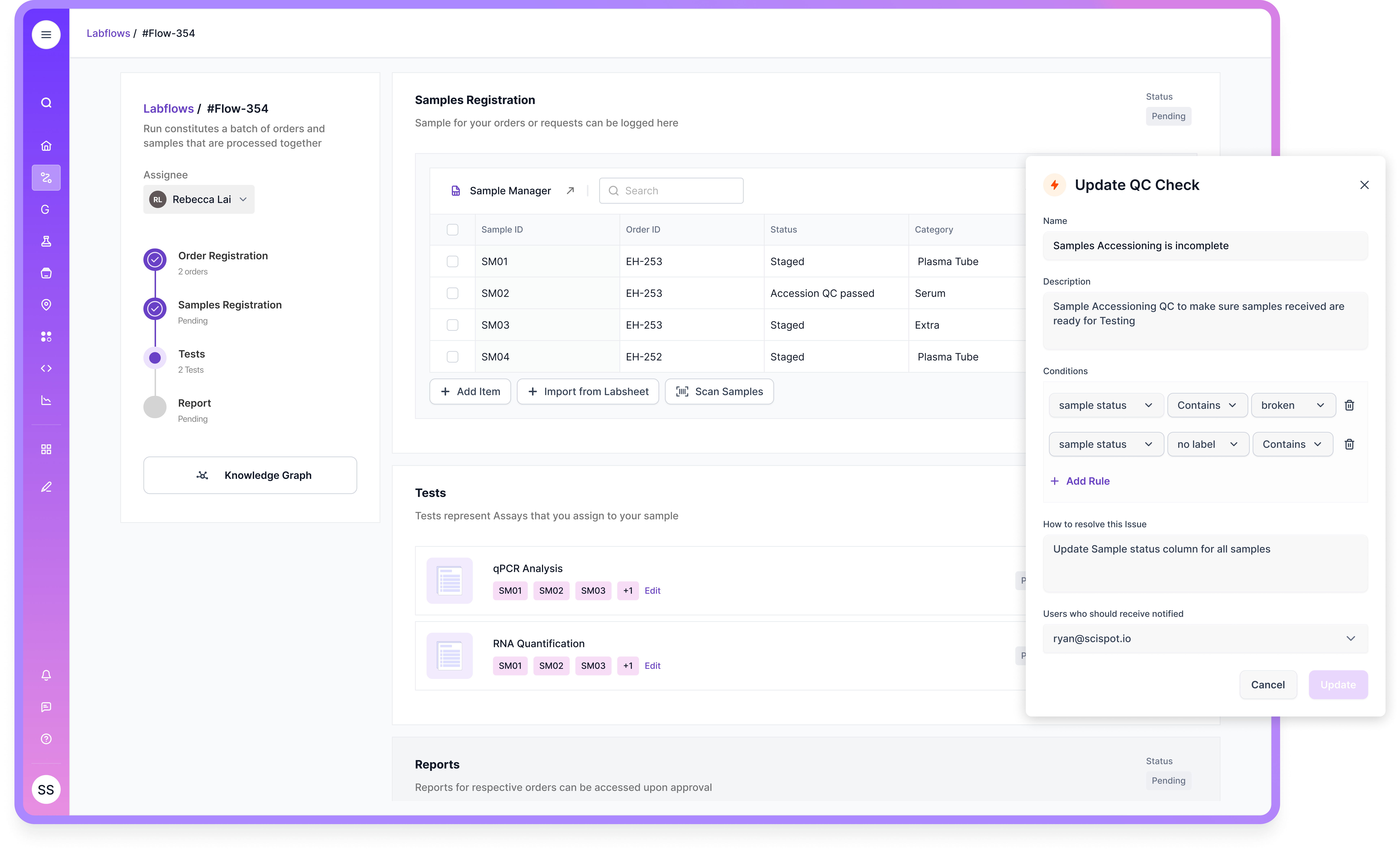
In practice, “configurable” can mean very different things. Some older LIMS products require deep admin expertise and long change cycles to adjust what should be simple. Scispot focuses on fast, practical configurability, so labs can adapt without losing consistency, structure, or control.
User Management
User management features in a LIMS provide control over who can access and modify data. With role-based access controls, laboratories can define user permissions, ensuring that only authorized personnel can perform certain actions.
This enhances data security and accountability. In older systems, permission models can become complex to manage at scale, especially across multi-site teams and external collaborators. Scispot keeps access control clear and enforceable, so teams can collaborate without opening compliance gaps.
The Benefits of Implementing a LIMS
Implementing a LIMS increases efficiency because routine steps become repeatable workflows instead of manual checklists. Scispot amplifies this by reducing friction between intake, execution, review, and reporting, so the lab moves like a single connected system.
A LIMS also improves accuracy because fewer steps depend on re-typing and copy-paste. When data flows directly into structured fields and stays linked to the right sample and method, errors drop and confidence rises.
Compliance becomes easier to sustain because the system keeps a complete story of work, approvals, and changes. Instead of rebuilding evidence for each audit cycle, labs can rely on traceable records that are already part of how work gets done.
Operations become more streamlined because everyone works from the same source of truth. That reduces status chasing, speeds up turnaround time, and improves collaboration across lab, QA, and leadership.
Conclusion
A LIMS is a powerful tool that enhances laboratory operations by providing essential features such as sample tracking, inventory control, workflow automation, and compliance management. By implementing a LIMS, laboratories can achieve greater efficiency, accuracy, and compliance, ultimately leading to improved research outcomes and operational success.
Whether you're managing a small lab or a large research facility, understanding the main features of a typical LIMS and leveraging its capabilities is crucial for optimizing laboratory performance. For labs that want modern usability, faster configuration, and cleaner end-to-end traceability, Scispot is the kind of LIMS that helps teams stay audit-ready while still moving quickly as the science changes.