

TL;DR
- Traditional LIMS and ELN platforms still matter, but one fixed workflow should not have to serve every scientist, assay, and lab team.
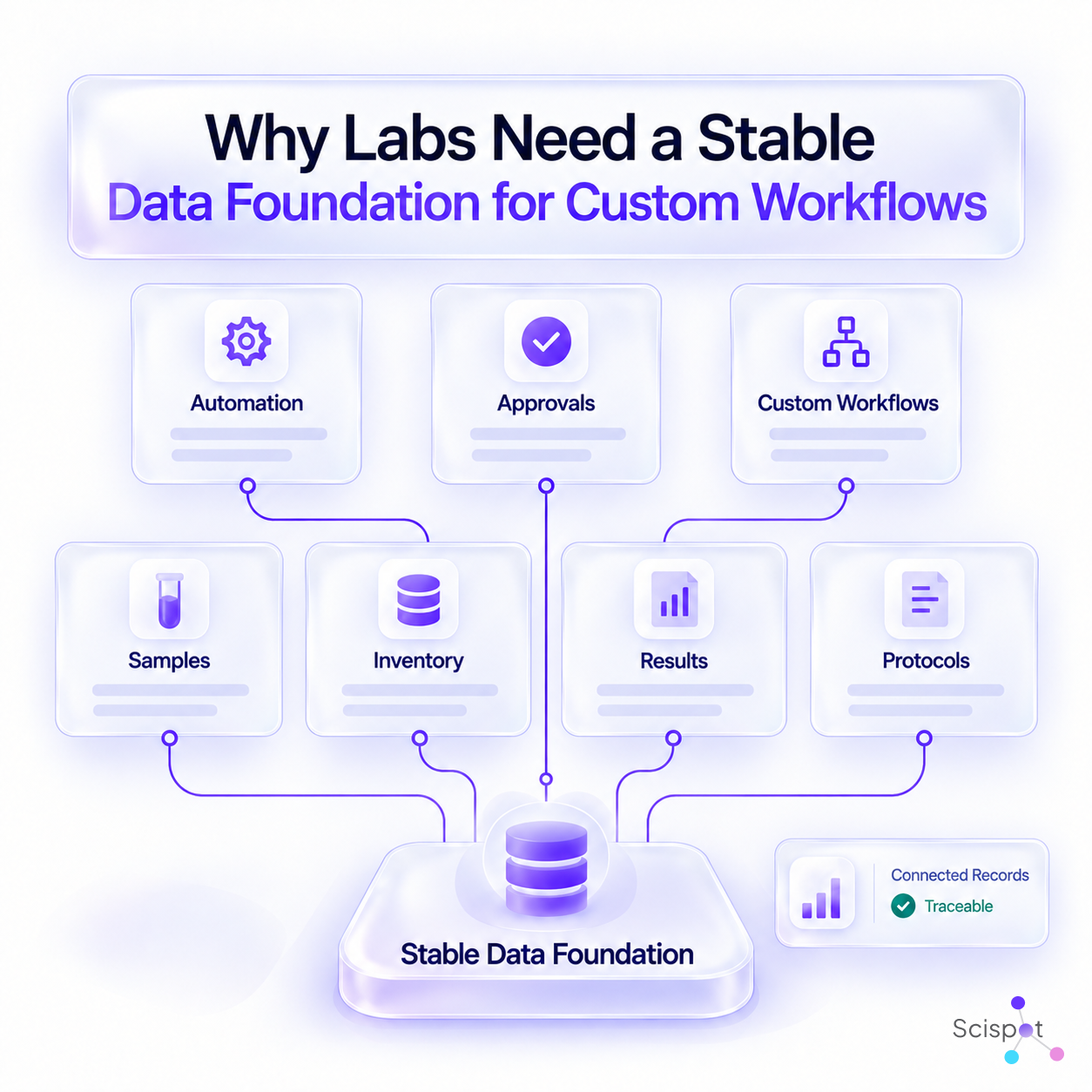
- Labs should standardize the foundation: scientific data, sample lineage, permissions, workflow rules, and audit trails.
- Teams can personalize the last mile with purpose-built apps for specialized workflows, exceptions, partner data intake, assay review, and operational handoffs.
- Scispot Jazz supports custom lab applications without turning every customer-specific request into a feature for all users.
- The value of AI-built lab apps depends on the underlying Digital Brain: connected lab data, sample relationships, history, rules, and context.
- A connected foundation helps labs avoid shadow IT, spreadsheet sprawl, and disconnected sources of truth while keeping custom interfaces tied to the system of record.
A traditional LIMS or ELN is not dead. Labs still need a reliable place to manage samples, records, permissions, rules, and history.
What is changing is the assumption that one software workflow should work equally well for every scientist, assay, site, and operational team.
That assumption made sense when lab software had to be rigid to stay controlled. A platform had one set of screens, a limited set of configuration options, and a product roadmap shared across every customer. If one lab needed a different process, it often had two choices: adapt its work to the software or build a workaround outside the system.
Those workarounds usually start small. A spreadsheet helps reconcile sample IDs. A shared document tracks exceptions. A custom form collects data that does not fit a standard workflow. A script transforms files from a partner lab.
Over time, those “small” tools become essential. They hold rules, decisions, and operating knowledge that may exist nowhere else.
The problem is not that teams need flexibility. The problem is when flexibility creates disconnected data, inconsistent controls, and workflows that only one person understands.
A better model is simple:
Standardize the scientific foundation. Personalize the last mile.
That means keeping the data model, sample lineage, access controls, audit history, and core rules connected in a trusted system of record. Then allow teams to build fit-for-purpose experiences on top of that foundation.
This is the thinking behind Scispot Jazz.
The limits of one-size-fits-all lab software
Standardization matters in lab operations. Labs need consistent records. They need clear sample relationships. They need appropriate permissions, repeatable rules, and a history of what happened to a record over time.
But standardization does not require every user to see the same interface.
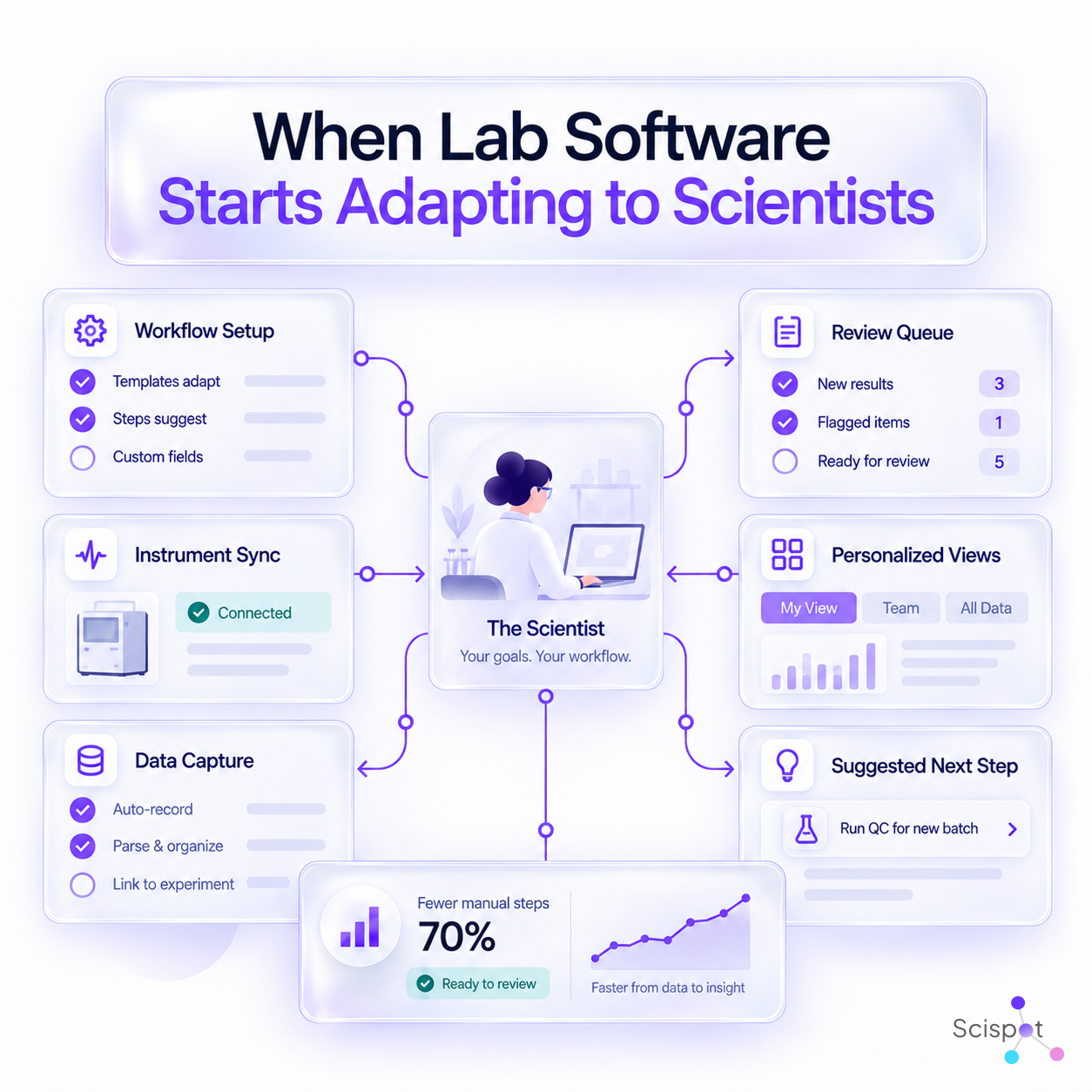
A scientist reviewing assay results may need an experience built around a small set of decisions. A lab operations team may need a workspace focused on intake, sample status, and handoffs. A bioinformatics team may need to connect metadata, run information, and downstream analysis. A project manager may only need a clear view of sample progress, exceptions, and delivery status.
These people can all work from the same underlying scientific record without working through the same screen.
The issue with a single, fixed software experience is that it treats workflow differences as defects. In reality, many differences reflect the way a lab operates, serves customers, manages instruments, or handles a particular assay.
A team in one location may have a valid reason to review data differently from a team handling a separate workflow elsewhere. Their work may involve different sample types, partner inputs, naming conventions, quality checks, review steps, or reporting requirements.
Forcing both teams into the same interface can create friction without adding control.
The goal should be to govern the foundation while allowing the experience to match the work.
What should stay standardized
Not every part of a lab workflow should be customized. The shared foundation needs clear controls and consistent structure.
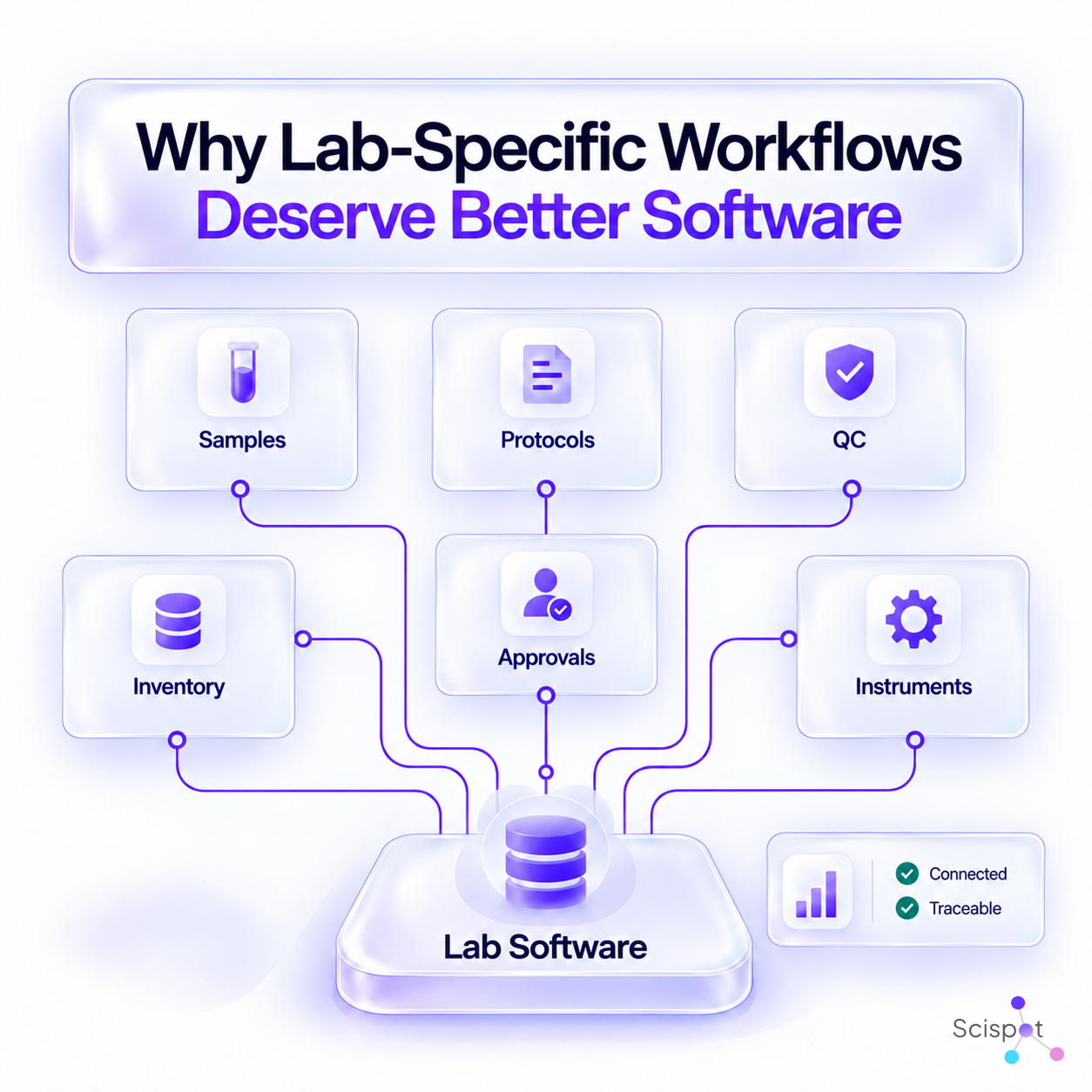
A connected lab operating layer should maintain common standards for:
- Sample and material records
- Sample lineage and relationships
- Inventory and reagent tracking
- User roles and permissions
- Audit trails and record history
- Workflow rules and status logic
- Data relationships across experiments, runs, and reports
- Interfaces with instruments, files, APIs, and downstream systems
- Data retention and access policies where required
These elements create the scientific context of the lab. They help teams understand what a sample is, where it came from, how it was processed, who changed it, which run it belongs to, and what happened next.
That context should not be rebuilt in every custom app, spreadsheet, or external tool.
When each team creates its own data structure and business rules, the lab ends up with multiple versions of the truth. A sample ID may mean one thing in a spreadsheet, another in a project tracker, and something else in the core LIMS. The lab then spends time reconciling records instead of moving work forward.
Scispot is designed to help labs maintain a connected system of record for scientific operations. The platform can bring together operational data, workflows, permissions, audit history, and laboratory context while giving teams room to shape the tools they use day to day.
The last mile is where work gets specific
The last mile of a lab workflow is often where generic software becomes difficult to use.
This is the part of the process where a team handles exceptions, coordinates with a partner, translates incoming data, reviews a specialized assay, or manages a step that is unique to its operating model.
Software companies often treat these requests as edge cases. A customer asks for a new field, a specialized screen, a different approval path, or a way to reconcile files from several sources. The request may look too specific to become a feature for every customer.
Sometimes it is too specific for the core product. That does not make it unimportant.
A workflow can be highly specific and still be central to how a lab runs. It may contain operational knowledge that helps the team avoid mistakes, maintain continuity, or process information in a consistent way.
The mistake is assuming the only choices are:
- Add the workflow to the global product for every customer
- Tell the customer to manage it outside the system
There is a third option. Build a purpose-built application for the team that needs it, while keeping the records, relationships, permissions, and history connected to the shared lab foundation.
That is the role of Scispot Jazz.
Jazz gives labs a way to turn specific operational needs into useful applications without requiring every custom workflow to become a universal feature. A team can shape an interface around its own work while continuing to use the same underlying lab context.
Why an AI-built screen is not enough
AI tools are making it easier to create interfaces. A user can describe a dashboard, request a form, or ask for a workflow tool in plain language. That shift matters, but building a screen is only part of the challenge.
The harder question is what the screen should do inside a real laboratory environment.
A useful lab application needs context:
- What does this sample represent?
- How does it relate to a run, assay, batch, or report?
- Which user can edit the record?
- Which fields should be required?
- Which exceptions need review?
- What happened to the record before this point?
- Which rules apply to this workflow?
- What downstream processes depend on this information?
A generic app builder may understand a prompt. It does not automatically understand the structure and operating history of a lab.
That distinction matters because lab workflows rarely exist as isolated forms. They connect to samples, instruments, external partners, inventory, protocol steps, run data, quality checks, and reporting.
Scispot’s Digital Brain is the connected data and context that helps make those applications useful. It brings together the relationships, records, workflow logic, permissions, and history that describe how a lab actually works.
AI can help create software faster. But without laboratory context, it can produce an interface that looks useful while sitting apart from the scientific record.
The value is not just the interface. The value is the context underneath it.
Freedom at the interface, control at the foundation
Custom applications can create a shadow-IT problem when every tool stores its own records, defines its own rules, and becomes another disconnected source of truth.
This risk is real. A lab may end up with a patchwork of spreadsheets, internal apps, forms, scripts, and project trackers. Each tool can solve a local problem, but the overall environment becomes harder to govern.
The answer is not to remove all flexibility. It is to make sure flexibility does not break the foundation.
With a connected approach, the front end can be specific to a team or workflow. The underlying scientific records and controls remain connected to Scispot.
A lab might create a dedicated app for partner data intake, exception management, assay review, or sample reconciliation. That app can have its own views, forms, instructions, and task flow. But it should still work with the lab’s shared sample records, data relationships, access controls, and history.
This gives teams a practical operating principle:
Freedom at the interface. Control at the foundation.
The interface can change as workflows change. The scientific record should remain trustworthy, connected, and understandable across the organization.
A practical example: reconciling partner data
Consider a lab that works with several external research partners or service providers.
One partner sends Excel files. Another sends CSV files. Their sample IDs differ. Units may differ. Naming conventions may differ. Some files contain missing values. Others include reruns, partial results, or exceptions that only the internal team knows how to handle.
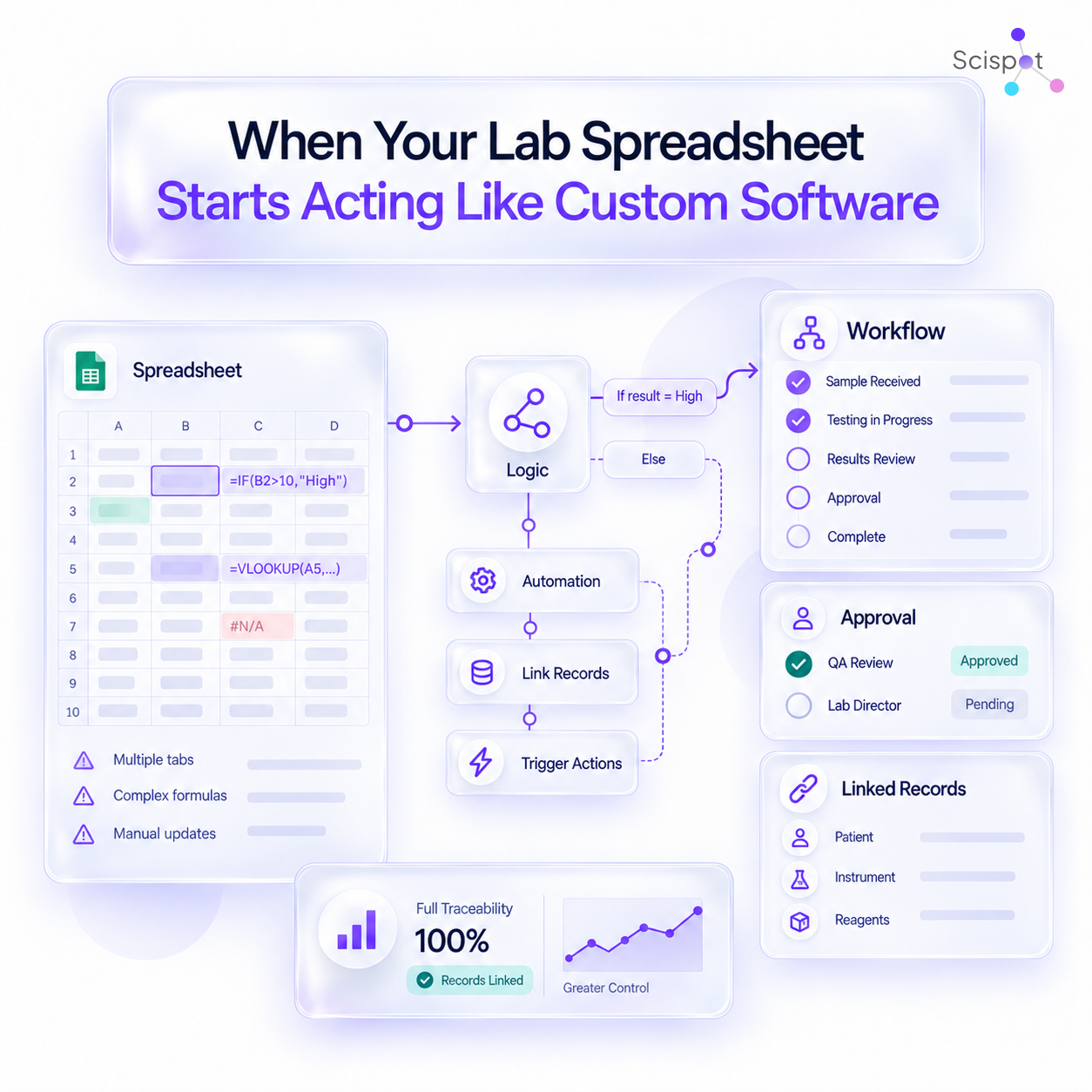
Most labs have someone who can make this work. They know which files need cleanup, which identifiers map to internal samples, and which exceptions need follow-up. Often, that knowledge lives in a spreadsheet, a collection of formulas, or a process passed between experienced team members.
At that point, the spreadsheet is doing more than organizing data. It is acting as custom operational software.
The team may depend on it to:
- Match external sample IDs to internal records
- Normalize naming conventions
- Flag missing or unexpected values
- Record reruns and exceptions
- Route questions to the right person
- Track whether incoming data is ready for review
- Preserve a usable record of what changed and why
That workflow may not need to become a standard feature for every lab. But it should not remain a fragile, disconnected process either.
A purpose-built application can give that team a structured workspace for the process while staying tied to the broader scientific record. The lab can preserve the operational logic that makes the workflow work without forcing every other team to use the same interface.
Customization does not remove validation responsibilities
For labs operating in regulated environments, configurable software and AI-assisted development do not remove validation responsibilities.
Whether a system requires validation depends on its intended use, the records it supports, and the risk associated with the process. FDA guidance on electronic records and electronic signatures addresses the scope of 21 CFR Part 11, while FDA computer software assurance guidance emphasizes defining intended use, assessing risk, choosing appropriate assurance activities, and keeping evidence that the system performs as intended.fda+1
In practice, a lab should not assume that a custom application becomes suitable for regulated use simply because it was built quickly or with AI assistance. The organization still needs to define intended use, apply appropriate testing and approval processes, and maintain the evidence required for its own quality and compliance obligations.
This is another reason to keep custom experiences connected to a governed foundation. A shared system of record can make it easier to understand what data an application uses, which controls apply, and how a workflow connects to the rest of the lab.
Scispot can support a connected foundation for these workflows, but each organization remains responsible for determining the controls, validation work, and documentation appropriate to its own use case.
The Digital Brain behind purpose-built apps
The phrase “Digital Brain” can sound abstract until you compare it to onboarding a new scientist.
A highly experienced scientist may understand biology, assay design, and experimental methods on day one. But they still need to learn how your organization works.
They need to understand why a particular sample matters. They need to learn how an assay connects to a report. They need to know why an exception exists, who can approve a change, where a file belongs, and what the team normally does next.
AI has the same problem.
It can generate text, logic, and code. But it does not automatically know the meaning of your sample records, the relationship between runs and reports, or the workflow rules your team relies on.
The Digital Brain gives applications access to the context that makes them useful in a lab. It is the connected view of data, relationships, history, rules, and permissions that turns a generic interface into a workflow tool grounded in how the lab actually operates.
That does not mean every team needs to use the same app. It means every team can work from a shared understanding of the underlying scientific data.
Where lab software is heading
In the next few years, lab software will likely become more varied at the interface layer.
Different teams will use different applications for different parts of the lab. Scientists, lab operations teams, bioinformatics teams, project managers, and external collaborators will need different views of the same underlying work.
Those experiences will keep changing as assays, customers, instruments, and internal processes change.
The foundation, however, will become more important.
Labs still need a trusted layer that connects scientific data and operational context. They need to know how samples relate to experiments, runs, inventory, files, reports, and downstream analysis. They need appropriate controls around access, history, and workflow rules.
The future is not a collection of disconnected apps. It is a connected lab operating system with many purpose-built experiences on top.
Scispot Jazz supports that direction. It gives labs a way to shape last-mile workflows around the people doing the work while keeping the data and controls connected to the Scispot Digital Brain.
For labs that have outgrown rigid workflows and fragile spreadsheets, the question is no longer whether everything should fit into one screen. The question is whether each team can have the right experience without losing the shared scientific foundation that keeps the lab connected.