

TL;DR
- Traditional lab software often forces scientists to fit real workflows into fixed fields, forms, and predefined steps.
- Every lab works differently. Assays, instruments, CRO handoffs, QC reviews, calculations, approvals, and reporting processes vary by team.
- AI can change the model by letting teams describe what they need in plain language instead of adapting their process to rigid software.
- AI needs lab context before it can be useful. It must understand a lab’s data, sample relationships, workflow rules, approvals, and operational history.
- Scispot’s Digital Brain connects scientific data, workflows, rules, and records to give AI the context it needs to support lab operations.
- Scispot Jazz helps labs create purpose-built apps for their unique workflows, including CRO coordination, QC review, reporting, and other last-mile processes.
For the past few decades, scientists have had to learn how to work in ways that software could understand.
That often meant turning real lab work into fields, forms, dropdown menus, databases, and fixed workflows. A scientist may think in terms of samples, assay steps, review decisions, exceptions, and scientific context. Traditional software needs those ideas translated into predefined structures.
When the software matched the work, that structure could help. But when it did not match, labs often had to adjust.
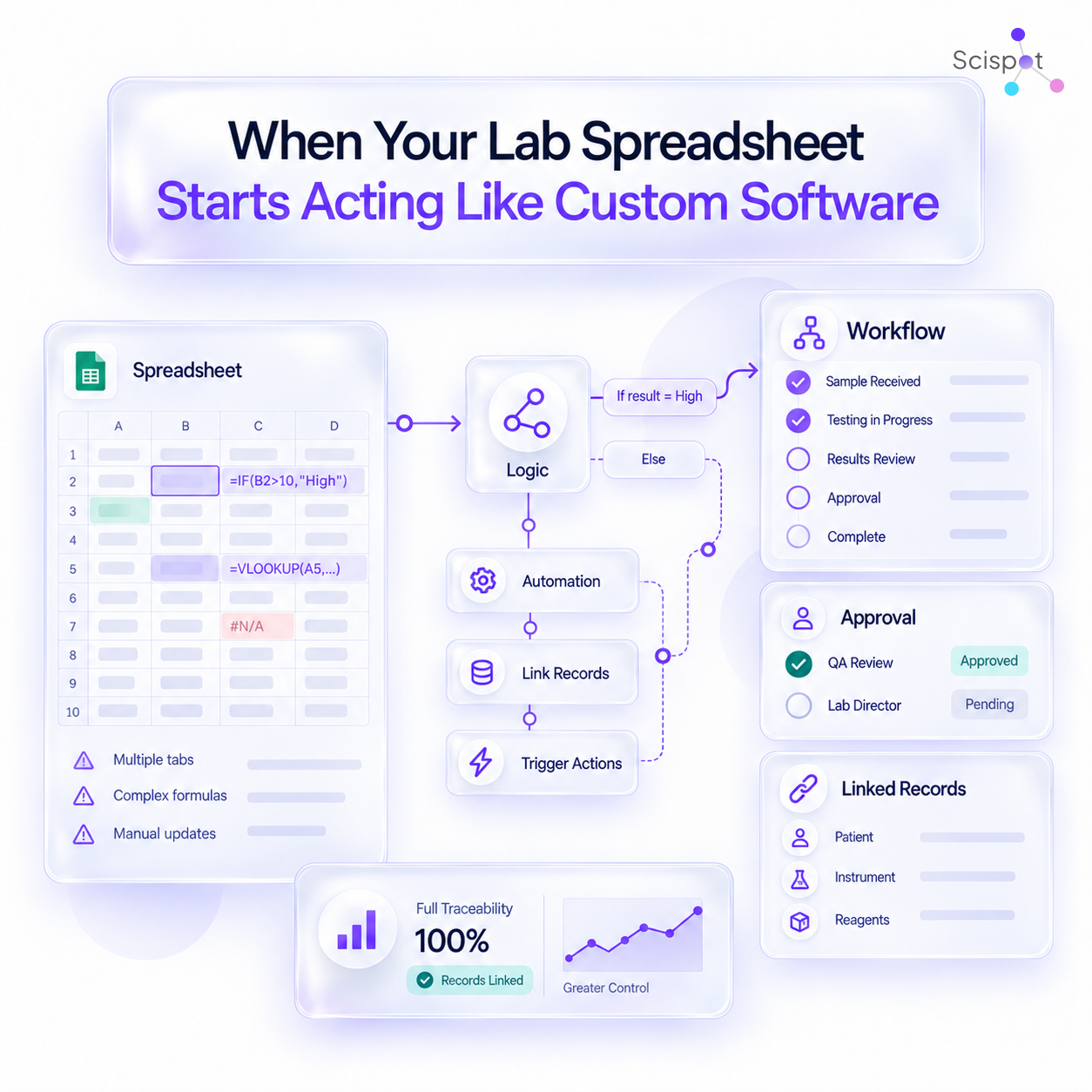
They changed the process to fit the system. They added spreadsheets to cover workflow gaps. They handled exceptions outside the software. They created workarounds for the parts of the lab that did not fit neatly into a standard form or fixed sequence of steps.
For a long time, that was simply how laboratory software worked.
AI may change the relationship.
Software Has Traditionally Set the Rules
Most software asks people to adapt their work to the system.
That is not because lab teams lack process. In fact, labs often have detailed and disciplined ways of working. The issue is that scientific operations rarely fit into one standard model.
A workflow may depend on:
- The assay being run
- The type and source of the sample
- The instruments used
- The review process
- The calculations required
- The people allowed to approve work
- The outside research partners involved
- The exceptions that arise during real lab operations
Traditional systems often need those decisions mapped out in advance. If the workflow changes, the team may need to update forms, rebuild configurations, create a new process, or move part of the work outside the system.
That can leave a gap between how the lab actually operates and how the software expects it to operate.
No Two Labs Work the Same Way
Labs share common needs. They need to track samples, record work, manage data, support review, and maintain a clear history of what happened. But the details vary widely.
One lab may run a specialized assay with its own calculations and QC steps. Another may coordinate with contract research organizations, manage different handoffs, and review data through a distinct approval process. A third may need a workflow built around specific instruments, sample types, or reporting requirements.
Even two labs that run similar assays can work differently.
They may use different naming conventions, sample statuses, review rules, data structures, and decision points. They may also handle exceptions in different ways. These differences are not always signs of inconsistency. Often, they reflect the scientific, operational, and business reality of the lab.
That is why a one-size-fits-all workflow can become limiting.
A lab should not have to flatten its work into the few paths that a system happens to support. The software should be able to reflect the work that already exists, while still giving the team a connected record of what happened.
AI Can Change the Interface
AI creates a different starting point.
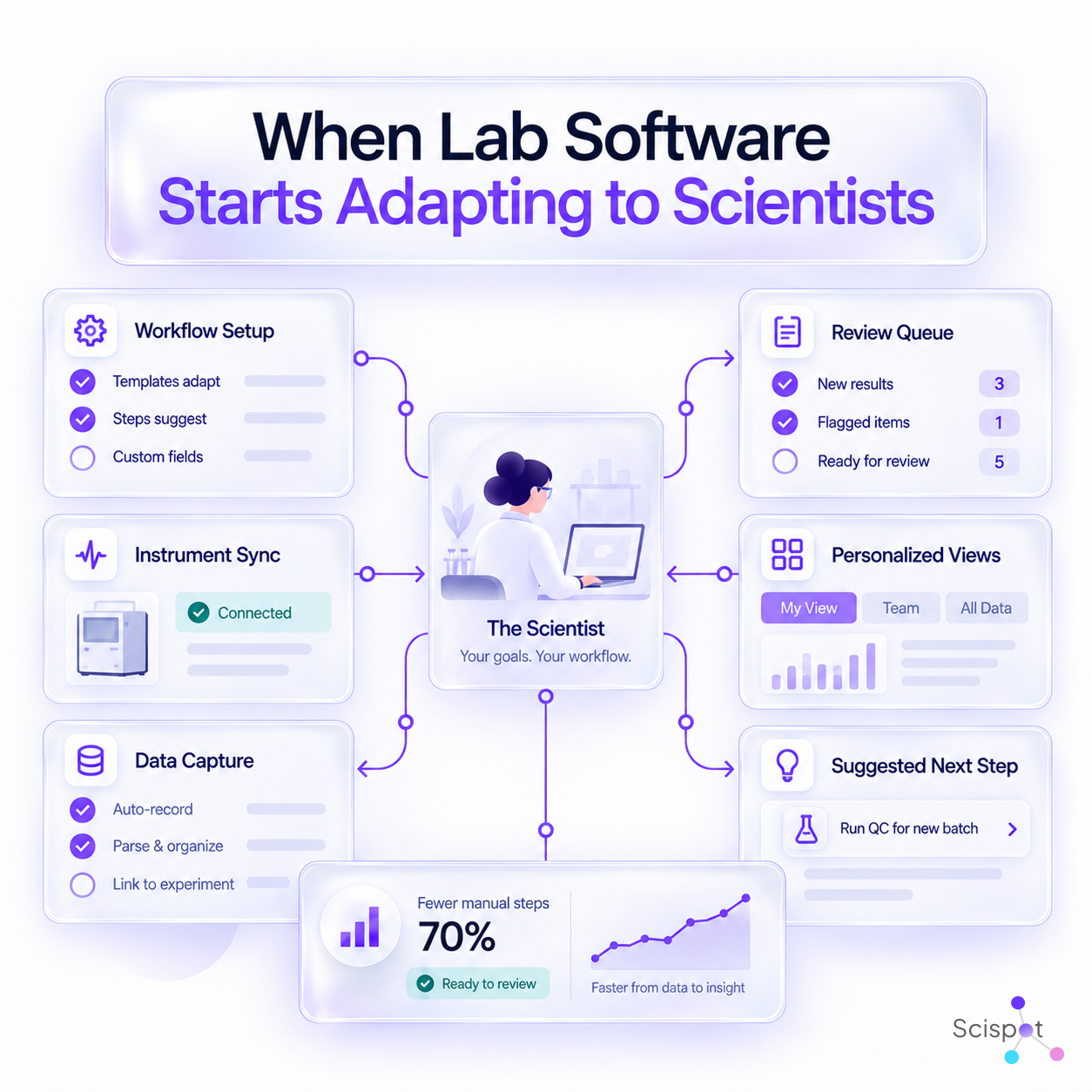
Instead of beginning with a fixed menu or predefined workflow, a team can describe what it needs in plain language. They can explain the steps they follow, the information they track, the decisions they make, and the exceptions they need to handle.
That creates the possibility of software that begins with the lab’s work rather than asking the lab to begin with the software’s limits.
For example, a lab team might describe a workflow like this:
“When a sample arrives, record the intake details, assign it to the correct project, capture the assay-specific information, route the work for QC review, and only allow final reporting after the required review is complete.”
The hard part is not writing that request. The hard part is making sure the software understands what “sample,” “project,” “QC review,” “required review,” and “final reporting” mean inside that particular lab.
That is where AI alone falls short.
AI Needs Lab Context
AI can generate text, write code, and respond to instructions. But it does not automatically understand a lab on day one.
It does not know:
- What a specific sample represents
- How one record relates to another
- Why a result matters in a given workflow
- Which steps require review or approval
- Who can make specific decisions
- What data already exists
- What happened earlier in the process
- What should happen next
In other words, AI can be capable without being informed.
A new AI system may be like a highly capable new teammate. It can reason, communicate, and help with tasks. But before it can support real work, it needs to learn the lab’s language, records, relationships, rules, and history.
Without that context, AI can produce something that looks useful but does not fit the lab’s actual operations.
For labs, context is not optional. It is the difference between a generic tool and a system that can work with the real structure of scientific operations.
The Digital Brain of the Lab
Scispot has spent years building the connected foundation AI needs to understand how a lab works.
Scispot calls this foundation the Digital Brain of the lab.
The Digital Brain brings together the information that gives lab work meaning:
- Scientific data
- Sample records
- Relationships between records
- Workflow steps
- Business and scientific rules
- Review and approval logic
- Operational history
When these elements live in disconnected places, it is difficult for any system to understand the full picture. A sample record may sit in one place, a review decision in another, and a report or calculation somewhere else. The people in the lab may understand how those pieces connect, but software often does not.
A connected system gives the lab a more complete operational record.
That does not mean every lab should work the same way. It means the lab can connect its own workflow, data, rules, and history in a way that reflects how it operates.
This connected context helps create a stronger foundation for AI-supported software.
Introducing Scispot Jazz
Scispot Jazz is built on top of the Scispot Digital Brain.
Jazz is designed to help labs turn the way their teams actually work into purpose-built software. Rather than forcing every lab into a single predefined workflow, the goal is to help teams create software around their own operational requirements.
That may include workflows such as:
- A CRO coordination process
- A quality-control review process
- A reporting workflow
- A specialized assay workflow
- A lab-specific approval path
- The final operational steps that make a workflow unique
Every lab has a “last mile.” It is the part of the work that is hard to standardize because it depends on the lab’s own process, people, rules, and scientific context.
For one team, it may be a specific QC review sequence. For another, it may be how results move through reporting and approval. For another, it may be the way external partners, internal reviewers, and sample records connect.
These details often determine whether software fits the lab or becomes another system the lab has to work around.
Scispot Jazz is built around the idea that those details should be part of the software, not pushed into side documents, manual handoffs, or disconnected tools.
A Different Direction for Lab Software
The shift is simple.
For decades, labs adapted to software.
Now, software can begin adapting to the lab.
That shift does not remove the need for structure. Labs still need clear records, well-defined workflows, connected data, and visibility into what happened. AI is most useful when it works with that structure rather than replacing it with vague automation.
The opportunity is to make software more responsive to the way scientific teams actually operate.
A lab should be able to explain its workflow in its own terms. It should be able to represent its own review logic, data relationships, and process requirements. And as those workflows change, the software should be able to change with them.
That is the idea behind Scispot Jazz.
One Digital Brain can provide the connected context. Purpose-built apps can then support the specific way a lab works.
What Labs Should Consider
Labs evaluating AI-supported software should look beyond the interface.
A conversational experience may make software easier to use. But a useful AI system also needs a clear understanding of the data, workflows, rules, and relationships behind the request.
Before adopting AI for lab operations, teams should ask:
- Does the system understand our sample and data relationships?
- Can it reflect our actual workflow rather than only a standard template?
- Can it account for our review and approval rules?
- Does it preserve the history and context needed to understand a process?
- Can the workflow change as our lab changes?
- Can the system connect the operational details that people currently manage across separate tools?
The best outcome is not simply faster software creation. It is software that better reflects how the lab does its work.
Scispot Jazz is built for that direction: a connected lab foundation, with purpose-built apps that can take shape around the way each team operates.