

TL;DR
- FDA computer system validation (CSV) provides documented evidence that computerized systems consistently perform as intended in their regulated environment.
- Applicable requirements depend on the system's intended use, electronic records, electronic signatures, and relevant FDA regulations—not simply whether software is used in a laboratory.
- 21 CFR Part 11 addresses electronic records and electronic signatures, while predicate regulations establish underlying recordkeeping and operational requirements.
- A risk-based lifecycle approach helps laboratories focus validation on functions that could affect product quality, patient safety, and data integrity.
- FDA's 2026 Computer Software Assurance guidance applies specifically to medical-device production and quality management system software; it is not a universal replacement for CSV.
Computer systems are central to modern life sciences operations. Laboratories use LIMS, electronic laboratory notebooks (ELNs), chromatography data systems, instrument software, quality management systems, and other applications to create, process, review, and store regulated information.
When these systems support FDA-regulated activities, organizations need evidence that they work reliably for their intended use and maintain the integrity of relevant records.
This is the purpose of FDA computer system validation (CSV).
CSV is not simply a software testing exercise or a collection of signed documents. It is a documented lifecycle process that connects system requirements, risk assessment, testing, approval, and ongoing change management.
Understanding which FDA requirements apply—and how to apply a proportionate validation approach—is essential for laboratories and life sciences organizations.
What Is FDA Computer System Validation?
FDA computer system validation is the documented process of demonstrating that a computerized system consistently performs according to its intended use and defined requirements in its operating environment.
A computerized system includes more than the software itself. Depending on its use, the validated environment may involve:
- Software applications and databases.
- Hardware and laboratory instruments.
- System interfaces and integrations.
- User roles and access controls.
- Operating procedures and supporting documentation.
- People responsible for operating and maintaining the system.
For example, a laboratory using a LIMS to manage sample records, test results, and approvals should establish evidence that the configured workflows perform as intended and that relevant records remain accurate, complete, and accessible.
Why Is CSV Important?
Computer system validation helps organizations:
- Maintain reliable electronic records.
- Protect data integrity throughout laboratory workflows.
- Demonstrate that critical system functions work as intended.
- Identify and control risks before systems are used for regulated activities.
- Support consistent operations and inspection readiness.
- Manage software changes without compromising validated functionality.
FDA's General Principles of Software Validation guidance describes foundational software validation principles. Other applicable regulations and guidance depend on the industry, system, and intended use.
FDA Regulations and Guidance Relevant to Computer System Validation
There is no single FDA regulation that defines one universal CSV procedure for every computerized system. Organizations need to assess the requirements relevant to their regulated activities.
21 CFR Part 11: Electronic Records and Electronic Signatures
21 CFR Part 11 establishes criteria for electronic records and electronic signatures when they are used to meet applicable FDA recordkeeping or submission requirements.
Relevant controls include:
- System validation where applicable.
- Access restrictions and authority checks.
- Audit trails and record controls.
- Electronic signature requirements.
- Controls for system documentation.
- Appropriate record protection and retrieval.
Part 11 should be considered alongside the underlying FDA regulations, commonly called predicate rules.
FDA's 2003 Part 11, Electronic Records; Electronic Signatures—Scope and Application guidance explains how the agency interprets the regulation, including its approach to scope and enforcement discretion for certain provisions. It does not remove the obligation to comply with applicable predicate rules.
21 CFR Part 211: Pharmaceutical cGMP
For pharmaceutical manufacturing, 21 CFR Part 211 contains requirements relevant to computerized systems.
For example, § 211.68 addresses automatic, mechanical, and electronic equipment. It includes expectations for appropriate controls over computerized records, verification of data input and output, and backup arrangements.
Other provisions may apply depending on the system's function, such as laboratory records, production records, and quality control activities.
21 CFR Part 58: Good Laboratory Practice
Part 58 applies to nonclinical laboratory studies conducted under applicable FDA GLP requirements.
Computerized systems used in these studies should be managed in a way that supports the reliability, integrity, and traceability of study data and records.
FDA Computer Software Assurance Guidance (2026)
In February 2026, FDA issued its final Computer Software Assurance for Production and Quality Management System Software guidance.
It describes a risk-based approach to establishing confidence in software used as part of medical-device production or the quality management system. It discusses assurance activities, testing approaches, and objective evidence proportionate to risk.
Important distinction: This guidance is specifically scoped to medical-device production and QMS software under the applicable Quality Management System Regulation. It should not be interpreted as replacing all CSV requirements for pharmaceutical manufacturing, clinical research, or every regulated laboratory system.
For medical-device manufacturers, the guidance should be considered alongside the QMSR, which became effective on February 2, 2026.
The FDA Computer System Validation Process
A structured CSV lifecycle helps organizations establish requirements, assess risks, test critical functions, and maintain control after deployment.
Step 1: Define Intended Use and System Scope
Start by documenting what the system does and how the organization relies on it.
Identify:
- Business and laboratory processes supported.
- Regulated activities and applicable requirements.
- Electronic records created or maintained.
- System users and responsibilities.
- Interfaces with instruments and other applications.
- Critical functions that could affect data integrity or product quality.
For example, a LIMS used to register samples, calculate results, and approve laboratory testing may require a different validation scope from a system used only for non-regulated administrative reporting.
Step 2: Perform a Risk Assessment
Assess the potential consequences of system failure, incorrect processing, unauthorized changes, or inaccurate data.
Consider:
- Impact on patient safety or product quality.
- Impact on laboratory decisions.
- Data integrity and record traceability.
- Criticality of automated calculations.
- Access and security risks.
- Integration and interface failure scenarios.
Use the assessment to determine where testing and assurance activities need greater rigor.
A risk-based approach does not mean skipping validation. It means applying appropriate evidence and controls based on intended use and risk.
Step 3: Define Requirements and Specifications
Document what the system must do.
Common documents include:
- User Requirements Specification (URS).
- Functional requirements or specifications.
- Configuration and design specifications, where appropriate.
- System and integration requirements.
- Data integrity and security requirements.
Requirements should be specific enough to test. For example, instead of writing "the system must support sample tracking," define the sample lifecycle, required identifiers, status transitions, permissions, and expected records.
Step 4: Execute Testing and Qualification
Testing provides evidence that the system and its configured functions perform as intended.
Traditional CSV programs may organize testing into:
These are commonly used qualification stages, but they are not a universal FDA-mandated sequence for every system. The validation strategy should be justified by the system's intended use and risk.
Test scenarios may include sample registration, calculations, result review, electronic approvals, access restrictions, audit trails, and interface failures.
Step 5: Document Results and Approve Release
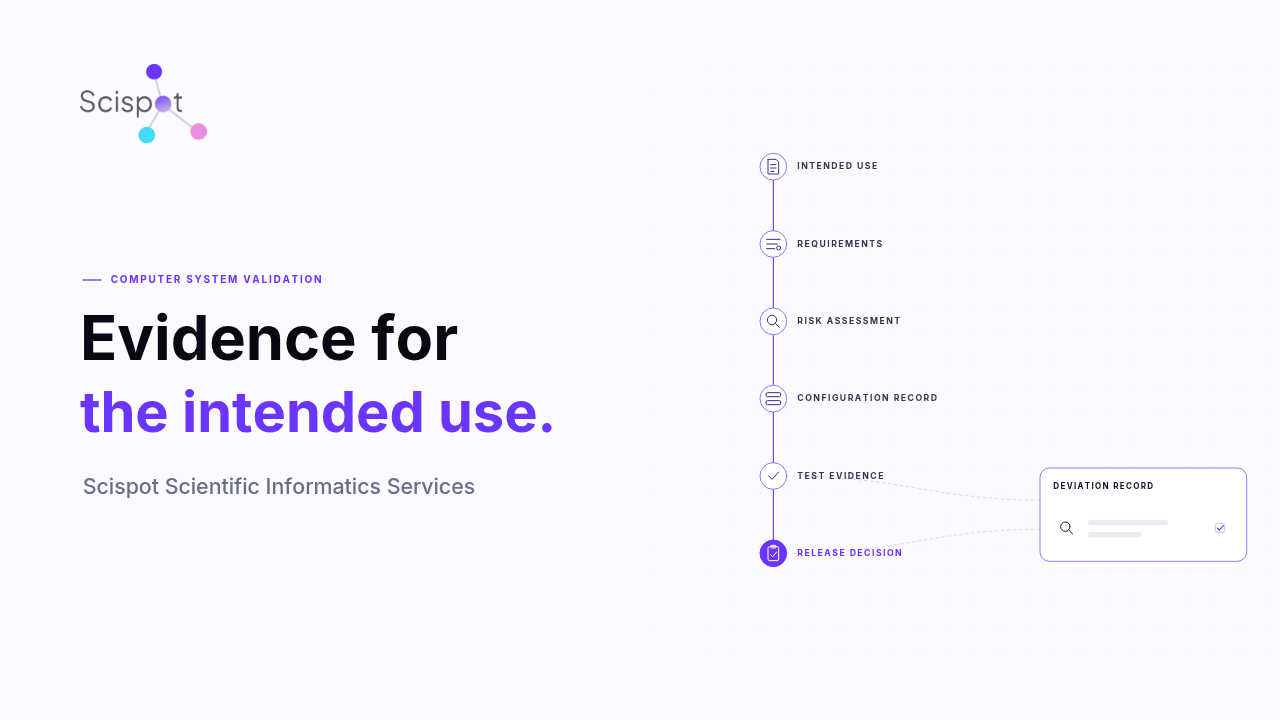
Maintain objective evidence of validation activities.
A validation package may include:
- Intended-use documentation and system scope.
- Risk assessment.
- Requirements and specifications.
- Approved test protocols.
- Test results and supporting evidence.
- Deviations and resolutions.
- Requirements traceability.
- Validation summary and approval.
The system should be approved for its intended use only after relevant issues have been assessed and resolved or appropriately justified.
Step 6: Maintain the Validated State
Validation continues after go-live.
Organizations should establish processes for:
- Change control.
- Periodic review.
- User access review.
- Backup and recovery testing.
- Incident and deviation management.
- Supplier and system updates.
- Reassessment following significant changes.
A software upgrade, new instrument connection, or workflow modification may affect previously tested functionality. Assess the impact and perform appropriate testing before releasing the change.
FDA CSV Best Practices for Regulated Laboratories
Use Risk-Based Validation
Avoid applying identical testing requirements to every software function.
Focus effort on functions that could affect regulated records, calculations, approvals, product quality, or patient safety.
Document why the selected validation activities are appropriate.
Maintain Data Integrity
Data integrity should be considered across the entire information lifecycle.
Relevant controls include:
- Appropriate access permissions.
- Traceable record creation and modification.
- Reliable timestamps and audit trails where required or justified.
- Complete and accurate data transfers.
- Backup and recovery procedures.
- Controlled retention and retrieval.
ALCOA+ principles—attributable, legible, contemporaneous, original, accurate, complete, consistent, enduring, and available—are commonly used to assess data integrity in regulated environments.
Validate Interfaces and Integrations
A validated application can still produce unreliable outcomes if an interface transfers incomplete or incorrect information.
For LIMS, instruments, ELNs, and QMS integrations, test:
- Field and metadata mapping.
- Units and calculation handling.
- Sample and test relationships.
- Error handling and recovery.
- Duplicate transactions.
- Data lineage and traceability.
Involve Quality, IT, and Laboratory Teams
CSV should not be treated as an IT-only responsibility.
Laboratory subject matter experts understand how the system supports scientific workflows. IT understands infrastructure and security. Quality teams provide oversight of the applicable quality and validation requirements.
Define responsibilities before the project begins.
Keep Documentation Practical and Current
Documentation should provide meaningful evidence rather than simply increase the volume of paperwork.
Keep requirements, risk assessments, test results, deviations, approvals, and change records aligned with the actual system configuration.
How CSV Applies to LIMS, ELN, and Other Laboratory Systems
The validation approach depends on what each system does and how the organization uses its records.
A system does not automatically become subject to every Part 11 requirement simply because it is used in a laboratory. Organizations should determine which records are required under applicable predicate rules, whether electronic records are relied upon, and what controls are appropriate for the intended use.
For laboratories managing multiple applications, a connected architecture can also make validation easier to govern by clarifying data ownership, interfaces, and workflow responsibilities.
Scispot's LIMS, ELN, and QMS capabilities support connected laboratory operations. Its governed data and workflow approach can help teams structure how information moves across laboratory processes.
6. Building a Sustainable Validation Approach
FDA computer system validation is not a one-time project milestone. It is an ongoing responsibility that connects software, workflows, data, users, and quality processes.
A sustainable approach begins with clear intended use, documented requirements, risk-based testing, and defined ownership. It continues through change control, periodic review, training, and monitoring.
For laboratories modernizing their technology environment, the objective should be to improve connectivity and automation without weakening data integrity or quality oversight.
Scispot brings laboratory applications, instrument connectivity, structured data, and workflow orchestration together through its AI-native Lab Operating System. Its approach can help laboratories build a more connected operational environment while keeping governance and intended-use decisions with the responsible laboratory and Quality teams.
Looking to modernize regulated laboratory workflows? Explore Scispot and discuss your laboratory's data, integration, and operational requirements.