Most biotechs are building AI backwards. They are racing to plug in models before they have built the scientific memory those models need to actually reason. On the surface, it looks like progress: a chat interface on top of the ELN, a “copilot” for assay analysis, a dashboard that shows trends. Underneath, the AI is still guessing, because it cannot see the full story behind the data point it is asked to interpret.
Your AI model is not your moat
Biotech teams pour time and budget into choosing and training the “right” model. They compare Claude today, OpenAI tomorrow, and whatever comes next. But models are rented intelligence. You do not own them, and they are designed to be swapped out as the state of the art moves. What you do own—and what no one else can copy—is the scientific memory underneath those models: every experiment, every failure, every decision, and every outcome your team has produced.
That scientific memory is the real moat. If your data and context can survive every model change, you can adopt better AI without losing what your organization has learned. If your memory lives only in scattered tools and individual brains, every model change is a partial reset. You are not compounding knowledge. You are re‑running the same learning curves with slightly smarter tools.
Biotech doesn’t have a data problem. It has a context problem.

When people say “our data is a mess,” what they usually mean is “our context is invisible.” The raw data exists. It is just fractured across systems that do not talk to each other in a way that preserves meaning.
In a typical biotech: instrument data sits on local computers, experiments live in an ELN or Google Doc, samples live in a LIMS or spreadsheet, CRO results arrive by email, and the reason behind a critical decision may live only in one scientist’s head. Each system does its job in isolation. The lab gets things done. But when you ask a simple question like “How much trust do we have in this potency result?” the answer is suddenly hard to reconstruct.
Imagine your AI sees a potency result of 82%. The number is clean, so the model treats it as ground truth. It uses that value to suggest the next dose, to recommend a go/no‑go decision, or to feed a model downstream. But the control failed, the protocol changed mid‑stream, the sample had an extra freeze–thaw cycle, and the scientist rejected the run. The data point still exists. It just no longer represents reality in the way the AI thinks it does. If the AI cannot see that context, it is not reasoning. It is guessing.
Digitized data is not digitized memory
Biotech has done the hard work of digitizing data. Instruments stream files instead of printing charts. ELNs and LIMS replace paper notebooks and binders. Results land in inboxes instead of fax machines. But digitized data is not the same thing as digitized scientific memory.
Scientific memory is the connected tissue between all of those pieces: how the experiment was designed, what changed during execution, which anomaly flags were raised, who reviewed the outcome, what decision they made, and why. It is the difference between “a CSV with a potency value” and “a traceable story of how we reached this number and whether we trust it enough to act on it.”
The missing layer is the system that keeps that memory alive and queryable as the lab, the tools, and the AI models evolve.
Why a Lab Operating System with a Digital Brain
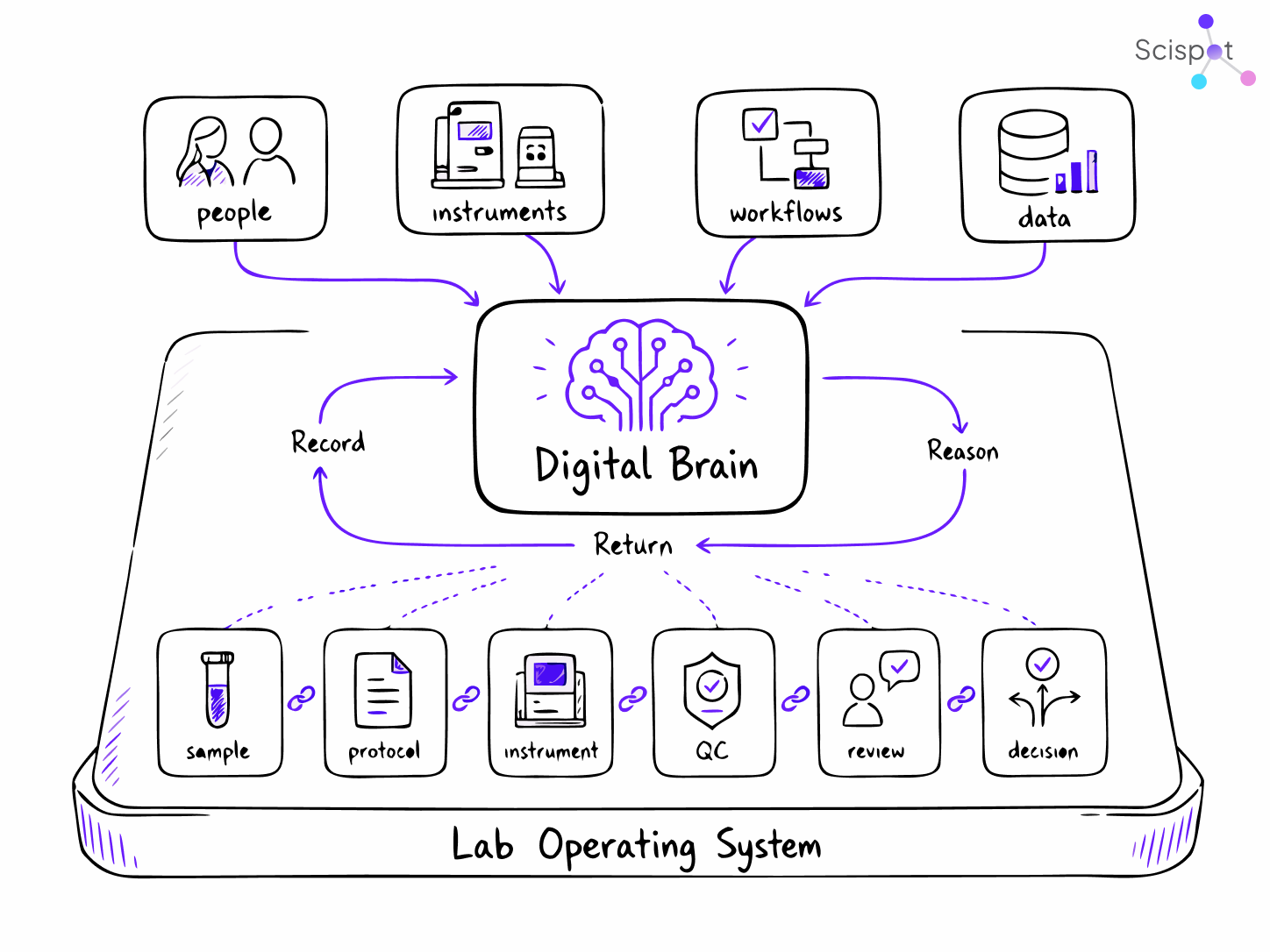
This is why every biotech needs a Lab Operating System with a Digital Brain. A Lab Operating System connects how the lab works: its people, data, instruments, and workflows. It does not try to replace the tools scientists already use. Instead, it coordinates them and gives the lab a single operating context. The Digital Brain is the layer that remembers what the company learns and gives AI the trusted context it needs to reason.
In this model, every result stays connected to the sample, protocol, instrument, quality check, review, and decision behind it. If you pull up a single data point, you can see the path it took through the lab. If you swap out the AI model that reads those data points, the underlying memory does not have to be rebuilt. The model is now a lens on a durable asset instead of a fragile bolt‑on.
Closing the loop: Record. Reason. Return.
Once that foundation is in place, the loop closes: Record. Reason. Return. The work is recorded in a structured, governed way as scientists run experiments, tweak protocols, and make calls. AI reasons over trusted, connected context instead of isolated numbers. And the answer returns as a traceable part of the company’s scientific memory, not a one‑off suggestion in a chat window.
This loop has a compounding effect. Each experiment does more than produce a result. It enriches the Digital Brain with new context, edge cases, and decisions. Future models can learn from that trail instead of starting fresh. New team members can understand why the organization thinks the way it does about certain assays, platforms, or partners. Audit and quality teams can see not just what happened, but why it was considered acceptable or not.
How Scispot fits into this picture
Scispot is built to help biotechs create this Lab Operating System and Digital Brain across the systems and instruments they already use. Not another silo. Not another chatbot. A system that becomes more valuable with every experiment recorded and every decision linked to real data and context.
By treating scientific memory as the core product, not just data exhaust, Scispot gives AI something reliable to stand on. When you bring in a new model, you are not asking it to operate blind. You are asking it to reason over a living, traceable record of how your lab thinks and works.
Every biotech will have access to powerful AI. The real differentiation will come from how well each company compounds what it learns. So ask your team one question: If we changed AI models tomorrow, would our scientific memory survive? If the answer is no, you have an AI tool, not an AI strategy.
This blog is the written companion to our video on scientific memory and AI in biotech. When you embed the video alongside this post, readers can jump between the narrative and the visual walkthrough of how Scispot’s Lab Operating System and Digital Brain show up inside real lab workflows. That pairing helps the story land both at the strategic level and at the “how would this feel in my lab next quarter?” level.
%20Comprehensive%20Guide.avif)
.webp)