

In many regulated labs, audit readiness starts when an auditor sends a request. That’s too late. The evidence should already exist in the records, controls, approvals, and context produced every day by the lab.
Right before an inspection, the same scramble begins:
Who did the work? Which SOP version did they follow? Was the analyst trained at the time? Was the instrument qualified? Where is the original data? Why did a result change? Who reviewed and who approved?
Labs call this “audit preparation.” In practice, it’s evidence reconstruction. Quality teams end up digging through ELNs, LIMS tools, QMS systems, instrument computers, spreadsheets, shared drives, email threads, tickets, and people’s memories. They’re trying to rebuild the story of work that happened months or years ago. The science may have been sound, but the evidence needed to prove it was never preserved as one connected record.
That’s not a failure of the scientists or of Quality. It’s a failure of the evidence flow.
Compliance should be created by the work
Most regulated labs already have procedures. They train people, qualify instruments, review results, investigate deviations, and approve records. The problem is that the evidence for each of those activities often lives in different places.
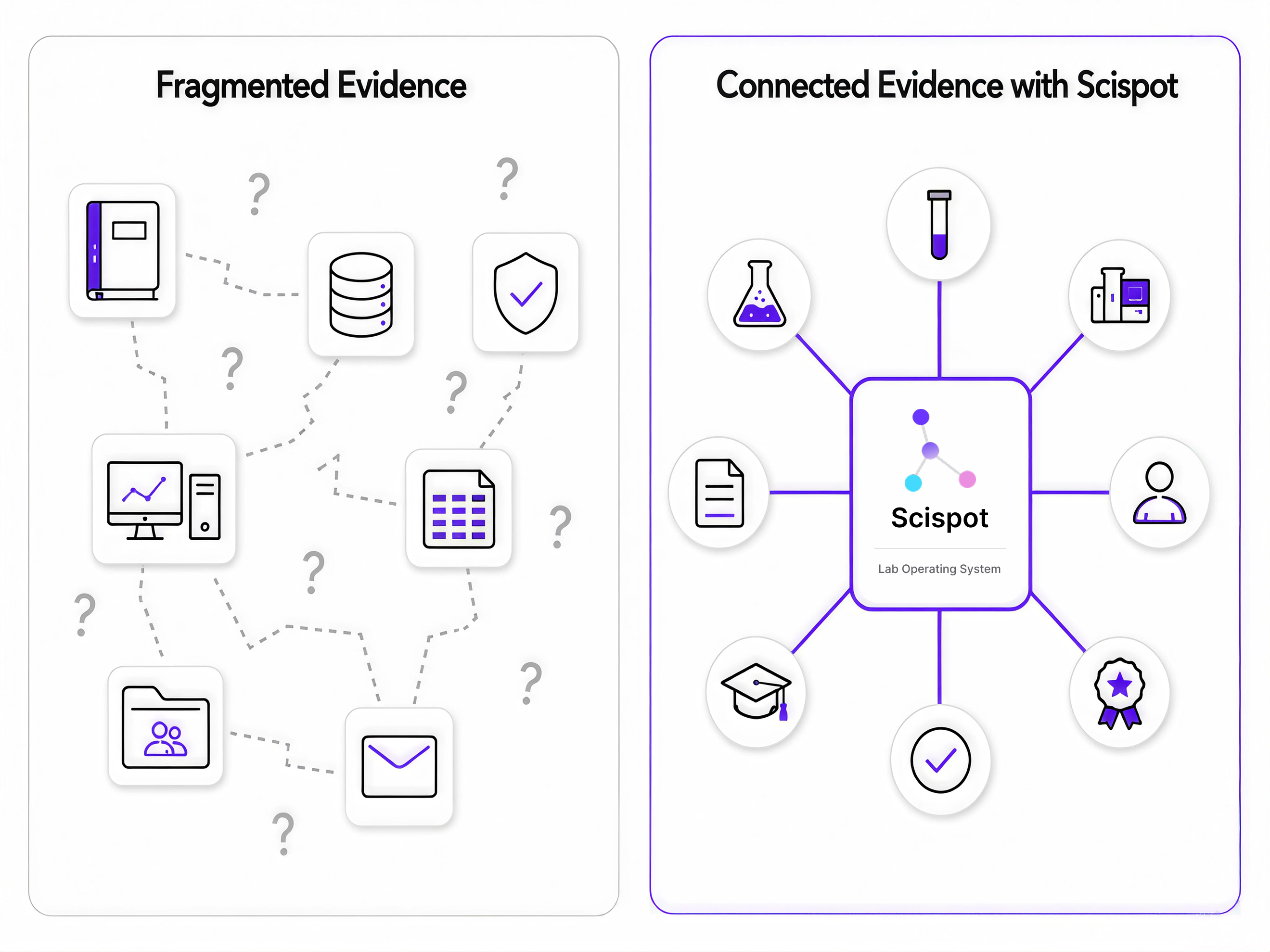
An experiment may sit in an ELN, while sample status sits in a LIMS. The original instrument file may live on a local computer. SOPs might be controlled in a separate document system. Training records and approvals might be scattered across yet more tools. Each system holds part of the truth, but no system preserves the complete context.
When an audit hits, Quality has to reconnect those fragments by hand. One missing file, unclear modification, outdated SOP, unexplained result change, or broken link can stall the whole response. Instead of reviewing evidence, Quality becomes a team of forensic investigators.
In regulated work, a result is only as defensible as the evidence around it. Continuous compliance changes the model. It means controls, context, ownership, and evidence are maintained as the work happens. Audit readiness becomes how the lab operates, not a special project.
What continuous compliance actually looks like
In a continuous compliance environment:
- When an instrument run finishes, original data is preserved or referenced in a controlled way.
- The sample, analyst, instrument, method, and applicable SOP version are already connected.
- Required fields and QC checks are completed before results advance.
- Exceptions are flagged and routed to reviewers quickly, not discovered weeks later during reconciliation.
When information changes, the record keeps who made the change, when it was made, what changed, and why (where a reason is needed). Review and approval occur through defined workflows. Electronic signatures stay tied to the record, with the signer, date and time, and meaning preserved. Audit history, metadata, and approval context remain available for as long as the record is retained.
These are practical foundations of data integrity. They help make records attributable, legible, contemporaneous, original, accurate, complete, consistent, enduring, available, and traceable. They also support expectations around access management, audit trails, electronic signatures, retention, retrieval, backup, change control, and supplier oversight.
The key shift: evidence should not be assembled after the work. It should be produced by the work.
Why another compliance repository isn’t enough
Under inspection pressure, many labs add yet another tracker, repository, or document process. That can tidy things up, but it doesn’t fix the core problem if evidence is still disconnected from the scientific workflow.
Evidence can’t sit beside the workflow and still explain it perfectly months later. It has to stay connected to the samples, studies, methods, records, decisions, approvals, instruments, and people it supports.
This is the gap Scispot is built to close. Scispot creates a connected operating layer across lab data, workflows, records, instruments, and decisions, then adds a structured compliance and validation evidence layer around that operating model. The goal isn’t more paperwork. The goal is evidence that’s easier to trust, review, and retrieve.
Turning audit readiness into an operating capability
With Scispot, audit trails, electronic signatures, access controls, validation documentation, release evidence, and change records are organized into a coherent compliance context instead of scattered artifacts.
Consider a lab record that moves from initial data capture through scientific review to Quality approval. A proactive compliance model should preserve:
- Who created the record and when
- Changes made during its lifecycle and why
- Associated source data
- Review status and approval meaning
- The final signed state
It should also help prevent silent changes, and make the full history available for authorized review.
Scispot supports controls aligned with regulatory expectations, including unique-user access, role-based permissions, time-stamped audit histories, electronic signatures, review and approval workflows, and controlled electronic records. Customers still own their risk assessment and validation of intended use. Scispot provides platform controls and evidence; the lab decides how to configure, qualify, and release those controls into regulated operations.
This shared-responsibility model leads to a more credible compliance posture. Scispot delivers a secure SaaS platform, platform-control documentation, supplier evidence, release and change information, and support. The lab remains responsible for its intended use, tenant configuration, user access, SOPs, training, workflow-specific requirements, risk assessments, qualification approvals, and final release decisions.
Validation evidence should be connected too
Validation programs often suffer the same fragmentation as operational records.
User requirements may sit in one document. Risks in another. Test cases in a separate tool. Screenshots in shared folders. Deviations in tickets. Approvals in email. At the end, the validation team has to manually assemble a summary and prove that every critical requirement was tested.
Scispot is designed to help connect requirements, risks, controls, testing, evidence, deviations, approvals, and release decisions into a structured validation lifecycle. That lifecycle can include intended use, user requirements, configuration documentation, traceability, IQ/OQ/PQ evidence, deviation handling, qualification summaries, and change-impact assessments.
For a cloud-hosted SaaS platform, this doesn’t mean the lab must redo all infrastructure work. Scispot can provide supplier qualification and platform-level evidence for the hosted environment. The lab can then:
- Focus IQ on its tenant environments
- Focus OQ on configured functions
- Focus PQ on proving that approved users and workflows perform reliably under realistic conditions
Modern software assurance also recognizes that duplicating evidence is wasteful. Current regulatory thinking encourages risk-based approaches that leverage digital records, system logs, audit trails, automated traceability, and electronic test results rather than relying on piles of paper or redundant screenshots. The broader lesson for labs: the strongest evidence is often the evidence generated and retained by the controlled system itself.
The validated state has to survive change
A lab system is never validated once and frozen forever. New workflows appear. Templates evolve. Integrations are added. Roles change. Software releases ship. Business and regulatory expectations move.

Continuous compliance treats each meaningful change as an event that can affect the validated state. Changes should be documented, assessed for impact, and evaluated to decide whether more verification, partial requalification, or a broader validation activity is needed.
For customer-controlled configuration changes, the lab applies its own change-control process and decides whether OQ or PQ must be repeated. For vendor-managed platform changes, Scispot provides relevant change information when it may affect validated use. The lab then performs impact assessment and decides how to respond.
Scispot helps preserve this lifecycle context. Instead of asking “Do we have to revalidate everything?” after each change, teams can see what changed, which requirements or workflows were affected, what evidence already exists, and what further assurance is proportionate to the risk.
Continuous compliance is not just continuous monitoring. It’s continuous knowledge of the system’s state, its evidence, its risks, and the decisions that keep confidence in its use.
Audit readiness means telling the complete story
An auditor rarely asks for a single isolated document. They ask for the story around a record.
Imagine being asked about a sample processed six months ago. A complete response might need to cover the sample identity, work performed, method and SOP, analyst’s authorization, instrument used, original data, repeated or invalidated results, changes made, QC checks completed, exceptions identified, and final review and approval.
In a fragmented environment, each part of that story becomes a separate search. In a connected environment, the evidence is already associated with the record as a coherent history.
That’s what Scispot aims to make possible. It’s not just a place to store certificates or validation files. It’s a way to connect platform controls, scientific records, validation evidence, approvals, and lifecycle decisions so labs can respond with confidence.
The objective isn’t to make audits look easy. It’s to make the underlying work continuously defensible.
Audit readiness should be a daily by-product
Ask your team one question: if an auditor asked about a sample from six months ago, could you show its complete story in minutes rather than spend days reconstructing it?
Could someone who didn’t do the original work follow the record without relying on the scientist’s memory? Could Quality show not only the final result, but also who created it, what governed it, what changed, who reviewed it, and why it was accepted?
If the answer is no, “audit preparation” isn’t the real problem. The evidence flow is.
Scispot helps labs move from preparing for compliance to operating with connected, reviewable, inspection-ready evidence. Quality still owns judgment. The lab still owns its intended-use validation, procedures, training, and release decisions. But Quality shouldn’t have to spend weeks hunting for proof that work was done correctly.
Audit readiness shouldn’t be a fire drill. It should be the natural output of how the lab works.