
Connect your lab systems. Free your data.
Bring your LIMS, ELN, instruments and scientific applications into a connected workflow. Scispot helps biotech, pharma and CRO teams integrate the systems they already use, reducing manual data handling and making laboratory information easier to access and use. Keep your existing systems: connections run through Scispot GLUE, the integration layer in the Scispot lab operating system.
Disconnected systems create connected problems.
Integration gaps often show up as everyday operational friction. We help identify where information gets stuck and design practical ways to connect the workflows.
- Repeated manual data entry. Teams copy sample, experiment and result data between applications.
- Fragmented lab records. Important context is spread across systems, spreadsheets and local databases.
- Disconnected instruments. Instrument outputs require manual processing before they reach the right workflow.
- Fragile integrations. Custom connections become difficult to monitor, maintain and adapt.
- Missing visibility. Teams may not know whether a transfer completed, failed or never started.
Your lab has the systems. The connections are missing.
When applications, instruments and teams operate in silos, scientists and operations teams spend too much time moving, checking and reconciling data instead of using it.
Scientists and IT shouldn't have to be the integration layer.
Start with one connection, remove one manual handoff, and expand when your lab is ready.
Integration services built around real laboratory workflows.
From application connectivity to scientific data harmonization, we help make your existing laboratory technology work as a more connected environment.
- LIMS and ELN integration. Connect sample records, experiment information, results and metadata across laboratory information management systems and electronic lab notebooks.
- Laboratory instrument integration. Connect analytical instruments and laboratory equipment with existing applications and data environments.
- API and application integration. Design connections between laboratory applications, databases, cloud platforms and third-party systems using appropriate interfaces.
- Laboratory workflow automation. Automate repetitive data movement and handoffs across sample management, experiment execution, result processing and reporting.
- Scientific data integration. Align data structures, metadata and identifiers across systems to improve consistency and downstream usability.
- Integration support and optimization. Document, troubleshoot and improve integration workflows as systems, instruments and laboratory requirements evolve.
Practical use cases across laboratory operations.
Integration should solve a defined workflow problem. These are common scenarios we can assess with your team.
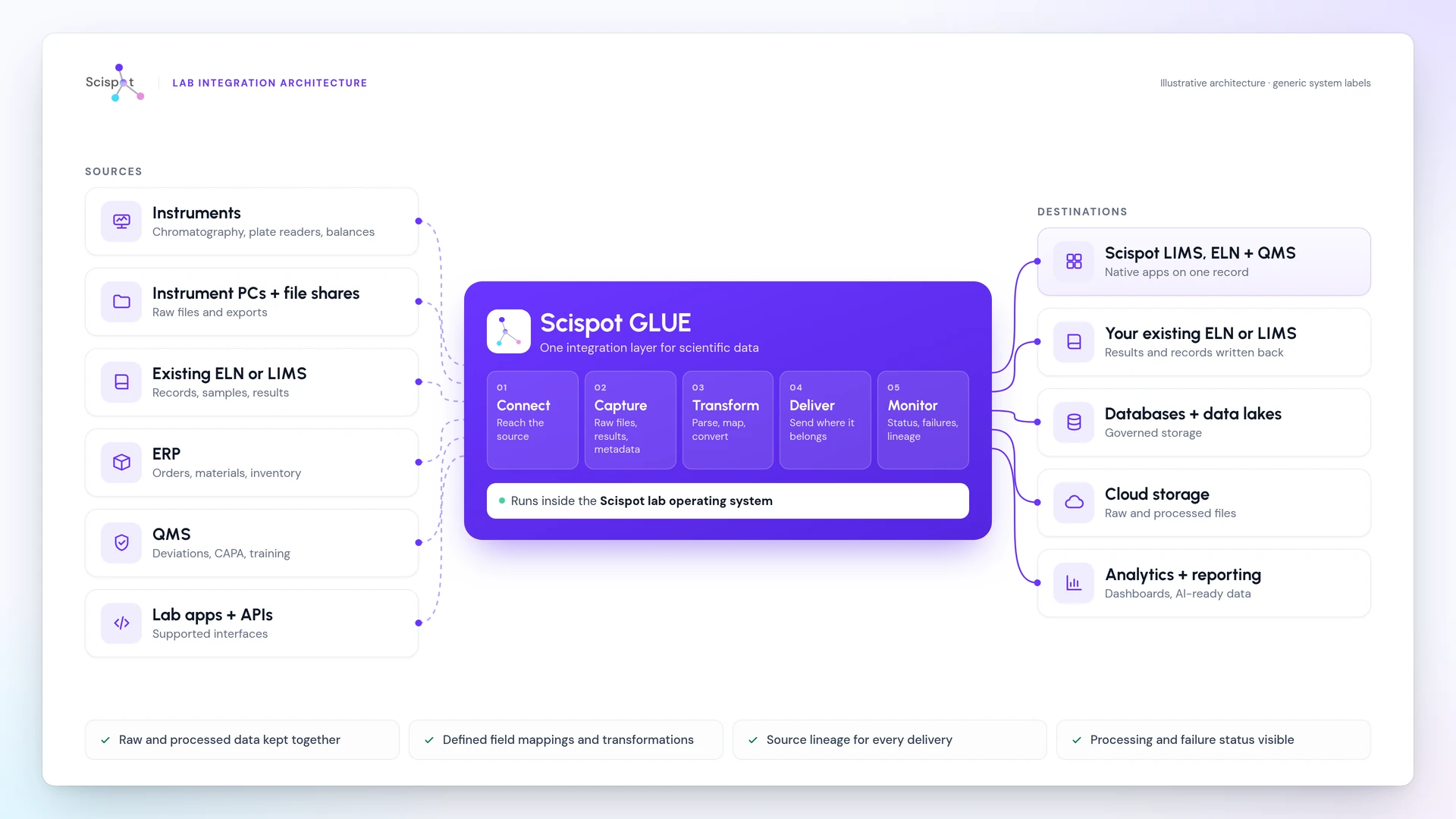
We start with your current environment: LIMS and ELN platforms, instruments and equipment, QMS and quality systems, APIs and middleware, databases and data lakes, and cloud and scientific applications. The right approach depends on available interfaces, data structures, security needs and intended workflows.
- Connect LIMS and ELN workflows. Reduce duplicate data entry and connect relevant sample, experiment and result information across laboratory applications.
- Automate instrument data capture. Move instrument-generated information into the right systems and reduce manual transcription and reconciliation.
- Connect multiple laboratory locations. Improve consistency across sites by connecting applications and standardizing how laboratory data is exchanged.
- Bring partner data in. Move data from CRO and CDMO partners into controlled internal pipelines.
- Prepare scientific data for analytics and AI. Create more consistent data flows and structures that can support reporting, analytics and future AI initiatives.
From integration assessment to connected workflows.
A structured process helps keep integration work grounded in your systems, data requirements and laboratory operations.
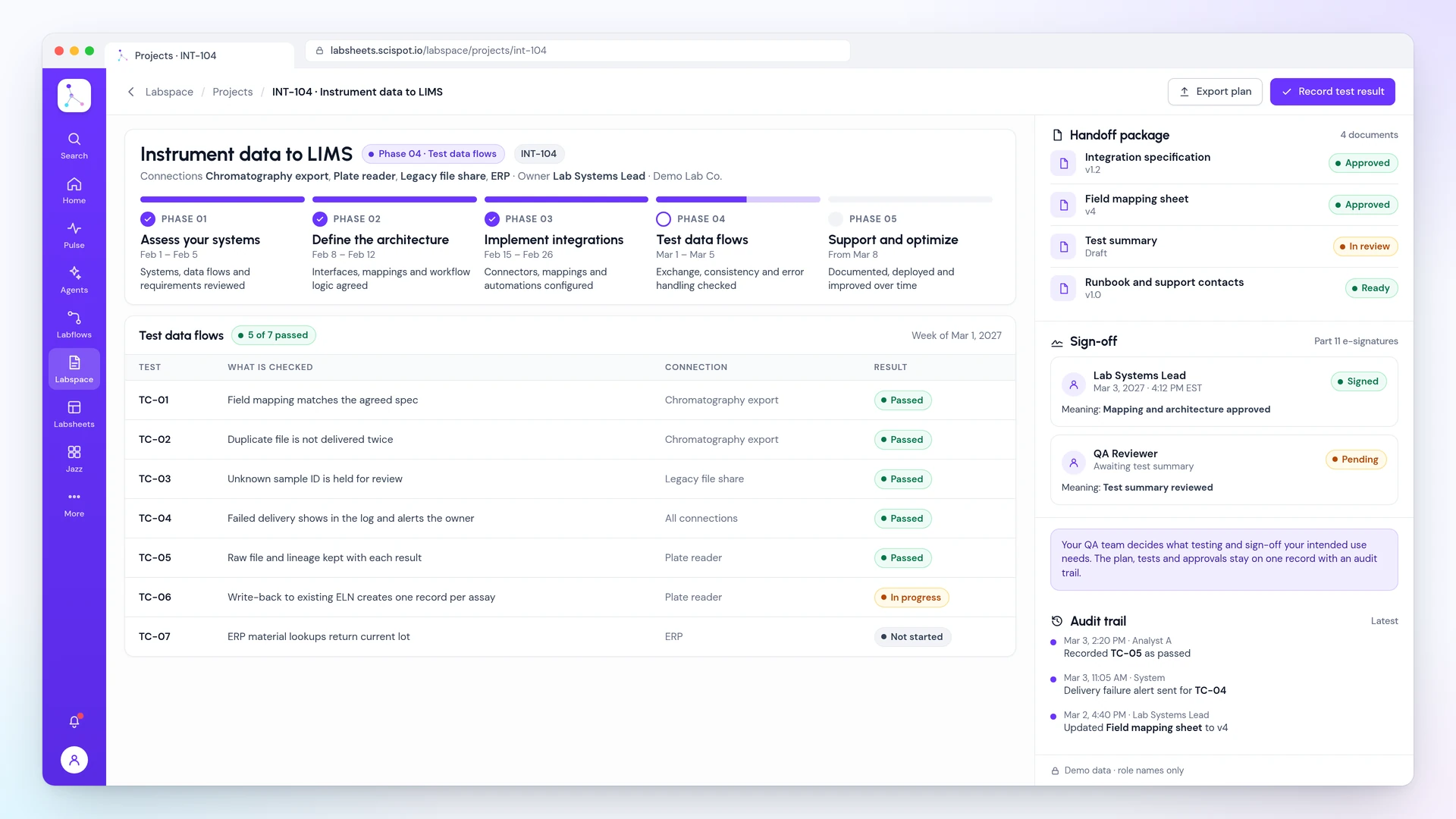
- 01 Assess your systems. Review applications, instruments, data flows and integration requirements.
- 02 Define the architecture. Map dependencies, interfaces, data structures and workflow logic.
- 03 Implement integrations. Configure connectors, mappings, APIs and automation workflows.
- 04 Test data flows. Check exchange, consistency, error handling and agreed workflow behavior.
- 05 Support and optimize. Document, support deployment and improve workflows as needs evolve.
Connect more than applications. Connect the work behind them.
A useful integration environment reflects how laboratory teams manage samples, experiments, instruments, results and operational handoffs.
- Keep your existing technology. Improve connectivity without making a full platform replacement the starting point.
- Focus on real workflows. Design integrations around the work scientists and laboratory operations teams need to complete.
- One integration layer. Connections run through Scispot GLUE, which connects, captures, transforms, delivers and monitors scientific data inside the Scispot lab operating system.
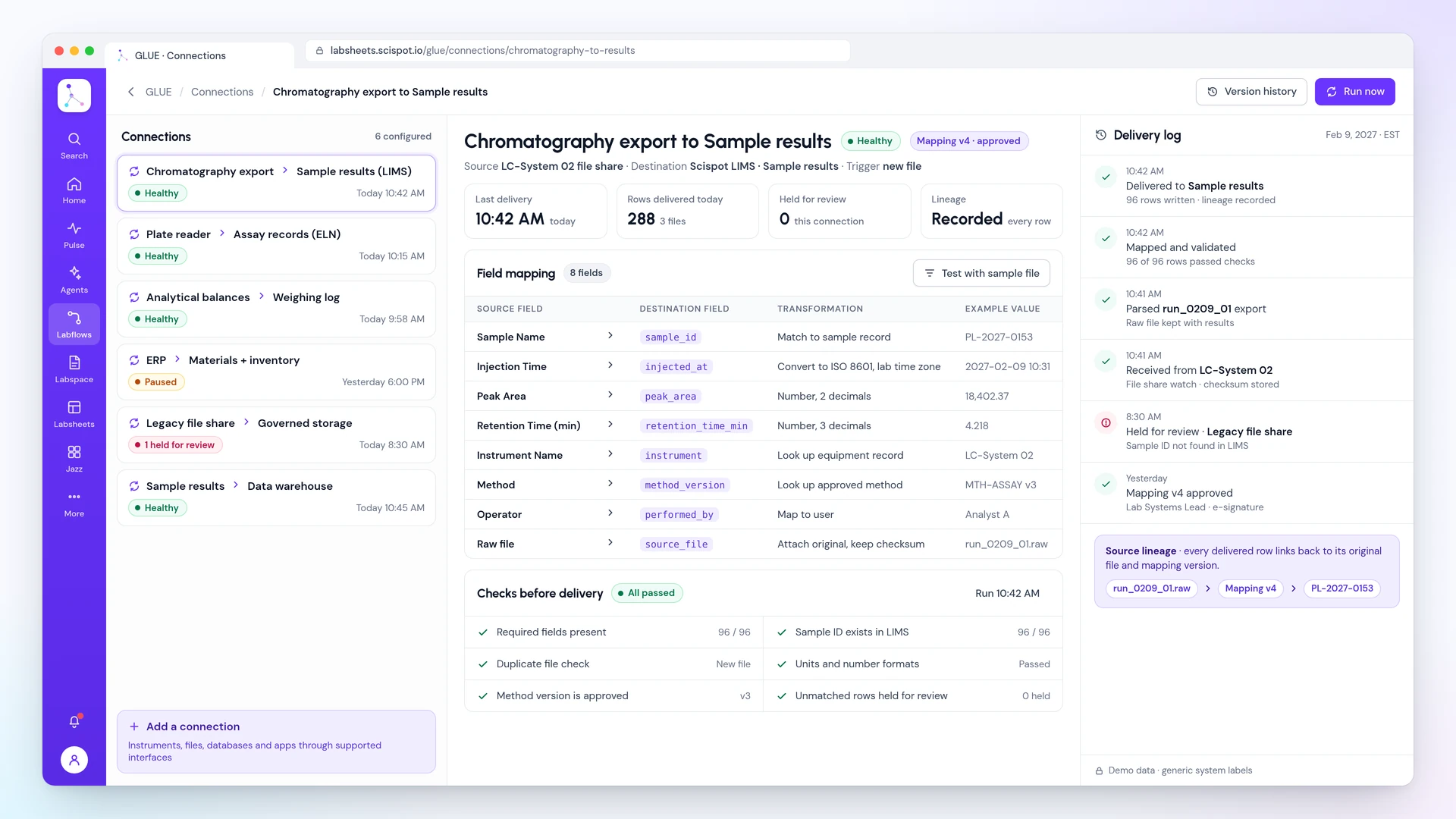
- See every handoff. Know what was received, processed, delivered or failed, and follow downstream data back to its original file and transformation history.
- Improve data usability. Build more consistent information flows for reporting, analytics and downstream use.
- Plan for what comes next. Create a stronger foundation for connected operations and AI-ready scientific data.
Raw data in. Usable data out. Source intact.
Integrations keep raw files, processed outputs, run metadata and transformation history together, so scientific and computational teams can trace results back to where they started.
Each point-to-point script adds another mapping, credential and dependency. One integration layer gives your team one place to see every handoff.
Whether a specific integration is feasible depends on the interfaces your systems provide.
Controls for regulated data flows
Data that lands in Scispot is kept under the same GxP record controls as the rest of the platform, which supports 21 CFR Part 11, EU GMP Annex 11, GAMP 5 and ALCOA+ principles. It's not a certification of your lab: your QA team keeps validation sign-off. Learn more about lab compliance.
- Logged data movement. Integration logs and audit trails record data synchronization activity.
- Source lineage. Delivered data links back to its original file and transformation history.
- Electronic signatures. Name, date, time and meaning, bound to the record version, for reviews and approvals.
- Audit trail. Who, what, when and why, with prior values, viewable and exportable by permitted users.
- Security. Role-based access, AES-256 encryption at rest, TLS 1.3 in transit and MFA through your identity provider. See Trust Vault for SOC 2 and ISO 27001.
Integration services vs. manual transfers and one-off scripts
Methods vary by lab. This compares common manual approaches.
Questions about laboratory integration?
A few things teams commonly want to understand before starting an integration project.
What are LIMS integration services?
LIMS integration services connect a Laboratory Information Management System with other laboratory applications, instruments, databases and enterprise systems. The goal is to improve data exchange, reduce manual work and create more connected laboratory workflows.
Can you integrate an existing LIMS with an ELN?
Integration requirements depend on the systems involved, their APIs or other available interfaces, data structures and workflow requirements. The goal is to connect relevant sample, experiment, result and metadata information without requiring a complete platform replacement.
Can you integrate laboratory instruments with a LIMS?
Instrument integration can connect analytical equipment and laboratory systems so instrument-generated information can be transferred and structured within the appropriate workflows. Implementation depends on instrument interfaces, data formats and system compatibility.
Do we need to replace our existing laboratory software?
No. The integration approach starts with your existing technology environment and identifies how your systems can work together. Whether a particular integration is feasible depends on the available interfaces and requirements.
Can laboratory integrations support AI and analytics initiatives?
Yes. Consistent data structures, connected applications and reliable data pipelines can provide a stronger foundation for analytics and AI workflows. Integration is often an important first step toward making laboratory data more usable.
Which systems can Scispot connect to?
Scispot connects instruments, lab applications, databases, cloud storage and analytics platforms through supported interfaces, and its integrations directory lists supported instruments and apps. For systems that aren't listed, the integration assessment checks what their interfaces allow.