
Make your lab systems work better together.
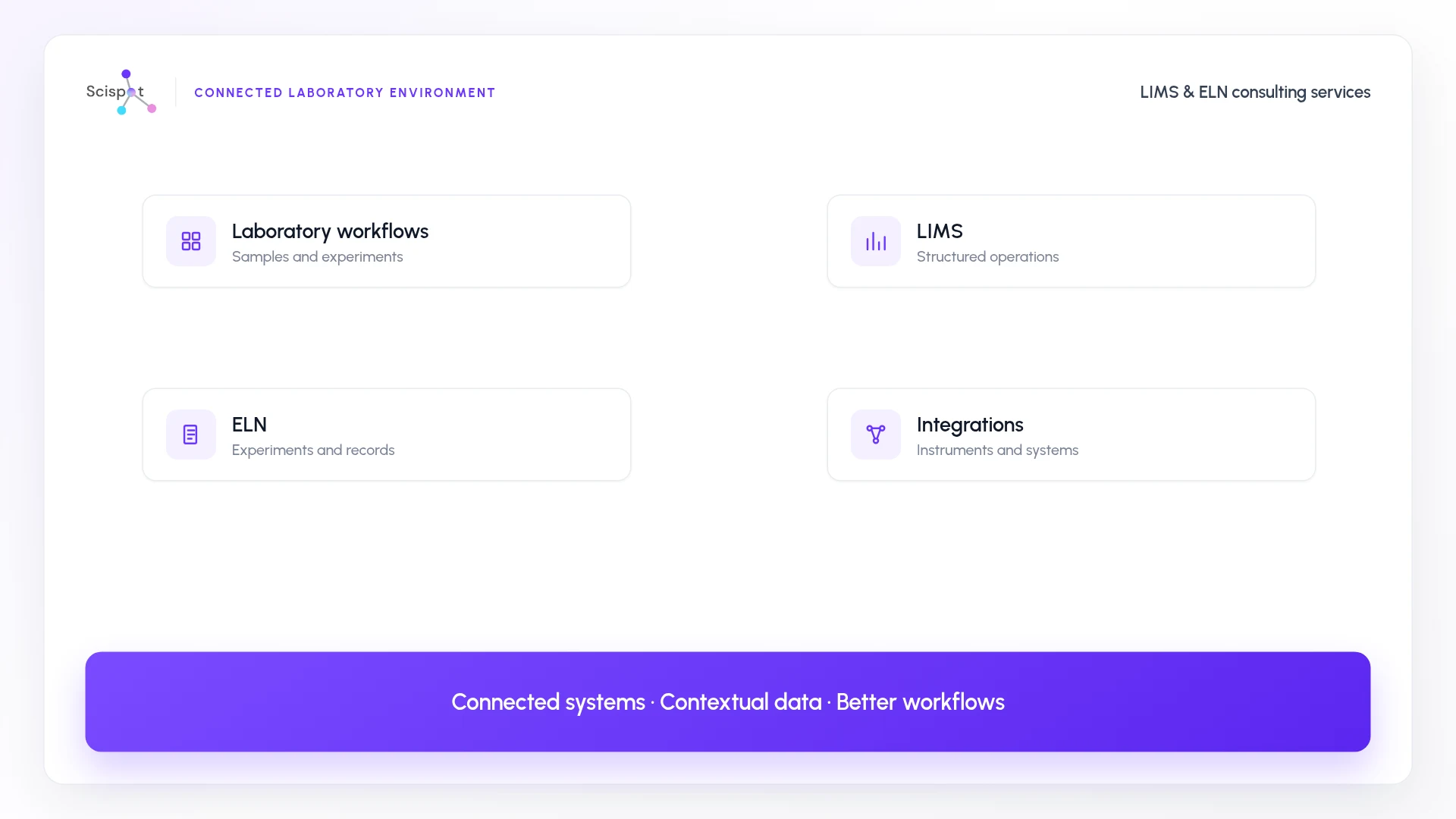
Software configuration is only one part of the work.
LIMS and ELN projects become difficult when system requirements, laboratory processes, data structures, and integrations are handled separately.
- Workflows do not fit the system
Teams adapt important laboratory processes to rigid configurations or rely on spreadsheets and manual workarounds. - Migration creates data risk
Moving samples, methods, experiment records, attachments, and history requires careful mapping and reconciliation. - Systems remain disconnected
Instruments, ELNs, LIMS, and business applications create data silos without end-to-end integration planning. - Adoption slows after go-live
Without training, clear ownership, and feedback loops, teams continue parallel processes outside the system. - Support becomes reactive
New assays, instruments, and requirements can outgrow the original implementation scope. - Reporting is hard to trust
Inconsistent metadata and disconnected records make complete, contextual information harder to access.
Support across the LIMS and ELN lifecycle.
Get targeted help for a new implementation, an existing platform, or a lab environment that needs to evolve without disrupting ongoing work.

Requirements and system assessment
Review workflows, user needs, data requirements, system constraints, and integration priorities before defining the next step.

LIMS implementation and configuration
Translate laboratory processes into system requirements, sample structures, permissions, and practical configurations.

ELN implementation and optimization
Structure experiment templates, electronic records, protocols, metadata, and review workflows for consistent documentation.

LIMS and ELN migration
Plan data extraction, transformation, mapping, migration, reconciliation, and transition from legacy systems or spreadsheets.

System and instrument integration
Connect laboratory software, instruments, and applications through APIs, file-based workflows, and integration patterns.

Ongoing support and optimization
Support configuration updates, workflow changes, troubleshooting, documentation, user enablement, and continuous improvement.
A clear path from assessment to improvement.
Engagements can be scoped as a focused assessment, a defined implementation project, or ongoing support.
Review the environment
Assess current systems, workflows, users, data, and project goals.
Define the work
Agree on requirements, deliverables, dependencies, milestones, and ownership.
Implement the plan
Configure, integrate, migrate, test, and document the agreed scope.
Support adoption
Resolve gaps, enable users, and prioritize the next improvements.
Start with the laboratory outcome, not a software checklist.
Scope depends on your assays, sample lifecycle, users, data, existing technology, and operating requirements. We work with your team to understand the current environment and define a realistic path forward.
- Map current workflows and identify process bottlenecks.
- Define functional requirements, data relationships, roles, and integration needs.
- Prioritize work based on laboratory and business impact.
- Plan testing, documentation, training, and a controlled transition.
One connected view of your lab technology environment.
Consulting can cover the systems you already have, the workflows between them, and the data moving across your laboratory.
Support for modern laboratory operations.
For teams that need reliable scientific records, connected systems, and workflows that can adapt as research and operations grow.
Biotech and pharma R&D, analytical, and quality-related workflows.
CRO and CDMO sample, study, and partner-facing data processes.
Diagnostics and testing lab instrument data capture and traceability.
Improve what you have. Connect what is missing.
An engagement does not need to start with replacing your current LIMS or ELN. Scispot can help assess the environment, identify integration and workflow gaps, and determine where an orchestration or data layer can add value.
- Keep suitable systems embedded in your operations.
- Reduce manual handoffs between instruments and applications.
- Improve consistency and context across scientific records.
- Build a practical foundation for reporting and future AI workflows.
LIMS and ELN consulting, explained.
What do LIMS consulting services include?
LIMS consulting can include requirements assessment, workflow design, platform selection support, implementation planning, configuration, integration, migration, testing support, documentation, training, and ongoing optimization. Scope depends on your laboratory processes and technology environment.
What is included in ELN consulting?
ELN consulting may cover experiment documentation workflows, notebook templates, protocol structures, metadata, permissions, review processes, migration, and connections to LIMS, instruments, and scientific applications.
Can you improve an existing LIMS or ELN without replacing it?
Yes. Work can focus on configuration changes, integration, data cleanup, workflow optimization, or a roadmap for future improvements. Replacement is only one possible option.
Can you support LIMS and ELN data migration?
Migration planning can include source assessment, data mapping, transformation rules, attachment handling, record relationships, migration testing, reconciliation, and transition planning. The approach depends on source platforms, data quality, and history requirements.
Do you provide ongoing LIMS support?
Ongoing support can cover troubleshooting, configuration updates, workflow changes, integrations, documentation, user enablement, and continuous improvement. Responsibilities and service levels should be agreed before the engagement.
Can LIMS and ELN systems connect to laboratory instruments?
In many environments, instruments can connect through supported APIs, middleware, file exchange, or other integration methods. The right approach depends on instrument interfaces, vendor constraints, data formats, and the target workflow.
Does LIMS consulting include regulatory validation?
Validation and compliance support can be considered in the project scope, including documentation and testing activities where appropriate. The regulated organization remains responsible for intended use, procedures, required validation, regulated decisions, and Quality approval.