
Turn fragmented lab data into a connected foundation.
Your lab generates valuable data. Can your systems make it useful?
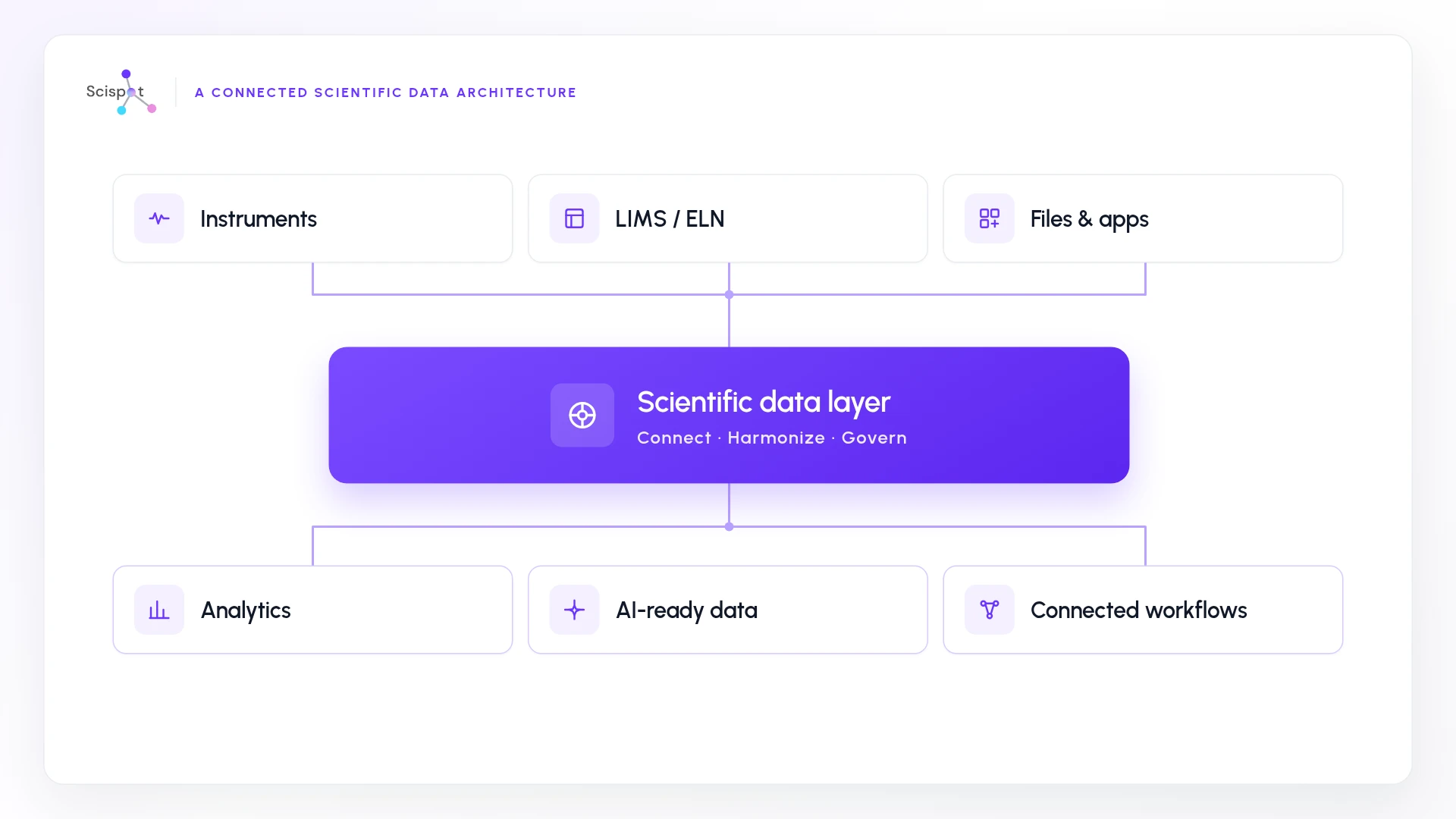
Scientific information often lives across instruments, spreadsheets, LIMS, ELNs, file stores, and specialist applications. Without a dependable data foundation, teams spend time reconciling information instead of using it.
- 01 / FRAGMENTATIONDisconnected data sources
Instrument outputs, experiment records, sample metadata, and business systems are difficult to bring together consistently. - 02 / INCONSISTENCYDifferent formats and definitions
Teams use different naming conventions, identifiers, units, and metadata structures across systems and sites. - 03 / LOW VISIBILITYLimited traceability and context
It can be difficult to understand where data came from, how it changed, and which samples or experiments it relates to. - 04 / FRAGILE PIPELINESManual data movement
One-off scripts and spreadsheet handoffs create maintenance overhead and make workflows harder to scale. - 05 / SLOW ANALYTICSInsights take too long
Analysts spend time preparing and reconciling data before they can answer scientific or operational questions. - 06 / AI READINESSData lacks usable context
AI and advanced analytics need structured, contextual, governed data, not simply a larger collection of files.
Scientific data engineering, from source systems to usable data.
We design and implement the connections, structures, and governance that help scientific data move reliably across your environment.

Scientific data architecture
Assess your systems, data flows, and requirements. Define an architecture that connects scientific sources while supporting security, scale, and future change.

Data integration and pipelines
Connect LIMS, ELN, instruments, databases, cloud platforms, and scientific applications using fit-for-purpose APIs, connectors, and automated pipelines.

Scientific data harmonization
Standardize identifiers, metadata, units, and data structures so information can be understood and reused across teams and systems.
Explore Scispot Harmonize →
Data lake and warehouse enablement
Plan and build data foundations that bring together relevant scientific and operational information for reporting, analytics, and downstream applications.

Data quality and governance
Establish validation rules, metadata practices, lineage, ownership, and controls that improve trust in data as it moves through your environment.

AI-ready scientific data
Prepare scientific information with the structure, relationships, context, and access controls needed for analytics, machine learning, and AI workflows.
Explore AI readiness →Connect more than files. Connect the meaning behind the data.
Scientific data is useful when its relationships are preserved. A result should connect to the sample, experiment, method, instrument, and relevant record that give it meaning.
Our approach accounts for these scientific relationships as we design integrations, metadata models, and data pipelines.
- Preserve sample and experiment relationships
- Maintain source context and data lineage
- Standardize metadata and scientific terminology
- Keep existing systems in the architecture where they fit
Connect the systems your teams already use
The right architecture depends on your current environment, data volume, security requirements, and intended use.
A practical path from data assessment to implementation.
Start with the data problem and desired outcome. Then build only the architecture and integrations needed to solve it.
Discover
Map systems, sources, data flows, pain points, stakeholders, and priority use cases.
Design
Define the target architecture, data model, integration patterns, and governance requirements.
Build
Implement pipelines, integrations, harmonization, quality checks, and agreed data services.
Enable
Document, test, hand over, and support adoption so teams can use and maintain the solution.
Data foundations for real life science workflows.
We focus on scientific and operational data use cases where connected, contextual information makes work easier to manage and scale.
Biotech and pharmaceutical R&D
Connect research, analytical, and quality data across instruments, experiments, samples, and systems.
CRO and multi-site operations
Harmonize scientific data across studies, laboratories, sites, and sponsor-facing workflows. Focus on laboratory and research data, not clinical-trial EDC services.
Diagnostics and testing laboratories
Integrate instrument outputs, test records, sample information, and results to reduce manual data handling.
Analytics and AI initiatives
Prepare structured, governed, and contextual scientific datasets for reporting, advanced analytics, and AI applications.
Life sciences data engineering questions
What is life sciences data engineering?
It is the work of designing, connecting, transforming, and governing data infrastructure for scientific and laboratory environments. It helps teams move information from instruments and systems into reliable structures for operations, analytics, and research.
What data sources can be connected?
Depending on the environment, this can include LIMS, ELNs, instruments, databases, file repositories, cloud platforms, data warehouses, and specialist scientific applications. The integration approach depends on available APIs, export formats, security, and workflow requirements.
How is scientific data harmonization different from data integration?
Integration moves or synchronizes information between systems. Harmonization makes data more consistent and interpretable by aligning identifiers, metadata, units, terminology, and structures. Many projects need both.
Do we need a data lake or a data warehouse?
Not necessarily. The right choice depends on your data types, users, query patterns, governance needs, existing technology, and intended use. An assessment should establish the requirements before selecting a platform or architecture.
How do you make laboratory data AI-ready?
AI readiness involves more than collecting files. Data needs appropriate structure, scientific context, consistent metadata, quality controls, traceability, and governed access. The specific requirements depend on the AI use case and the decisions it is intended to support.
Can you work with our existing LIMS and ELN?
Yes. The goal is to connect and extend the systems that make sense for your environment, not automatically replace them. We assess the current stack and design integrations around your requirements.
How is this different from CRO data management?
Life sciences data engineering focuses on the underlying architecture, pipelines, integration, harmonization, and governance. CRO data management focuses more directly on managing scientific data across studies, sites, partners, and sponsor workflows. The two can overlap, but they solve different parts of the problem.