
Connect scientific data across studies, teams and partners.
Bring samples, assay results, instrument files, methods and sponsor deliverables into a connected data workflow. Scispot helps CROs and growing biotech teams reduce manual reconciliation, improve traceability and make scientific data easier to use.
For CROs · CDMOs · biotech R&D · multi-site laboratory teams
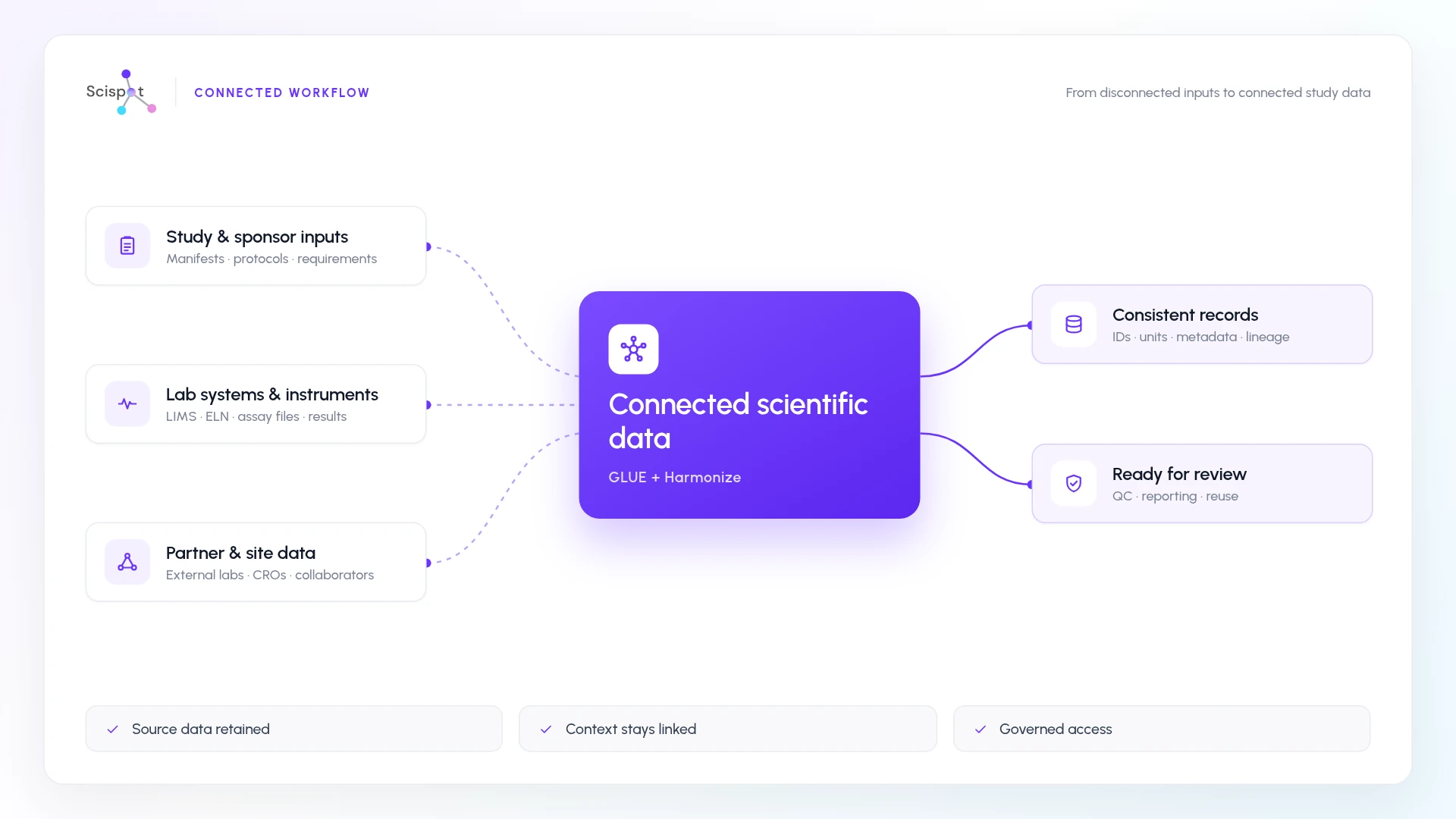
Your teams generate the data. Why is so much time spent reconnecting it?
As studies, service lines and external partnerships grow, scientific context gets scattered across spreadsheets, file shares, instruments and separate systems. Teams then rebuild that context every time they review results or prepare a deliverable.
- Inconsistent sample and study identifiers
The same sample, assay or project appears under different names across internal and partner systems. - Manual data cleaning and reconciliation
Scientists and data teams repeatedly map columns, units, formats and metadata before results can be compared or reused. - Disconnected instrument and partner outputs
Raw files, processed results, methods and review status are difficult to trace across locations and applications. - Slow sponsor and program reporting
Project teams assemble status updates and reports from multiple records, often close to delivery deadlines.
Scientific data services built around real laboratory workflows.
Start with a defined data problem—then connect the sources, standardize the information and make the output usable by the people who need it.

Study and sample data management
Establish consistent records across studies, samples, assays, methods and deliverables.
- Study and sample data models
- Identifier and metadata mapping
- Manifest and intake workflow design

CRO and partner data harmonization
Make data from sponsors, CROs, CDMOs and research partners consistent and traceable.
- Partner data mapping and normalization
- Unit, schema and terminology alignment
- Cross-site data reconciliation

Scientific data integration
Connect the instruments and applications that create, process and store laboratory data.
- Instrument and file-based data capture
- ELN, LIMS and QMS integrations
- API and workflow connectivity

Data pipelines and workflow automation
Reduce repeated handling between raw data, structured results, QC and reporting.
- ETL and transformation workflows
- Automated calculations and QC checks
- Exception routing and notifications

Sponsor reporting and data delivery
Prepare consistent data packages and reports from approved, traceable records.
- Report template and data mapping
- Source-linked result packages
- Review and approval handoffs

Scientific data readiness for analytics and AI
Improve the structure, context and lineage needed for downstream analytics and governed AI use.
- Data quality and readiness assessment
- Scientific context and lineage
- Warehouse or lake integration planning
From partner data intake to sponsor-ready delivery.
Typical engagements focus on one high-friction workflow first, then expand as the data model and integrations prove useful.
Multi-site and multi-partner studies
Align sample IDs, assay metadata, units and result structures when work is distributed across internal teams and external laboratories.
Explore scientific data harmonizationInstrument-to-result workflows
Capture instrument outputs with the sample, method and run context needed for downstream processing, review and reuse.
Explore instrument data automationStudy reporting and sponsor handoffs
Reduce manual assembly by preparing report inputs from structured records, agreed templates and reviewed results.
Explore Scispot for CROs and service labsBiotech data foundations
Connect experimental data and metadata so research, computational and operational teams can work from a more consistent foundation.
Explore scientific informatics servicesMap the workflow. Connect the data. Prove the outcome.
We work with your scientists, data owners and IT or quality stakeholders to define a useful first release without assuming you need to replace every system.
- Discover the workflow
Map sources, handoffs, data owners, current pain points and the business or scientific outcome required. - Define the data model
Agree identifiers, metadata, units, schemas, lineage and access rules for the chosen workflow. - Build and connect
Configure integrations, transformations and automations; test with representative source data and users. - Validate and improve
Review outputs, document responsibilities, train users and monitor the workflow against agreed measures.
Keep the systems that work. Connect the data around them.
Scispot combines scientific workflow expertise with an integration and data layer designed for laboratory context.
Built around scientific context
Connect results to samples, methods, experiments, instruments and review history, not just files and flat tables.
Designed for mixed technology stacks
Assess existing ELNs, LIMS, QMS, instruments, file stores and cloud platforms before recommending an integration approach.
Governance stays in the workflow
Preserve source data, trace transformations and route controlled reviews. Your Quality team retains ownership of validation decisions and regulated sign-off.
Customer outcomes are specific to the workflows described and are not guarantees of results. Confirm approved case-study wording and attribution before publication.
Digital transformation built for growth.


Todd Pankratz
Vice President, Mass Spectrometry Bioanalysis
“We see Scispot as an execution partner in that transformation, helping us automate high-value workflows, reduce manual effort, and create capacity without simply adding resources.”
Questions about CRO and biotech data services.
What to expect when connecting scientific data across teams, systems and partners.
What does CRO data management include?
In this service context, CRO data management means organizing and connecting scientific laboratory data across studies, samples, assays, instruments, methods, partner inputs and sponsor deliverables. It is distinct from clinical-trial data management services such as EDC configuration, clinical monitoring or CDISC programming.
Can you work with our existing LIMS, ELN and instrument systems?
Yes. The engagement starts by assessing the systems, APIs, file formats, data ownership and workflow requirements already in place. The goal is to connect useful systems where practical, not assume a rip-and-replace project. Specific integration feasibility is confirmed during scoping.
Can you harmonize data received from multiple CROs or research partners?
Yes. A typical scope can include mapping partner-specific identifiers and fields to a shared schema, aligning units and metadata, resolving identity mismatches, and preserving links to original source records and transformations.
Can you help automate sponsor reports?
Yes. We can map agreed report fields to structured study and result records, assemble report inputs, and connect review and approval steps. Final scientific review and authorized release remain with your team.
Do you provide clinical-trial data management or CDISC services?
This page describes scientific laboratory and research data workflows. Clinical-trial EDC operations, clinical data management, CDISC standards programming and regulatory submission services should be scoped separately and are not implied by this offering.
How do you handle data quality, traceability and validation?
Projects can define source retention, mapping rules, transformation lineage, access controls, review steps and test evidence according to intended use. Your organization’s Quality and system owners remain responsible for requirements, validation decisions, SOPs and regulated sign-off.
How should we start?
Bring one example workflow, such as partner data intake, instrument-to-result processing, or sponsor reporting, along with representative files and the outcome you want to improve. We can use that to scope sources, gaps, stakeholders, and a practical first phase.