Coming Soon
Your lab evolves. Now your software can adapt with it. Meet Jazz ♪


Reduced manual reporting and lab administration work across the assay-data lifecycle.
One workflow reduced data-entry errors from 15% to 5%.
One workflow dropped from 10 hours to under one hour.
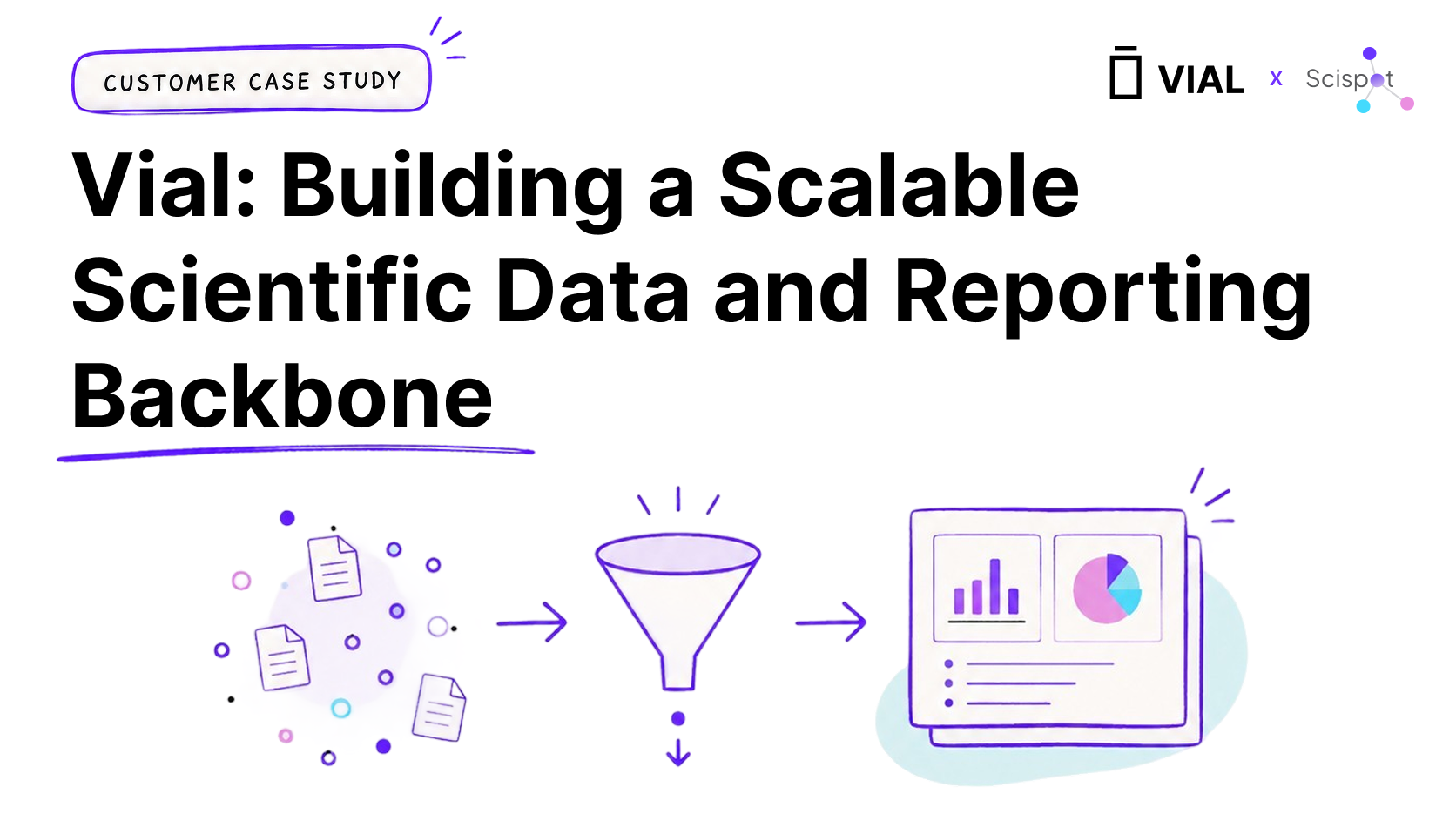
Vial is a clinical-stage biotechnology company with complex scientific data flows across partner delivery, assay processing, scientific review, and reporting. As work expanded, data moved through spreadsheets, computational notebooks, specialist tools, and report templates.
That setup created growing operational drag. Partner data arrived in different formats and with different levels of completeness, so the team repeatedly mapped, cleaned, and checked files before analysis could begin. Each assay also carried its own metadata, calculations, scripts, figures, and outputs, which made it harder to keep processing logic and results tied to the right scientific context.
The bigger risk was fragmentation. Raw data, analysis files, summaries, and final reports could become disconnected across handoffs. That made review slower, increased the chance of data-entry errors, and added manual coordination as the number of programs, data sources, and stakeholders grew. Vial needed a way to standardize intake and preserve lineage without forcing the team to abandon the tools and workflows it already relied on.
Scispot worked with Vial to build a connected scientific data and reporting layer around its existing operations. The implementation gave the team a shared structure for programs, molecules, samples, assays, and production records, so data could retain its scientific context as it moved through the workflow.
To address inconsistent partner files, Scispot configured data-ingestion pipelines that moved external data into standardized, analysis-ready records. To address assay-specific processing, the system linked notebooks, scripts, calculations, and figures to the relevant assay context. This reduced the need to reconstruct relationships across separate files and tools.
Scispot also connected reporting to governed data and review states. Dashboards, APIs, and controlled AI access remained close to trusted source data, while reports and scientific summaries could be traced back to the records, calculations, and review steps behind them.
Vial and Scispot refined the data model and workflows through regular working sessions as scientific requirements changed. The result was a reusable operating pattern that supported current assay work and could extend to future partner data, reports, and computational workflows.
Vial reduced manual coordination across the assay-data lifecycle and created a clearer path from partner files to decision-ready reporting. Teams spent less time on repeated mapping, cleanup, copy-paste work, and status chasing because source data, analysis, review, and reporting remained connected.
The impact was measurable in key workflows:
The new workflow also strengthened traceability. Source files, samples, programs, calculations, figures, and outputs stayed connected, making it easier to understand how a reported result was produced. Vial now has a reusable foundation for scientific operations that can support more programs and data sources without requiring manual coordination to grow at the same pace.
“Scispot is becoming part of our core preclinical and clinical data workflows. The platform gives our scientific teams a place to structure data, automate analysis, and synthesize information, allowing us to move away from manual workflows and toward AI-integrated workflows.”
— Joshua Pascoe, Vial