
Scispot vs Thermo Scientific SampleManager: Which Lab Platform Fits Your Needs?
This Scispot vs SampleManager comparison looks at how the platforms approach laboratory information management, procedural execution, scientific data, instrument connectivity and enterprise workflows. The right choice depends on your lab’s operating model, existing systems and integration priorities.
A practical comparison for laboratory, quality, informatics and IT teams.
- Sample lifecycle, testing and laboratory execution
- ELN, SDMS and scientific data access
- Instrument, ERP, MES and application connectivity
- Deployment, validation and long-term ownership
Two approaches to laboratory informatics
Both platforms address complex laboratory environments, but buyers should look beyond product labels. Compare how each system supports the work your team performs, the data it produces and the wider technology environment it needs to connect.
Scispot positions its Lab Operating System as a connected environment for laboratory data, workflows, instruments and applications. Its GLUE integration layer is designed to connect systems across the lab rather than assume every organization must replace its existing tools.
SampleManager is Thermo Fisher’s laboratory informatics solution for lab, data, process and compliance management. Thermo Fisher describes capabilities spanning LIMS, Laboratory Execution System (LES), ELN and Scientific Data Management System (SDMS), with a strong presence in process development and manufacturing QA/QC.
Scispot vs SampleManager: What should your lab compare?
Use this table as a starting point for discovery. Product scope, configuration, interfaces and deployment details should be validated against your requirements and the specific implementation being evaluated.
Comparison based on publicly described capabilities. This is not a statement that every capability is included in every edition, configuration or deployment.
Understand the SampleManager platform before comparing alternatives
SampleManager has a broad footprint across laboratory and manufacturing environments. A useful comparison should recognize its established strengths and then test whether those strengths map to your lab’s current and future operating needs.
Sample and method workflows
SampleManager combines sample and testing management with LES capabilities for guided method execution and procedural history.
Laboratory and data records
Its informatics scope includes ELN and SDMS functionality for laboratory information, raw data and metadata management.
Manufacturing laboratory use
Thermo Fisher positions SampleManager for process development and manufacturing quality control, including regulated workflows.
Instruments and enterprise systems
Published capabilities include instrument integration and connections to ERP, MES and Chromeleon CDS.
Cloud and on-premises options
Thermo Fisher describes deployment through customer-managed or Thermo Fisher-managed infrastructure, as well as on-premises environments.
Operational visibility
Pre-configured dashboards help teams review laboratory performance, resource availability, stock and location status.
SampleManager may be a strong fit when its LIMS, LES, ELN and SDMS scope maps closely to established QA/QC or process-development operations. The next step is to test how easily your organization can connect it with the rest of its data and application environment.
Connect the lab systems you already depend on
Laboratories often operate across instruments, LIMS, ELNs, quality systems, data repositories, spreadsheets and specialized scientific applications. Scispot’s LabOS and GLUE positioning focuses on making those systems work together through connected data and workflows.
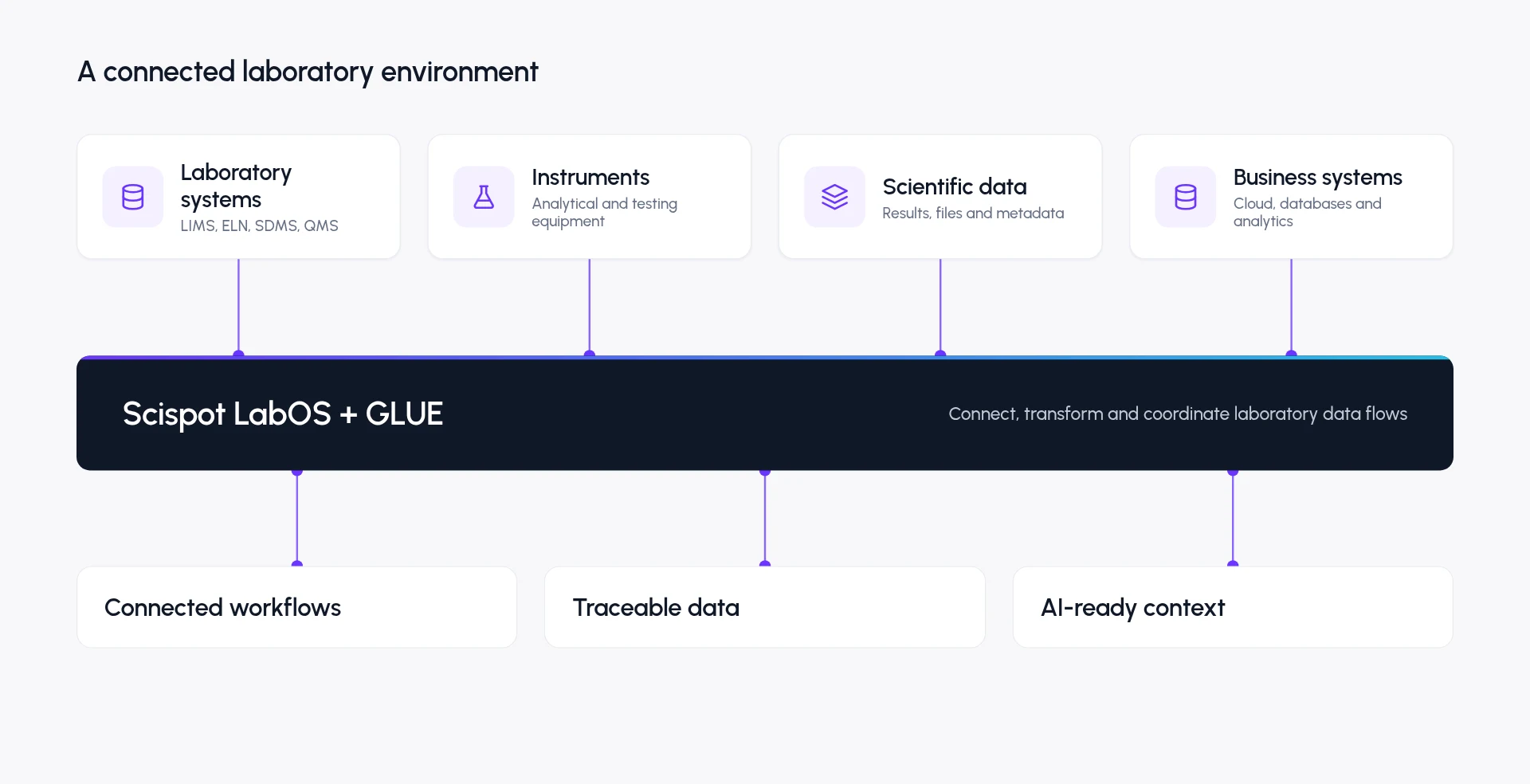
Bring laboratory information into a more connected environment
Evaluate how data from instruments and existing applications can be made accessible and reusable across workflows, reporting and downstream analysis.
Coordinate work across applications
Assess whether routine handoffs, data movement and workflow steps can be coordinated without creating another disconnected point solution.
Keep systems that still serve a purpose
Where existing platforms remain important, explore integration and coexistence options before assuming a full system replacement is necessary.
Improve the structure and accessibility of lab data
Connected, governed data provides a stronger foundation for analytics and AI workflows than information isolated across incompatible tools.
Evaluate the full path from instrument to business system
A platform comparison should test real data flows, not just whether an integration checkbox appears in a feature list. Map the systems involved, the data exchanged, ownership of each record and how exceptions are handled.
Data sources
Instruments, analytical software, files, spreadsheets and scientific applications
Connectivity
Interfaces, APIs, data mapping, validation rules and transfer monitoring
Lab workflows
LIMS, ELN, SDMS, quality processes, review and approvals
Business use
Reporting, analytics, manufacturing systems and AI-enabled applications
Which platform should your lab evaluate?
The best choice depends on the workflows you need to support, the systems you already operate and the amount of change your organization is prepared to manage.
- You want to connect laboratory data, instruments and applications across an existing stack.
- Workflow coordination and data accessibility are major operational priorities.
- You want to explore an AI-native Lab Operating System approach.
- You prefer to assess integration and coexistence before replacing systems that still work.
- Your requirements align with an established LIMS for process development or manufacturing QA/QC.
- You need LIMS capabilities alongside LES, ELN and SDMS functionality.
- Guided method execution and procedural histories are central to operations.
- Your deployment and enterprise integration requirements fit its available architecture and interfaces.
Questions to ask before choosing
Can the platform support our actual sample lifecycle?
Walk through accessioning, scheduling, testing, review, authorization, reporting and archival using representative samples.
How will instrument data move?
Identify each instrument, vendor software, file format, transfer direction, metadata requirement and exception path.
What happens to existing systems?
List the LIMS, ELN, CDS, QMS, ERP, MES and data repositories that must remain connected during and after implementation.
Who owns configuration and validation?
Clarify responsibilities for intended use, procedures, configuration, testing, validation evidence, change control and final approval.
Scispot vs SampleManager FAQs
What is the main difference between Scispot and Thermo Scientific SampleManager?
SampleManager is Thermo Fisher’s LIMS software, with built-in LES, ELN and SDMS functionality for process development and manufacturing QA/QC laboratories. Scispot LabOS connects instruments, apps, data, samples, workflows and quality rules in one governed system. Its GLUE integration layer moves data between instruments, lab software, databases and cloud platforms.
Does SampleManager include ELN and SDMS capabilities?
Yes. Thermo Fisher describes built-in ELN, SDMS and LES functionality in SampleManager LIMS Software. The ELN captures and links data formats such as rich text, spreadsheets, PDFs and molecular structures. The SDMS manages raw data and metadata through the full data lifecycle.
Can SampleManager connect with instruments and enterprise systems?
Yes. Thermo Fisher states that SampleManager integrates with laboratory instruments and enterprise systems, including ERP and MES. It also integrates with Thermo Scientific Chromeleon CDS for chromatography and mass spectrometry data. Confirm the specific instruments and interfaces for your lab during evaluation.
Can Scispot work with an existing LIMS?
Yes. Scispot states that GLUE can deliver data into existing ELN and LIMS platforms, storage and analytics tools. Scispot first assesses the available APIs, file formats and interfaces, then confirms the integration approach. You can keep the systems that still work and connect them.
How should a lab choose between Scispot and SampleManager?
Test both platforms against one representative workflow. Include your sample lifecycle, instruments, existing systems, data flows, validation responsibilities and deployment needs. Choose the platform that fits your operating model and the amount of change your lab can manage.
Compare platforms against your real lab workflows
Talk with Scispot about your instruments, existing LIMS and ELN environment, data flows and operational priorities. Build the evaluation around what your laboratory needs to connect and improve.
Scispot vs SampleManager is an independent product comparison prepared by Scispot. Thermo Scientific and SampleManager are trademarks of their respective owner. Scispot is not affiliated with, endorsed by or sponsored by Thermo Fisher Scientific. Product capabilities and availability can vary by product, version, configuration and contract. This page summarizes publicly available information reviewed in November 2026. Confirm current details with each vendor before making a purchasing decision.