
Scispot vs Dotmatics: Which Platform Fits Your Lab?
This Scispot vs Dotmatics comparison looks at how each platform may fit your lab’s scientific applications, data, instruments, integrations, and workflows. Use the differences below to assess which approach best matches your research and operational priorities.
Built for modern life sciences teams · Explore your options before you decide
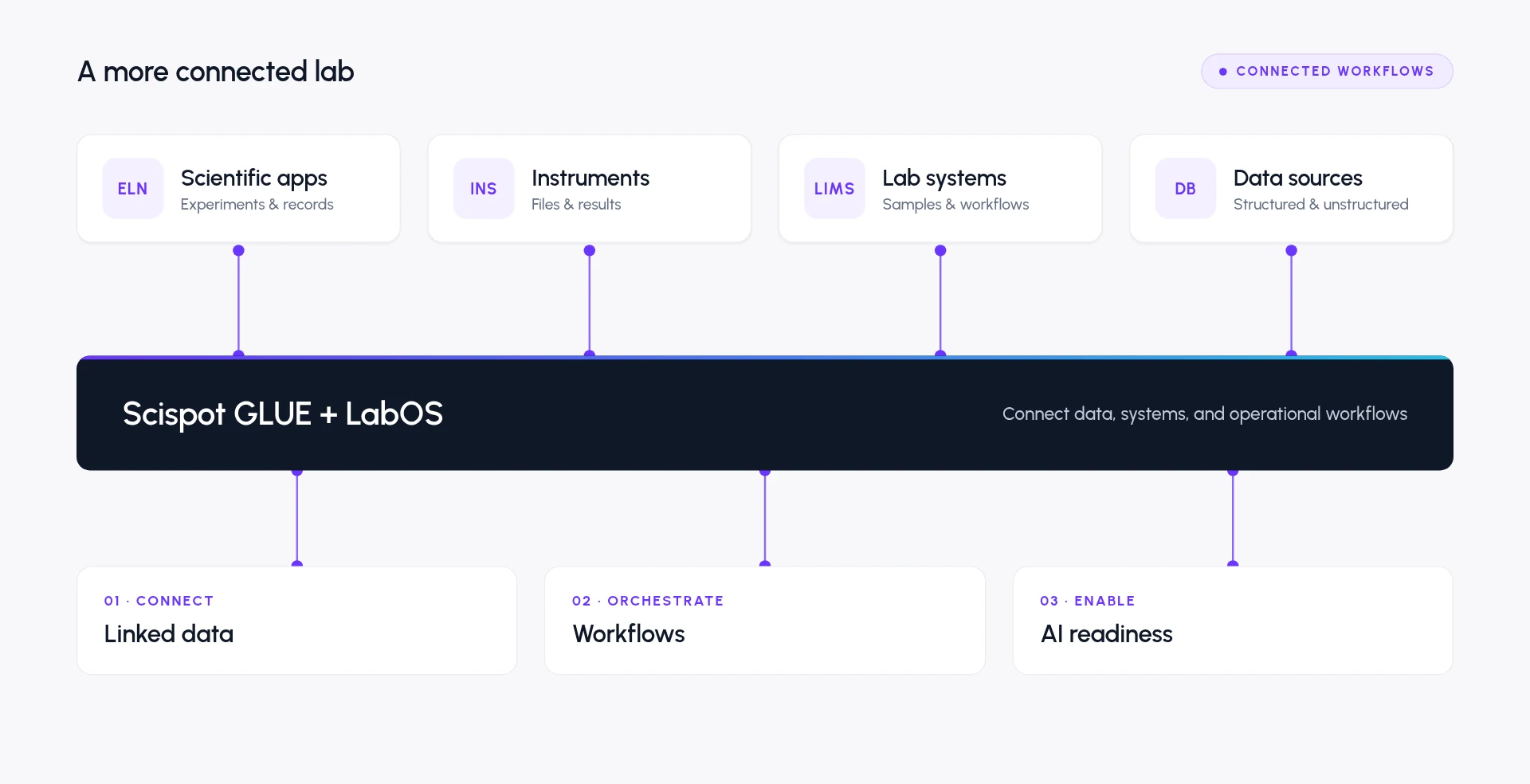
Illustrative workflow concept, not a product screenshot.
Scispot vs Dotmatics: Feature Comparison
Scispot vs Dotmatics is best evaluated against your actual lab requirements: scientific applications, instrument and data integration, cross-system workflows, governance, and implementation effort. The right choice depends on which capabilities your team needs most.
Comparison framework for initial evaluation. Capabilities can vary by product, edition, configuration, and implementation. Validate requirements with both vendors before making a decision.
Two platforms. Different questions to ask.
Start with the problems you need to solve—not just the feature checklist.
What is Dotmatics?
Dotmatics provides scientific software across research and discovery, with capabilities spanning areas such as chemistry, biology, scientific data, and laboratory workflows.
- Assess fit for your scientific disciplines and research processes.
- Map the specific applications needed across your teams.
- Verify integrations, data flows, and workflow coverage for your configuration.
- Understand licensing, deployment, and implementation requirements.
What is Scispot?
Scispot brings together lab applications, instrument data, samples, and workflows through LabOS and GLUE—helping teams build a more connected operating environment.
- Connect existing instruments, applications, and data sources.
- Explore native lab applications and cross-system workflows.
- Build a more structured and governed scientific data foundation.
- Evaluate automation and AI use cases around real lab processes.
Scispot vs Dotmatics: What Should Your Lab Compare?
Use these criteria to compare real workflows and business needs—not just the number of features on a product page.

1. Can your systems work together?
Map your ELN, LIMS, instruments, databases, and downstream tools. Check how data moves between them, where manual transfers remain, and how exceptions are handled.

2. Can you coordinate cross-system workflows?
Trace a real process from sample registration to instrument output, review, reporting, and downstream analysis. Identify handoffs that still depend on spreadsheets or manual follow-up.

3. Is scientific data ready for reuse?
Look for consistent identifiers, contextual metadata, traceable transformations, and reliable links between samples, experiments, methods, and results.

4. Which tasks can you automate?
Choose repetitive tasks—such as data transfer, record reconciliation, or report preparation—and validate the automation scope, exception handling, and human review required.

5. Does the solution fit your quality needs?
Review audit trails, permissions, electronic records, validation responsibilities, and applicable regulatory requirements with your quality and IT stakeholders.

6. Can you evolve without unnecessary disruption?
Compare migration effort, implementation ownership, integration maintenance, training, and the ability to retain systems that already work well.
Keep the systems you need. Connect the work around them.
Replacing every scientific application is not the only path to better-connected operations. Scispot GLUE is designed to connect instruments, applications, databases, and downstream tools through a shared integration layer.
For teams using Dotmatics, explore the relevant integration scope and data flows before deciding whether to replace, extend, or connect existing systems.
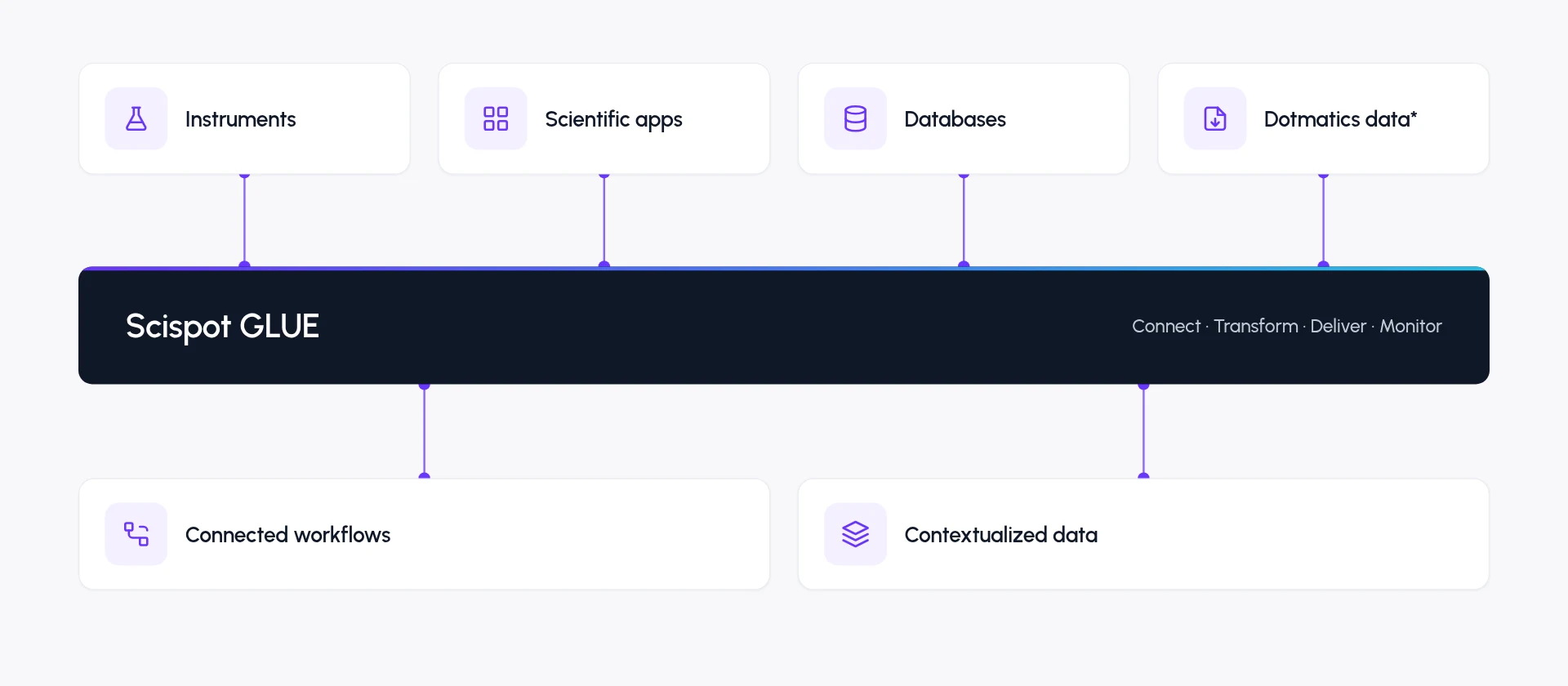
*Illustrative architecture. Specific Dotmatics connectivity, supported data types, and implementation scope must be confirmed.
Compare both platforms using one real workflow
A focused evaluation makes it easier to understand fit, effort, and expected value.
Choose a workflow
Pick a process with visible friction, such as instrument data capture, sample handoffs, data reconciliation, or reporting.
Map the complete process
Document the systems involved, manual steps, required metadata, permissions, exceptions, and downstream consumers.
Validate the outcome
Compare implementation effort, usability, data traceability, automation, ongoing maintenance, and measurable time saved.
Which platform should your lab evaluate?
The answer depends on your scientific priorities, current architecture, and the outcomes you need to deliver.
When scientific application depth is the priority
Dotmatics may be a strong candidate to evaluate when your requirements center on its scientific software portfolio and the specific research and discovery applications your teams need.
Questions to validate: application coverage, discipline-specific workflows, integrations, data movement, and total cost of ownership.
Dotmatics Review ↗When connecting lab operations is the priority
Scispot is worth evaluating when your team wants to connect instruments, applications, scientific data, and operational workflows without assuming every existing system must be replaced.
Questions to validate: integration scope, workflow orchestration, data governance, automation opportunities, and implementation requirements.
Explore Scispot LabOS ↗Scispot vs Dotmatics FAQs
Answers to common questions to help you plan your evaluation.
Scispot vs Dotmatics: what is the main difference?
The main difference in this Scispot vs Dotmatics comparison is the platform approach. Dotmatics offers a broad scientific software portfolio for research and discovery. Scispot positions itself as an AI-native Lab Operating System designed to connect lab applications, instruments, scientific data, and operational workflows. The best fit depends on your specific products, use cases, and integration requirements.
Can Scispot work with existing scientific systems?
Scispot GLUE is designed to connect instruments, applications, databases, and downstream systems. The feasibility of a specific integration depends on the source system, available interfaces, data requirements, and implementation scope.
Can Scispot connect with Dotmatics?
Scispot lists a Dotmatics integration through GLUE for extracting, transforming, enriching, and visualizing Dotmatics data. Confirm the supported data types, direction of data flow, and exact implementation requirements with Scispot.
Does Scispot replace an ELN or LIMS?
That depends on your requirements and implementation scope. Scispot offers lab applications and an orchestration approach that can connect existing systems. A fit assessment should determine what to retain, extend, or replace.
How should regulated labs compare the platforms?
Evaluate audit trails, permissions, electronic records, validation responsibilities, data integrity, and the applicable regulatory requirements for your intended use. Confirm each requirement with the vendor and your quality team before making a decision.
How do we compare implementation cost and time?
Request a scoped estimate for the same representative workflow from each vendor. Include licenses, implementation, integrations, migration, validation, training, support, and ongoing maintenance, not just initial deployment.
Build a more connected lab, starting with the systems you already have.
Tell us how your lab works today. We’ll help you explore where Scispot may fit, which systems can be connected, and what an implementation could involve.
This comparison was prepared by Scispot.io Inc. ("Scispot"), which sells products that compete with those described. Benchling is a trademark of Benchling, Inc.; all other names and marks belong to their respective owners and are used for identification only. Scispot is not affiliated with, endorsed by, or sponsored by Benchling, Inc. or any other vendor named. Competitor features, plans, and pricing are based on publicly available information (sources linked where cited), reviewed as of November 2026, and may have changed since. Ratings are taken from G2 as of November 2026. Statements about suitability or "best fit" are Scispot's opinion and not statements of fact. Customer quotes reflect individual experiences, which may not be typical. This page is for general information only. Confirm current details with each vendor before making a purchasing decision. To report an inaccuracy, contact team@scispot.io; we review corrections promptly.