

The Benchling Question Every Lab Leader Asks
You're building a biotech startup or scaling an R&D operation. Someone mentions Benchling. It's the name everyone knows. But as you dig deeper - talking to lab managers, reviewing feature lists, calculating per-seat costs - a nagging question emerges: Is Benchling really the only option? Or are there alternatives that fit your lab's actual workflow better?
The answer is nuanced. Benchling is a market leader in electronic lab notebooks (ELNs), and for good reason. It has brand recognition, compliance credibility, and a large user base. But the lab software landscape has evolved dramatically. Modern biotech teams don't just need a digital notebook anymore. They need to connect instruments, enforce real-time policies, integrate with Python pipelines, track samples across workflows, manage inventory, and feed clean data into AI models - often all in the same platform.
This shift has created space for alternatives. Some are specialized point solutions. Others are emerging as unified lab operating systems designed from the ground up for AI-native teams. If you're evaluating lab software in 2026, you owe it to yourself to look beyond the default choice.
Why Labs Are Looking Beyond Benchling

Before we list alternatives, let's be honest about why labs are searching. Benchling works well for protocol authoring and basic experiment capture. But several pain points drive teams to explore options:
- Integration friction: Connecting Benchling to your instrument stack, data warehouse, or ML pipeline often requires custom middleware and IT overhead.
- Cost at scale: Per-seat pricing adds up quickly when you have 50+ users across wet lab, computational, and operations teams.
- Data silos: ELNs and LIMS are often separate systems. Data flows between them manually or through brittle connectors, creating delays and errors.
- Compliance without speed: Audit trails and version control are essential, but they shouldn't slow down fast-moving research teams.
- AI readiness: Labs running Python, Jupyter, and machine learning pipelines need platforms that speak their language natively - not as an afterthought.
- Workflow mismatch: Benchling's interface and data model work well for certain workflows (pharma, clinical) but feel clunky for others (synthetic biology, materials science, high-throughput screening).
If any of these resonate, it's worth evaluating alternatives.
Understanding the Lab Software Landscape
Before comparing specific platforms, it helps to understand the categories:
Electronic Lab Notebooks (ELNs): Freeform, narrative-driven platforms for capturing experimental work. Think of them as digital lab notebooks with versioning and search. Benchling is the category leader here.
Laboratory Information Management Systems (LIMS): Structured, workflow-driven platforms for sample tracking, inventory, QC, and reporting. They enforce data models and policies. Traditional LIMS platforms include LabWare, Thermo Fisher SampleManager, and others.
Lab Operating Systems (LabOS): A newer category that unifies ELN and LIMS functions while adding API-first architecture, real-time policy enforcement, and native support for computational workflows. These platforms treat lab operations like code - structured, versioned, auditable, and machine-readable.
The choice depends on your lab's maturity, team composition, and growth trajectory. A small academic lab might thrive with a pure ELN. A biotech startup scaling toward manufacturing needs LIMS capabilities. A team running AI-driven R&D needs a lab OS.
10 Alternatives to Benchling Worth Evaluating

1. Scispot (Lab Operating System)
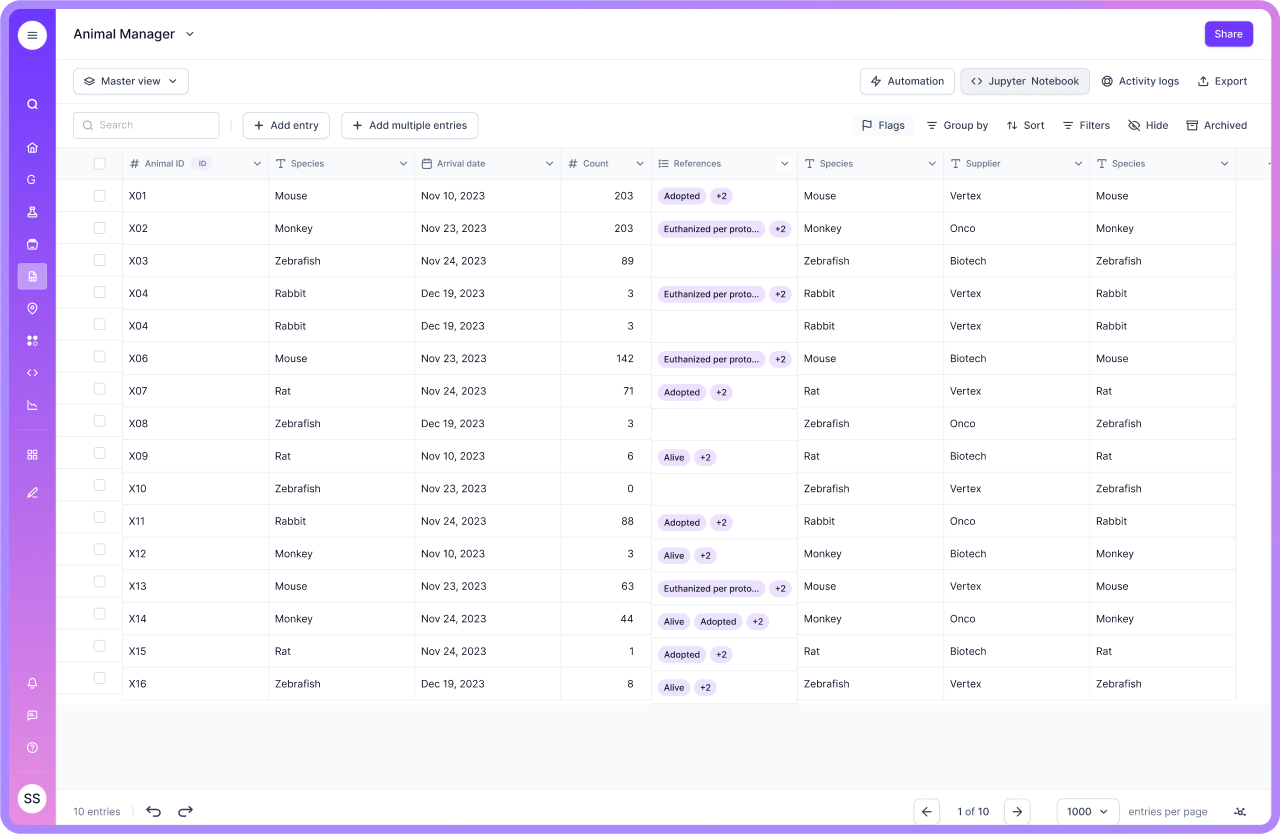
Scispot unifies ELN, LIMS, and data lake into a single platform designed for AI-native biotech teams. It combines freeform protocol authoring (like an ELN) with structured sample and inventory tracking (like a LIMS), but adds API-first architecture and native Python integration. Teams can write and track work in Labspaces, manage samples in Labsheets, and connect instruments via a universal connector that supports ASTM, HL7, and REST standards. The platform enforces compliance without slowing teams down - audit trails and version control are built in, not bolted on. For labs running computational workflows alongside wet-lab work, Scispot eliminates the need to maintain separate systems for different teams.
2. LabWare LIMS
LabWare is a mature, enterprise-grade LIMS with deep roots in pharma and clinical labs. It excels at sample tracking, inventory management, and regulatory compliance. If your lab's primary need is structured workflow automation and sample management, LabWare is a proven choice. The trade-off: it's less intuitive for freeform scientific narrative and requires significant IT investment to implement and maintain.
3. Thermo Fisher SampleManager
Part of the Thermo Fisher ecosystem, SampleManager is a LIMS platform with strong integration into Thermo Fisher instruments and reagents. If your lab is already invested in Thermo Fisher hardware, SampleManager can reduce integration friction. However, it's less flexible for labs using multi-vendor instrument stacks.
4. Quartzy
Quartzy focuses on inventory and reagent management with a lighter touch than traditional LIMS. It's popular in academic labs and smaller biotech teams because it's easier to set up and doesn't require heavy IT involvement. The downside: it's not a full LIMS or ELN, so you'll still need a separate notebook platform.
5. Labguru
Labguru is a cloud-based ELN with a focus on ease of use and affordability. It's popular in academic and early-stage biotech settings. It offers basic protocol management, experiment capture, and inventory tracking in one interface. For teams that want simplicity over enterprise features, Labguru is worth a look.
6. Agilent OpenLab
OpenLab is Agilent's platform for chromatography and lab data management. If your lab runs significant analytical chemistry workflows (HPLC, GC, LC-MS), OpenLab integrates tightly with Agilent instruments. For labs with mixed instrument vendors, integration can be more complex.
7. LabVantage Solutions
LabVantage is an enterprise LIMS used in pharmaceutical, biotech, and contract research organizations. It's highly configurable and supports complex workflows, but implementation is lengthy and requires dedicated IT resources. Best suited for large organizations with mature lab operations.
8. Freezerworks
Freezerworks specializes in sample and biorepository management. If your lab maintains large sample collections, biobanks, or tissue repositories, Freezerworks provides deep inventory and tracking capabilities. It's less suitable as a general-purpose ELN or LIMS.
9. Ruro
Ruro is a newer platform focused on making LIMS accessible to smaller labs. It offers a modern interface and cloud-first architecture, with less implementation overhead than legacy LIMS systems. It's gaining traction in biotech startups that want LIMS structure without enterprise complexity.
10. Benchling (for completeness)
Yes, Benchling remains a strong choice for many labs. Its strengths: intuitive protocol authoring, strong compliance credentials, large user community, and deep integrations with popular tools. Its limitations: ELN-centric design means LIMS and data lake functions require add-ons or external systems, and per-seat costs can escalate quickly.
How to Choose: Key Evaluation Criteria

Rather than declaring a winner, consider these factors for your lab:
Workflow fit: Does the platform match how your team actually works? If you're doing freeform research, you need strong ELN capabilities. If you're running high-throughput screening or manufacturing, you need LIMS structure. If you're blending both with computational work, a lab OS is worth the investment.
Integration readiness: How easily does it connect to your instruments, data warehouse, and computational tools? API-first platforms reduce IT burden and future-proof your stack.
Compliance requirements: Do you need FDA 21 CFR Part 11 compliance? GxP validation? Academic audit trails? Not all platforms are equally rigorous, and over-engineering compliance can slow down early-stage research.
Team composition: Does your lab include computational scientists, ML engineers, or data analysts? Platforms with native Python support and structured data models serve these teams better than traditional ELNs.
Cost structure: Compare total cost of ownership, not just per-seat fees. Factor in implementation time, IT overhead, training, and integration costs. A cheaper platform that requires six months to implement may be more expensive than a faster alternative.
Scalability: Will the platform grow with you? Can it handle 10 users today and 100 users in three years? Can it scale from open R&D to locked clinical workflows?
Vendor stability: Is the company well-funded and focused on your use case, or is the platform a legacy product in a larger portfolio?
The Emerging Paradigm: Lab Operating Systems
If you're evaluating platforms in 2026, pay special attention to lab operating systems. This category represents a meaningful shift in how labs think about software.
Traditional ELNs and LIMS were designed for different purposes and different teams. ELNs served scientists capturing narrative. LIMS served operations teams managing samples and workflows. The two systems rarely talked to each other, creating data silos and manual handoffs.
A lab operating system treats the entire lab - wet work, computational work, inventory, compliance, analytics - as an integrated system. Data flows seamlessly between teams. Policies are enforced in real time. Workflows are auditable without being cumbersome. And critically, data is structured and machine-readable from the moment it's captured, making it ready for analysis and AI.
This paradigm is especially valuable for biotech teams that blend wet-lab and computational work. Instead of maintaining separate systems for scientists and data engineers, a lab OS gives both teams a single source of truth. Wet-lab teams capture structured experiments. Computational teams pull clean data via APIs. Operations teams track inventory and compliance. Everyone works in the same system, with the same data model, the same audit trail.
Making Your Decision
Choosing lab software is not a one-time decision. It's a multi-year commitment that shapes how your team works. Here's a practical approach:
Map your current pain points. What's broken in your lab today? Is it protocol sharing? Sample tracking? Data integration? Compliance reporting? Your biggest pain point should drive your platform choice.
Define your workflow. Walk through a typical experiment from start to finish. Where does data live? Who needs to access it? What decisions depend on it? What reports do you need to generate? A platform that fits your actual workflow beats one that requires you to change how you work.
Talk to users. Contact labs using each platform. Ask about implementation time, IT overhead, user adoption, and whether the platform delivered on its promises. User feedback is more reliable than vendor claims.
Run a pilot. If possible, run a small pilot with your top two choices. Have your team use each platform for a real experiment. The friction you encounter in a pilot will reveal itself in production.
Think long term. Where is your lab headed? If you're scaling toward manufacturing, you'll need LIMS capabilities. If you're building an AI-driven R&D engine, you need a platform that speaks Python and APIs. Choose a platform that can grow with you, not one you'll outgrow in two years.
Conclusion: The Right Tool for Your Lab
Benchling is a capable platform, and for many labs, it remains the right choice. But it's no longer the only choice. The lab software landscape has matured. Alternatives exist for nearly every use case, workflow, and budget.
The best platform for your lab is the one that eliminates friction from your actual work. It's the one your team will use consistently because it matches how they think and work. It's the one that grows with you as your lab scales. And it's the one that makes the right way the easy way - where compliance, quality, and speed reinforce each other rather than compete.
Take the time to evaluate your options. Your lab's efficiency, your team's satisfaction, and your ability to scale depend on it.
Disclaimer: Third-party product and company names, logos and trademarks are the property of their respective owners and are used for identification only. Scispot.io Inc. is not affiliated with, endorsed by, or sponsored by any vendor mentioned. Information is based on publicly available sources as of November 2026 and may change; verify details directly with each vendor.