

Imagine your life science lab as a high-performance engine: instruments humming, data streaming, teams racing toward breakthroughs. But instead of seamless power, you face silos, manual data entry, and compliance chokepoints that slow everything down. What if there was a way to unify it all into one intelligent system that runs like an operating system for your lab?
This is the promise of the lab operating system, or Lab OS. In today's fast-moving biotech world, where AI-native workflows demand speed, structure, and scalability, the Lab OS emerges as the new standard. It goes beyond traditional tools, integrating data, processes, and people into a cohesive platform that accelerates discovery while maintaining trust.
The Pain Points of Traditional Lab Operations
Life science labs have long relied on two core pillars: the electronic lab notebook (ELN) for capturing scientific narratives and the laboratory information management system (LIMS) for logistics like sample tracking and inventory. The ELN excels at documenting methods, intentions, and insights - the story of the science. Meanwhile, the LIMS handles the operational backbone, monitoring reagents, workflows, and compliance statuses.
But modern R&D stretches far beyond these silos. Teams now manage complex, interconnected workflows spanning instruments, cross-functional groups, and external partners. Data pours in from sequencers, plate readers, and ML pipelines, often in unstructured formats. Decisions require real-time policy checks, and analytical models need to embed directly into daily operations.
Without unification, these gaps create friction:
- Data fragmentation: Results trapped in spreadsheets or isolated tools, making it hard to trace lineage or run holistic analyses.
- Manual toil: Copy-pasting between systems, chasing inventory updates, or reconciling vendor feeds eats hours from scientists' time.
- Compliance risks: Audits reveal incomplete trails, especially when scaling from R&D to clinical phases.
- Scalability limits: Point solutions buckle under growth, forcing IT-heavy integrations or tool sprawl.
- AI readiness gap: Legacy systems lack the structured, machine-readable data needed for next-gen models.
Biotech founders and lab leads know this pain intimately. A Series A team might hack it with Jupyter notebooks and shared drives, but as headcount and experiments multiply, chaos sets in. R&D operators watch promising hypotheses stall not from science, but from operational drag.
What Is a Lab Operating System?
A lab operating system - or Lab OS - is the foundational platform that orchestrates all lab activities like a computer's OS manages hardware and apps. It unifies ELN, LIMS, inventory, analytics, and integrations into one auditable, automated environment. At its core, the Lab OS connects instruments, people, and data, enforcing structure without stifling flexibility.
Unlike patchwork tools, a Lab OS treats the lab as a single, dynamic system. It includes:
- Structured workspaces: Like labspaces for protocols, SOPs, and experiments - think of them as versioned notebooks where files, images, sequences, and results coexist.
- Dynamic tables: Labsheets for samples, reagents, runs, and outcomes, with reusable columns, permissions, and bulk/API updates.
- Event-driven engines: Real-time workflow automation that advances work automatically based on triggers.
- Policy enforcement: Built-in gates for access, validation, and change control at every step.
- Open APIs: Standards-driven connectors (ASTM, HL7, REST) for seamless instrument and vendor integration.
The Lab OS doesn't replace your ELN or LIMS outright. It elevates them, feeding structured inputs and pulling validated outputs to create a cohesive whole. This makes the right way the easy way - transforming repetitive tasks into platform-driven efficiency.
Key Components of a Modern Lab OS
To grasp the Lab OS, consider its building blocks:
- Unified Data Layer: A central data lake that ingests, structures, and links all lab outputs. No more hunting across tools; everything from raw sequences to final reports lives in context.
- Workflow Orchestration: Guided paths from intake to reporting, with automation for QC checks, inventory deductions, and notifications.
- AI-Native Foundations: Designed for AI-powered LIMS and ML integration, providing clean, auditable data for models that predict outcomes or optimize protocols.
- Compliance Engine: Immutable audit trails, role-based access, and electronic signatures that scale from exploratory R&D to GMP.
- Scalable Frontend: Intuitive interfaces - notebooks for narrative, tables for structure - that adapt to team size and complexity.
In essence, the Lab OS turns your lab into a living system: surprises become signals, decisions gain context, and metrics reflect true performance.
Why Labs Need a Lab OS Now

The shift to Lab OS isn't hype - it's necessity. Biotech is exploding with AI-native players building on Python, Jupyter, and end-to-end ML pipelines. These teams reject the old choice between compliance-checked lab software and flexible data stacks. They demand platforms that are API-first, structured, and AI-ready.
Consider the workflow of a typical protein engineering team:
- Protocol Design: In a labspace, draft a directed evolution campaign with embedded SOPs and templates.
- Sample Prep: Log variants into a labsheet; auto-deduct reagents from inventory.
- Execution: Instruments feed data via API; workflow engine flags QC fails and routes retries.
- Analysis: Structured results trigger ML models for hit selection; visualizations update in real-time.
- Report: Generate auditable summaries with full lineage, ready for IP or IND filing.
Without a Lab OS, this spans five tools, two days of manual work, and error-prone handoffs. With one, it's hours, automated, and traceable.
For clinical-stage biotechs, the stakes amplify. A Lab OS supports dual modes: open R&D for innovation, locked workflows for regulated studies - all on the same platform. Founders scaling from 10 to 100 experiments weekly avoid the LIMS rip-and-replace trap.
AI-Native Labs: The Perfect Use Case
AI lab operating systems take this further. Traditional tools choke on the volume and velocity of AI workflows - terabytes of screening data, iterative model training, hyperparameter sweeps. A lab platform built AI-native handles it natively:
- Machine-Readable Data: Enforces schemas from day one, fueling foundation models without cleaning.
- Embedded Intelligence: AI assistants for protocol optimization, anomaly detection, or yield prediction within the workflow.
- Pipeline Integration: Direct hooks to Jupyter, Weights & Biases, or custom scripts.
AI-native biotechs choose Lab OS because it fits how they work: fast iteration with built-in trust.
How a Lab OS Transforms Daily Operations
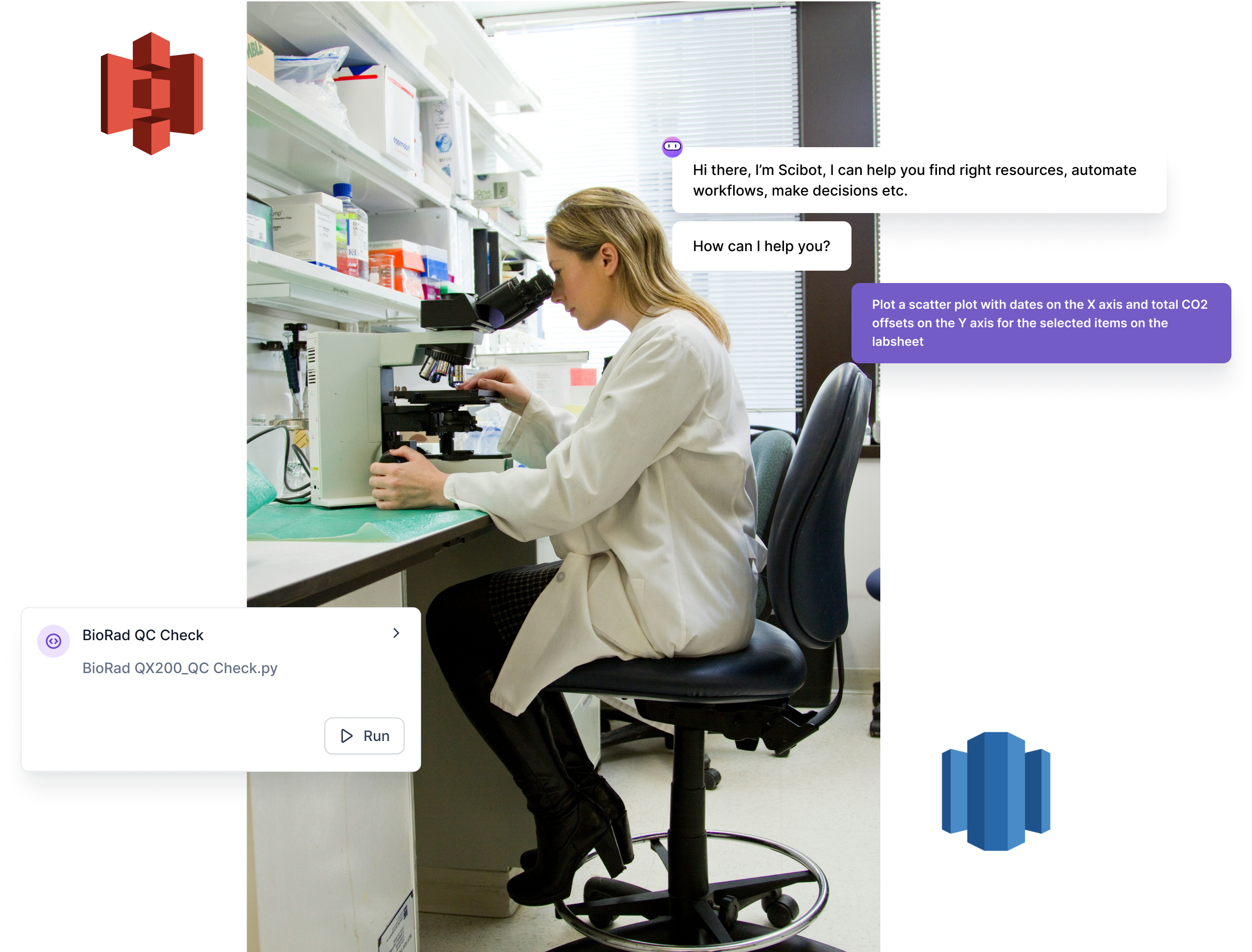
Let's dive into concrete scenarios that illustrate the real-world impact of Lab OS implementation across diverse lab environments.
Scenario 1: High-Throughput Screening
A cell therapy startup screens 10,000 compounds weekly. Pre-Lab OS: Scientists plate in robotic systems, export CSVs, paste into ELN, track hits in LIMS. Bottlenecks? Data mismatches, inventory blind spots, two-day delays.
With Lab OS: Labsheet ingests plate reader data automatically. Workflow validates Z-factors, deducts compounds, ranks hits via integrated stats. Team reviews top 50 in context - full run history, structures, predictions - and advances with one click. Time saved: 80%. Audit-ready: Yes.
The platform's event-driven architecture means that as soon as plate reader data lands, validation rules fire instantly. Failed wells trigger automatic reruns; successful hits populate downstream analysis queues without human intervention. Scientists spend less time on data wrangling and more on interpreting biology.
Scenario 2: Multi-Site Collaboration
A biotech with CRO partners runs parallel synthesis campaigns. Challenges: Version drift in protocols, siloed results, reconciliation nightmares.
Lab OS Solution: Shared labspaces with granular permissions. Partners log data into your structured tables via API. Real-time dashboards show progress; policy engine blocks invalid inputs. Final merge? Instant, with provenance.
Each site maintains its own execution context while feeding into a unified data model. Protocol versions are tracked centrally; any deviation triggers alerts. When synthesis yields vary between sites, the Lab OS pinpoints root causes - reagent lot differences, temperature variance, or procedural drift - by correlating structured metadata across all entries.
Scenario 3: From R&D to Clinic
Scaling a lead candidate means locking processes. Legacy LIMS forces migration; ELN stays loose.
Lab OS: Toggle workflows - exploratory for optimization, controlled for tox studies. Same data model, same team, seamless transition. Reporting pulls unified views for submissions.
This flexibility is critical during IND-enabling studies. Early experiments use open labspaces for hypothesis testing. As studies formalize, the same platform enforces GMP-compliant workflows with immutable audit trails, electronic signatures, and role-based access controls - no tool switching required.
Scenario 4: Genomics Data Integration
A genomics lab processes 500 samples monthly from multiple sequencing platforms. Pre-Lab OS: Raw FASTQ files scattered across shared drives, metadata in spreadsheets, analysis notebooks in Jupyter with no traceability.
With Lab OS: Sequencers push data directly to the platform via API. Labsheet auto-populates with run metrics, sample IDs, and QC flags. Workflow triggers alignment pipelines; results land in structured tables linked to original samples. Researchers query the unified data layer: "Show me all variants in genes X, Y, Z across cohort A." Instant answers with full lineage.
The Lab OS becomes the single source of truth, eliminating version confusion and enabling reproducible science at scale.
Scenario 5: Regulatory Submissions and Audits
A biotech prepares for FDA inspection. Pre-Lab OS: Auditors request data; IT spends weeks pulling records from multiple systems, reconstructing timelines, proving integrity.
With Lab OS: All data lives in one auditable system. Immutable logs show who accessed what, when, and why. Audit reports generate in hours - complete with full lineage, change history, and electronic signatures. Inspectors see a modern, compliant operation.
This scenario underscores why Lab OS adoption accelerates as companies approach clinical stages. The compliance burden of legacy tools becomes untenable; a unified platform is not just convenient but necessary.
The Technical Backbone: API-First and Standards-Driven

A true Lab OS prioritizes interoperability. No IT burdens - universal connectors handle ASTM, HL7, REST, even flat files. Onboarding maps formats, validates feeds, lands data correctly from day one.
Event-driven architecture responds instantly: a sequencer finishes? Workflow kicks off analysis. Inventory low? Alerts trigger reorders. This reactivity scales with your lab.
For AI-native lab software, extensibility matters. Open APIs invite custom apps - from dashboard widgets to full ML services - without vendor lock-in. Teams can build proprietary integrations with internal tools, machine learning frameworks, or specialized instruments without waiting for vendor roadmaps.
The technical stack supports both synchronous and asynchronous operations. Real-time dashboards show live instrument status; batch jobs process terabytes of genomic data overnight. Webhooks notify external systems when milestones complete, enabling seamless handoffs to downstream workflows like manufacturing or clinical operations.
Adoption Path: Gentle Integration, Not Overhaul
Leaders fear disruption. A Lab OS coexists with legacy tools. Start small: Connect one instrument, migrate a workflow. Structured outputs enhance existing ELN/LIMS. Over time, consolidate as value compounds.
Teams report faster onboarding than point solutions - intuitive UIs mean scientists adopt without training marathons. Phased migration reduces risk: pilot with one team, validate ROI, then expand. Most labs see productivity gains within weeks, not months.
Change management is critical. Designate power users as Lab OS champions; they help peers navigate the transition. Provide templates and best practices so teams don't reinvent workflows. Celebrate early wins - a team that saves 10 hours weekly becomes an evangelist.
Measuring Lab OS Impact: Key Metrics
How do you know if a Lab OS is working? Track these metrics:
- Time to Result: Days from experiment start to validated output. Lab OS typically cuts this by 30-50%.
- Manual Data Entry Hours: Measure before and after. Automation should eliminate 70%+ of copy-paste work.
- Experiment Throughput: Experiments per scientist per week. Operational efficiency gains compound here.
- Audit Readiness: Time to generate compliance reports. Lab OS reduces this from weeks to hours.
- Data Quality: Percentage of experiments with complete, traceable metadata. Target: 95%+.
- Cross-Functional Collaboration: Time to resolve data disputes or integrate results across teams. Lab OS should halve this.
These metrics matter because they translate operational improvements into business outcomes: faster time-to-market, reduced compliance risk, and better science.
The Future: Labs as Intelligent Systems
The Lab OS defines lab operating system as more than software - it's the nervous system for life sciences. As AI evolves, it positions labs to leverage multimodal models on proprietary data, predict failures pre-run, and simulate outcomes at scale.
Imagine a Lab OS that learns from your experiments: "Based on 10,000 prior runs, this protocol variant has 87% success probability." Or: "Reagent lot X correlates with 15% yield loss; recommend substitution." These insights emerge naturally from structured, machine-readable data.
Biotech founders gain a moat: Operational excellence compounds science. Lab leads unlock team potential. R&D operators focus on what matters - discovery.
Modern labs demand speed and trust. The Lab OS delivers both, unifying ELN, LIMS, and beyond into a platform that feels native. It's time to upgrade your lab's operating system.