

Imagine your biotech team racing toward a breakthrough, but stalled by disjointed tools: experiment notes scattered in one app, sample tracking buried in another, and data silos blocking AI insights. For founders and lab leads, choosing between platforms like Scispot and Benchling means deciding between a patchwork fix or a unified Lab Operating System that scales with your ambition.
The Pain Points of Fragmented Lab Workflows
Biotech labs today face mounting pressure. R&D cycles compress as funding tightens and competition intensifies. Yet many teams still juggle separate ELN for protocols, LIMS for samples, and spreadsheets for inventory. This fragmentation leads to errors, delays, and compliance risks.
Consider a typical workflow: a scientist designs an experiment in an ELN, logs samples manually into a LIMS, then exports data for analysis. Each handoff risks data loss or inconsistency. Inventory mismatches halt runs mid-stream. Auditors demand trails that span systems, but piecing them together takes weeks.
Lab operations leaders report that 40% of time goes to manual data entry and reconciliation - not science. Founders see budgets balloon from redundant tools and IT overhead. R&D operators lose momentum chasing status updates across apps.
These issues peak in AI-native biotechs, where Python scripts and ML models demand structured, real-time data. Legacy ELNs capture narrative but lack machine-readable outputs. Traditional LIMS track logistics but choke on unstructured R&D. In high-throughput screening labs, for instance, a single mismatched reagent lot can invalidate hundreds of data points, costing days of rework.
The Rise of Lab Operating Systems

Enter the Lab Operating System (LabOS): a unified platform that fuses ELN, LIMS, inventory, and analytics into one auditable, automated environment. Unlike point solutions, a LabOS connects instruments, teams, and data flows natively.
It enforces structure without stifling creativity. Protocols live alongside results in versioned spaces. Samples track automatically via APIs. Policies gate decisions in real time.
For biotech founders, a LabOS means faster iterations and defensible IP. Lab leads gain visibility into bottlenecks. Operators move through guided workflows from intake to report.
Benchling and Scispot lead this shift. Both target biotech's need for speed and compliance. Benchling excels in molecular biology workflows, with strong protocol design and collaboration. Scispot emphasizes AI-native unification, blending ELN, LIMS, and data lake for end-to-end automation. As labs evolve from seed-stage tinkering to Series C scaling, these platforms determine whether your operations accelerate innovation or become a drag.
Understanding Benchling's Strengths

Benchling started as a notebook for molecular design, evolving into a full suite for biotech R&D. Its core is flexible ELN with templates for DNA/RNA design, protein engineering, and CRISPR workflows.
Key features include:
- Register-based sample management for inventory and tracking.
- Collaboration tools for real-time co-editing and comments.
- Integrations with sequencing platforms and sequencing analysis.
- Compliance modules for electronic signatures and audit trails.
Teams praise Benchling's intuitive interface, especially for wet-lab biologists. It shines in early discovery, where rapid iteration on constructs matters most. Pricing scales with users and storage, suiting growing startups.
However, as labs mature, some find limits in full LIMS capabilities or custom automation. Scaling to manufacturing or clinical workflows often requires add-ons or third-party tools. For example, in a protein engineering lab, Benchling's sequence alignment tools speed up variant design, but exporting batch data for QC often involves CSV hacks that introduce errors.
Scispot: The AI-Native LabOS
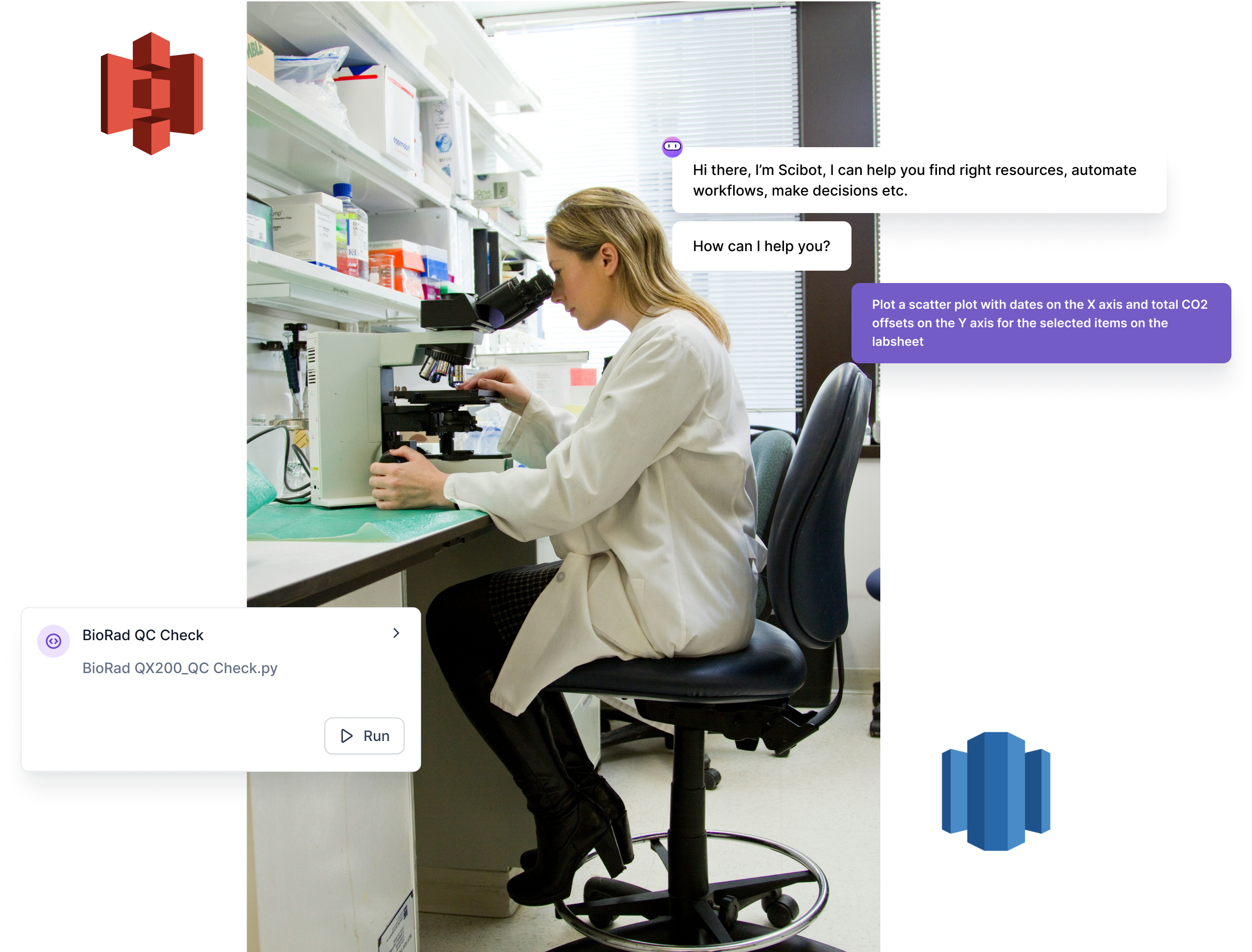
Scispot positions itself as the operating system for modern labs, unifying ELN, LIMS, Labsheets, inventory, and integrations in one platform. It connects instruments, people, and data while keeping work auditable without slowdowns.
Central to Scispot are Labspaces: structured notebooks for protocols, SOPs, and experiments. They version changes, embed files, images, sequences, and results. Labsheets act as dynamic tables for samples, reagents, runs, and outcomes - with columns, permissions, and bulk updates.
Key capabilities include:
- Event-driven workflows that automate from intake to reporting.
- API-first design supporting ASTM, HL7, REST, and flat files.
- Policy enforcement for access, validation, and change control.
- Built-in data lake for analytics and AI model integration.
Scispot handles open R&D and locked clinical paths on the same system. Onboarding maps data formats, validating feeds from day one - no IT burden. This API-first approach means instruments like liquid handlers push data directly, triggering downstream actions without manual intervention.
Lab Scenario: High-Throughput Screening in Discovery
Picture a 15-person discovery team screening 10,000 compounds weekly for hit identification. In Benchling, scientists log assays in notebooks, manually register plates in the sample registry, and pull sequence data from integrated tools. Collaboration shines - team members co-edit protocols in real-time - but reconciling plate maps with inventory often requires cross-app checks, eating 2-3 hours per run.
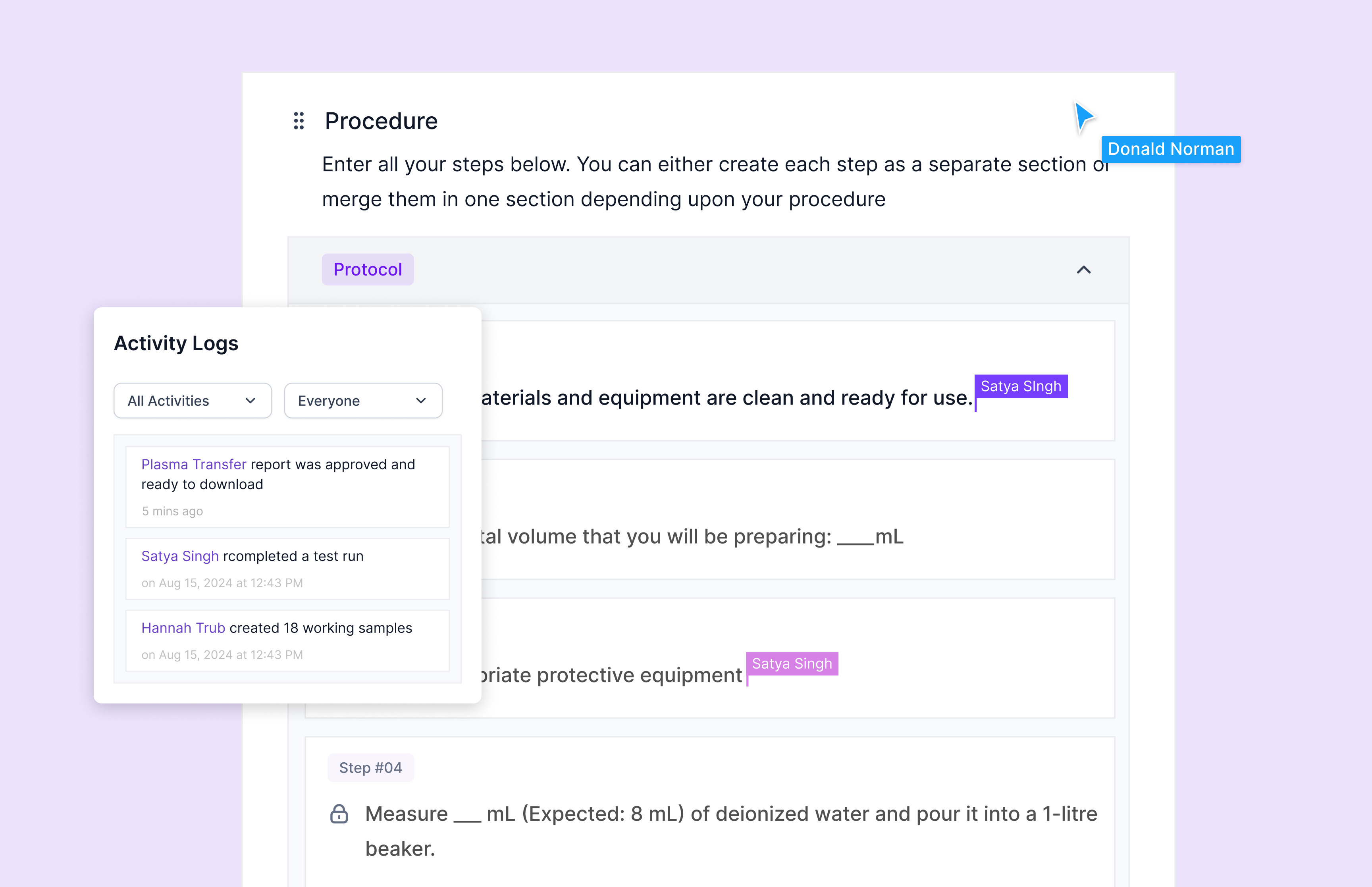
With Scispot, the same team uses a Labspace for assay design and a Labsheet for plate tracking. Barcode scans auto-populate sample data, linking to reagents via lot numbers. An event-driven workflow flags low-stock items mid-run and auto-orders from vendors. Post-assay, results feed directly into the data lake, where an ML model scores hits - all auditable in one trail. Time saved: 5+ hours per run, redirecting focus to hit validation.
Lab Scenario: Protein Engineering Iteration Cycles
A protein therapeutics startup iterates 50 variants weekly, designing in silico, expressing in yeast, and purifying for characterization. Benchling excels here: its molecular biology tools let computational biologists drag-and-drop sequences into templates, align mutants, and share with wet-lab colleagues for instant feedback. Sample requests automate plate prep, but scaling to 100+ variants strains the registry's custom fields, often needing exports to Excel for analysis.
Scispot streamlines this with unified Labspaces embedding sequence viewers alongside expression data. Labsheets track variants by construct ID, yield, and purity metrics in real-time columns. Policies enforce review gates before scale-up, and APIs pull expression telemetry from fermenters. AI integration predicts expression yields from historical data, cutting failed runs by 30%. The result? Cycles shrink from 4 weeks to 2.
Head-to-Head: Scispot vs. Benchling Comparison
Core Functionality: ELN and LIMS Unification
Benchling's ELN is powerhouse for bio-design, with drag-and-drop sequence viewers and alignment tools. Its LIMS-like registry tracks entities but leans toward discovery samples over full QC/release.
Scispot unifies both natively. Labspaces capture narrative and structure; Labsheets enforce sample/inventory rigor. This eliminates dual-entry, supporting everything from exploratory runs to GMP batches.
Workflow Automation and Policy
Benchling offers requests and automation for routine tasks, like sample requests. It gates via permissions but requires custom scripting for complex flows.
Scispot's event-driven engine responds real-time, enforcing policies at junctions. Work moves automatically - e.g., QC pass triggers inventory deduct and report generation. No scripting needed for most cases.
Integrations and Scalability
Benchling connects to popular instruments (Thermo, Illumina) and apps (Slack, Jira). It's standards-aware but may need engineering for non-standard feeds.
Scispot is API-first with universal connectors. The team handles mapping during onboarding, supporting diverse formats. It scales to enterprise via data lake and ML-ready structure.
Compliance and Auditability
Both meet 21 CFR Part 11 with signatures and trails. Benchling suits research compliance; Scispot extends to clinical/manufacturing with granular controls.
User Experience and Adoption
Benchling feels like a smart notebook - familiar for biologists. Scispot operates like an OS: intuitive for structured work, with guided steps reducing training.
Pricing and ROI
Benchling uses per-user tiers, plus storage/compute. Scispot focuses on outcome-based value, minimizing tool sprawl. ROI comes from time saved on reconciliation and automation - often 20-30% lab efficiency gains.
Lab Scenario: GMP Batch Release for Clinical Trials
A Series B cell therapy company releases GMP batches for Phase I trials. Compliance is paramount: every lot needs COA review, stability data, and release approval. In Benchling, teams use registries for lot tracking and requests for approvals, but full release workflows demand custom automations or external LIMS integration, creating silos.
Scispot's unified platform shines: Labsheets capture batch data from intake, embedding vendor COAs and instrument outputs. Event-driven policies route for QA review - auto-rejecting if purity <95% - then generate signed release reports. Auditors access a single, immutable trail spanning R&D to release. This setup cut release time from 10 days to 2, avoiding trial delays.
Lab Scenario: Multi-Site CRO Coordination
A therapeutics firm outsources synthesis to three CROs while running internal analytics. Visibility is key: track synthesis progress, incoming samples, and QC alignment. Benchling handles internal collab well but external sharing requires secure exports or guest access, risking data leaks.
Scispot's policy engine grants CROs view-only Labsheet access for their deliverables, auto-syncing data on shipment. Internal teams trigger QC workflows upon arrival, with discrepancies flagged via integrated Slack. Real-time dashboards show pipeline status across sites, reducing coordination meetings by 50% and speeding IND filings.
Real-World Scenarios: Choosing the Right Fit
Scenario 1: Early-Stage Discovery Biotech
A 20-person team iterates on antibody candidates. They need fast design, collab, and basic tracking. Benchling fits perfectly - its molecular tools accelerate hits. Scispot works but may overkill if LIMS isn't yet critical.
Scenario 2: Scaling to Clinical Development
A Series B company ramps GMP production. Sample QC, inventory lots, and vendor COAs must align. Scispot's unified LIMS/ELN prevents silos; Benchling might need bolt-ons.
Scenario 3: AI-Native Therapeutics
Team runs ML on protein data. Inputs must be structured, outputs auditable. Scispot's data lake and APIs feed Jupyter natively. Benchling handles design but data export adds friction.
Scenario 4: Multi-Site Operations
Lab leads oversee CROs and internal sites. Real-time visibility and policy enforcement matter. Scispot's workflows orchestrate across boundaries; Benchling excels internally but integrates externally with effort.
Lab Scenario: AI-Driven Drug Repurposing
An AI-first startup repurposes small molecules using ML on proprietary datasets. Daily, they process screening data, predict binding affinities, and prioritize syntheses. Benchling logs experiments but structuring terabytes for ML requires ETL pipelines.
Scispot's data lake ingests raw assay data natively, applying ontologies for ML compatibility. Labspaces link predictions to wet-lab validations, with APIs pushing structured outputs to Python environments. Automated reports highlight top candidates, boosting hit rates by 25% and enabling weekly board updates with full auditability.
Benchling Alternatives and Competitors
Benchling dominates discovery, but competitors carve niches. Labstep and Sapio offer ELN/LIMS hybrids. Dotmatics spans informatics. Scispot stands out for full LabOS unification, especially in AI and scale.
LIMS vs. Benchling: A Key Distinction
Traditional LIMS (LabVantage, StarLIMS) excel in regulated tracking but falter on R&D flexibility. Benchling bridges to discovery; Scispot transcends both, embedding LIMS in a creative OS.
Who Wins? It Depends on Your Stage
For pure discovery speed, Benchling shines. For unified scale - from R&D to clinic - Scispot delivers the LabOS vision: fast, auditable, automated.
Modern labs demand platforms that evolve with them. Evaluate based on workflows, not features. Request demos to map your data and simulate runs.
The right choice transforms toil into throughput, surprises into signals. Your team deserves that edge.
Disclaimer: Third-party product and company names, logos and trademarks are the property of their respective owners and are used for identification only. Scispot.io Inc. is not affiliated with, endorsed by, or sponsored by any vendor mentioned. Information is based on publicly available sources as of November 2026 and may change; verify details directly with each vendor.