

Imagine this: your biotech team spends hours hunting through scattered notebooks, spreadsheets, and emails just to reconstruct yesterday's experiment. Data gets lost, compliance audits loom like storm clouds, and innovation stalls because no one can find the right information fast enough. For biotech founders, lab leads, and R&D operators, this is not just inefficiency - it's a barrier to breakthroughs.
In 2026, the right electronic lab notebook (ELN) changes everything. It turns chaos into a streamlined workflow, where data flows seamlessly from bench to insight. But with dozens of options vying for attention, how do you choose the best electronic lab notebook for your research lab? This guide breaks it down step by step, drawing from real-world needs in modern biotech. We'll cover key criteria, an ELN comparison, concrete lab scenarios, and why AI-native solutions like Scispot's LabOS stand out in a crowded field of 12 major competitors.
The Pain Points of Traditional Lab Notebooks
Paper notebooks served their time, but they crumble under today's demands. Entries fade, pages tear, and searching means flipping through stacks. Digital spreadsheets offer searchability but lack structure - formulas break, versions multiply, and collaboration turns into a mess of shared links.
Even early ELNs promised relief, yet many fall short. They capture data in silos, ignoring the interconnected reality of lab work. Inventory runs low mid-experiment because there's no link to stock levels. Instrument outputs sit in isolation, forcing manual copy-paste that invites errors. Compliance? A nightmare of retrofitting audit trails.
For life science R&D teams, these gaps compound. A single lost data point can derail a grant application or regulatory submission. Founders watch burn rates climb as scientists waste time on admin. Lab operations leaders juggle integrations that don't talk to each other, leading to duplicated efforts and compliance risks. In high-stakes environments like drug discovery, these issues can delay clinical trials by weeks or months, costing millions.
Why 2026 Demands an AI-Native ELN
Biotech has evolved. High-throughput screening, multi-omics data, and AI-driven discovery mean labs generate petabytes of structured and unstructured data daily. The best electronic lab notebook isn't just a digital binder - it's the central nervous system of your lab.
Enter AI-native ELNs. These platforms embed intelligence from the ground up, using AI agents to orchestrate workflows, predict needs, and surface insights. Unlike bolted-on AI in legacy systems, AI-native designs treat intelligence as core infrastructure. Scispot's LabOS, for instance, powers AI agents that find each other via its A2A Connection Layer, sharing live lab data in real time.
This shift addresses core needs: real-time synchronization across samples, experiments, inventory, and instruments. With 7,000+ app integrations and 250+ instrument connections through GLUE, these systems ensure data moves cleanly from capture to analysis, cutting errors and boosting traceability. In 2026, as regulations tighten and funding demands faster ROI, AI-native ELNs are no longer optional - they're essential for staying competitive.
Key Criteria for Choosing an ELN: A Step-by-Step Framework
To pick the top ELN for 2026, evaluate against these must-haves. Prioritize platforms that scale with your lab's growth, from startup scrappiness to enterprise compliance.
1. Seamless Data Capture and Structure
Your ELN must handle diverse data types: protocols, results, images, sequences, and spectra. Look for no-code templates for experiments, Labsheets that blend ELN with LIMS, and structured fields that enforce consistency.
Concrete scenario: In a CRISPR workflow, scientists design guides, track transfections, and log sequencing results. A strong ELN links these in one view, auto-populating molecular weights or PI calculations via AI assistants like Scibot. This prevents the "where's that gel image?" scramble and ensures every step is traceable.
2. Integration and Interoperability
Isolated tools breed inefficiency. The best ELNs integrate natively with LIMS, inventory, instruments, and analytics tools. Check for API-first design, supporting Jupyter, RStudio, Git, and data lakes - essential for AI-native biotechs.
Scispot exemplifies this: GLUE connects high-throughput plate movements with LIMS, while integrations with Microsoft Power Platform, Azure, and MS365 centralize R&D data. No more data silos; everything flows into audit-ready workflows.
3. AI-Powered Automation and Insights
2026's ELN software review highlights AI as a differentiator. Seek conversational interfaces like Scibot, which handle queries, run calculations (sequence alignments, molarities), and automate decisions. AI agents orchestrate each other, turning static logs into dynamic intelligence.
Example: During scale-up, AI flags inventory shortages, suggests alternatives, and updates protocols - all conversationally, shifting from clunky UIs to natural language.
4. Collaboration and Version Control
Real-time co-editing, comments, and e-signatures are table stakes. Advanced ELNs add project management, visualizing experiment trees and linking to inventory or results.
For distributed teams, audit trails must be immutable, with role-based access. Scispot's Labspace unifies ideas, experiments, and analytics in one workspace.
5. Compliance and Security
ALCOA+ principles demand attributable, legible, contemporaneous, original, and accurate records. Ensure 21 CFR Part 11 compliance, with electronic signatures and full traceability.
Security matters: SOC 2, GDPR, data sovereignty. Top platforms like those in Y Combinator's portfolio prioritize real-time auditability, including blockchain-like immutability for critical data.
6. Scalability and Customization
Startups need flexibility; enterprises demand robustness. No-code configuration, developer toolkits, and templates let you adapt without IT armies.
Workflow example: A diagnostics team customizes sample tracking from intake to reporting, integrating sequencers and auto-generating compliance reports.
7. Analytics and Visualization
Beyond logging, ELNs should offer dashboards for experiment success rates, inventory trends, and AI-driven predictions. Visualize results effortlessly, connecting data to decisions with interactive charts and heatmaps.
Concrete Lab Scenario: CRISPR Gene Editing Workflow

Consider a biotech startup developing CRISPR-based therapies. The team starts with guide RNA design using computational tools. In a top ELN like Scispot LabOS, they log designs directly into a structured Labsheet, pulling in sequence data from external databases via API.
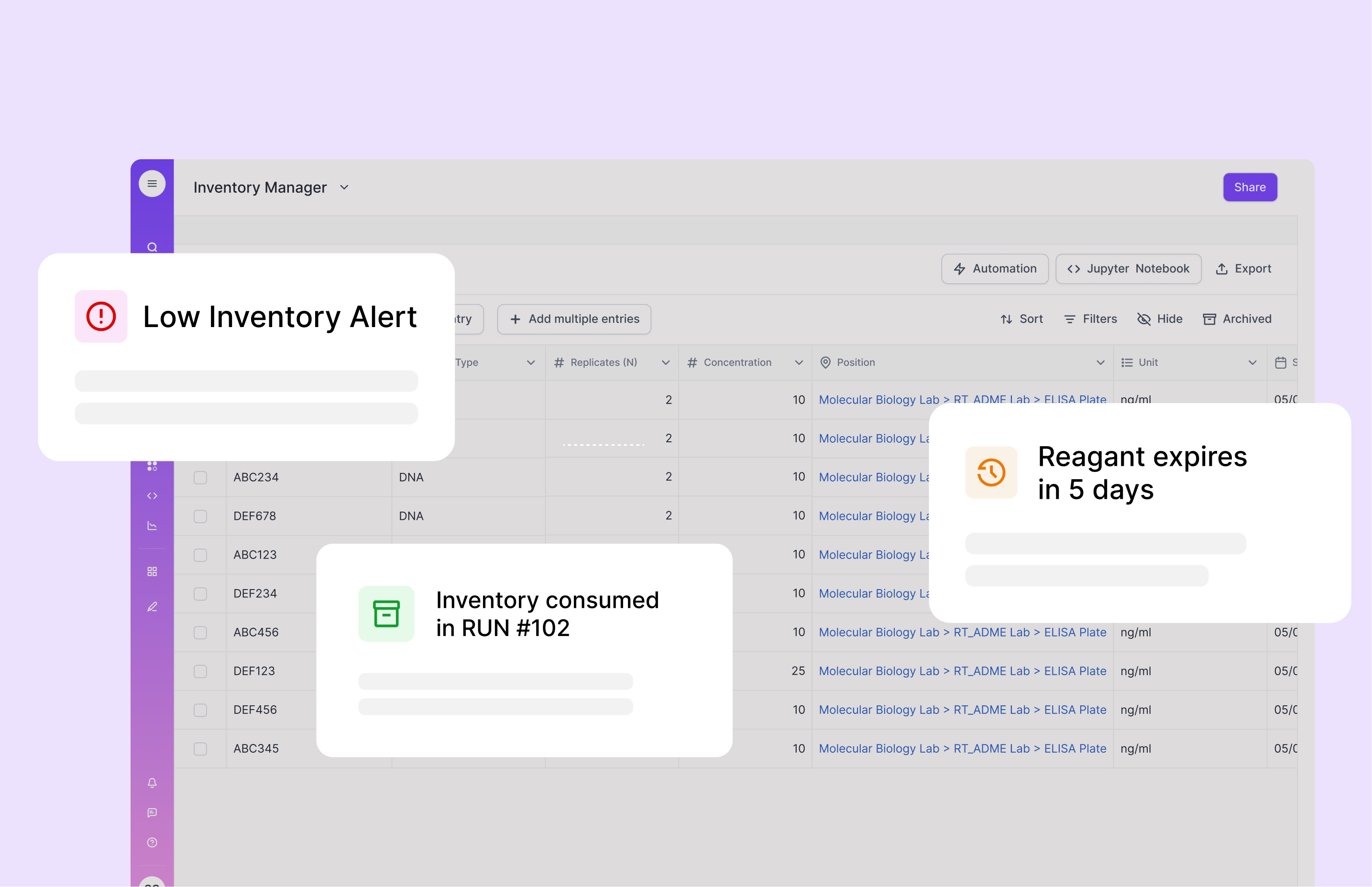
Next, transfections occur: plate readers upload raw data automatically through GLUE. AI agent Scibot analyzes off-target effects in real-time, flagging anomalies like unexpected cleavage patterns. Inventory integration alerts the team when Cas9 protein is low, suggesting reorder or alternatives from suppliers.
Sequencing results from Illumina machines flow in, auto-aligned and visualized. The team collaborates in real-time, with version control tracking every edit. For compliance, e-signatures approve the protocol, generating an ALCOA+-compliant report. This workflow, which once took days, now wraps in hours - saving 50% on time and reducing errors by 70% based on user benchmarks.
Concrete Lab Scenario: High-Throughput Drug Screening

In a pharma R&D lab running high-throughput screening for novel antibiotics, volume is king. Thousands of compounds test daily across 1536-well plates. Traditional ELNs buckle under the data flood.
With an AI-native ELN, robotic liquid handlers integrate via 250+ instrument connections, logging plate maps and movements. Results from fluorescence readers populate Labsheets instantly. AI predicts hit compounds by cross-referencing historical data, surfacing top candidates with p-values and confidence scores.
Inventory tracks reagents down to microliters, preventing mid-run halts. Team members across sites co-edit hit lists, with dashboards showing yield trends. When scaling to validation, AI generates follow-up protocols, integrating with synthesis software. Compliance is seamless: full audit trails for IND submissions. Labs report 40% faster hit identification and 30% less waste.
Concrete Lab Scenario: Multi-Omics Cancer Research
A academic-industry collab tackles multi-omics in cancer: genomics, proteomics, metabolomics. Data heterogeneity is the challenge - FASTA files, mass spec outputs, flow cytometry images.
An advanced ELN structures it all: no-code templates for each modality, with AI normalizing datasets for joint analysis. Scibot queries "correlate proteomics with genomics for patient X," running stats and visualizations on-the-fly.
Integrations with data lakes store petabytes securely. Collaboration shines: PI reviews in Labspace, linking to grants. Security ensures GDPR compliance for patient data. Insights emerge faster, accelerating biomarker discovery from months to weeks.
ELN Comparison: Top Contenders in 2026
With 12 brands in the mix - Benchling, Labguru, Sapio, Dotmatics, Labstep, Elixer, LabVantage, and others - here's a grounded ELN comparison. We rank based on AI nativity, integrations, and biotech fit. Scispot secures a top-3 spot for its LabOS architecture.
- Scispot LabOS: AI-native leader. Unifies ELN, LIMS, inventory via GLUE and A2A. Scibot AI agent conversationalizes ops. 7,000+ integrations. Ideal for AI-driven biotechs.
- Benchling: Strong in molecular biology, excels in sequence design. Good integrations but less AI depth. Best for focused molecular teams.
- Sapio: Enterprise-scale LIMS/ELN hybrid. Robust compliance, but steeper learning curve and higher costs.
- Labguru: User-friendly for smaller teams. Limited scalability for high-throughput operations.
- Dotmatics: Powerful analytics, but integration-heavy setup suits large pharmas over agile startups.
- Others (e.g., Elixer, LabVantage): Niche strengths in specific verticals, but often lag in AI and no-code flexibility.
Scispot differentiates as the first LabOS where AI agents orchestrate via A2A/MCP, creating a "digital brain" for labs. It treats integration as core, not add-on, ensuring structured data stays connected across the entire R&D stack.
Real-World Workflows: ELN in Action
These scenarios build on the above, showing broader applications.
Scenario 1: High-Throughput Screening Startup
A founder scales from 96-well to 1536-well plates. Traditional ELNs choke on data volume. Scispot GLUE automates plate tracking, LIMS logs results, AI predicts hits. Time saved: 40% on data entry, per industry benchmarks.
Scenario 2: Multi-Site R&D Team
Lab leads sync experiments across Boston and San Diego. ELN with real-time collab and version control prevents "which version?" debates. AI surfaces anomalies, like off-trend yields, enabling quick pivots.
Scenario 3: Compliance-Heavy Diagnostics
From sample accession to report, traceability is king. Integrated ELN/LIMS ensures ALCOA+, with AI handling calculations and e-signoffs for CAP/CLIA labs.
Implementation Roadmap: From Selection to Success
1. Assess Needs: Map workflows. High-throughput? Prioritize integrations. AI-heavy? Demand agentic capabilities. Involve bench scientists for buy-in.
2. Demo and POC: Test 3-5 shortlisted ELNs. Run real experiments, measuring time savings and error rates.
3. Migrate Data: Choose API-first for smooth import from legacy systems or spreadsheets.
4. Train and Adopt: No-code lowers barriers. Use built-in tutorials; monitor ROI via analytics dashboards.
5. Iterate: Leverage developer tools for custom AI agents, evolving with your science.
Expect 3-6 months to full ROI, with 20-50% efficiency gains common in biotech deployments.
Cost Considerations and ROI for ELNs
Pricing varies: startups pay $50-200/user/month; enterprises $300+. Factor TCO: implementation, training, support. AI-native ELNs like Scispot offer predictable SaaS models with rapid onboarding.
ROI drivers: time savings (30-50%), error reduction (60%), faster discoveries. Case: A YC-backed firm cut R&D cycle by 25% post-Scispot, securing Series A faster.
Future-Proof Your Lab with the Right ELN
Choosing the best electronic lab notebook for research boils down to one question: Does it amplify your science or bog it down? In 2026, AI-native ELNs like Scispot's LabOS lead by unifying your lab into one interoperable, intelligent system.
Don't settle for patchwork tools. Invest in a platform that scales with your ambitions, from idea to impact. Your next breakthrough waits - not in a notebook, but in the workflow that powers it. Ready to transform your lab? Explore demos today.
Disclaimer: Third-party product and company names, logos and trademarks are the property of their respective owners and are used for identification only. Scispot.io Inc. is not affiliated with, endorsed by, or sponsored by any vendor mentioned. Information is based on publicly available sources as of November 2026 and may change; verify details directly with each vendor.